Smartsheet Unveils vsActual AI Platform to Track Strategic Execution Across Enterprise Systems


2 Sources
[1]
A year in, Smartsheet CEO Raj Singh bets on a new vision beyond the company's flagship product
Smartsheet's biggest new product in years doesn't require Smartsheet. The Bellevue, Wash.-based company unveiled vsActual, as in "plan versus actual," an AI product that reads a company's strategy and budgets, tracks the work across tools such as Jira, Workday and Slack, and flags when projects
[2]
Smartsheet AI-powered platform bridges gap between planning and results
Smartsheet Inc. today introduced an artificial intelligence-powered planning and execution platform designed to help enterprises identify when projects are veering off course and take corrective action before delays and cost overruns become serious problems. Announced at the company's Engage 2026
Share
Copy Link
Smartsheet launched vsActual, its first standalone AI-powered platform that monitors work across enterprise tools like Jira and Workday to detect when projects drift off course. CEO Raj Singh announced the product at the Engage conference, marking Smartsheet's shift from a single-product company to a multi-product company targeting C-suite executives rather than project managers.
Smartsheet Transforms Into Multi-Product Company With vsActual Launch
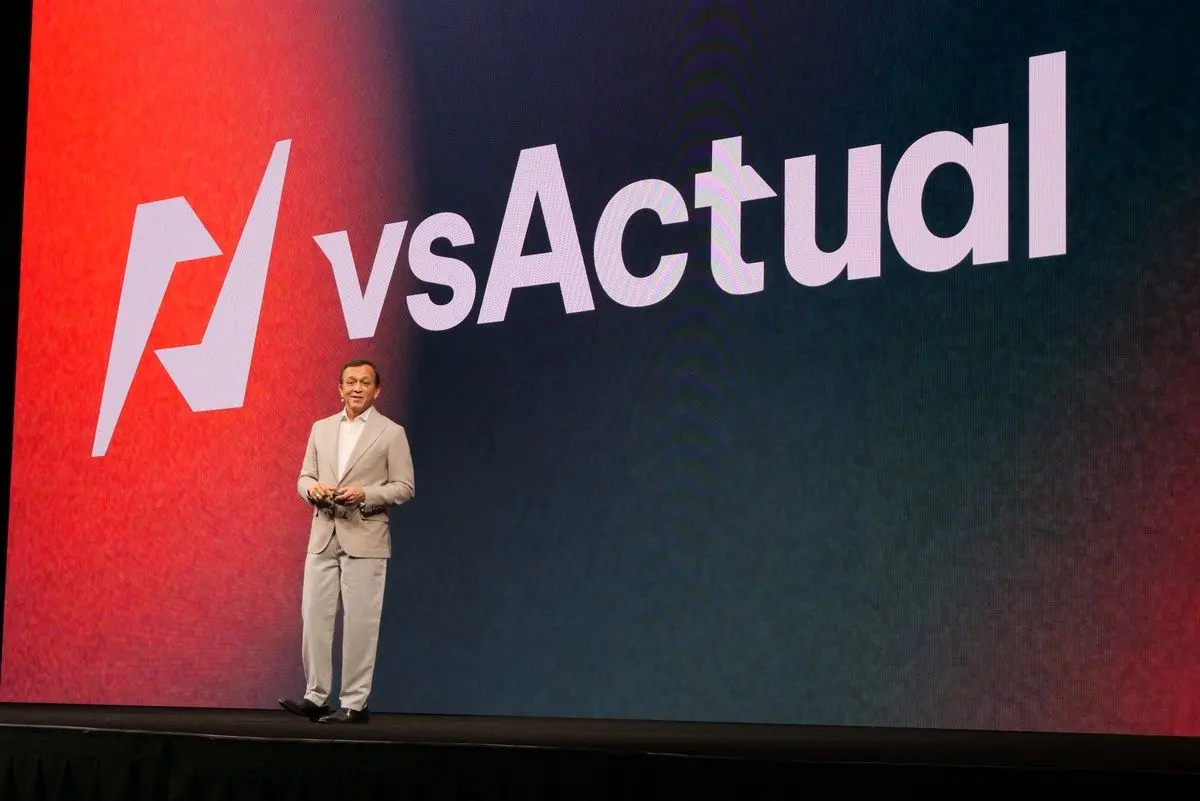
Smartsheet unveiled vsActual at its Engage conference in Seattle, marking a strategic pivot under CEO Raj Singh who took the helm a year ago
1
. The AI-powered platform represents the company's first standalone product that doesn't require its flagship spreadsheet-style software. Singh, the Concur co-founder, showed attendees a slide from a year earlier that labeled Smartsheet "a product company" confined to a single box. Now, he explained, Smartsheet has broken through that ceiling to become a multi-product company1
.
Source: GeekWire
How vsActual Monitors Strategic Objectives Across Enterprise Systems
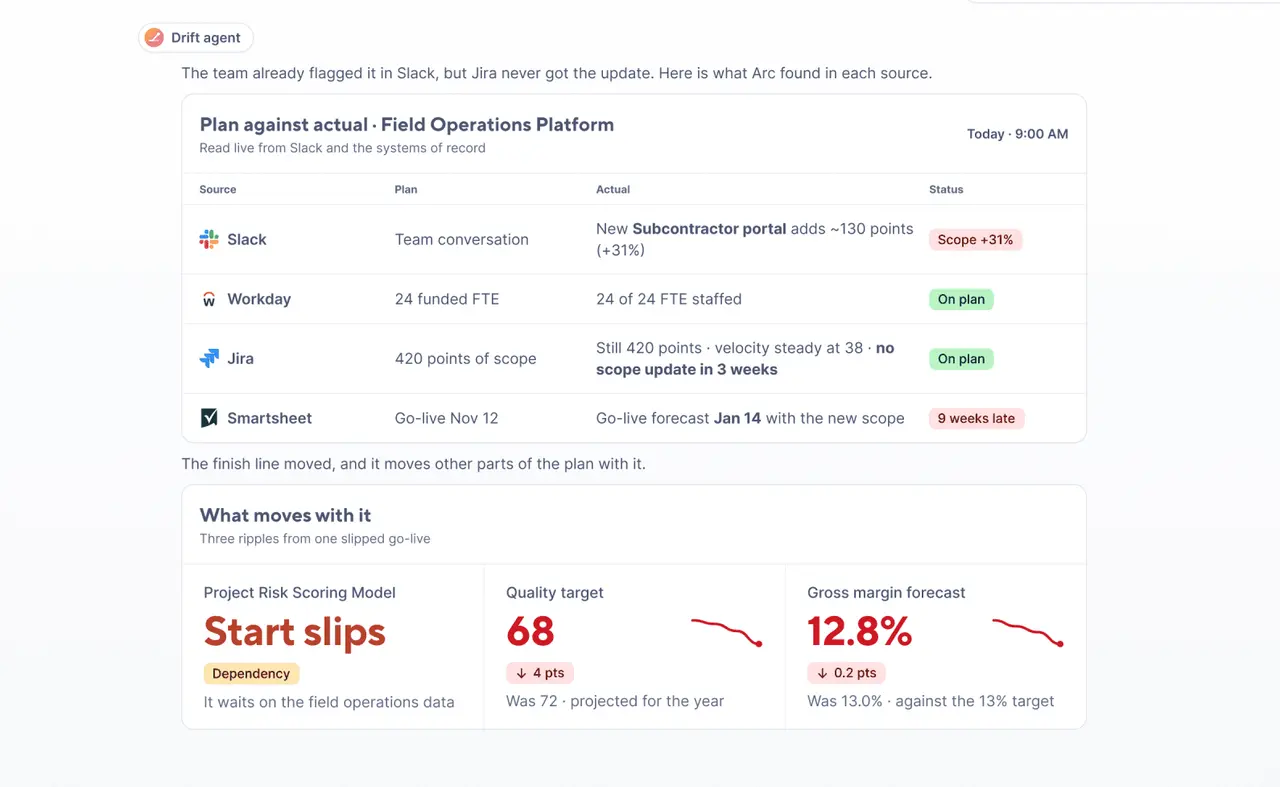
The vsActual AI platform reads company strategy documents and budgets, then tracks work across tools such as Jira, Workday, and Slack to flag when projects drift off course
1
. The platform uses AI agents to continuously monitor work across multiple enterprise systems, compare progress against strategic objectives, and recommend adjustments before delays and cost overruns become serious problems2
. Unlike competitors demanding platform consolidation, Singh noted that most CIOs resist moving everything onto a single system. The platform connects to applications from Oracle, SAP, Workday, Atlassian, and ServiceNow through APIs and the Model Context Protocol (MCP)1
2
.
Source: SiliconANGLE
Execution Graph Powers AI Agents With Two Decades of Workflow Data
The centerpiece of vsActual is the Execution Graph, a knowledge graph built from 20 years of workflow data encompassing millions of projects and nine petabytes of information
2
. This knowledge graph maps relationships between tasks, projects, programs, and strategic objectives to help AI agents understand how changes in one organizational area affect others. Pratima Arora, Smartsheet's chief product and technology officer, explained the goal addresses a disconnect between individual productivity improvements and measurable organizational results. The Execution Graph builds on an existing Amazon Web Services Neptune knowledge graph containing approximately 100 million nodes2
. Singh described the Execution Graph as "the long-term differentiated value of our company"1
.New Target Audience: CEOs, CFOs, and COOs Replace Project Managers
vsActual targets CEOs, CFOs, and COOs rather than the project managers who have long been Smartsheet's core users
1
. A drift-detection agent continuously searches for emerging problems, while other agents generate executive reports and recommend changes as business priorities evolve2
. The system can trace consequences of disruptions across organizational hierarchies. Arora noted that if a delay in a Jira ticket has impact five levels up, the platform can detect it and explain what's happening2
. Keith Kirkpatrick, a Futurum Group analyst, wrote that vsActual is "the company's clearest move yet from managing tasks to governing strategy," though he noted the strategy requires selling to a different kind of buyer and that many executives still see Smartsheet as a "glorified Excel" project management software tool1
.Consumption-Based Pricing Model Replaces Per-Seat Licensing
Smartsheet is moving away from charging by the user to a new consumption-based pricing model where customers pay a base fee plus credits drawn down as people use the software, including AI features, automations, and API connections
1
. Singh said customers balked at paying full price for people who use Smartsheet only occasionally. As an example, creating a dashboard might cost 50 cents rather than a license running hundreds of dollars. Customers who switch won't be charged for going over their credits initially. Singh described the net effect on revenue as "nothing but positive," calling the shift a way to unlock demand from customers who held back under per-seat pricing. He added that "agents are clearly going to be users moving forward"1
.Related Stories

Human-in-the-Loop Approach Balances Automation With Oversight
Arora emphasized that agentic workflows combine conventional automation with AI rather than relying exclusively on large language models, noting the industry "overuses LLMs sometimes where it is just simple deterministic action"
2
. Although some agents can execute scheduled tasks automatically, human approval remains the default approach for consequential actions. "Our default stance is human-in-the-loop," Arora said2
. The company uses multiple foundation models, selecting them based on workload requirements and cost, with AWS and Databricks as major underlying technology providers. Smartsheet isn't training its own large language models2
.Competitive Landscape and Future Implications
The new product enters a crowded field where Microsoft, ServiceNow, Workday, and others are adding AI agents that plan and track work inside their own products
1
. Founded two decades ago, Smartsheet went public in 2018 and was taken private in January 2025 by Vista Equity Partners and Blackstone in an $8.4 billion deal when it had more than $1 billion in annual revenue. Its rivals include Microsoft, Google, Salesforce, Asana, Monday.com, Airtable, and ClickUp1
. The approach carries risk: if companies can track work through vsActual without moving it into Smartsheet, they have less reason to expand use of the core software. Singh countered by pointing to new AI features in Smartsheet itself, including its Smart Assist agent and an MCP server that lets customers use Smartsheet from AI assistants such as Claude and Copilot, stating "the core keeps growing"1
.References
Summarized by

Navi
[1]
Related Stories
Smartsheet and AWS Collaborate to Enhance AI-Powered Decision-Making with Amazon Q Business Integration
09 Oct 2024•Technology

Atlassian opens Teamwork Graph to third-party agents as Rovo evolves into autonomous executor
06 May 2026•Technology

Airtable Revolutionizes No-Code App Development with AI Integration
27 Sept 2024

Recent Highlights
1
Google Unveils Gemini 4 Carbon AI Model With Major Cybersecurity Gains, Beating Claude Opus 5.5
Technology

2
Binance Hack: How AI-Enabled Cyberattack Led to Record $6.3 Billion Crypto Theft
Technology

3
Pope Leo XIV Demands AI Disarmament and Ban on Autonomous Weapons at UN Geneva Meeting
Policy and Regulation

Recent Highlights
Today's Top Stories






Don’t drown in AI news. We cut through the noise - filtering, ranking and summarizing the most important AI news, breakthroughs and research daily. Follow topics that matter to you and stay ahead.


