3 Sources
[1]
Snowflake adds AI model routing to cut costs | VentureBeat
Enterprise teams running AI agents at scale are finding that a single model handles every task poorly -- either the model is too expensive for simple questions or not capable enough for hard ones. Model routing, which picks the right model for each task automatically, is becoming the fix. Snowflake's Cortex AI Gateway now offers dynamic model routing to address that: enterprises can select "auto" instead of a fixed model, and the system routes each task to whichever model offers the best combination of quality and cost. Snowflake said the capability can cut token costs by as much as 3x on some workloads -- a figure from the company's own internal testing -- after finding that simple questions were often handled by its most capable model, making responses more expensive and slower than necessary. The move lands amid a broader industry shift toward automated model routing. Databricks, AWS, Google Cloud and Nvidia have all announced some form of model routing technology. Snowflake argues that model routing is more complex than just price and performance, it's also about governance and context. "For high quality, enterprise grade agents to be built, it's crucial to get the context and the governance right," Baris Gultekin, vice president of AI at Snowflake, told VentureBeat. "Context, trust and model choice all go hand in hand." Two mechanisms decide where a task goes The capability builds on Cortex AI Gateway, which Snowflake launched in July 2026 as a governance layer for agent and model traffic. Before dynamic routing, model selection ran off a static list per task rather than a true fallback system, Gultekin said. Dynamic routing itself runs on two mechanisms, according to Gultekin. A small model tries first. Under what Snowflake calls an advisor pattern, a smaller model attempts a task first. If it cannot finish the job, it calls a larger model as a tool and continues from there. A classifier sorts by task history. A separate classifier, trained on past queries, automatically routes straightforward questions to simpler models. Customers can still pin a model. Auto routing is optional. Customers can restrict routing to one model or a defined set of models, and the system routes only within that boundary. There is no separate fee. Snowflake prices AI purely on token usage. Routing to a cheaper model produces a cheaper bill, with no additional charge for the routing decision itself. Access controls follow the task, not just the data Snowflake ties routing to the same access controls it already uses for data governance. Governance starts at the data level with role-based access controls. It extends to models next, where customer roles map to buckets of approved models. It extends again to agents, where an agent can be restricted to narrower privileges than the user invoking it. Open models can run from a customer's own region to satisfy data residency requirements. Gultekin said all inference, open and proprietary alike, stays inside Snowflake's security boundary rather than routing out to an external provider. That regional and perimeter setup matters specifically for open models with non-U.S. origins, including DeepSeek-V4-Flash and GLM-5.3, both developed in China. Snowflake's recent acquisition of Natoma adds another layer. The deal brings more than 100 MCP connectors with scoped, governed access. An agent could get read-only access to a connected tool like email, for example, rather than broader permissions. Context lets a cheaper model do the work Snowflake recently announced its Horizon Context and Cortex Sense tools that provide context capabilities. Without good context, a model has to do the exploratory work itself, writing and testing SQL, searching through data and retrying when something does not work. Gultekin explained that the process is expensive, and getting it right typically requires a more capable model. Packaging the context in advance removes that exploratory step, which means a simpler, cheaper model can often handle the same task. Snowflake also builds agent memory into that context. As an agent is used repeatedly, its memory updates and gets folded back into future queries. The system does not re-solve the same problem from scratch each time. Memory becomes part of the context passed to the model. OpenRouter, Databricks and Nvidia are chasing the same problem There is no shortage of technologies in the model routing space. OpenRouter is one of the most widely known options, providing a platform that enables organizations to route based on cost and performance. Nvidia on August 11 announced Switchyard as a technology layer to help route AI model choice. Databricks has an offering as well with Smart Routing for its Unity AI Gateway. "The interesting part is what it says about where differentiation has moved," Sanjeev Mohan, Principal and Founder, SanjMo, told VentureBeat. "Snowflake isn't really selling routing, it's selling routing that never leaves the governed data boundary, with access controls, tagging, and cost attribution already attached." Mohan added that for a company whose data and compliance already center on Snowflake, routing that keeps data in place and attributes spend by team is a real lever on that problem. For a company without that center of gravity, a neutral gateway may route across more models with less friction. Mohan frames the market as three distinct camps rather than one competitive field. Databricks approaches governance from data engineering and ML lineage. Its Unity Catalog governs data, models and pipelines for teams building and training models. Snowflake approaches governance from analytics and access control, governing who can touch which data and attributing usage across business units. A third camp includes neutral gateways such as OpenRouter, LiteLLM, Portkey and hyperscaler routers like Azure AI Foundry. These compete on model breadth and avoiding lock-in rather than deep governance. Choosing a router means choosing a governance model Model routing is now table stakes for enterprises. The decision that matters is which governance model already fits how their data and teams are organized, not which vendor's router is fastest or cheapest. Manual model selection is becoming a cost liability at agent scale. What worked when a team ran a handful of agents breaks down at scale. Hundreds of agents making routine model calls with no automated cost check in place adds up fast. Evaluate the governance model, not the router's feature list. The real question, per Mohan, is which governance model matches the data estate already in place, and which one gives the cost visibility needed to avoid an unpleasant surprise. The right starting point depends on where an enterprise's data already lives. A Snowflake shop gets more value from in-platform routing that respects its existing access model and bills back to cost centers than from raw model breadth, according to Mohan. A Databricks-centric team worried about lineage across training and deployment is better served by a gateway built around that same lineage. A multi-platform or model-first team that wants maximum choice with minimal lock-in fits better with a neutral gateway, the same pitch behind OpenRouter's valuation. "For a practitioner, don't start with the router, start with where your governed data and platform commitment already live, and with how exposed your margins are to inference cost," Mohan said.
[2]
Snowflake Unlocks Better AI Economics with Dynamic Model Routing, Delivering More Value to Customers
New capabilities in Cortex AI Gateway help enterprises lower AI costs with targeted model choice for each workload while keeping data governed in Snowflake Snowflake today announced dynamic model routing2 within Cortex AI Gateway and Snowflake's flagship AI products, alongside expanded access to leading open models. Snowflake's innovations help enterprises reduce unnecessary AI spend and improve what Snowflake calls intelligence efficiency, measuring how effectively companies turn compute, models, data, and context into business impact. The new capabilities build on Cortex AI Gateway, which Snowflake announced in July 2026 as a unified foundation for governing agent connections, intelligently routing requests, and optimizing AI consumption. As companies deploy more AI apps and agents into production, using the same model for every task can drive up costs, while evaluating and managing a growing mix of models creates more work for development teams. Snowflake is addressing both challenges by making model selection more automatic and giving customers access to a broader range of open source and proprietary models. With the addition of dynamic model routing, Cortex AI Gateway can automatically select the specific model with the optimal balance of quality and cost for the task at hand. Dynamic model routing is also integrated across Snowflake's flagship AI products, including Snowflake CoCo and Snowflake CoWork, and is available to third-party AI agents using Cortex AI Gateway. This new capability directs lower-complexity or repetitive tasks to more efficient models, while work that requires deeper reasoning is routed to frontier models. This helps customers reduce unnecessary inference spend, without having to manage model selection for each request themselves. Snowflake will also be expanding customers' access to leading open models, including DeepSeek-V4-Flash 07311and GLM-5.33, through Snowflake Cortex AI. This adds to Snowflake's extensive model library, giving customers even more options to balance model quality and cost, while keeping governed data secure within Snowflake. Snowflake's latest innovations give enterprises more control over the economics of AI as usage scales, helping them increase intelligence efficiency by matching each task with the right model and reducing unnecessary spend. "Enterprises are becoming much more rigorous about the economics of AI. The question is no longer how much AI they are using, but whether that AI is translating into meaningful business value," said Sridhar Ramaswamy, CEO, Snowflake. "Achieving intelligence efficiency requires the flexibility to use the best model for each task as the landscape evolves. Snowflake's role is to absorb that complexity so customers can focus on outcomes while we optimize model choice underneath." "Enterprises are drowning in model choices, but the real problem isn't which model to pick. It's the operational overhead of picking the right one for every task, at scale. Snowflake's dynamic model routing directly addresses that gap," said Sanjeev Mohan, Principal and Founder, SanjMo. "By automating intelligent model selection within Cortex AI Gateway, Snowflake is removing a real friction point that has been slowing enterprise AI deployment. The ability to match workload complexity to model cost, without rebuilding your infrastructure every time a new model drops, is exactly the kind of efficiency enterprises need to move from AI experimentation to AI at scale." Cortex AI Gateway Delivers Better AI Economics Through Model Choice The addition of dynamic model routing in Cortex AI Gateway is designed to help enterprises use costly frontier models only when they materially improve an outcome across Snowflake CoCo, Snowflake CoWork, and third-party AI agents. Beyond automatically selecting a model for each request, dynamic model routing gives customers control over which models and providers are available to their users. This is particularly important for global organizations navigating regional model availability or for regulated industries with specific compliance requirements. As model performance and pricing change, Cortex AI Gateway can update routing decisions across Snowflake's AI products like Snowflake CoCo and Snowflake CoWork so customers don't need to rebuild their apps or agents. This allows enterprises to take advantage of new model options as they emerge while Snowflake manages the complexity of model choice and optimization underneath. Snowflake's internal testing indicates that using a mix of open and proprietary models for various tasks can deliver comparable quality, while materially improving token efficiency. In one evaluation, agents using dynamic model routing with Cortex AI Gateway built a dbt pipeline with up to 3x greater token efficiency than a frontier-model-only path, while maintaining the same quality. In a separate test, engineering teams completed the same number of pull-requests with 25 percent greater token efficiency4. Snowflake Introduces New Open Models to Governed Enterprise Data DeepSeek-V4-Flash 0731 and GLM-5.3 are the latest models that will be added to Snowflake's growing portfolio of models available across Cortex AI, Snowflake CoCo, and Snowflake CoWork. Together with models from providers including Anthropic, OpenAI, Google, SpaceXAI, Meta, and Mistral, this portfolio gives customers more freedom to choose the right combination of performance and cost for each workload. Rather than treating each open model release as a standalone integration, Snowflake is building an environment designed to keep pace with the rapidly evolving open model ecosystem. Snowflake continuously evaluates and optimizes how these models are served and used across its AI products, helping customers take advantage of advances in the open model ecosystem without having to repeatedly rework their apps or infrastructure. As a result, customers can benefit from newer and more capable models, while applying consistent access controls and governance across both open and proprietary options. Snowflake's AI Research Team evaluated DeepSeek-V4-Flash on enterprise-focused tasks, with recent testing showing that DeepSeek v4 Flash outperformed the leading proprietary models used for the evaluation, scoring 74.4 percent on data engineering tasks. GLM-5.2 also performed strongly at 62.8 percent, while using fewer tokens than any other model tested5. These results demonstrate that open models are increasingly capable of supporting mission-critical tasks at a lower cost. Snowflake Helps Enterprises Improve Intelligence Efficiency at Scale As enterprises use more models across a growing number of AI apps and agents, improving intelligence efficiency requires visibility and control over how AI resources are consumed. Cortex AI Gateway gives administrators visibility into token usage and costs, while allowing organizations to establish spending limits across AI apps and agents. Snowflake CoCo extends those controls through Snowflake's existing role-based access and tagging framework, allowing administrators to set default models, attribute usage to teams or cost centers, establish per-user quotas, and receive notifications as consumption approaches defined limits. Coupled with dynamic model routing and expanded model choice, these capabilities give enterprises greater control over their AI economics. Organizations can automatically match workloads to the right models, take advantage of new model options as they emerge, and manage how AI resources are consumed across the business. This helps enterprises improve intelligence efficiency while maintaining Snowflake's trusted governance and retaining ownership of their proprietary enterprise data and context.
[3]
Snowflake Announces Dynamic Model Routing and Expands Access to Deepseek-V4-Flash 0731 and Glm-5.3 in Cortex Ai Gateway
Snowflake announced dynamic model routing within Cortex AI Gateway and Snowflake?s flagship AI products, alongside expanded access to leading open models. New capabilities in Cortex AI Gateway help enterprises lower AI costs with targeted model choice for each workload while keeping data governed in Snowflake. The new capabilities build on Cortex AI Gateway, which Snowflake announced in July 2026 as a unified foundation for governing agent connections, intelligently routing requests, and optimizing AI consumption. With the addition of dynamic model routing, Cortex AI Gateway can automatically select the specific model with the optimal balance of quality and cost for the task at hand. Dynamic model routing is also integrated across Snowflake?s flagship AI products, including Snowflake CoCo and Snowflake CoWork, and is available to third-party AI agents using Cortex AI Gateway. This new capability directs lower-complexity or repetitive tasks to more efficient models, while work that requires deeper reasoning is routed to frontier models. Snowflake will also be expanding customers? access to leading open models, including DeepSeek-V4-Flash 0731 and GLM-5.3, through Snowflake Cortex AI. This adds to Snowflake?s extensive model library, giving customers even more options to balance model quality and cost, while keeping governed data secure within Snowflake. The addition of dynamic model routing in Cortex AI Gateway is designed to help enterprises use costly frontier models only when they materially improve an outcome across Snowflake CoCo, Snowflake CoWork, and third-party AI agents. Beyond automatically selecting a model for each request, dynamic model routing gives customers control over which models and providers are available to their users. As model performance and pricing change, Cortex AI Gateway can update routing decisions across Snowflake?s AI products like Snowflake CoCo and Snowflake CoWork so customers don?t need to rebuild their apps or agents. Snowflake?s internal testing indicates that using a mix of open and proprietary models for various tasks can deliver comparable quality, while materially improving token efficiency. In one evaluation, agents using dynamic model routing with Cortex AI Gateway built a dbt pipeline with up to 3x greater token efficiency than a frontier-model-only path, while maintaining the same quality. In a separate test, engineering teams completed the same number of pull-requests with 25% greater token efficiency. DeepSeek-V4-Flash 0731 and GLM-5.3 are the latest models that will be added to Snowflake?s growing portfolio of models available across Cortex AI, Snowflake CoCo, and Snowflake CoWork. Snowflake continuously evaluates and optimizes how these models are served and used across its AI products, helping customers take advantage of advances in the open model ecosystem without having to repeatedly rework their apps or infrastructure. Snowflake?s AI Research Team evaluated DeepSeek-V4-Flash on enterprise-focused tasks, with recent testing showing that DeepSeek-V4-Flash outperformed the proprietary models used for the evaluation, scoring 74.4% on data engineering tasks. GLM-5.2 also performed strongly at 62.8%, while using fewer tokens than any other model tested. These results demonstrate that open models are increasingly capable of supporting mission-critical tasks at a lower cost. Cortex AI Gateway gives administrators visibility into token usage and costs, while allowing organizations to establish spending limits across AI apps and agents. Snowflake CoCo extends those controls through Snowflake?s existing role-based access and tagging framework, allowing administrators to set default models, attribute usage to teams or cost centers, establish per-user quotas, and receive notifications as consumption approaches defined limits. Organizations can automatically match workloads to the right models, take advantage of new model options as they emerge, and manage how AI resources are consumed across the business.
Share
Copy Link
Snowflake unveiled dynamic model routing within Cortex AI Gateway, enabling enterprises to automatically select the most cost-effective AI model for each task. Internal testing shows up to 3x greater token efficiency while maintaining quality. The capability addresses rising AI costs by routing simple queries to efficient models and complex tasks to frontier models.
Snowflake announced dynamic model routing within Cortex AI Gateway, a capability designed to automatically select the most cost-effective AI model for each task without compromising quality
1
2
. The move addresses a critical pain point for enterprise AI deployments: teams running AI agents at scale find that using a single model for every task either proves too expensive for simple questions or insufficiently capable for complex ones1
. Snowflake's internal testing indicates the capability can reduce token costs by as much as 3x on some workloads, after discovering that simple questions were often routed to the most capable model, making responses unnecessarily expensive and slower1
. In one evaluation, agents using dynamic model routing with Cortex AI Gateway built a dbt pipeline with up to 3x greater token efficiency than a frontier-model-only approach while maintaining the same quality2
3
. A separate test showed engineering teams completed the same number of pull requests with 25% greater token efficiency2
3
.The capability builds on Cortex AI Gateway, which Snowflake launched in July 2026 as a governance layer for agent and model traffic
1
2
. Enterprises can now select "auto" instead of a fixed model, and the system routes each task to whichever model offers the best combination of quality and cost1
. Dynamic model routing operates through two mechanisms, according to Baris Gultekin, vice president of AI at Snowflake1
. Under an advisor pattern, a smaller model attempts a task first, and if it cannot finish the job, it calls a larger model as a tool and continues from there1
. A separate classifier, trained on past queries, automatically routes straightforward questions to simpler models1
. This new capability directs lower-complexity or repetitive tasks to more efficient models, while work that requires deeper reasoning is routed to frontier models2
3
. Customers retain control: auto routing is optional, and they can restrict routing to one model or a defined set of models1
. Snowflake prices AI purely on token usage, with no separate fee for the routing decision itself1
.
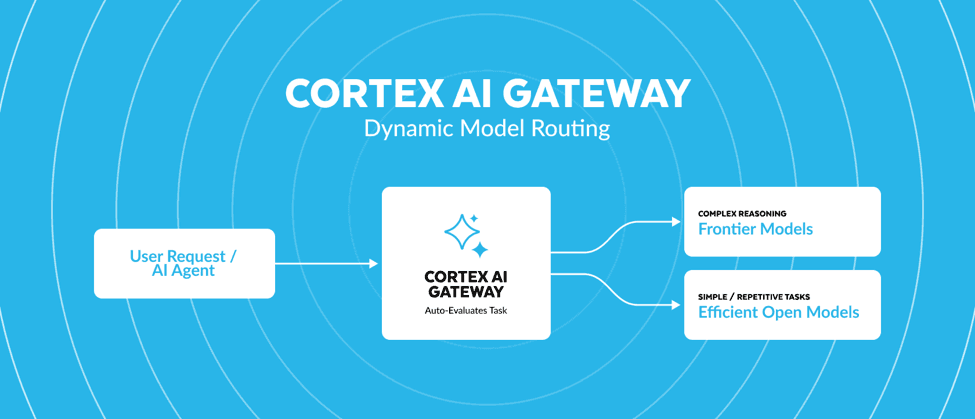
Source: CXOToday
Dynamic model routing is integrated across Snowflake's flagship AI products, including Snowflake CoCo and Snowflake CoWork, and is available to third-party AI agents using Cortex AI Gateway
2
3
. Snowflake ties routing to the same access controls it already uses for data governance1
. Governance starts at the data level with role-based access controls, extends to models where customer roles map to buckets of approved models, and extends again to agents, where an agent can be restricted to narrower privileges than the user invoking it1
. "For high quality, enterprise grade agents to be built, it's crucial to get the context and the governance right," Gultekin told VentureBeat. "Context, trust and model choice all go hand in hand"1
. Open models can run from a customer's own region to satisfy data residency requirements, with all inference staying inside Snowflake's security boundary rather than routing out to an external provider1
. Cortex AI Gateway gives administrators visibility into token usage and costs, while allowing organizations to establish spending limits across AI apps and agents3
. Snowflake CoCo extends those controls through role-based access and tagging framework, allowing administrators to set default models, attribute usage to teams or cost centers, establish per-user quotas, and receive notifications as consumption approaches defined limits3
.Snowflake is expanding customers' access to leading open models, including DeepSeek-V4-Flash 0731 and GLM-5.3, through Snowflake Cortex AI
2
3
. This adds to Snowflake's extensive model library, giving customers more options to balance model quality and cost while keeping governed data secure within Snowflake2
. Both DeepSeek-V4-Flash and GLM-5.3 are developed in China, and the regional setup matters specifically for open models with non-U.S. origins1
. Snowflake's AI Research Team evaluated DeepSeek-V4-Flash on enterprise-focused tasks, with recent testing showing that DeepSeek-V4-Flash outperformed the proprietary models used for the evaluation, scoring 74.4% on data engineering tasks3
. GLM-5.3 also performed strongly at 62.8%, while using fewer tokens than any other model tested3
. These results demonstrate that open models are increasingly capable of supporting mission-critical tasks at a lower cost3
. Snowflake continuously evaluates and optimizes how these models are served and used across its AI products, helping customers take advantage of advances in the open model ecosystem without having to repeatedly rework their apps or infrastructure3
.Snowflake recently announced its Horizon Context and Cortex Sense tools that provide context capabilities
1
. Without good context, a model has to do the exploratory work itself, writing and testing SQL, searching through data and retrying when something does not work1
. Gultekin explained that the process is expensive, and getting it right typically requires a more capable model1
. Packaging the context in advance removes that exploratory step, which means a simpler, cheaper model can often handle the same task1
. Snowflake also builds agent memory into that context, and as an agent is used repeatedly, its memory updates and gets folded back into future queries1
. The system does not re-solve the same problem from scratch each time, and memory becomes part of the context passed to the model1
. Snowflake's recent acquisition of Natoma adds another layer, bringing more than 100 MCP connectors with scoped, governed access1
. An agent could get read-only access to a connected tool like email, for example, rather than broader permissions1
.Related Stories
The move lands amid a broader industry shift toward automated model routing
1
. Databricks, AWS, Google Cloud and Nvidia have all announced some form of model routing technology1
. Databricks has an offering with Smart Routing for its Unity AI Gateway, while Nvidia on August 11 announced Switchyard as a technology layer to help route AI model choice1
. OpenRouter is one of the most widely known options, providing a platform that enables organizations to route based on cost and performance1
. Snowflake argues that model routing is more complex than just price and performance—it's also about governance and context1
. "The interesting part is what it says about where differentiation has moved," Sanjeev Mohan, Principal and Founder, SanjMo, told VentureBeat. "Snowflake isn't really selling routing, it's selling routing that never leaves the governed data"1
. Mohan also noted that "enterprises are drowning in model choices, but the real problem isn't which model to pick. It's the operational overhead of picking the right one for every task, at scale"2
. He added that "the ability to match workload complexity to model cost, without rebuilding your infrastructure every time a new model drops, is exactly the kind of efficiency enterprises need to move from AI experimentation to AI at scale"2
."Enterprises are becoming much more rigorous about the economics of AI. The question is no longer how much AI they are using, but whether that AI is translating into meaningful business value," said Sridhar Ramaswamy, CEO, Snowflake
2
. He added that "achieving intelligence efficiency requires the flexibility to use the best model for each task as the landscape evolves. Snowflake's role is to absorb that complexity so customers can focus on outcomes while we optimize model choice underneath"2
. As model performance and pricing change, Cortex AI Gateway can update routing decisions across Snowflake's AI products like Snowflake CoCo and Snowflake CoWork so customers don't need to rebuild their apps or agents2
3
. This allows enterprises to take advantage of new model options as they emerge while Snowflake manages the complexity of model choice and optimization underneath2
. Organizations can automatically match workloads to the right models, take advantage of new model options as they emerge, and manage how AI resources are consumed across the business3
. Watch for enterprises to scrutinize token efficiency metrics more closely as they scale AI deployments, and expect further competition among cloud providers to offer similar routing capabilities with tighter governance controls.Summarized by
Navi
[1]
[2]
28 Jul 2026•Technology

02 Oct 2025•Technology

03 Jun 2025•Technology

1
Technology

2
Technology

3
Technology