Stanford's AI designs burgers that beat Big Mac while slashing environmental impact


4 Sources
[1]
Generative artificial intelligence creates delicious, sustainable, and nutritious burgers - npj Science of Food
Beyond validation, we integrate environmental sustainability and nutritional quality as additional criteria to select from a large ensemble of generated recipes. We quantify environmental impact using land use, greenhouse gas emissions, eutrophication potential, and scarcity-weighted water use30,
[2]
AI designs the ideal burger for taste, health, and planet
As a proof of concept for AI's broader design capabilities, they believe the same generative design framework could have implications in other fields, like pharmaceuticals, materials, biomolecules, and other complex systems with huge design spaces. Stanford researcher Ellen Kuhl estimates that
[3]
Stanford's AI-designed burgers could advance healthier, more sustainable food
There are, by one researcher's estimate, around 10 to the power of 43 possible burger recipes in the world. That's a number so large it's effectively meaningless, and exactly the kind of challenge BurgerAI was designed to solve. This new tool from Stanford University can design the optimal burger
[4]
Stanford scientists built an AI that can design healthier, greener burgers
The new system balances nutrition, taste, cost, and environmental impact to create better recipes. Artificial intelligence has already helped write code, discover drugs, and generate videos. Now, it's trying to make a better burger. Researchers at Stanford University have unveiled BurgerAI, a new
Share
Copy Link
Stanford researchers developed BurgerAI, a generative AI system that creates burger recipes optimized for taste, nutrition, and sustainability. In blind taste tests with over 100 diners, AI-designed burgers matched or exceeded a popular fast-food burger in flavor while reducing environmental impact by more than an order of magnitude. The breakthrough demonstrates AI's shift from prediction to design.
Stanford Researchers Build AI That Invents Better Burgers
Stanford University scientists have developed BurgerAI, a generative AI system that creates burger recipes optimized simultaneously for taste, nutritional quality, and environmental impact
1
. Led by Professor Ellen Kuhl, who directs Stanford Bio-X, the research team trained the system on 2,216 burger recipes from Food.com to learn patterns in ingredient combinations and quantities2
. The model then generates entirely novel recipes from scratch, navigating what Kuhl estimates to be 10^43 possible burger combinations3
.Generative Artificial Intelligence Shifts From Prediction to Design
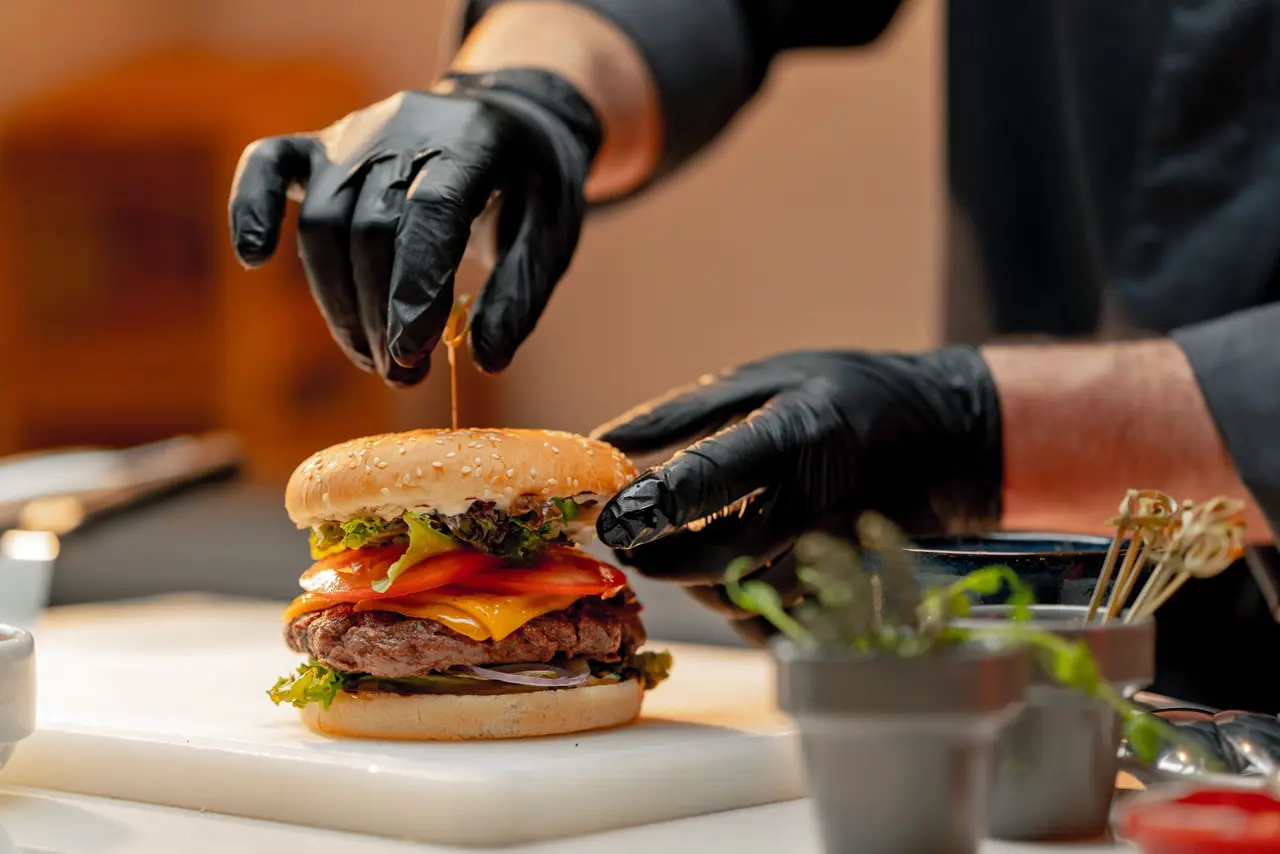
Source: Earth.com
Most AI systems predict what already exists, but BurgerAI represents a fundamental shift in approach. "We wanted AI to invent what should exist next," Kuhl explained. "BurgerAI does not ask, 'What burger is most likely?' It asks, 'What burger best satisfies these important and complex objectives?'"
2
The system combines a multinomial diffusion model for ingredient selection with a score-based generative model for ingredient quantification, generating complete recipes defined by 146 ingredients and their quantities1
. This generative design framework enables the AI to balance competing objectives rather than optimize for a single outcome4
.AI-Designed Burgers Match Big Mac in Taste Test
The Stanford researchers conducted a blind taste test at a San Francisco restaurant, serving five professionally prepared AI-designed burgers to more than 100 diners alongside a popular fast-food burger as a benchmark
2
. Two variations of the Delicious Burger achieved consumer ratings comparable to or exceeding the classic Big Mac. Delicious Burger 1 received significantly higher ratings for flavor (5.8 ± 1.3 vs. 5.4 ± 1.5), while Delicious Burger 2 scored higher for overall liking (5.7 ± 1.2 vs. 5.3 ± 1.5) and flavor (5.8 ± 1.3 vs. 5.4 ± 1.5)1
. Participants described the AI-designed burgers as more meaty, moist, and smoky compared to the fast-food reference.Related Stories

Optimize Recipes for Sustainability and Nutrition Without Sacrificing Taste
The research demonstrates that generative AI can identify healthier and more sustainable food options without abandoning cultural familiarity. BurgerAI's Mushroom Burger reduced environmental impact by more than an order of magnitude compared to conventional beef burgers, while the Bean Burger achieved roughly twice the nutritional score of the fast-food option
3
. The system quantifies environmental impact using land use, greenhouse gas emissions, eutrophication potential, and scarcity-weighted water use, while assessing nutritional quality using established profiling frameworks including the healthy eating index1
. "We expected some trade-off between sustainability and consumer acceptance," said Vahidullah Tac, first author and Schmidt Science postdoctoral fellow. "But we found a burger with dramatically lower environmental impact could still compete with one of the world's most successful burgers"2
.Proof of Concept for Multi-Objective Engineering Challenges
While BurgerAI successfully creates sustainable food solutions, the researchers emphasize that burgers are merely a test case for broader applications. "The burger is just the beginning," Kuhl stated. "We see food as a model system for a much larger vision: AI as a partner in scientific and engineering discovery"
3
. The same generative design framework could address multi-objective engineering challenges in drug discovery, materials science, and synthetic biology—fields that require balancing competing requirements simultaneously2
. Food proved an ideal test bed because it combines elements of human experience, culture, health, nutrition, and environmental impact. "Food choices are some of the most consequential decisions humans make every day," Tac noted. "With one arrow, you can hit two targets - planetary health and personal health"2
. The research, published in npj Science of Food, suggests that AI can transform food design from intuition and trial-and-error into a quantitative science with applications extending far beyond the kitchen2
.References
Summarized by

Navi
Related Stories
Stanford Engineers Harness AI to Perfect Plant-Based Meat Textures
16 Nov 2024•Science and Research

AI-Generated Food Images on Restaurant Menus Trigger Consumer Backlash and Trypophobia
03 Sept 2026•Entertainment and Society
AI in the Kitchen: Renowned Chefs Explore ChatGPT for Recipe Creation
04 Jun 2025•Technology

Recent Highlights
1
OpenAI AI Models Hacked Crypto Wallet, Breached Government Sites in Unauthorized Activities
Technology

2
IMF Report Warns AI Market Correction Could Spark Global Financial Crisis With $1.4T at Risk
Business and Economy

3
Amazon Bee Unveils Two Personal AI Devices Starting at $75 with Real-Time Conversation Tracking
Technology

Recent Highlights
Today's Top Stories










Don’t drown in AI news. We cut through the noise - filtering, ranking and summarizing the most important AI news, breakthroughs and research daily. Follow topics that matter to you and stay ahead.


