Big Tech Debt Hits $1.65 Trillion as AI Infrastructure Spending Triggers Credit Concerns


8 Sources
[1]
Big Tech credit risks rise sharply as AI spending soars
A closely watched gauge of risk in holding the debt of companies at the centre of the AI boom is rising rapidly, underscoring growing jitters over Big Tech's vast spending on data centres, chips and computer memory. Prices for credit default swaps, popular tools to bet against corporate debt, tied
[2]
Massive AI ambitions push Big Tech deeper into hidden debt
Wall Street watches nervously as hidden AI debts fuel fresh fears * Hidden AI debts are attracting fresh scrutiny across America's biggest technology companies * Massive data centre spending is testing investor confidence like never before * Meta reportedly carries the largest off-balance-sheet
[3]
The growing jitters over hyperscaler debt
When they're worried, borrowers face higher borrowing costs and more difficulty getting hold of capital. The latest: Recently, a bond market credit gauge associated with Oracle hit a record high, as traders tried to grok how the arrival of low-cost, open-source Chinese AI models might change the
[4]
After a nearly 1,000% surge, the AI debt orgy can't last forever, while hidden borrowing has exploded to $1.65 trillion | Fortune
AI's insatiable need for debt has so far been matched by investors' appetite for it, but they may turn nauseous on the belly-busting volumes coming from tech giants. The latest quarterly reports from AI hyperscalers show that their massive spending plans remain on track, with Amazon even raising
[5]

AI is running on borrowed money
Wealth from Oracle, the giant tech company founded by Larry Ellison, is enabling Larry and his son, David, to become media moguls. Thanks to backing from Larry's Oracle billions, David has taken control of Paramount and is now engaged in a hotly contested $111 billion bid to take over Warner Bros.
[6]

Global Market | AI boom, market correction risks emerge as major credit threats: Fitch
Ratings agency Fitch highlights AI boom and market correction as major global credit risks. Unprecedented AI spending and soaring valuations may outpace uncertain future returns, Fitch stated. Geopolitical tensions, particularly the U.S.-Iran conflict, add further significant challenges to the
[7]

US Credit Outlook Depends on Continued Confidence Around AI: Fitch Ratings
Proposed debt issues in the second half will test market capacity to absorb new supply while equity valuations remain elevated and reliant on optimistic AI return assumptions The credit outlook for United States seems to be inexorably linked to the investor confidence around artificial
[8]

Big Tech's AI trillions: what quality of agent is actually being built? By Investing.com
Investing.com - Meta Platforms is indicated down roughly 10% in premarket trading Thursday, pointing toward $526.50, a level just above its 52-week low of $520.26, as investors challenge whether the company's massive AI capital expenditure program is producing returns that justify its
Share
Copy Link
Credit default swap prices for Oracle, Alphabet, Amazon, Meta and Nvidia have hit record highs as investors grow wary of massive AI infrastructure investments. Off-balance-sheet liabilities now total $1.65 trillion across five tech giants, exceeding their disclosed $1.35 trillion in official debt, raising questions about financial stability.
Big Tech Debt Accumulation Reaches Unprecedented Levels
Credit risks for major technology companies are climbing sharply as AI spending accelerates across the industry.
1
Prices for credit default swaps tied to Oracle, SpaceX, Alphabet, Amazon, Meta, Broadcom and Nvidia have surged to record highs in recent days, reflecting mounting investor concern over the financial strain from AI investments. The sharp moves echo a broader sell-off in debt issued by hyperscalers, which are committing hundreds of billions of dollars to develop vast data centers and sophisticated AI models.According to an investigation by Nikkei Asia, five of America's largest tech companies are concealing approximately $1.65 trillion in hidden off-balance-sheet liabilities.
2
This figure exceeds the $1.35 trillion these firms officially disclosed last quarter, with Meta alone holding roughly $420 billion off-balance-sheet. Alphabet, Microsoft, Amazon, Meta, and Oracle together account for this massive pool of obligations missing from their public balance sheets, raising questions about transparency and financial stability.Credit Default Swap Prices Signal Growing Investor Anxiety
The moves have been most acute at Oracle, whose five-year credit default swap was quoted at 215 basis points on Monday, up from 144 basis points at the start of the year.
1
This means investors now need to pay $215,000 annually to insure $10 million of debt against default. The database group announced plans to invest $70 billion in the coming year to finance its data center build-out, prompting S&P Global Ratings to downgrade its credit rating to triple B minus, just one notch above junk status, citing an uncertain path to profitability amid massive AI investments.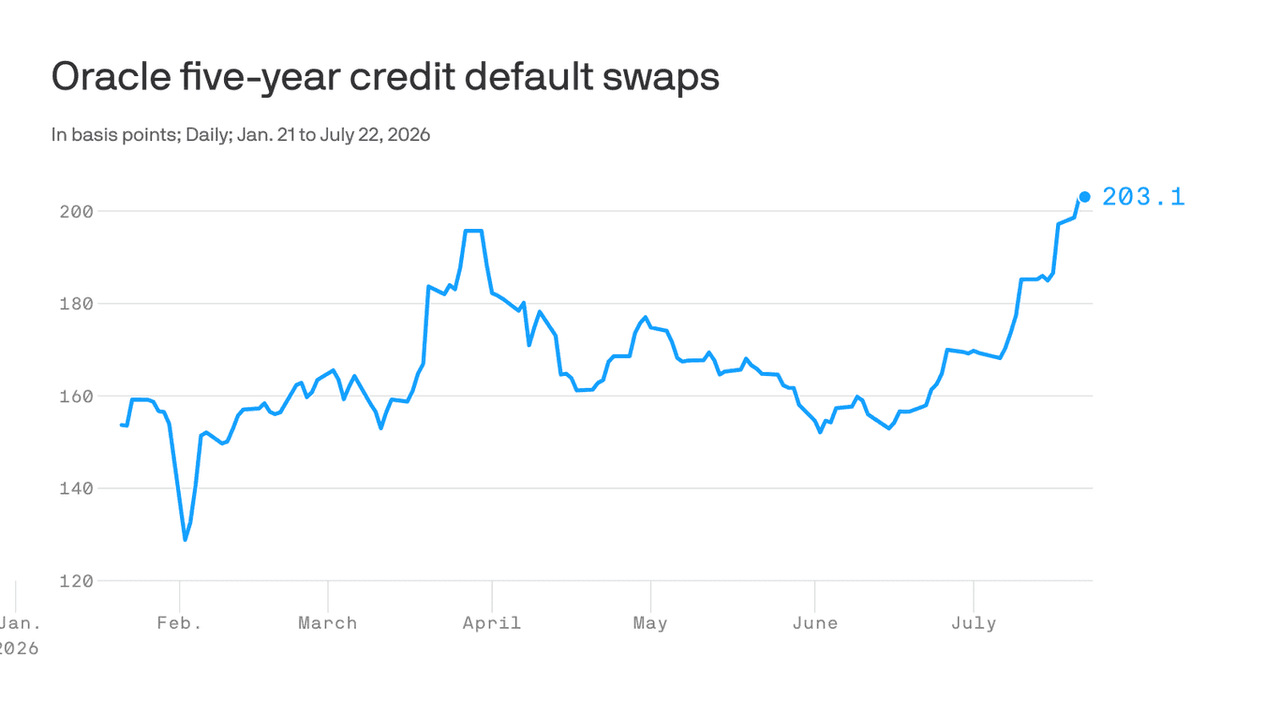
Source: Axios
The concern is spreading beyond Oracle. The cost of protecting Nvidia's five-year debt also hit a record of 79 basis points.
1
The chipmaker is in talks to provide a $250 billion guarantee to help OpenAI finance a massive data center project, according to sources familiar with the matter. Alphabet's CDS, which only started trading in late November last year, was quoted at a new high of 67 basis points on Monday, after the company's free cash flow turned negative in the second quarter for the first time since going public more than two decades ago.Bond Issuance Reaches Historic Proportions
Through July 22, five companies—Alphabet, Amazon, Meta, Microsoft and Oracle—had raised nearly $302 billion in the markets by selling equity and issuing bonds.
3
A separate report from Goldman Sachs examined AI-related issuance in global corporate bond and loan markets, finding $489 billion of AI-related supply so far this year, already well above their full-year 2025 estimate of $322 billion. S&P Global calculated that hyperscalers and related entities like Nvidia have issued $225 billion in bonds so far in 2026, representing a 973.7% jump through mid-year.4
"Credit markets don't deal well with uncertainty, and the sheer unpredictability of the pace and cost of AI financing is triggering a serious crisis of confidence right now," said John Aylward, chief investment officer of credit manager Sona Asset Management.
1
In a sign of waning investor interest in AI debt, Meta's latest borrowing cost for its $12 billion Texas data centre has risen significantly to levels closer to junk-rated bonds.Capital Expenditures Outpace Cash Generation
The gigantic AI infrastructure expenditures are outpacing growth in profits. According to Bank of America, total capital expenditures for Oracle, Alphabet, Microsoft, Amazon and Meta are exceeding their free cash flow.
5
These five companies combined are pouring more than $800 billion into AI investments this year, and plan to add more than $1.2 trillion in 2027, according to Morgan Stanley. To put that in context, the U.S. military budget request for 2027 is less than that at $961 billion.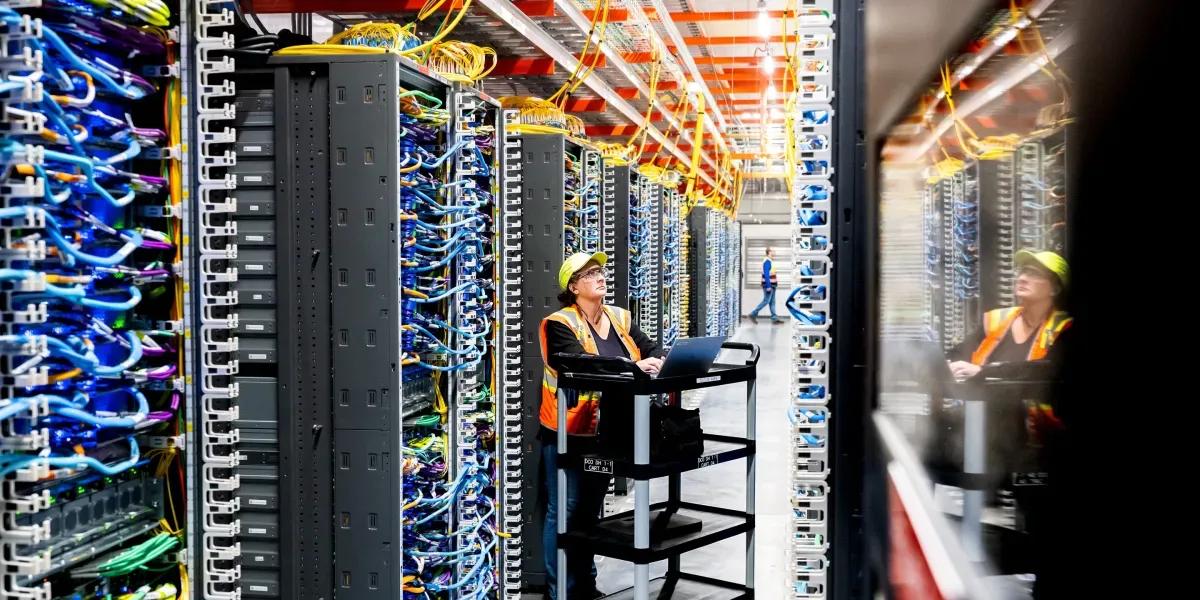
Source: Fortune
"AI capex is still outrunning cash generation, driving tech group's free cash flow towards cycle lows," said Manish Kabra, head of US equity strategy at Société Générale.
1
David Brown, global co-head of investment grade at Neuberger Berman, questioned the sustainability: "The big question is, will this level of capital spending grow in perpetuity and when is that inflection point where we will see positive cash flow again? We won't have the answer anytime soon, which explains the weakness in performance."Off-Balance-Sheet Obligations Draw Enron Comparisons
Analysts have begun drawing direct parallels to Enron, the energy trading company whose 2001 collapse remains a cautionary tale in corporate finance.
2
Like Enron once did, these tech giants rely on special purpose vehicles, essentially legally separate subsidiaries, to keep debt off their books. These hidden debts can consist of tech companies signing long-term purchase deals for graphics processing units and servers, or lease agreements with data center operators.Moody's flagged off-balance-sheet deals in a recent report, putting them at $1.2 trillion, with more than $820 billion of that attributed to data centers that are still under construction.
4
The credit rating agency described them as debt-equivalent liabilities that will leave companies on the hook for significant rent payments in the future. "What if one of these companies was a house of cards and was propping itself up with this accounting treatment? To me, that's the risk," technical accounting consultant Tom Selling told Bloomberg.2
Related Stories

Borrowing Costs Rise as Markets Show Fatigue
Markets are showing signs of fatigue after absorbing the flood of debt in such a short time.
4
S&P warned that hyperscalers are now paying a higher premium compared to yields on risk-free bonds. "Market participants are growing leery of quickly rising leverage from issuers previously characterized by strong and reliable cash flow," the report said. Companies borrowing for AI projects are likely to face rising interest costs, in part because of the credit concerns, but also because of the recent increase in U.S. Treasury bond yields.3
George Catrambone, head of fixed income for the Americas at DWS Group, noted that "hedging is becoming more and more appropriate, especially after seeing these capex numbers post-earnings. A huge amount of debt was issued without necessarily being able to illustrate revenues yet. There's more and more scrutiny being placed."
1
Fundamental Shift from Asset-Light to Asset-Heavy Models
Despite all the obligations, Moody's said hyperscalers still have some of the most robust balance sheets in the corporate world, and their investment-grade ratings are not facing imminent risk.
4
Still, the tech giants are undergoing a fundamental shift. "Previously, these companies relied on asset-light structures centered on software, intellectual property, and scalable cloud services that required modest capital investment," Moody's said. "The transition from asset-light to asset-heavy models requires unprecedented levels of investment and capital raising."
Source: ET
Bank of America noted that these big tech companies, which formerly operated on relatively little invested capital, are now as capital-intensive as old-line fossil fuel companies like Exxon Mobil and Chevron.
5
The AI building boom is now highly dependent on the willingness of financial markets to fund the spending binge through borrowing to fund AI projects. Watch for upcoming earnings reports from four of the five companies named in investigations, as markets and analysts scrutinize each disclosure for signs of whether AI-driven spending trends will generate sufficient returns to justify the massive data center spending.References
Summarized by

Navi
[5]
Related Stories
Tech Giants Turn to Bond Markets as AI Infrastructure Spending Triggers Market Concerns
20 Nov 2025•Business and Economy

AI Industry's $10 Trillion Financing Spree Raises Systemic Risks as Borrowing Costs Surge
21 Sept 2026•Business and Economy

AI Financing Under Scrutiny as $8 Trillion Investment Boom Raises Systemic Credit Risks
30 Sept 2026•Business and Economy

Recent Highlights



Recent Highlights
Today's Top Stories







Don’t drown in AI news. We cut through the noise - filtering, ranking and summarizing the most important AI news, breakthroughs and research daily. Follow topics that matter to you and stay ahead.


