Nvidia's $500B AI Infrastructure Financing Plan Creates Secondary Market for Aging GPUs


66 Sources
[1]
Nvidia's new $500B plan is risky but brilliant, especially for aging GPUs
Nvidia announced this week that Apollo, BlackRock, Blackstone, Brookfield, Goldman Sachs, and KKR were willing to commit up to $500 billion to build AI data centers. That eye-popping figure got a lot of the attention, but the bigger story is Nvidia's effort to create a secondary market for aging
[2]
Nvidia teams up with financial giants to create $500 billion AI infrastructure funds -- six investment firms to enable access to long-term funding at attractive rates
Nvidia late on Monday announced that it had signed memorandums of understanding with Apollo, BlackRock, Blackstone, Brookfield, Goldman Sachs, and KKR to establish independent financing platforms that could mobilize more than $500 billion in third-party capital to invest in AI infrastructure.
[3]
Private credit roundup: Nvidia's half trillion for chips financing, plus others
LONDON, Aug 14 (Reuters) - Nvidia's (NVDA.O), opens new tab colossal financing deal for AI infrastructure buildouts is the talk of private markets this week. The chip giant said it has partnered with six major financial institutions to launch compute financing platforms aimed at raising over $500
[4]
Everybody loves Nvidia -- but then, they can't afford not to
There's no mystery about why the Masters of the Universe are thrilled to be Huang's wingmen Wall Street loves Nvidia. In case that wasn't clear already, this week the bosses of six of the biggest names in global asset management pledged support for the chipmaker's new project: a financing platform
[5]

AI's infrastructure boom is getting more leveraged -- and harder to track
* Hyperscalers' debt issuance and Situational Awareness's unravelling have brought the increasingly leveraged foundations of the AI boom into sharp focus. * Nvidia has unveiled plans for a new AI funding push that could involve using infrastructure as an investable asset. * Some strategists say
[6]

Nvidia may have just built its own hyperscaler without owning a single data center
Serving tech enthusiasts for over 25 years. TechSpot means tech analysis and advice you can trust. Why it matters: Nvidia has quietly assembled every piece of a cloud giant, and it doesn't even need to own the buildings. That is the theory making the rounds, and once you see it laid out, the last
[7]

Wall St. Wants Another Half-Trillion Dollars for the A.I. Boom
Six giant investment firms announced a $500 billion effort to raise money for customers of Nvidia to pay for computing power. In some quarters, the words "artificial intelligence" have never been less popular, as many worry about job losses, environmental impacts and plain old uncertainty. Not so
[8]

Nvidia gets $500bn from major banks for AI build out
Nvidia has teamed up with some of Wall Street's largest banks to help raise $500bn (£370bn) in capital to develop artificial intelligence (AI) infrastructure. The chipmaker said it had struck deals with Apollo, BlackRock, Blackstone, Brookfield, Goldman Sachs and KKR, and that the banks were for
[9]

Goldman Sachs is courting investors on Nvidia's $500bn AI-compute financing deal
Goldman Sachs has secured the role every Wall Street firm wanted, and it is now working the phones. The bank is in talks with investors about Nvidia's $500bn AI-compute financing deal, having landed a prized mandate that effectively casts it as the lead, and for now near-sole, lender behind one of
[10]

NVIDIA AI Factory Compute Is Becoming an Investable Asset Class
We announced partnerships with Apollo, BlackRock, Blackstone, Brookfield, Goldman Sachs and KKR to establish independent financing platforms designed to mobilize over $500 billion of third-party capital to support the buildout of AI infrastructure over time. This is a major milestone for NVIDIA
[11]

Top Wall Street Firms Reportedly Partnering With Nvidia for $500 Billion AI Investment
Some of the biggest financial firms in the world are reportedly getting ready to pour half a trillion dollars into a deal with Nvidia for AI infrastructure buildout. A consortium of Wall Street firms, including heavy hitters like Blackstone, BlackRock and Goldman Sachs, is working on a deal with
[12]
Breakingviews - Jensen Huang takes wheel of $500 bln AI bandwagon
NEW YORK, August 11 (Reuters Breakingviews) - Nvidia's boss gathered Apollo, Goldman and others to help finance buyers of his company's GPUs. He is channeling the auto-loan market by using computing power as collateral as other funding sources thin. The chipmaker takes the driver's seat, with
[13]
Wall Street giants bet Nvidia's AI chips will defy the laws of finance
Wall Street is betting that AI chips can defy one of finance's basic rules: that fast-moving technology quickly loses its value. Nvidia unveiled this week a $500bn deal under which tech groups will be able to lease semiconductors with financing from groups including Apollo Global, KKR, Brookfield,
[14]
Investors question data center loan valuations after latest Nvidia financing move
The biggest names in finance gave their blessing to the AI computing buildout this week, partnering with chipmaker Nvidia to promote the company's computing capacity as an " investable asset class ." Larry Fink, CEO of BlackRock, one of Nvidia's financing partners, compared Nvidia's computing power
[15]
Nvidia calms its own credit market after Jensen Huang clarifies the $500bn financing plan
The chipmaker's credit-default swaps had spiked to a record on fears of circular financing. They eased once Jensen Huang recast the plan as other people's money, with Nvidia's own exposure capped. After weeks in which the cost of insuring its debt climbed to a record on worries about so-called
[16]

Backstopping the AI boom
Why it matters: Like it or hate it, investment in AI data centers is the engine powering the stock market and much of the growth in the economy. Catch up quick: On their own, the hyperscalers -- Alphabet, Amazon, Meta, Microsoft and Oracle -- are expected to spend roughly $800 billion this year
[17]

Nvidia links with Wall Street firms for $500bn AI financing deal
Apollo, BlackRock, Goldman Sachs and KKR among those working with chipmaker to fund infrastructure Nvidia has partnered with six major Wall Street financial institutions to raise more than $500bn (£370bn) capital for artificial intelligence infrastructure. The Nvidia chief executive, Jensen
[18]

NVIDIA Partners With Apollo, BlackRock, Blackstone, Brookfield, Goldman Sachs and KKR to Establish AI Compute Infrastructure Financing Platforms to Mobilize Over $500 Billion of Third-Party Capital
These partnerships remain subject to execution of the final agreements. About NVIDIA NVIDIA (NASDAQ: NVDA) is the world leader in AI and accelerated computing. About Apollo Apollo is a high-growth, global alternative asset manager. In our asset management business, we seek to provide our
[19]
Wall Street giants partner with Nvidia on $500bn AI financing deal
The world's largest financial groups are working with Nvidia to assemble a $500bn funding package for AI infrastructure development, in one of Wall Street's most ambitious lending efforts to date. A consortium of groups including Apollo Global, Blackstone, BlackRock's Global Infrastructure
[20]

Goldman Sachs courts investors for Nvidia $500B AI financing deal
U.S. insurers, money managers, and banks are expected to form the core investor base for the deal, which Nvidia announced earlier this week Goldman Sachs $GS has been approaching a range of potential participants -- among them banks, insurers, asset managers, and private credit firms -- about
[21]

Nvidia found a new way to keep the AI boom funded: your retirement money | Fortune
Nvidia has been arguably the No. 1 profiteer of the AI boom, selling the picks and the shovels of the trade. But now it wants Wall Street to figure out how to keep paying for them. On Monday, Nvidia announced partnerships with Apollo, BlackRock, Blackstone, Brookfield, Goldman Sachs, and KKR to
[22]
CNBC Daily Open: Big Tech wants to tap Wall Street's big wallets
Nvidia also launched its first open-source model, named Nemotron 3.5 Lightning. This is the first model since CEO Jensen Huang joined most of his tech peers in urging the U.S. government to support open models. In the AI gold rush, Nvidia already sells the picks and shovels. Now it wants Wall
[23]

What Nvidia's $500 billion Wall Street deal signals about the AI boom
Nvidia and six of the world's largest investment firms announced plans last week to channel more than $500 billion (€433bn) into AI infrastructure, an arrangement designed to let tech companies build data centres without loading the cost onto their own balance sheets. Nvidia has recruited Wall
[24]

Nvidia reckons new $500 billion investment should allay fears AI companies are just funded by the same pot of cash moving around in one big circle. Reassured yet?
This week, Nvidia announced it will be receiving "over $500 billion of third-party capital" from banks and investment companies. And now, in a blog post explaining how 'AI factory' compute is "becoming an investable asset class", Nvidia has answered the question, "Is this circular financing?" The
[25]

Nvidia partners with Wall Street giants to raise $500 billion for AI buildout
Nvidia said on Monday it has partnered with six major financial institutions to launch compute financing platforms aimed at raising over $500 billion in third-party capital for AI infrastructure. The move highlights how surging demand for AI computing capacity is drawing institutional investors,
[26]
Six finance giants back Nvidia's $500bn plan to fund the AI buildout
Six of finance's biggest names are building 'compute financing platforms' around Nvidia hardware, a new stage in the debt-fuelled AI buildout. Nvidia has recruited six of the largest names in finance to help turn its chips into something a bank can lend against. The company announced partnerships
[27]
Nvidia wants the AI revolution to be securitized
Zoom in: Much of that money is likely to come via GPU securitizations -- spreading out the exposure across insurance companies, pension systems, sovereign wealth funds, and more. The big picture: Wall Street is betting America's economy on unwavering compute demand. * Not just this deal, but also
[28]

Did Nvidia's Jensen Huang just make the AI buildout too big to fail?
Nvidia Corp. is no longer just selling technology. It is helping create a financial asset class around artificial intelligence compute. In our last Breaking Analysis, we argued that AI can be technologically transformative and still produce a capital bubble. Our thesis was simply that the bubble
[29]
Nvidia partners with Wall Street firms on $500B AI financing
The chipmaker signed MOUs with Apollo, BlackRock, Blackstone, Brookfield, Goldman Sachs, and KKR to treat AI compute as a financeable asset class Nvidia $NVDA announced partnerships Monday with six major financial institutions to establish compute financing platforms aimed at mobilizing more than
[30]
Nvidia taps Wall Street for $500 billion funding commitment | Fortune
The coalition, which also includes Goldman Sachs Group Inc. and KKR & Co., will "create dedicated pools of capital at significant scale at attractive rates for Nvidia customers," according to a statement Monday. Nvidia Chief Executive Officer Jensen Huang said in a CNBC interview that he approached
[31]
Why Jensen Huang's $500 billion AI financing plan faces a big risk from China
Jensen Huang built the world's most valuable company by pioneering the specialized computer chips behind the artificial intelligence boom. To keep his vision for the future within reach, the Nvidia founder is now attempting a different kind of engineering: convincing Wall Street investors that
[32]
Nvidia, Wall Street partner on $500B AI financing
Why it matters: The gargantuan financing package illustrates the mushrooming scope and costs of the infrastructure needed to keep the AI economy humming. The big picture: Nvidia announced Monday that it is partnering with Apollo, BlackRock, Blackstone, Brookfield, Goldman Sachs and KKR to assemble
[33]
Nvidia lines up Wall Street for a $500bn AI package
Six of the biggest names in private capital are in talks to put $500bn behind Nvidia's AI buildout. Nobody has yet said what the money buys, or who absorbs the loss if the demand never arrives. A group of financial firms is working with Nvidia on a $500bn funding package for AI infrastructure. The
[34]
Nvidia taps Wall Street for half a trillion dollars to fuel global AI infrastructure buildout
Some of Wall Street's biggest financial firms are partnering with Nvidia Corp. to pour half a trillion dollars of funding into the artificial intelligence industry's massive infrastructure buildout. Nvidia said today it has struck deals with Apollo Global Management Inc., BlackRock Inc.,
[35]

Nvidia Is Close to a $500 Billion Deal to Build AI Infrastructure. Why Aren't Some Investors Happy About It?
A group of Wall Street's biggest investment firms wants to hand Nvidia $500 billion for AI infrastructure, but not everyone is jumping for joy, according to Bloomberg. Apollo Global Management, Blackstone, BlackRock, Brookfield Asset Management, Goldman Sachs and KKR are among the firms in talks,
[36]
Nvidia is trying to quiet 'circular financing' accusations. Wall Street is unsure it will
Wall Street is on the fence about chipmaker Nvidia's latest financing initiative. Nvidia announced "memorandums of understanding" with six financial heavyweights on Monday, designed to provide half-a-trillion dollars of financing for Nvidia customers to purchase the company's products. CEO Jensen
[37]

Nvidia's $500 billion plan envelops Wall Street in its AI frenzy
Nvidia has unveiled a major financing initiative aimed at supporting artificial intelligence chip acquisitions. By collaborating with prominent financial institutions, the plan seeks to provide substantial debt solutions tailored for AI startups. This multifaceted financing strategy is designed to
[38]

Nvidia partners with Wall Street mobilise funds for AI infrastructure, Goldman Sachs leads financing
This content has been selected, created and edited by the Finextra editorial team based upon its relevance and interest to our community. On Monday the AI chipmaker announced partnerships with Wall Street firms including Apollo, Blackstone, Blackrock, Brookfield, Goldman Sachs, and KKR to raise at
[39]

What Makes the AI Music Stop: a $1.5 Trillion Mountain of Hidden Leverage - Meta Platforms (NASDAQ:META),
The artificial-intelligence infrastructure race might be entering an opaque phase. What began as a cash-flow-funded spending spree by the world's richest technology companies is increasingly becoming a debt-driven capital-expenditure cycle. A vast amount of capital is routed through leases, joint
[40]

US Tech Advisor David Sacks Calls The Biggest Risk To NVIDIA's $500 Billion AI Financing Plan A 'Dark GPU' Glut
After NVIDIA and CEO Jensen Huang announced their latest initiative last week, which now turns the firm's GPU into an asset class similar to financial securities, Trump advisor David Sacks discussed the biggest risk to the plan and the ongoing AI buildout. NVIDIA's latest announcement will also see
[41]

Nvidia's show of financial force soothes credit markets
Six of the biggest names in finance are helping Nvidia ease some of the investor anxiety that's been building for weeks over its swelling commitments to backstop the artificial intelligence boom. The early signs came after Nvidia CEO Jensen Huang announced Monday that the coalition of major
[42]

Nvidia teams up with Wall Street banks for huge AI investment
The chip manufacturer has raised $500 billion for AI infrastructure. Nvidia has struck deals with Apollo, BlackRock, Blackstone, Brookfield, Goldman Sachs and KKR, some of the biggest banks on Wall Street, in order to invest $500 billion into artificial intelligence. According to Nvidia, this is
[43]
Wall Street just endorsed Jensen Huang's 'big concept' for AI. What now?
"You can think about it as a revenue stream, and you can securitize it or effectively divide that risk and sell it," said Waldemar Szlezak, KKR's head of digital infrastructure. The first three-plus years of the artificial intelligence buildout has been paid for through record amounts of equity
[44]
Goldman in talks with investors on Nvidia financing deal after landing prized role
Nvidia announced on August 10 it has partnered with six major financial institutions including Goldman to launch compute platforms aimed at raising over $500 billion in third-party capital for AI infrastructure. The move highlights how surging demand for AI computing capacity is drawing
[45]

Nvidia Uses $500 Billion Financing Initiative to Dispel AI Bubble Fears | PYMNTS.com
The initiative is also meant to expand Nvidia's customer base beyond hyperscalers, some of which are developing their own components; to show that some of the largest Wall Street firms are set to arrange financing for chip deals; and to ease investors' concerns that circular financing, including
[46]
Goldman Sachs Eyes Role in Nvidia's $500B AI Financing Initiative - Goldman Sachs Group (NYSE:GS)
Goldman Sachs Courts Investors to Join Nvidia's $500 Billion AI Financing Initiative: Report Goldman can supply junior capital and private credit, and help place debt into private and public markets, Reuters reported, citing sources. Asset managers plan to retain a sizable share of the
[47]

Nvidia Has a $500 Bn Plan To Create a Secondary Market for Ageing GPUs
More compute creates better AI; better AI creates more usage; more usage creates more revenue; and more revenue drives more compute. GPU-maker Nvidia had announced earlier this week that a bunch of investors led by the likes of BlackRock, Brookfield, Goldman Sachs, and KKR would commit up to $500
[48]
Goldman Sachs Mobilizes Investors for Nvidia's $500 Billion AI Infrastructure Push | PYMNTS.com
Goldman Sachs has talked with banks, asset managers, insurers and private credit firms, according to the report. The firm's investment bank can help place the debt into private credit funds and public debt markets, while its asset management arm can provide junior capital and private credit
[49]
Goldman Sachs taps investors for Nvidia's $500 billion AI financing push
Goldman Sachs is negotiating with investors for Nvidia's massive AI financing initiative. U.S. insurers and money managers will likely form the core investor base. This plan aims to raise over $500 billion for AI infrastructure development. Nvidia's CEO approached Goldman Sachs with this innovative
[50]
CCTV Script 11/08/26
- This is the script of CNBC's financial news report for China's CCTV on AUG 11, 2026. NVIDIA said Monday it has signed memorandums of understanding with six Wall Street giants, including Apollo Global Management, Blackstone, BlackRock, Brookfield, Goldman Sachs and KKR, to advance a $500 billion
[51]
Jensen Huang's $500 Billion Nvidia AI Financing Bet Faces a China Problem -- Could Cheaper Chinese Chips Sin
China Could Threaten Nvidia's $500B AI Financing Bet That creates a major risk for Nvidia's new financing strategy. The initiative aims to help companies, including startups and cloud providers, finance the cost of expensive data centers and GPU clusters. Huang's argues that Nvidia's AI
[52]

Nvidia partners with major Wall Street players to raise $500B for AI infrastructure
Nvidia said on Monday it has partnered with six major financial institutions to launch compute financing platforms aimed at raising over $500 billion in third-party capital for AI infrastructure. Nvidia CEO Jensen Huang said on X that the company has the option to backstop up to $125 billion, or
[53]

Nvidia, Wall Street firms partner on US$500 billion AI financing venture, source says
A group of financial firms, including Apollo Global and Blackstone, is working with Nvidia to put together a US$500 billion funding package for AI infrastructure development, a person familiar with the matter told Reuters on Monday. Nvidia's shares fell over 3 per cent in afternoon trading. The
[54]

Morgan Stanley sees AI financing as defining summer 2026 By Investing.com
Investing.com -- Morgan Stanley analysts said summer 2026 may be remembered for major developments in AI financing rather than new technology releases, as capital markets rapidly adapted to fund the AI infrastructure buildout. The four largest hyperscalers, Microsoft (NASDAQ:MSFT), Alphabet
[55]
Nvidia Forms Financial Partnerships to Fuel AI Factory Boom | PYMNTS.com
The firms with which the AI chip manufacturer has announced these strategic partnerships are Apollo, BlackRock, Blackstone, Brookfield, Goldman Sachs and KKR. The partnerships remain subject to the execution of final agreements, according to the release. The compute financing platforms will be
[56]
Forget gold and stocks: Nvidia CEO Jensen Huang aims to make chips an investable asset, lines up $500 bn in financing
Nvidia CEO Jensen Huang said AI compute is emerging as a new investable asset class as the chipmaker partners with six major financial firms to establish financing platforms. The initiative aims to mobilise over $500 billion in third-party capital for AI infrastructure, as Nvidia seeks to position
[57]
Why Is NVIDIA Stock Gaining Tuesday? - NVIDIA (NASDAQ:NVDA)
NVIDIA's Jensen Huang Says AI Isn't Just Tech Anymore -- It's Infrastructure, and Wall Street Is Financing It The world's most valuable chipmaker is seeking to turn AI infrastructure into a major financing opportunity as CEO Jensen Huang increasingly frames NVIDIA chips as long-lived,
[58]
New AI financing backstops allows compute buyers more control over business models By Investing.com
Investing.com -- Artificial intelligence infrastructure financing backstops announced by Nvidia and Broadcom recently have allowed major buyers of AI compute to take more control of their business models, according to Barclays. Nvidia this week unveiled a mega $500 billion in third-party capital
[59]
Nvidia teams up with Wall Street asset managers on $500 billion AI infrastructure push
Nvidia is working with some of Wall Street's largest asset management firms on a $500 billion effort to finance artificial intelligence infrastructure, a person familiar with the matter told CNBC Monday. The chipmaker has enlisted Apollo Global Management, Blackstone, BlackRock's Global
[60]
Nvidia partners with Wall Street giants to raise $500 billion for AI buildout
In an ambitious collaboration, Nvidia is joining forces with six prominent financial institutions to establish compute financing platforms with the goal of unlocking upwards of $500 billion in third-party investment for AI infrastructure. Nvidia said on Monday it has partnered with six major
[61]

Why Nvidia and Wall Street are lining up half a trillion dollars
STORY: :: What's behind Nvidia's $500 billion for AI infrastructure push? :: San Francisco, California / August 11, 2026 :: Max Cherney, Reuters Tech Correspondent "So $500 billion is an enormous amount of money for the company." // "Nvidia signed a deal for a $500 billion financing project
[62]
Nvidia's neocloud funding could drive significant revenue stream - Morgan Stanley By Investing.com
Investing.com -- Nvidia this week grabbed the spotlight in the artificial intelligence space after unveiling a mega $500 billion in third-party capital for AI infrastructure, teaming up with some of the biggest players in global finance: Apollo, BlackRock, Blackstone, Brookfield, Goldman Sachs, and
[63]
Nvidia and Wall Street prepare $500bn financing plan for AI
The initiative is meant to marshal the capital needed to finance chips, data centers and power-generation capacity that are essential to AI's expansion. It comes as technology giants continue to accelerate investment in the field, with combined spending expected to top $730bn this year. The
[64]
Nvidia Just Turned Its Chips Into a Mortgage Market
Nvidia (NASDAQ:NVDA), the world's most valuable company, has done something genuinely new. It has partnered with a group of major financial institutions to mobilise more than $500 billion in third-party capital for AI infrastructure, treating computing power the way lenders have traditionally
[65]
Nvidia's $500 Billion AI Push Is Starting to Show Up in Credit
The chipmaker is working with some of Wall Street's largest financial groups on a framework that could mobilize more than $500 billion for AI infrastructure. Apollo, Blackstone, BlackRock, Brookfield, Goldman Sachs and KKR are all involved, with dedicated pools of capital expected to support data
[66]
Nvidia and Wall Street giants ink $500B AI infrastructure mega-deal By Investing.com
Investing.com -- What began as a massive Monday leak is now official. Following a mid-day Financial Times report that initially sent Nvidia (NASDAQ: NVDA) shares sliding more than 2%, the tech giant put the speculation to rest after the closing bell. Nvidia formally announced it has signed
Share
Copy Link
Nvidia announced a $500 billion AI infrastructure financing initiative with six major financial firms including BlackRock, Goldman Sachs, and Apollo. The chipmaker will guarantee up to 25% of GPU collateral value to protect lenders, creating an unprecedented secondary market for aging GPUs while addressing concerns about circular financing.
Nvidia Financing Partners With Wall Street Giants for AI Infrastructure
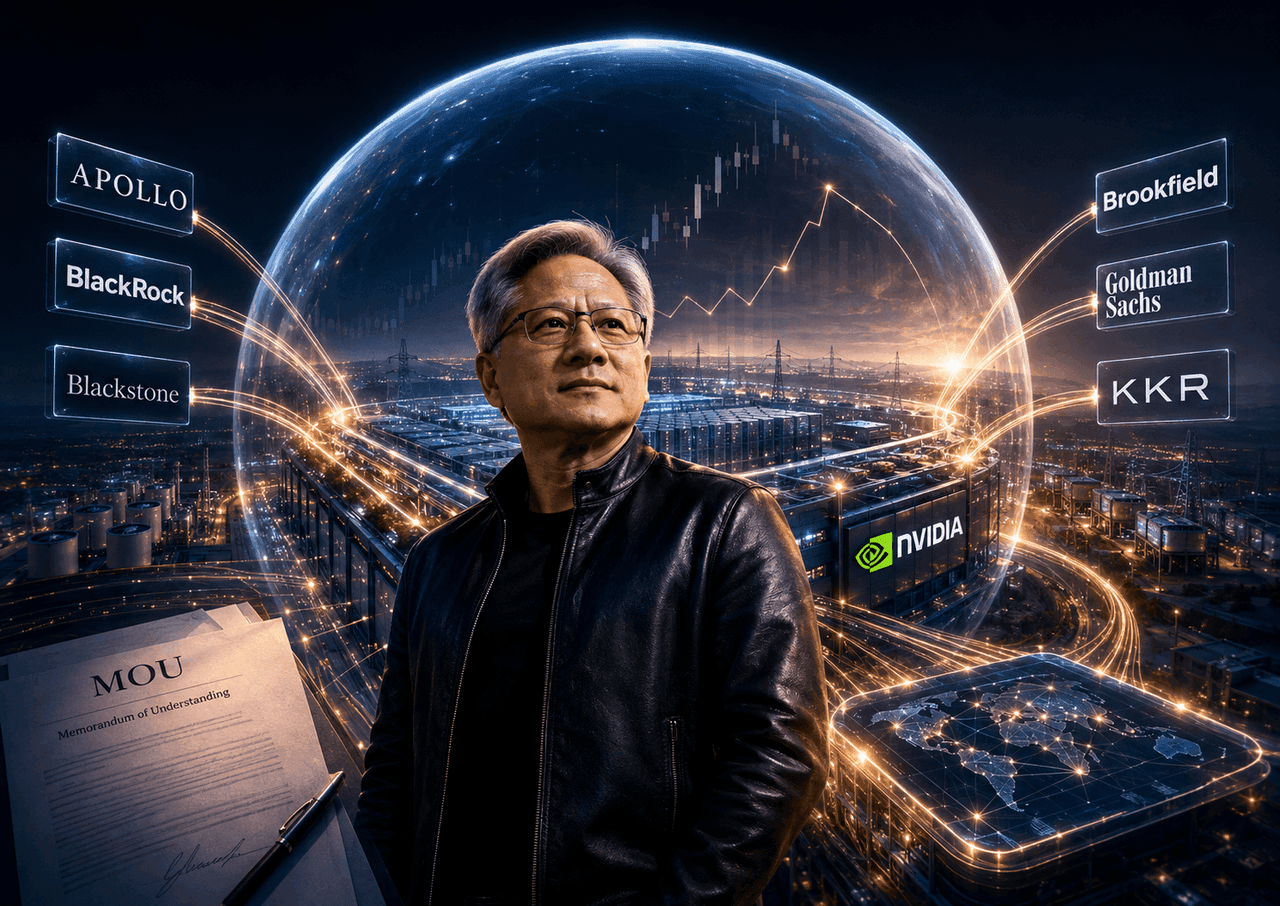
Nvidia has signed memorandums of understanding with Apollo, BlackRock, Blackstone, Brookfield, Goldman Sachs, and KKR to establish independent financing platforms that could mobilize more than $500 billion in third-party capital for AI infrastructure buildouts
1
2
. The proposed funds are intended to provide dedicated pools of capital for customers such as AI labs, cloud service providers, and enterprises deploying Nvidia-based AI data centers2
. Rather than financing projects itself, Nvidia intends to work with these six investment firms to enable access to long-term funding at attractive rates2
.
Source: SiliconANGLE
Creating a Secondary Market for Aging GPUs Through Collateral Guarantees
The most significant aspect of Nvidia's plan involves guaranteeing GPU value to protect lenders. Nvidia is promising that if GPUs used as collateral don't retain their value as expected, the company will cover up to 25% of the difference
1
. Jensen Huang stated on X that the company has the option to backstop up to $125 billion, or 25% of the potential deals3
. This creates something financiers call "wrong way" risk, where Nvidia's obligations will grow as demand weakens1
. The scheme deliberately aims to establish aging GPUs as tradable assets with residual value, helping sustain demand for Nvidia hardware as AI accelerators age1
.AI Infrastructure as Investable Assets Rather Than Depreciating Equipment
Jensen Huang is positioning Nvidia's chips as "revenue-generating assets" that are broadly adopted, flexible, and transferable
3
. The financial companies believe that AI data centers can be treated as long-duration infrastructure assets rather than conventional IT equipment, in part because Nvidia compute can generate revenue over an extended period and retain value across different workloads and operators2
. Huang stated that Nvidia has reached an important milestone, moving from building chips to helping create "a new class of productive, investable infrastructure: AI factories"2
. BlackRock boss Larry Fink thinks Nvidia's $500 billion plan heralds the "future for financial engineering"4
.
Source: Wccftech
Addressing Circular Financing Concerns in the AI Hardware Market
The arrangement has drawn comparisons to Lucent Technologies, the telecommunications equipment provider that crashed with the dotcom bubble after lending customers money to buy its products
1
. Huang acknowledged these concerns on X, writing: "Is this circular financing? This initiative is designed to address that concern. We are bringing independent, long-term institutional capital into the AI infrastructure market"1
. Unlike Lucent, Nvidia is getting others to shoulder the bulk of the capital and risk, merely by agreeing to protect a portion of its chips' value in the future1
. The arrangement increases the risk of an AI infrastructure boom bubble as it potentially weakens one of the natural brakes on overbuilding: the availability and price of capital2
.Related Stories

Growing Financial Leverage Across the AI Investment Cycle
Hyperscalers and their financial backers are turning to bond markets, joint ventures, leases, and other structures to fund an unprecedented AI infrastructure buildout
5
. Goldman Sachs analysts estimated that hyperscalers have combined lease commitments for data centers, R&D facilities, offices, and equipment of $1.5 trillion, up from about $200 billion five years ago5
. This includes about $1 trillion of "uncommenced" lease commitments, which are not yet shown in financial statements but will result in future payments5
. Lotfi Karoui, multi-asset credit strategist at PIMCO, said the AI capex cycle is, adjusted for inflation, on track to be the largest investment cycle since 19th-century railway construction5
. Big Tech companies have signaled spending on AI will not slow down, with combined outlays set to surpass $730 billion this year3
.Private Credit Industry Expands Into Third-Party Capital for AI Infrastructure
The Bank for International Settlements estimated that $200 billion of loans had been made by the private credit industry to AI-related borrowers at the end of 2025, a number that could triple by 2030
4
. Tech and hardware companies have issued $350 billion of U.S. dollar bonds this year so far, twice what they had issued by this time last year4
. BofA analyst Tom Curcuruto estimates Broadcom's chip-financing vehicle could grow to $370 billion of senior debt by mid-2029 to fund 20 GW of compute, implying around $150 billion of net new supply in 2027 alone3
. David Solomon, Chairman and CEO of Goldman Sachs, stated: "We are in a pivotal moment of a historic AI investment cycle. Nvidia's full-stack platform is in high demand and uniquely positioned at the center of that global buildout"2
.
Source: PYMNTS
References
Summarized by

Navi
Related Stories
AI Industry's $10 Trillion Financing Spree Raises Systemic Risks as Borrowing Costs Surge
21 Sept 2026•Business and Economy

Wall Street banks ride AI super cycle to record quarters as financing demands reshape markets
15 Jul 2026•Business and Economy
Big Tech Debt Hits $1.65 Trillion as AI Infrastructure Spending Triggers Credit Concerns
27 Jul 2026•Business and Economy
Recent Highlights



Recent Highlights
Today's Top Stories




Don’t drown in AI news. We cut through the noise - filtering, ranking and summarizing the most important AI news, breakthroughs and research daily. Follow topics that matter to you and stay ahead.


