2 Sources
[1]
Tencent's Hy3 beats GLM-5.2 at half the size | VentureBeat
For the past year, the awkward secret of the open-weight model boom has been that many of the strongest Chinese releases were off-limits to a large slice of the enterprises most interested in them. License terms that excluded the European Union, the United Kingdom and South Korea meant legal teams killed deployments before engineering teams finished their evals -- not just for companies headquartered there, but for any enterprise serving traffic into those regions. For IT teams weighing open models, the trade-offs are unusually explicit. Tencent just removed that obstacle. The company's Hunyuan team released the full version of Hy3, a 295-billion-parameter Mixture-of-Experts (MoE) model with 21 billion active parameters, and -- in a reversal from April's preview release -- shipped it under the permissive Apache 2.0 license. The reaction from the open-model community was immediate, with researchers on X singling out the license change as the real headline, and one widely shared post arguing that if the scores hold up, Tencent has just become one of the leaders of open source. Tencent says it will be free on OpenRouter for two weeks. The scores are worth scrutinizing -- and they don't all point the same direction. But the more interesting story is what Tencent chose to lead with: reliability metrics and deployment economics aimed squarely at production use. From preview to product in ten weeks, shaped by 50 internal teams Hy3's April preview was the first model of Tencent's rebuilt pre-training and reinforcement learning infrastructure, shipped less than three months after the February rebuild. Chief AI Scientist Shunyu Yao framed the early open release as a deliberate move to gather feedback from developers and users before the official version -- and Tencent says that's exactly what happened. According to the model card, the team collected feedback from more than 50 product teams after the late-April preview, fixed issues in task execution and interaction, and scaled up its post-training pipeline. The architecture is unchanged: 295B total parameters, 21B active per forward pass via top-8 routing across 192 experts, a 3.8B-parameter multi-token prediction (MTP) layer for speculative decoding, and a 256K context window. What changed is behavior. Tencent's positioning is that the full release significantly outperforms similar-size models and rivals flagship open-source models with two to five times the parameters. That "two to five times" framing makes sense for where this model is aimed -- and it invites a direct comparison with the current open-weight coding leader, GLM-5.2. Tencent's blind test favors Hy3 over GLM-5.1, but GLM-5.2 still owns coding Tencent's headline evaluation is a blind human study rather than a leaderboard. Arguing that public benchmarks don't tell the full story, the company ran a blind test with 270 experts across disciplines working on real-world workflows, collecting 312 valid comparisons, in which Tencent reports that Hy3 scored 2.67 out of 4 against GLM-5.1's 2.51 -- with the clearest advantages in frontend development, CI/CD, and data and storage work. The choice of opponent matters. Zhipu AI released GLM-5.2 in mid-June, and Tencent's own benchmark appendix shows GLM-5.2 ahead of Hy3 across essentially the entire agentic coding suite: SWE-bench Verified (84.2 vs. 78.0), SWE-bench Multilingual (83.0 vs. 75.8), Terminal-Bench 2.1 (81 vs. 71.7) and DeepSWE by a wide margin (46.2 vs. 28.0). The blind test targeted the older model; the newer one keeps the coding crown. GLM-5.2's coding lead is less surprising once you consider the sizes are side by side: GLM-5.2 is roughly a 744-billion-parameter MoE with around 40 billion active parameters per token, against Hy3's 295 billion total and 21 billion active. Tencent is fielding a model with less than half the parameters -- and nearly half the per-token compute -- of the one it trails. Hy3's genuine wins sit elsewhere. On agentic search, it posts 84.2 on BrowseComp and 91.0 on DeepSearchQA -- ahead of every open model in Tencent's table and competitive with Claude Opus 4.8 and GPT-5.5. It leads the open field on tool orchestration (79.1 on the public MCP-Atlas set), on agent-harness evaluations like ClawEval, and on long-context retrieval (73.4 on AA-LCR). Read together, the appendix suggests a model that is arguably the best open-weight choice for search-and-tool-heavy agent workloads, while conceding repository-scale coding to GLM-5.2. One caveat applies to both the wins and the losses: nearly all competitor numbers in Tencent's appendix are marked as coming from Tencent's own test runs. Independent verification, from indices like Artificial Analysis, is still pending as of publication. The reliability pitch: hallucination rates cut in half Where the release gets most interesting for enterprise buyers is the set of numbers Tencent chose to emphasize instead of benchmarks. The model card reads less like a leaderboard announcement and more like a production reliability report. In internal evaluations on real-world scenarios, Tencent says Hy3's hallucination rate dropped compared to the preview version from 12.5% to 5.4%, and commonsense error rates fell from 25.4% to 12.7% -- improvements it attributes to fine-grained data cleaning and training constraints built around an explicit behavior pattern: answer when grounded, state when evidence is missing, don't conflate sources, don't fabricate data. Multi-turn behavior gets the same treatment: the issue rate on internal multi-turn tests fell from 17.4% to 7.9%, and Tencent reported that the model's score on the open MRCR long-dialogue benchmark jumped from 42.9% to 75.1%. Tencent also emphasizes consistency across agent scaffolds -- reporting SWE-bench variance within a few points whether the model runs inside Claude Code-style harnesses, Cline or KiloCode. That's an underrated property: enterprises rarely control which agent framework their teams standardize on, and a model that only performs in one harness is a hidden integration cost. These are self-reported internal measurements, and they deserve the same skepticism as any vendor benchmark. But the choice to foreground them at all signals who Tencent believes its customer is: teams that have been burned by models that demo well and fabricate confidently in production. The deployment math: a 295B model in a 744B world -- on export-compliant silicon The reliability story connects directly to the economics, and this is where Hy3's coding gap against GLM-5.2 starts to look like a deliberate trade rather than a loss. GLM-5.2 is a roughly 744-billion-parameter MoE with about 40 billion active parameters per token; in FP8, its weights alone consume roughly 744GB, making an 8x H200 node the practical minimum for production serving. Hy3, at 295B total parameters, carries an FP8 footprint of under 300GB -- less than half the memory, with roughly half the active parameters per token driving lower per-request compute. For an organization deciding what to self-host, that's the difference between one heavily-specced node and something far more attainable, with room left over for KV cache and batching. There's a geopolitical wrinkle in the deployment guide worth noticing too: Tencent's recommended serving configuration targets Nvidia's H20-3e -- the memory-boosted variant of the H20, the GPU Nvidia designed specifically to comply with U.S. export restrictions on China. Unlike GLM-5.2, there is no mention of Huawei or Ascend chips here. In other words, the model is sized so that eight of the chips Chinese companies can legally buy comfortably serve it at full precision. That constraint-driven design has a convenient side effect for everyone else: a model that runs well on deliberately capped silicon runs even more comfortably on the H100s, H200s and B200s available in Western data centers, through standard vLLM and SGLang deployments with MTP speculative decoding. Add the Apache 2.0 license -- no regional exclusions, no field-of-use restrictions -- and the enterprise equation becomes clear. GLM-5.2 remains the open-weight choice when coding performance is the only criterion and an 8x H200 budget is available. Hy3 makes its case everywhere else: search and tool-heavy agent workloads, reliability-sensitive applications and organizations that want frontier-adjacent capability without frontier-scale infrastructure. The open question is whether Western enterprises, now that the license barrier is gone, will treat a Tencent model as a serious candidate at all -- or whether the next Artificial Analysis update settles the benchmark debate before procurement gets the chance.
[2]
Tencent Hy3 is now available: a 295B open MoE model
Tencent released Hy3 on July 6, 2026. It's a new open Mixture-of-Experts model with 295B total parameters, 21B active on any given task, a 256K context window, and an Apache 2.0 license. The MoE design is the point here: each prompt only passes through part of the Hy3 network, which Tencent says cuts inference and serving costs. Hy3 is also meant to stay useful on long documents, large codebases, and multi-step work. And because it's under Apache 2.0, you've got wide commercial freedom to self-host it, fine-tune it, and build global products with it, without the geographic restrictions that showed up in some earlier China-based open models. Tencent says the July 6, 2026 release is better than the April preview after feedback from 50 internal product teams. By Tencent's numbers, hallucinations dropped from 12.5% to 5.4%, and commonsense errors fell from 25.4% to 12.7%. Hy3 is already being used in WorkBuddy, Yuanbao, WeChat assistants, and Path of Exile: Advent, which makes it feel more substantial than a research demo built mainly to post benchmark scores. If you want an open model for search, tool use, or agentic tasks, Hy3 looks like one to download. Coding may still be a weaker spot, since Zhipu AI's GLM-5.2 could still have the edge there, and Tencent's claims need independent testing either way. Still, Hy3 now joins Zhipu AI, DeepSeek, Alibaba's Qwen, and Mistral AI in putting more pressure on closed models from OpenAI and Anthropic. You can get Hy3 from Tencent as an open release under the Apache 2.0 license.
Share
Copy Link
Tencent released Hy3, a 295-billion-parameter Mixture-of-Experts AI model under Apache 2.0 license, removing geographic restrictions that plagued earlier Chinese models. With hallucinations cut from 12.5% to 5.4%, the model leads in agentic search and tool orchestration while trailing GLM-5.2 in coding. The license shift signals a new era for enterprise AI deployments.
Tencent Hy3 arrived on July 6, 2026, marking a turning point for enterprises that had been locked out of China's strongest open models
1
. The Hunyuan team released the full version of this 295-billion-parameter model under the permissive Apache 2.0 license, reversing the restrictive terms from April's preview that excluded the European Union, United Kingdom, and South Korea1
. Legal teams that previously killed deployments before engineering teams finished evaluations can now move forward. The open-source MoE model gives companies wide commercial freedom to self-host, fine-tune, and build global products without geographic restrictions2
. Researchers on X singled out the license change as the real headline, with one widely shared post arguing that Tencent has become one of the leaders of open source1
.
Source: Softonic
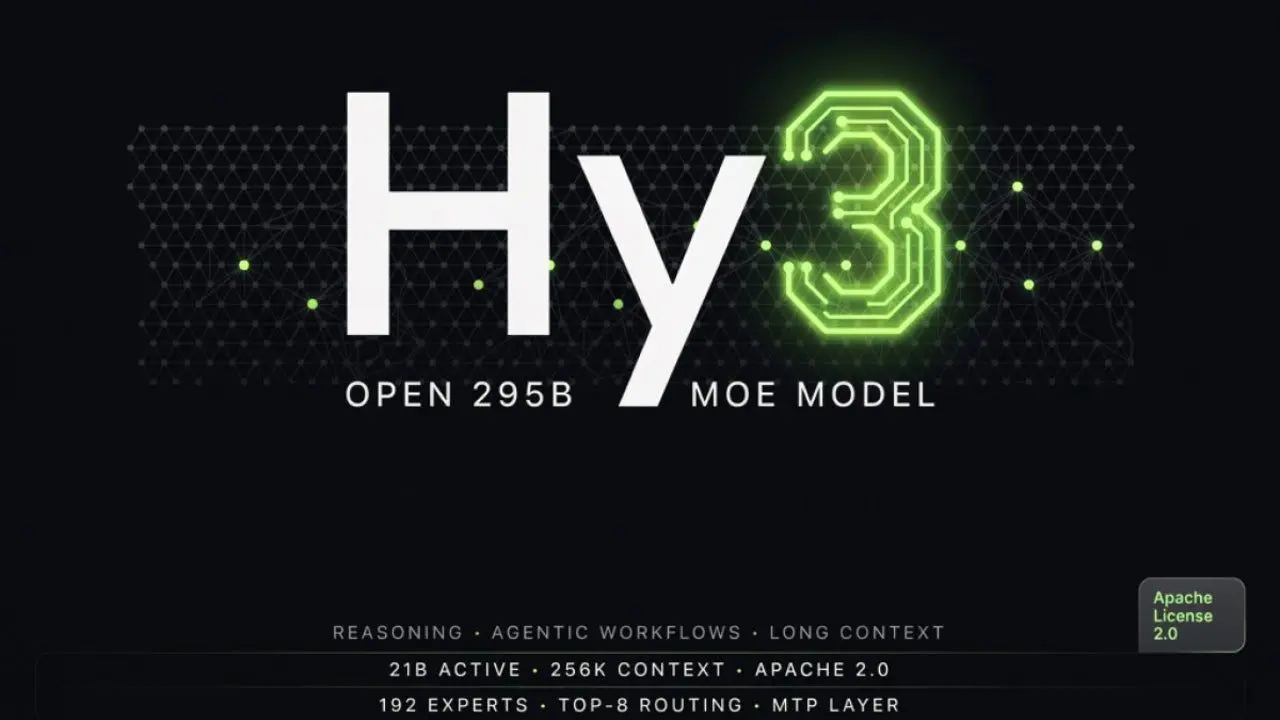
The AI model operates as a Mixture-of-Experts system with 21 billion active parameters per forward pass via top-8 routing across 192 experts, despite its 295 billion total parameters
1
. Each prompt only passes through part of the network, which cuts inference costs and serving expenses2
. The architecture includes a 3.8-billion-parameter multi-token prediction layer for speculative decoding and a 256K context window designed to handle long documents, large codebases, and multi-step work1
2
. Tencent will offer the model free on OpenRouter for two weeks1
.

Source: VentureBeat
Tencent Hy3 evolved from preview to product in ten weeks, shaped by feedback from more than 50 product teams after the late-April preview
1
. Chief AI Scientist Shunyu Yao framed the early open release as a deliberate move to gather feedback before the official version1
. The team fixed issues in task execution and interaction, then scaled up its post-training pipeline1
. By Tencent's numbers, hallucinations dropped from 12.5% to 5.4%, and commonsense errors fell from 25.4% to 12.7%2
. These reliability metrics aim squarely at production use rather than benchmark chasing1
.Related Stories

Tencent Hy3 excels in agentic search, posting 84.2 on BrowseComp and 91.0 on DeepSearchQA, ahead of every open model in Tencent's table and competitive with Claude Opus 4.8 and GPT-5.5
1
. It leads the open field on tool orchestration with 79.1 on the public MCP-Atlas set, on agent-harness evaluations like ClawEval, and on long-context retrieval with 73.4 on AA-LCR1
. Tencent ran a blind test with 270 experts across disciplines working on real-world workflows, collecting 312 valid comparisons, in which Hy3 scored 2.67 out of 4 against GLM-5.1's 2.51, with advantages in frontend development, CI/CD, and data and storage work1
.However, Zhipu AI's GLM-5.2 keeps the coding crown. Tencent's own benchmark appendix shows GLM-5.2 ahead across the entire agentic coding suite: SWE-bench Verified at 84.2 versus 78.0, SWE-bench Multilingual at 83.0 versus 75.8, Terminal-Bench 2.1 at 81 versus 71.7, and DeepSWE by a wide margin at 46.2 versus 28.0
1
. GLM-5.2 is roughly a 744-billion-parameter MoE with around 40 billion active parameters per token, nearly double Hy3's active compute1
. Nearly all competitor numbers in Tencent's appendix come from Tencent's own test runs, and independent verification from indices like Artificial Analysis is still pending1
.Tencent Hy3 is already deployed in Tencent WorkBuddy, Yuanbao, WeChat assistants, and Path of Exile: Advent, making it more substantial than a research demo built mainly to post benchmark scores
2
. The model joins Zhipu AI, DeepSeek, Alibaba's Qwen, and Mistral AI in putting pressure on closed models from OpenAI and Anthropic2
. For enterprises weighing an open-weight choice for search-and-tool-heavy agent workloads, Hy3 presents a compelling option with deployment economics that favor efficiency over raw parameter count1
.Summarized by
Navi
[1]
24 Apr 2026•Technology

17 Jun 2026•Technology

29 Jul 2025•Technology

1
Policy and Regulation

2
Policy and Regulation

3
Policy and Regulation