Mira Murati's lab built an AI model that runs on a laptop and still beats bigger rivals


2 Sources
[1]
Inkling 2 Mini runs on a laptop and built a flight sim in mid-air
Inkling 2 Mini loops its middle layers three times per token and built a flight simulator offline in mid-air. Artificial Analysis found it six times cheaper per task than Qwen. Thinking Machines Lab has released Inkling 2 Mini, an open-weights model small enough to run on a laptop. The lab says it
[2]
Thinking Machines wows with Inkling 2 Mini looped transformer model that runs locally on laptops
Thinking Machines Lab, the San Francisco-based AI startup started and led by former OpenAI chief technology officer Mira Murati, is challenging the dominant paradigm of cloud-based AI frontier models with the release yesterday of Inkling 2 Mini, an open-weights multimodal model engineered to run
Share
Copy Link
Thinking Machines Lab, the startup led by former OpenAI CTO Mira Murati, released an open-weights AI model on Friday that runs offline on a MacBook Pro with 32GB of memory or on a single desktop GPU and, per the lab's own tests, out-codes every other open-weights model under 100bn parameters
1
2
. For developers and companies that want agentic coding work without sending code to a cloud, it offers a local option.The lab's launch post said users found Inkling 2 Small, released two weeks earlier at 594bn parameters, too big. Mini was built small enough for a laptop while keeping the agentic capability
2
. It is the latest step in a fast cadence. The lab has shipped a fine-tuning API (October 2025), a multimodal preview (May 2026), two giant open models (July 2026) and Inkling 2 Small itself on November 52
.A transformer that runs its middle layers three times
Inkling 2 Mini is a 24-layer sparse mixture-of-experts, meaning it holds 26.4bn parameters but switches on 3.4bn of them per token. The twist is looping. The first and last six layers each run once; the middle dozen run three times. That lets the model work over the same layers repeatedly, spending an effective 5.4bn parameters per token
1
2
. The trick buys reasoning depth without buying weights. Per the lab's own scaling tests, a version without looping needed 140% more inference compute to keep pace with the looped model1
2
.The model takes about 20GB of memory, and Ollama runs it on Macs with 32GB or more
1
2
. The weights are on Hugging Face under Apache 2.0, which permits royalty-free commercial use, with a 1m-token context window1
2
.The receipts, and where they stop
On the lab's own coding benchmarks, Inkling 2 Mini scores 48.2% on DeepSWE v1.1 against Alibaba's Qwen3.8-27B at 42.2%
1
2
. Artificial Analysis, an independent benchmarking firm, gives partial corroboration. On its Intelligence Index the model ties Qwen3.8-27B at 20 while costing about six times less per task, $0.59 against $3.53, and running about four times faster1
2
.It still trails the frontier. OpenAI's GPT-6 Luna scored 28 on the same index, at a cost of $0.15 per task
1
. The lab lists its own weaknesses too. Qwen3.8-27B beats Mini on multi-turn chat and multi-constraint instructions, and looping does nothing for factual recall1
2
.The lab's headline demo ran the model offline in airplane mode on a MacBook Pro, where it built a playable flight simulator in minutes. In another lab demo, a pixel town with 20 persistent autonomous villagers ran on a single offline MacBook
1
2
.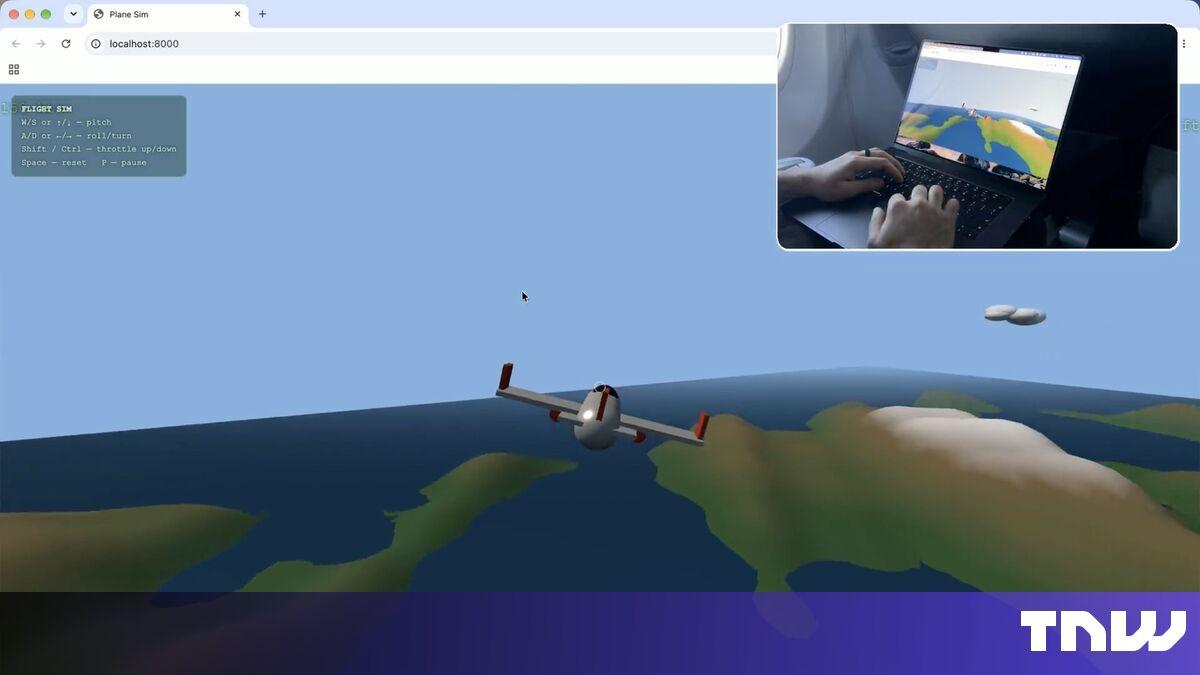
Source: The Next Web
Local-AI tooling picked it up within a day. UnslothAI published quantized builds and called it the strongest 26.4B model that fits in 16GB of memory. Exolabs' X post measured 210 tokens per second on a Mac Studio, where the model built a native weather app 1.8 times faster and 11 times cheaper than Claude Sonnet 5.5
2
. Developer Kyle Hessling called it the most impressive small model he had tested from anyone outside Qwen, per VentureBeat's report of his X post2
. A minority of early testers noted task failures in game-mechanics generation and quirks in the still-new runtimes for looped models. Cloud models still clearly win demanding knowledge work2
.Related Stories

The catch the lab built a research model for
Looping has a cost the benchmarks do not show. Because the model reasons longer without writing its reasoning down, it is harder for overseers to read. So alongside the release it shipped a companion research model, built with the research group Goodfire, that loops between one and five times, published so outside researchers can study the effect
1
. The first results had reasoning at five loops running 1,661 tokens against 3,703 at one, and it stayed readable1
2
. The lab flags its own limits all the same. The research model was trained with reinforcement learning at three loops alone, and a monitor that saw just tool calls missed a significant number of attacks1
2
. At the loop counts it tested, the lab's preliminary finding was no meaningful reduction in monitorability1
.References
Summarized by

Navi
Related Stories
Thinking Machines Unveils Inkling Small: Compact AI Model Delivers Near-Identical Performance at Quarter Size
31 Jul 2026•Technology

Thinking Machines Unveils Inkling 2 Small: 594 Billion Parameters AI Model Challenges China's Lead
06 Nov 2026•Technology
Thinking Machines Lab releases Inkling, a massive open-weight AI model to challenge closed systems
16 Jul 2026•Technology
Recent Highlights


Recent Highlights
Today's Top Stories








Don’t drown in AI news. We cut through the noise - filtering, ranking and summarizing the most important AI news, breakthroughs and research daily. Follow topics that matter to you and stay ahead.


