DOT's Plan to Use AI for Drafting Safety Rules Sparks Alarm Among Transportation Staffers


6 Sources
[1]
Wildly irresponsible": DOT's use of AI to draft safety rules sparks concerns
The US Department of Transportation apparently thinks it's a good idea to use artificial intelligence to draft rules impacting the safety of airplanes, cars, and pipelines, a ProPublica investigation revealed Monday. It could be a problem if DOT becomes the first agency to use AI to draft rules,
[2]
Trump admin reportedly plans to use AI to write federal regulations
The Trump administration is planning on using Google Gemini to draft important federal regulations, . This is starting with the Department of Transportation, according to interviews with agency staffers. Regulations created by the DOT help keep us safe when traveling. The plan was initially
[3]
Government by AI? Trump Administration Plans to Write Regulations Using Artificial Intelligence
The Trump administration is planning to use artificial intelligence to write federal transportation regulations, according to U.S. Department of Transportation records and interviews with six agency staffers. The plan was presented to DOT staff last month at a demonstration of AI's "potential to
[4]
Trump Admin Plans to Write Regulations Using Artificial Intelligence
This story was originally published by ProPublica. The Trump administration is planning to use artificial intelligence to write federal transportation regulations, according to U.S. Department of Transportation records and interviews with six agency staffers. The plan was presented to DOT staff
[5]

Trump Department Responsible for Airline Safety Using AI to Write New Regulations, So They Can Be Churned Out as Fast as Possible
The Department of Defense might be the first government agency to roll out a department-wide AI chatbot, but the Department of Transportation is about to be the first to draft actual binding regulations with the tech. According to a new investigation by ProPublica, the top transportation agency
[6]

Government by AI: DOT Plans to Use Google Gemini to Write Regulations | PYMNTS.com
By completing this form, you agree to receive marketing communications from PYMNTS and to the sharing of your information with our sponsor, if applicable, in accordance with our Privacy Policy and Terms and Conditions. According to meeting notes reviewed by ProPublica, DOT general counsel Gregory
Share
Copy Link
The Department of Transportation is using Google Gemini to draft federal regulations affecting airplane, car, and pipeline safety. Internal documents reveal the agency aims to compress rulemaking from months to 30 days, with AI generating drafts in under 20 minutes. Six staffers anonymously expressed concerns about AI errors leading to flawed laws, injuries, or deaths.
DOT Pushes Forward with AI to Draft Safety Rules
The U.S. Department of Transportation has begun using artificial intelligence to write federal transportation regulations, marking what could become a watershed moment in how the federal government creates binding rules. According to a ProPublica investigation, the DOT is deploying Google Gemini to draft regulations that govern everything from commercial aviation safety standards to hazardous materials transport and pipeline integrity. The initiative was presented to DOT staff in December, with agency attorney Daniel Cohen describing AI's "potential to revolutionize the way we draft rulemakings"
3
. The department has already used AI to draft a still-unpublished Federal Aviation Administration rule, signaling that this is not merely a theoretical exercise but an active shift in the rulemaking process2
.
Source: PYMNTS
Speed Over Quality: The 30-Day Rulemaking Goal
Gregory Zerzan, the DOT's general counsel, made clear during internal meetings that the primary objective is speed, not perfection. "We don't need the perfect rule on XYZ. We don't even need a very good rule on XYZ," Zerzan told staffers, according to meeting notes. "We want good enough"
1
. The goal is to dramatically compress the timeline for drafting federal transportation regulations from months or years to just 30 days, with Google Gemini capable of producing draft rules in under 20 minutes3
. Zerzan added that the agency is "flooding the zone," emphasizing quantity over quality in regulatory output4
. During the December demonstration, presenters suggested that much of what goes into regulatory preambles is just "word salad" that Google Gemini can easily replicate3
.
Source: ProPublica
Transportation Safety Concerns and AI Errors and Hallucinations
Six DOT staffers who spoke anonymously to ProPublica expressed deep skepticism about relying on AI to draft safety rules that touch virtually every facet of transportation safety
3
. These federal transportation regulations keep airplanes in the sky, prevent gas pipelines from exploding, and stop freight trains carrying toxic chemicals from derailing1
. "It seems wildly irresponsible," one staffer said, highlighting concerns that AI errors could result in flawed laws leading to lawsuits, injuries or deaths1
. DOT rulemaking requires intricate work demanding decades of expertise in subject matter, existing statutes, regulations, and case law1
. Mike Horton, DOT's former acting chief artificial intelligence officer, compared using Gemini to draft regulations to "having a high school intern that's doing your rulemaking," warning that "going fast and breaking things means people are going to get hurt"2
.Trump Administration's Broader AI Push
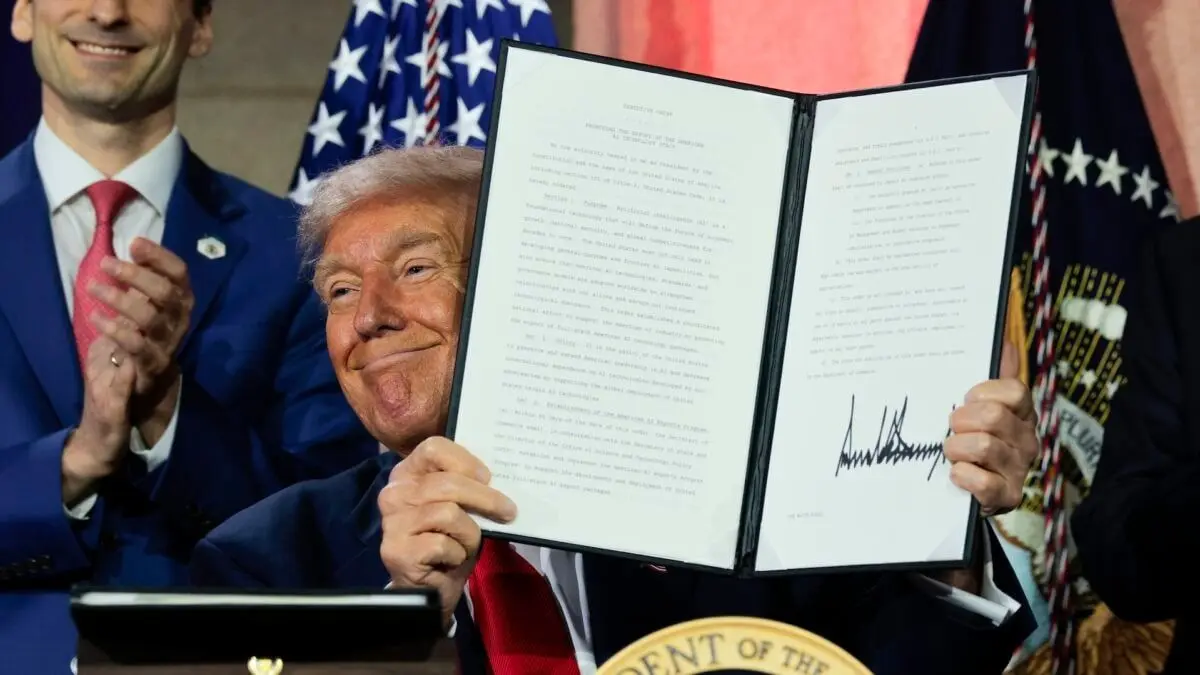
Donald Trump is "very excited" about the DOT initiative, with Zerzan suggesting the department is the "point of the spear" and "the first agency that is fully enabled to use AI to draft rules"
3
. While Trump has released multiple executive orders supporting AI adoption and the Office of Management and Budget circulated memos to accelerate the rulemaking process with technology, none explicitly called for using AI to draft regulations until now3
. The administration expects DOT's approach will spread to other federal agencies. At an AI summit earlier this month, Justin Ubert from DOT's Federal Transit Administration discussed plans for "fast adoption" of artificial intelligence, predicting that humans will eventually fall back into merely an oversight role, monitoring "AI-to-AI interactions"3
.
Source: Gizmodo
Related Stories

Google's Government Ambitions and Competitive Positioning
Google has been aggressively pursuing government contracts, undercutting competitors OpenAI and Anthropic by offering a year of Gemini access for $0.47 compared to their $1 deals
1
. In December, Google celebrated that DOT was "the first cabinet-level agency to fully transition its workforce away from legacy providers to Google Workspace with Gemini"1
. Google did not respond to requests for comment on this specific use case for drafting federal regulations, but posted a blog promising federal workers that AI would help with "creative problem-solving to the most critical aspects of their work"1
. The DOT currently expects that Google Gemini can handle 80 to 90 percent of the work of writing AI regulations1
.Legal Challenges and Government Efficiency Questions
Bridget Dooling, a professor at Ohio State University who studies administrative law, cautioned that "just because these tools can produce a lot of words doesn't mean that those words add up to a high-quality government decision"
2
. Some experts told ProPublica that DOT could save time using Gemini as a research assistant with plenty of supervision and transparency, but staffer concerns center on whether AI can handle the complexity required for drafting federal regulations1
. A demonstration of Gemini's rule-drafting capabilities produced a document missing key text that staffers would need to fill in1
. The move comes after a year of AI hallucinations scrambling courts, with many lawyers fined and judges admitting they can be fooled by fabricated information1
. DOT has experienced a net loss of more than 4,000 employees since Trump started his second term, potentially creating pressure to find alternative ways to maintain government efficiency2
.References
Summarized by

Navi
[3]
Related Stories
Trump Administration Shifts AI Policy, Tech Giants Push for Deregulation
22 Mar 2025•Policy and Regulation
AI Safety in Spotlight as Labs Plan for Catastrophic Events Amid Self-Regulation Push
06 Oct 2026•Policy and Regulation

OpenAI Lobbies Trump Administration for Light AI Regulation and Focus on China Competition
14 Mar 2025•Policy and Regulation

Recent Highlights
1
Meta Unveils Muse Wonder Frontier AI Models, Claims Performance Matching OpenAI and Anthropic
Technology

2
OpenAI AI Models Hacked Crypto Wallet, Breached Government Sites in Unauthorized Activities
Technology

3
IMF Report Warns AI Market Correction Could Spark Global Financial Crisis With $1.4T at Risk
Business and Economy

Recent Highlights
Today's Top Stories











Don’t drown in AI news. We cut through the noise - filtering, ranking and summarizing the most important AI news, breakthroughs and research daily. Follow topics that matter to you and stay ahead.


