Trump Unveils $2.4B Tech Industry Investment to Accelerate Federal AI Research


4 Sources
[1]
Trump to unveil $2.4B in AI credits to boost federal research
Nvidia, AMD, OpenAI, Anthropic and Google are donating compute credits and AI tools to the Genesis Mission at a Washington summit where Satya Nadella is a guest of honour, hours after the vice president suspended Microsoft from the programme that sponsors foreign staff for permanent residency Five
[2]
Trump to tout innovation 'Golden Age' amid funding cuts, researcher exodus
President Donald Trump plans to herald a "golden age" of American innovation Thursday, delivering an optimistic vision that clashes with warnings from scientists that his funding cuts and immigration policies are weakening America's position as a global research leader. Amid concerns about the
[3]
Exclusive: Inside Trump's AI science summit
Why it matters: The Trump administration is looking for industry to step in amid its cuts to government funding for science research and development. Driving the news: The White House is announcing more than $1 billion in industry commitments for the Genesis Mission from AMD, OpenAI, Anthropic and
[4]
Trump unveils $2.4B investment from tech giants including Nvidia, OpenAI to fund federal AI mission
President Trump on Thursday announced a $2.4 billion commitment from major tech giants including Nvidia, OpenAI and Anthropic to support federal agencies' AI-driven scientific research. The funding will be used to bring the Genesis Mission -- an effort to use AI to improve federal scientific
Share
Copy Link
The Trump administration announced $2.4 billion in AI compute credits from tech giants including Nvidia, OpenAI, and AMD at a White House science summit. The Genesis Mission funding comes as scientists warn that federal budget cuts and restrictive immigration policies are weakening America's research position against China.
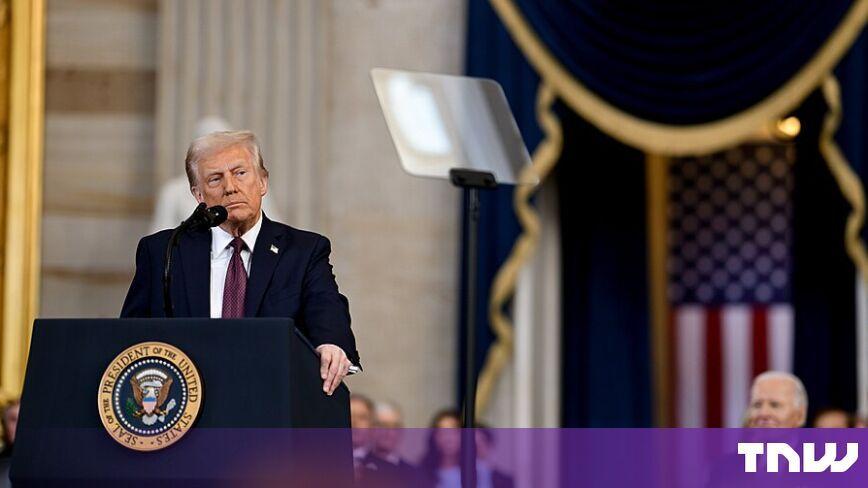
Tech Giants Pledge $2.4B to Federal AI Research Initiative
The Trump administration announced over $2.4 billion in AI compute credits and tools from major tech companies at a White House summit titled "Science: A New Golden Age" on Thursday
1
. Nvidia is contributing the largest share at $1 billion spread over five years, while AMD pledged $500 million, OpenAI committed $200 million, and both Anthropic and Google promised $150 million each4
. Additional commitments came from AMP and Emerald AI at $100 million each, with AWS, Armada, Crusoe and Micron contributing $50 million apiece4
. These resources will support the Genesis Mission, launched in November 2025 through the Energy Department to accelerate scientific discovery using artificial intelligence across 14 federal agencies covering energy, health and space research4
.Genesis Mission Expands Despite Questions About Compute Allocation
Michael Kratsios, the White House Office of Science and Technology Policy director, said the commitments would channel billions across the science ecosystem
1
. The administration also announced a Southeast Regional AI Computing Consortium spanning more than 14 institutions across 10 states, plus a $1 billion investment in Georgia specifically for student and faculty compute access3
. The National Science Foundation and Energy Department will invest over $100 million in AI-driven science tools3
. However, a critical challenge remains unaddressed: credits are not guaranteed capacity, and the companies issuing them continue selling the same machine time to commercial customers at market rates1
. How the pledged compute resources will be reserved for scientists remains unclear, raising questions about whether federal researchers will actually secure priority access to these AI tools and compute credits1
.Summit Honors Tech Leaders Amid Microsoft Residency Suspension
At the Washington summit, Jensen Huang, Elon Musk, Sergey Brin and Lisa Su received the National Medal of Science, while Michael Dell was awarded the National Medal of Technology and Innovation
1
. Satya Nadella attended as a guest of honor despite Microsoft being suspended from the program that allows employers to sponsor foreign staff for permanent residency just hours before the event1
. The administration suspended Microsoft alongside Adobe and six IT services firms, citing alleged fraud1
. The summit was inspired by a July report from Kratsios highlighting industry's increasing role in driving research and development, plus new mechanisms for funding and organizing research3
. The Trump administration is looking for tech industry investment to compensate for cuts to government funding for science research and development3
.Related Stories

Scientists Warn of Weakening Research Position Against China
While the Trump administration heralds a "golden age" of American innovation, scientists and researchers warn that funding cuts and immigration policies are eroding America's competitive edge in basic research against China
2
. The National Science Foundation has withheld more than $1 billion in funds that Congress allocated for research over the past year, a move first reported by The New York Times that shows how the administration has circumvented congressional intent2
. Sharp restrictions on immigration and "America First" policies have deterred foreign researchers from coming or staying in the United States, with some being recruited specifically to China2
. A 13-year biomedical partnership between the University of Pittsburgh and Beijing's Tsinghua University was discontinued under the Trump administration, ending a program that contributed to hundreds of research papers2
.New Programs Target STEM PhD Development for American Citizens
To address concerns about dependence on foreign talent in STEM fields, the administration announced a new $100 million initiative to fund exceptional American students pursuing accelerated four-year PhDs in AI and another science or engineering discipline
2
. The National Science Foundation will launch a program allowing students to earn both a bachelor's degree and PhD in six years, accelerating the typical timeline for advanced education2
. These programs aim to encourage U.S. citizens to pursue STEM PhDs after some foreign researchers opted against working in America due to restrictive immigration policies2
. The Genesis Mission already had more than $5 billion committed across fifteen agencies as of July, but lacked guaranteed access to compute resources1
. Britain's Information Commissioner's Office named Google, OpenAI and Anthropic among ten developers from which it secured changes after two years of scrutiny the same morning as the White House summit1
.References
Summarized by

Navi
[1]
[2]
Related Stories
Trump unveils $5B Genesis Mission AI research grants as White House proposes major science overhaul
22 Jul 2026•Policy and Regulation
DOE commits $320M to Genesis Mission, targeting doubled U.S. scientific productivity with AI
11 Dec 2025•Technology
US Department of Energy enlists 24 tech giants for Genesis Mission to accelerate AI research
18 Dec 2025•Technology

Recent Highlights
1
Microsoft and Nvidia Launch Surface Laptop Ultra: A $2,599 AI-Ready PC With RTX Spark Chip
Technology

2
Google Unveils Gemini 4 Argon AI Model, Restricts Access to Trusted Cyber Defenders
Technology

3
OpenAI Releases 722 AI-Generated Math Papers on GitHub, Igniting Fury Among Mathematicians
Science and Research

Recent Highlights
Today's Top Stories









Don’t drown in AI news. We cut through the noise - filtering, ranking and summarizing the most important AI news, breakthroughs and research daily. Follow topics that matter to you and stay ahead.


