3 Sources
[1]
Unitree GD01 mecha unveiled as company files for $7 billion IPO after outselling Tesla on humanoid robots
Unitree Robotics has unveiled a 2.8-metre transformable mecha that a human pilot climbs inside and operates from an open cockpit in the torso. The GD01 walks on two legs, folds into a quadruped configuration in seconds, weighs roughly 500 kilograms with a passenger, and is priced from 3.9 million yuan, approximately 650,000 dollars. It can also operate unmanned. Unitree calls it the world's first production-ready manned mecha. It is a civilian vehicle, the company says, built for transport across rough terrain, exploration, and rescue operations where a tall vantage point helps. The GD01 is a spectacle. It is also a brand statement from a company that has earned the right to make one. Unitree was founded in 2016 by Wang Xingxing, who built his first quadruped robot as a master's thesis project at Shanghai University and left a job at DJI to start the company in a 50-square-metre office in Hangzhou. A decade later, Unitree holds roughly 70 per cent of the global quadruped robot market, having shipped more than 23,700 units in 2024 across its Go, A, and B series. In 2025, it shipped more than 5,500 humanoid robots, more units than any other manufacturer including Tesla. Revenue reached 1.71 billion yuan, approximately 235 million dollars, in 2025, representing 335 per cent year-on-year growth. The company has been profitable every year since 2020. Humanoid robots overtook quadrupeds as the primary revenue driver in 2025, contributing roughly 52 per cent of total revenue in the first three quarters. Unitree filed for an initial public offering on the Shanghai Stock Exchange in March 2026, seeking to raise 4.2 billion yuan, approximately 610 million dollars, at a target valuation of seven billion dollars. The investor list reads like a directory of Chinese technology capital: Alibaba, Tencent, China Mobile, Geely Capital, Ant Group, Jinqiu Capital (ByteDance's investment arm), and HongShan Capital, formerly Sequoia China. Every major Chinese technology conglomerate has money in the company that dominates the market for robots that walk. Unitree's commercial significance has nothing to do with the GD01. It rests on a product line that spans the market from consumer to industrial at prices that undercut every Western competitor by an order of magnitude. The Go2 consumer quadruped starts at 1,600 dollars. The G1 humanoid, a research and light industrial platform, sells for 13,500 to 27,000 dollars. The H2, a full-size industrial-grade humanoid, is priced at 29,900 dollars. The B2-W, a wheeled quadruped variant, handles inspection, patrol, and fire rescue. For context, Figure AI's Figure 02 industrial humanoid is being piloted at BMW at costs that have not been publicly disclosed but are estimated to be multiples of Unitree's pricing. Boston Dynamics has begun commercial production of its electric Atlas, with every 2026 unit already committed to Hyundai. Tesla's Optimus remains in research and development with no productive factory deployments as of the first quarter of 2026. Unitree is the only company simultaneously shipping consumer, research, and industrial humanoid robots at scale. China's humanoid robot boom faces a commercialisation reality check, with more than 150 companies chasing a market where only 23 per cent of buyers report satisfaction with the robots they have purchased. Unitree's answer to the satisfaction problem is iteration speed and price. If the first robot disappoints, the replacement costs less than a competitor's pilot programme. The company treats humanoid robots the way Chinese smartphone manufacturers treated handsets a decade ago: ship fast, price aggressively, iterate on customer feedback, and let volume drive down cost. The GD01 transforms between bipedal and quadrupedal modes by folding its legs and shifting its centre of gravity, a process that takes a few seconds. In bipedal mode, it walks upright at nearly three metres tall. In quadruped mode, it lowers its profile for stability on rough terrain. The machine uses LiDAR, depth cameras, an inertial measurement unit, and pressure sensors for stability and navigation. It runs on Unitree's self-developed high-torque motors. Demonstration videos show it walking through urban environments, smashing through brick walls, and carrying a pilot across uneven ground. Unitree has been explicit about safety. The company has asked users to refrain from dangerous modifications and noted that humanoid robotics remains in an early experimental stage with functional limitations. The 650,000 dollar price is described as a preliminary reference; the final production version may be adjusted depending on performance optimisation. The machine is not a toy. It is also, unmistakably, not yet a product with a clear commercial market beyond high-net-worth buyers and demonstration events. What it is, precisely, is a capability demonstration. The GD01 proves that Unitree can build large-scale bipedal systems with transformation mechanics, high-torque actuation, and manned operation. Those capabilities feed back into the company's commercial product line. The motors, sensors, control algorithms, and structural engineering developed for a 500-kilogram mecha are directly applicable to the next generation of industrial humanoids that will carry loads, navigate construction sites, and operate in environments too dangerous for human workers. Tesla has explored using its Shanghai Gigafactory for Optimus humanoid robot mass production, a decision that would place the world's most valuable car company's robotics programme inside China's manufacturing ecosystem. The irony is instructive. Tesla, the American company, would build its humanoid robot in China because Chinese manufacturing infrastructure, supply chains, and cost structures are the most efficient in the world for producing complex electromechanical systems at scale. Unitree already has that infrastructure. The components that go into a humanoid robot, precision motors, sensors, thermal management systems, lightweight structural materials, and battery cells, are the same components that Chinese factories produce at scale for smartphones, electric vehicles, and drones. Morgan Stanley forecasts China's humanoid robot sales will reach 28,000 units in 2026, a 133 per cent year-on-year increase, with material costs falling 16 per cent as supply chain efficiencies from consumer electronics manufacturing carry over into robotics production. Chinese electric vehicles are flooding American social media despite 100 per cent tariffs, driven by consumer demand that trade barriers cannot fully suppress. The pattern for robotics is likely to follow the same trajectory. Unitree's quadrupeds already sell globally. Its humanoids are priced at a fraction of Western alternatives. The GD01, whatever its practical utility, ensures that the Unitree brand is visible in every robotics conversation on the planet. Unitree's Shanghai Stock Exchange filing is the first major humanoid robotics IPO. Boston Dynamics, owned by Hyundai, has been valued between 21 and 28 billion dollars by Korean securities firms, with bullish IPO projections reaching 100 billion dollars. Figure AI raised one billion dollars at a 39 billion dollar valuation in September 2025. But neither has gone public. Unitree, the company from the 50-square-metre Hangzhou office, would be the first pure-play robotics company to list. Cerebras, the AI chipmaker, is targeting a 40 billion dollar IPO valuation in what would be the first major AI hardware listing of 2026. Unitree's seven billion dollar target is more modest, but the company has something Cerebras does not: profitability. Unitree has been profitable every year since 2020. In a market where AI and robotics companies routinely burn capital at extraordinary rates, a profitable robotics manufacturer filing for a public listing is an anomaly. UBTech, one of Unitree's Chinese competitors, has offered 18 million dollars to hire a chief AI scientist, a figure that illustrates the talent arms race in Chinese robotics. Unitree's advantage is not a single hire. It is a decade of iteration from Wang Xingxing's thesis project to a product line that covers the market from 1,600-dollar consumer quadrupeds to 650,000-dollar pilotable mechs, all manufactured in China at costs that Western competitors cannot match. The GD01 will not sell in volume. A 650,000 dollar mecha does not have a mass market. What it has is attention. Every technology publication in the world covered the announcement. The videos went viral. The brand registered. And behind the spectacle, Unitree's actual business, the one generating 335 per cent revenue growth and filing for a seven billion dollar IPO, continued shipping robots that walk, run, and work at prices that make every competitor recalculate their cost structure. Wang Xingxing built his first walking robot in a university lab in 2013. Thirteen years later, the company he founded from that project sells more humanoid robots than Tesla, holds 70 per cent of the quadruped market, counts every major Chinese technology company as an investor, and just unveiled a vehicle that transforms from a walking machine into a crawling one with a human inside. The GD01 is not the product. The product is the company that could build it.
[2]
China unveils a giant rideable robot straight out of sci-fi movie
Unitree Robotics - the Chinese company that has quickly become one of the world's most prolific robot manufacturers - unveiled the GD01, which is being billed as the world's first production-ready manned transformable mecha. It's roughly 2.8 metres tall and lets a human pilot climb up and operate it from an open cockpit in its torso. It can walk upright on two legs in humanoid stance or reconfigure its build to move on four legs for rougher terrain. Promotional footage even shows it smashing through a wall of cinder blocks. But it's unlikely most of us will be using these to get from A to B anytime soon. The starting price is 3.9 million yuan, nearly €500,000. And Unitree has not yet publicly disclosed key technical details such as battery life, maximum speed, payload capacity or operating duration. Founded in 2016 in Hangzhou by engineer Wang Xingxing, the company began with quadruped "robot dogs" inspired by research platforms like Boston Dynamics' Spot robot. Wang reportedly built his first quadruped robot as part of a university thesis before leaving drone giant DJI to start his own company. A decade on, Unitree controls roughly 70 percent of the global quadruped robot market and in 2025 it shipped more than 5,500 humanoid robots - which is more than any other manufacturer on earth, including Tesla. Its robots even appeared during China's hugely watched Spring Festival Gala television show. This remains the big unanswered question. Unitree says the GD01 is aimed at "high-value markets" including industrial operations, emergency rescue and for cultural tourism. In theory, systems like this could eventually be used in disaster zones, collapsed buildings, hazardous industrial sites or environments where wheeled vehicles struggle. There are also obvious military implications - although Unitree explicitly describes the GD01 as a civilian platform and warned users to operate it in a "friendly and safe manner." The broader robotics industry has long explored similar ideas. Powered exoskeletons already exist in medicine, logistics and defence. Companies including Sarcos Technology and Robotics Corporation, Hyundai Motor Company and Lockheed Martin have spent years developing wearable robotic systems that enhance lifting strength or reduce worker fatigue. Humanoid robotics is currently going through one of its biggest investment booms in decades. Companies across the US, China and Europe are racing to build general-purpose robots capable of working in warehouses, factories and eventually homes. Tesla is developing its Optimus humanoid robot. Figure AI has partnered with BMW. Agility Robotics already has warehouse robots operating commercially. China, meanwhile, is scaling up extremely quickly. In April, Chinese smartphone company Honor made global headlines when its humanoid robot completed a half marathon in Beijing in 50 minutes and 26 seconds - beating the human world record by nearly seven minutes. According to research cited by the South China Morning Post, Chinese companies accounted for nearly 90 percent of global humanoid robot sales in 2025. Official data also show that China had more than 140 humanoid robot manufacturers and over 330 models in 2025. Accelerating the development of technologies such as humanoid robots was listed a priority in Beijing's latest five-year plan, which has pledged to "target the frontiers of science and technology". The GD01 is undeniably one of the most eye-catching product to emerge from this race so far. But whether it's a glimpse of a genuinely useful future technology, or an elaborate, marketing proof of concept, is a question the industry is still working out how to answer.
[3]
Unitree unveils $574K 'transformer' robot that shifts from two legs to four - VnExpress International
Chinese robotics company Unitree Robotics has introduced the GD01, a 2.7-meter manned robot that can switch between walking on two legs and moving on four. The GD01, described by the company as the world's first production-ready manned mecha, is built from high-strength alloy and designed for civilian transport, according to the South China Morning Post. It weighs about 500 kilograms with a pilot on board, roughly the weight of a grand piano, and starts at 3.9 million yuan (US$574,000). In a video released Tuesday, Unitree founder Wang Xingxing was seen inside the machine, controlling it as it moved forward, used its mechanical arms to break through walls, and then reconfigured its chassis to shift into a four-legged crawl. The demonstration quickly went viral across Chinese and international social media, with many users comparing the machine to scenes from science fiction. "How did they even come up with this track? It feels like watching Transformers in real life," one user wrote on Weibo, as quoted by Global Times. Another commented: "The avatar armor is real now," while others said "China is truly a paradise for engineers." Chen Jing, vice president of the Technology and Strategy Research Institute, told the Global Times that the GD01 represents an important step for embodied artificial intelligence in China. "It is no longer just a proof-of-concept machine confined to laboratories, but a product with a clear price tag and commercialization roadmap," Chen said. He added that the machine still faces practical challenges, including difficulty getting in and out of the cockpit, battery-life concerns, limited comfort, regulatory uncertainty, and maintenance complexity. Huang Jiawei, a marketing staff member at Unitree, said the GD01's price remains high, but it is only a preliminary reference as further functional improvements and cost reductions will take time after the product's initial launch. "The product is still in its first generation at this stage, and there is indeed a lot of room for imagination," Huang said.
Share
Copy Link
Unitree Robotics unveiled the GD01, a 2.8-meter transformable mecha that a human pilot operates from an open cockpit. Priced at approximately $650,000, the robot switches between bipedal and quadrupedal modes in seconds. The launch comes as Unitree files for a $7 billion IPO, having shipped more humanoid robots than Tesla in 2025 and capturing 70% of the global quadruped robot market.
Unitree Robotics has introduced the GD01 robot, a 2.8-meter transformable mecha that represents one of the most ambitious product launches in the robotics industry
1
. The human-piloted robot features an open cockpit in its torso where operators control the machine as it walks upright or reconfigures into a quadrupedal stance for traversing rough terrain2
. Weighing approximately 500 kilograms with a passenger aboard, the giant rideable mecha robot starts at 3.9 million yuan, roughly $650,0003
. Unitree describes it as the world's first production-ready manned mecha, designed for civilian transport, exploration, emergency rescue operations, and industrial operations where elevated vantage points provide tactical advantages1
.
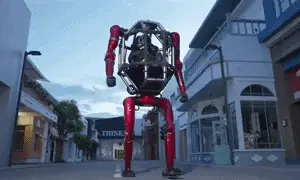
Source: VnExpress
Demonstration videos show founder Wang Xingxing operating the machine as it moves forward, uses mechanical arms to smash through brick walls, and transforms between configurations in seconds
3
. The transformer robot uses LiDAR, depth cameras, an inertial measurement unit, and pressure sensors for stability and navigation, running on Unitree's self-developed high-torque motors1
. While the company has not disclosed critical specifications like battery life, maximum speed, or operating duration, it has emphasized safety protocols and asked users to operate the machine in a "friendly and safe manner"2
.Founded in 2016 by Wang Xingxing, who built his first quadruped robot as a master's thesis project at Shanghai University before leaving DJI, Unitree Robotics has achieved remarkable commercial traction
1
. The company now controls roughly 70% of the global quadruped robot market, having shipped more than 23,700 units in 2024 across its Go, A, and B series1
. In 2025, Unitree shipped more than 5,500 humanoid robots, exceeding every other manufacturer including Tesla2
. Revenue reached 1.71 billion yuan, approximately $235 million, in 2025, representing 335% year-on-year growth, with the company maintaining profitability every year since 20201
.Humanoid robot sales overtook quadrupeds as the primary revenue driver in 2025, contributing roughly 52% of total revenue in the first three quarters
1
. Unitree filed for an IPO on the Shanghai Stock Exchange in March 2026, seeking to raise 4.2 billion yuan, approximately $610 million, at a target valuation of $7 billion1
. The investor roster includes Alibaba, Tencent, China Mobile, Geely Capital, Ant Group, Jinqiu Capital (ByteDance's investment arm), and HongShan Capital, formerly Sequoia China1
.Unitree's commercial advantage stems from aggressive pricing that undercuts Western competitors by an order of magnitude
1
. The Go2 consumer quadruped starts at $1,600, while the G1 humanoid robot, designed for research and light industrial applications, sells for $13,500 to $27,0001
. The H2, a full-size industrial-grade humanoid robot, is priced at $29,900, a fraction of what competitors charge1
. For context, Figure AI's Figure 02 industrial humanoid is being piloted at BMW at costs estimated to be multiples of Unitree's pricing, while Boston Dynamics has committed every 2026 unit of its electric Atlas to Hyundai1
. Tesla's Optimus remains in research and development with no productive factory deployments as of the first quarter of 20261
.According to research cited by the South China Morning Post, Chinese companies accounted for nearly 90% of global humanoid robot sales in 2025, with China hosting more than 140 humanoid robot manufacturers and over 330 models
2
. The country's five-year plan has prioritized accelerating development of technologies like humanoid robots to "target the frontiers of science and technology"2
.Related Stories
Chen Jing, vice president of the Technology and Strategy Research Institute, told the Global Times that the GD01 represents an important step for embodied artificial intelligence in China
3
. "It is no longer just a proof-of-concept machine confined to laboratories, but a product with a clear price tag and commercialization roadmap," Chen said3
. However, practical challenges remain, including difficulty accessing the cockpit, battery-life concerns, limited comfort, regulatory uncertainty, and maintenance complexity3
.China's humanoid robot boom faces a commercialization reality check, with more than 150 companies competing in a market where only 23% of buyers report satisfaction with purchased robots
1
. Unitree's answer relies on rapid iteration and volume-driven cost reduction, treating humanoid robots the way Chinese smartphone manufacturers approached handsets a decade ago: ship fast, price aggressively, iterate on customer feedback1
. Huang Jiawei, a marketing staff member at Unitree, acknowledged that the GD01's price remains high but noted it is "only a preliminary reference" subject to adjustment as functional improvements and cost reductions progress3
. "The product is still in its first generation at this stage, and there is indeed a lot of room for imagination," Huang said3
. Potential applications span disaster zones, collapsed buildings, hazardous industrial sites, and cultural tourism, though the clear commercial market beyond high-net-worth buyers and demonstration events remains undefined1
2
.Summarized by
Navi
[1]
25 Jul 2025•Technology

14 Oct 2025•Technology

20 Mar 2026•Business and Economy

1
Technology

2
Technology

3
Technology