US Army taps Carlyle and KKR to build $2bn data centers as AI warfare demands skyrocket


2 Sources
[1]
Army Taps Private Capital to Build Data Centers on Its Bases
The US Army has announced the first group of companies that will build data centers on military bases, as the armed forces address a growing need for artificial intelligence computing power. The Army plans to work with Carlyle Group Inc. to build a data center at Fort Bliss in Texas, and KKR &
[2]
Carlyle and KKR to build two data centres for US Army at a cost of $2bn each
The US Army has selected Carlyle and KKR to build two data centres on military bases estimated to cost $2bn each as the service's use of AI has skyrocketed during the war in Iran. The army will provide long-term leases to the firms, which are responsible for building and operating the centres, as
Share
Copy Link
The US Army has selected Carlyle Group and KKR to build data centers on military bases, with each project costing an estimated $2 billion. The facilities at Fort Bliss, Texas, and Dugway Proving Ground, Utah, will be financed through 50-year leases with private capital firms, allowing the military to access critical AI computing power without direct investment. Army Secretary Dan Driscoll revealed that AI token usage has surged 8x in recent weeks during the Iran conflict.
US Army Partners with Private Capital Firms to Build Data Centers on Military Bases
The US Army has announced a major infrastructure initiative, selecting Carlyle Group and KKR to build data centers on military bases in response to surging artificial intelligence demands. Army Secretary Dan Driscoll revealed that the service will work with Carlyle Group Inc. to construct a facility at Fort Bliss in Texas, while KKR-backed data center operator CyrusOne will build another at Dugway Proving Ground in Utah
1
2
. Each project is estimated to cost $2 billion, representing a significant shift in how the military approaches infrastructure development2
.The centers will be constructed on underused Army land through 50-year leases, allowing private developers to finance construction and operations in exchange for access to computing power
1
. This model enables the military to secure artificial intelligence computing power without direct government investment, avoiding boom-and-bust spending cycles tied to federal budgets.Massive Scale Projects Address Growing AI Warfare Needs
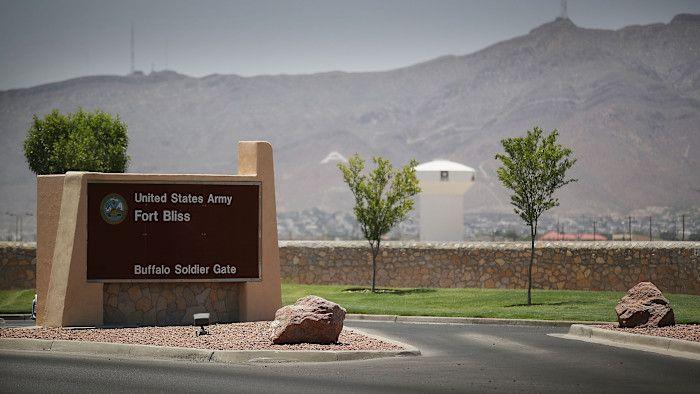
The Fort Bliss campus-style center will span roughly 1,384 acres and is structured to generate its own energy with a closed water system to avoid stressing local communities
1
. Carlyle will build a 2.5 to 3 gigawatt facility expected to begin operating at 200 megawatts in 2027, with full operational capacity forecast for 20282
. The project is expected to bring 2,000 new jobs to the El Paso region1
.
Source: FT
The Dugway-based center will occupy a 1,200 acre parcel, with KKR utilizing CyrusOne, jointly owned with BlackRock, to construct a 1 gigawatt facility expected to be operational in 2029
2
. This location will anchor economic activity in a remote region while providing critical computing infrastructure.Conflict in Iran Drives 8x Surge in AI Token Usage
Dan Driscoll emphasized that the conflict in Iran encapsulates the military's escalating need for data infrastructure as artificial intelligence plays a greater role in modern warfare. "The amount of tokens the United States Army is using right now on these AI platforms has gone up by 8x in the last couple of weeks," Driscoll said, referring to the units of data processed by AI models
2
2
. It takes approximately 1,300 tokens to generate 1,000 words of text, illustrating the massive computational demands facing military operations."We just have massive demands when our soldiers are under air and missile threats coming at them from all sorts of directions," Driscoll noted
2
. The computing power needed to fight drone swarms and launch attacks requires entirely different infrastructure than traditional military systems. The Pentagon is currently locked in a dispute with Anthropic about terms governing military use of its AI models, with Claude being the only model known to have been used in classified operations, though OpenAI signed a Pentagon contract earlier this month2
.Related Stories

Private Investment for Military Infrastructure Creates New Partnership Model
Under the arrangement, the US Army will receive a certain percentage of the data centers' capacity for exclusive use. The Army currently spends hundreds of millions of dollars on data center usage annually, according to David Fitzgerald, deputy under-secretary of the US Army
2
. Computing power not used by the military will be sold by Carlyle Group and KKR to commercial customers, creating a revenue stream for the private capital firms.The initiative aligns with President Donald Trump's executive order signed in December to restrict state-level regulation, part of broader efforts to bolster the AI industry by making it easier to build infrastructure and increase energy supply for data centers
1
. The Army and private capital groups do not yet have final agreements but are negotiating exclusively2
.Global Expansion Plans and Future Implications
Driscoll indicated this is "the first of many, many projects" the Army hopes to announce
1
. The military aims to develop skills and expertise with such facilities in the continental US before replicating them globally. "In a contested environment, we can actually go build a lot of these things in the theatres where our soldiers are," Driscoll explained2
. The Army is working toward having its own computing capacity in the Indo-Pacific region by the end of Trump's term, particularly relevant for any potential conflict with China.Driscoll suggested this private investment for military infrastructure model could extend beyond data centers. "We may create an investment vehicle where the army is co-investing to own a mine, and then the output of that mine is being processed on the army base" for weapons components
2
. This partnership approach with the $13 trillion private capital industry represents a fundamental shift in military infrastructure development2
.The AI drive has emerged as politically contentious in November midterm elections, as voters express concerns over rapid data center development in their communities, energy use driving up utility costs, potential job losses, and environmental impact
1
. How the military balances these local concerns with national security imperatives will shape future expansion efforts.References
Summarized by

Navi
Related Stories
OpenAI, Oracle, and SoftBank Launch $500B 'Stargate Project' for U.S. AI Infrastructure
22 Jan 2025•Business and Economy

Brookfield and NextEra to Build $100bn AI Data Center Campus on Former Nuclear Weapons Site in Kentucky
29 Jul 2026•Business and Economy
US Department of Energy Identifies 16 Federal Sites for AI Data Center Development
04 Apr 2025•Technology

Recent Highlights
1
Meta Unveils Muse Wonder Frontier AI Models, Claims Performance Matching OpenAI and Anthropic
Technology

2
IMF Report Warns AI Market Correction Could Spark Global Financial Crisis With $1.4T at Risk
Business and Economy

3
OpenAI Releases 722 AI-Generated Math Solutions, Triggering Existential Crisis in Mathematics
Technology

Recent Highlights
Today's Top Stories









Don’t drown in AI news. We cut through the noise - filtering, ranking and summarizing the most important AI news, breakthroughs and research daily. Follow topics that matter to you and stay ahead.


