Nvidia caught between U.S. export controls and China's pushback as AI chip war intensifies


8 Sources
[1]
The Senate's new SAFE bill is set to curb access to advanced chips to China, but that won't slow down the AI war -- training workloads still heavily rely on Nvidia, while alternatives remain inefficient
A new bipartisan bill in the Senate could pause shipments, but there are ways around it. A new bipartisan bill in the U.S. Senate threatens to put the brakes on Nvidia's efforts to sell its latest AI-training hardware to Chinese customers, even as the Trump administration mulls allowing
[2]
China does not need Nvidia chips in the AI war -- export controls only pushed it to build its own AI machine. | Fortune
But they are wrong. These arguments assume that China cannot succeed in AI without access to these advanced AI chips, which is not the case. Advanced AI chips simply reduce the cost of AI. Today's state-of-the-art AI models require a large number of AI chips to build and run. An advanced chip has
[3]
China wants an AI-powered military built with Nvidia chips, and that's a problem
Despite much speculation, President Trump did not allow China greater access to advanced AI semiconductors during his meeting with Chinese leader Xi Jinping at last month's Asia-Pacific Economic Cooperation summit. Although Trump balked in Seoul, he is reportedly considering greenlighting sales of
[4]
Investor Outlook: U.S. shift on Nvidia chip exports runs into China's pushback
The United States has approved exports of Nvidia's H200 artificial intelligence chips to China, marking one of the sharpest reversals in Washington's tech policy since restrictions tightened last year. The move comes as Beijing signals it will limit access to the processors, highlighting the
[5]

Chinese chipmakers extend losses after US moves to ease Nvidia export curbs By Investing.com
Investing.com-- Chinese chipmaking stocks extended losses on Wednesday after the U.S. moved to allow Nvidia (NASDAQ:NVDA) to resume exports of its advanced H200 artificial intelligence chips to "approved customers" in China. Shares of Hua Hong Semiconductor (HK:1347) declined 2.6%, while
[6]
China promoted domestic AI chips before Nvidia move - FT By Investing.com
Investing.com-- China has added domestic artificial intelligence chips to an official government procurement list for the first time, to strengthen its tech sector ahead of Washington's easing of Nvidia (NASDAQ:NVDA) export curbs, the Financial Times reported on Wednesday, citing people familiar
[7]
Nvidia H200 Exports to China Reshape AI Investment | Investing.com UK
The decision by the Trump administration to allow Nvidia to export its advanced H200 artificial intelligence chips to approved customers in China marks a clear turning point for global AI investing. This move reshapes how capital markets must think about capability, competition, and long-term
[8]
Chinese chipmaking stocks fall on US move to permit Nvidia H200 shipments By Investing.com
Investing.com-- Shares of major Chinese chip-making companies fell on Tuesday after the U.S. said it will allow Nvidia (NASDAQ:NVDA) to ship its H200 artificial-intelligence chips to China, a move seen by investors as a blow to domestic semiconductor outfits. Hong Kong-listed Hua Hong
Share
Copy Link
The U.S. approved exports of Nvidia's H200 AI chips to China, reversing restrictive policies, but Beijing is limiting access to favor domestic alternatives. A new Senate bill could halt shipments for 30 months, while evidence shows the People's Liberation Army uses Nvidia hardware for military applications. The escalating tensions highlight the complex geopolitical frictions reshaping the global semiconductor supply chain.
U.S. Approves Nvidia H200 Chips to China as Policy Shifts
The United States has approved exports of Nvidia's H200 artificial intelligence chips to China, marking a sharp reversal in Washington's tech policy
4
. This decision comes after Nvidia CEO Jensen Huang spent much of last week meeting with U.S. legislators, including President Trump and Republican members of the Senate Banking Committee1
. The move represents a significant shift for Nvidia, which was expected to sell approximately $17 billion worth of chips to China this year before restrictions brought that figure down to zero4
. Current analyst estimates include nothing for China sales, making this approval an incremental positive, though it comes with considerable uncertainty around tariffs and market access.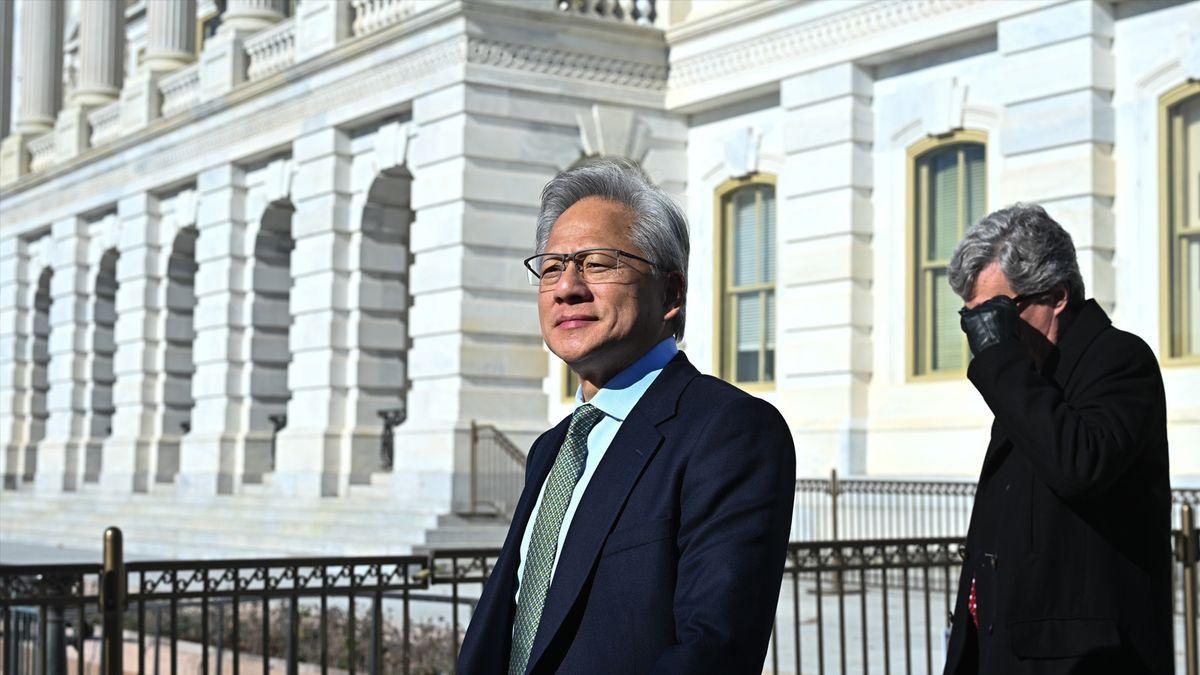
Source: Tom's Hardware
China Limits Access Despite U.S. Approval
Beijing is signaling it will limit access to the advanced AI chips, requiring permits and explanations for purchases
4
. Chinese authorities have spent months pushing back on the on-again, off-again availability of Nvidia hardware by encouraging domestic companies to use domestic chip suppliers where possible, mandating that Chinese companies use at least 50% domestically produced hardware1
. Beijing has quietly added domestic AI chips from firms including Huawei to an official government procurement list for the first time, a move intended to expand the use of homegrown semiconductors across government agencies and state-owned firms that could generate billions of dollars in orders for local chip designers5
. Chinese chipmaking stocks extended losses, with Hua Hong Semiconductor declining 2.6% and SMIC sliding 2% in Hong Kong trading5
.Senate SAFE Bill Threatens 30-Month Export Ban
Despite the recent approval, the proposed Secure and Feasible Exports Act (SAFE) bill would force the Commerce Department to halt export licenses for the sale of the latest chips to U.S. adversaries, including China and Russia, for 30 months
1
. This ban could cover all existing chips and anything more powerful developed by major companies over that period. Although it primarily targets Nvidia's Blackwell GPUs, it would also cover Nvidia's last-generation Hopper designs, AMD's graphics chips, and Google's latest TPU designs1
. This represents devastating news for Nvidia and many chip-manufacturing contemporaries, as China remains a massive market for hardware and AI development.Military Modernization Concerns Drive Export Controls
Analysis of dozens of procurement documents published by the People's Liberation Army reveals that the Chinese military is directly soliciting and using advanced U.S. chips, including those designed by Nvidia, to develop AI-enabled military capabilities
3
. One contract for an "intelligent optoelectronic target recognition system" specifies the use of Nvidia computing resources, while another notice for server procurement to help the Chinese military "perform AI algorithm calculations" relies on Nvidia H100 GPUs, a chip that was export controlled in 20223
. The PLA is requesting systems that can generate, collect and analyze troves of battlefield data to quickly identify targets and accelerate decision-making cycles, with other documents featuring requests for algorithms to power swarms of autonomous vehicles3
. Authoritative Chinese documents indicate that Beijing believes the development and deployment of advanced AI-enabled military systems provides the best chance to catch up to or surpass the U.S. military3
.Training Workloads Still Depend on Nvidia Hardware
Nvidia's GPU versatility is particularly well-suited for AI training, and it has no real rival in this domain
1
. When DeepSeek developers were forced to use locally produced chips for training, they ended up switching back to Nvidia hardware because the performance just wasn't there1
. Frontier model training still largely relies on Nvidia hardware, and Chinese access to cutting-edge Nvidia chips will make it easier for frontier AI labs to acquire advanced computing power to train increasingly capable AI models3
. Nvidia chips are very strong for general-purpose computing, and anytime you need Nvidia's CUDA software, there is really no better substitute4
.
Source: BNN
Related Stories

China Advances Domestic Chip Alternatives Despite Efficiency Gaps
China has made major leaps in its AI hardware development over the past year as it sought to build more reliable access to powerful AI hardware while the U.S. turned the tap on and off
1
. These conditions have led Huawei to make tremendous advances and design high-power systems that scale well, at the expense of efficiency1
. Recently announced Huawei SuperClusters are more powerful than any Nvidia system, despite not using the most advanced AI chips2
. China claims that new chip packaging and assembly techniques can close the performance gap between Nvidia and its local producers1
. Chinese chip firms have announced enormous plans to manufacture several times the chips they managed in 2025 as soon as next year1
.Geopolitical Frictions Reshape Semiconductor Supply Chain
U.S. export controls have made this an issue of national pride and led to a wave of investment into a domestic AI chip ecosystem within China
2
. It's unclear if the U.S. will ever regain market share even if chip controls are reversed, as China has also retaliated in many ways that have further hurt the U.S. economy and geopolitics . The U.S. has lost what could have been one of the largest markets for advanced AI chip companies . Despite all the blocks and barriers from various governments and organizations, it hasn't been too difficult for companies to allegedly get their hands on Nvidia hardware, with Singaporean companies allegedly used to circumvent trade blocks, and leasing computing power from international partners effectively allowing Chinese national companies to use whatever hardware they like1
. The way to win the AI war is with continued innovation rather than restricting sales, as staying ahead on the innovation front matters more than limiting market access4
.References
Summarized by

Navi
Related Stories
Huawei Challenges Nvidia's AI Chip Dominance with New Ascend 920 Processor
29 Apr 2025•Technology

Nvidia China market share plummets to 55% as Chinese chipmakers capture 41% with 1.65 million AI GPUs
01 Apr 2026•Business and Economy
Trump approves Nvidia H200 exports to China with 25% revenue cut, sparking national security debate
04 Dec 2025•Policy and Regulation
Recent Highlights
1
Microsoft and Nvidia Launch Surface Laptop Ultra: A $2,599 AI-Ready PC With RTX Spark Chip
Technology

2
Meta Muse AI Agent Surges to 6.6M Downloads Despite Privacy and Security Controversies
Technology

3
Scientists Build AI Model That Reconstructs Images From Brain Scans in Record Time
Science and Research

Recent Highlights
Today's Top Stories










Don’t drown in AI news. We cut through the noise - filtering, ranking and summarizing the most important AI news, breakthroughs and research daily. Follow topics that matter to you and stay ahead.


