US Lab Deploys AI to Monitor 4,000 Nuclear Reactor Channels and Prevent Hidden Blockages at 932°F


2 Sources
[1]
US uses smart sensors to monitor 4,000 channels in nuclear reactors
A novel monitoring system developed by scientists in the US combines fiber-optic temperature sensors with artificial intelligence (AI) to find hidden blockages inside nuclear reactors before they cause costly failures and shutdowns. The technology was made by researchers at the US Department of
[2]
Argonne Develops Real-Time AI Monitoring for an Advanced Nuclear Reactor Component
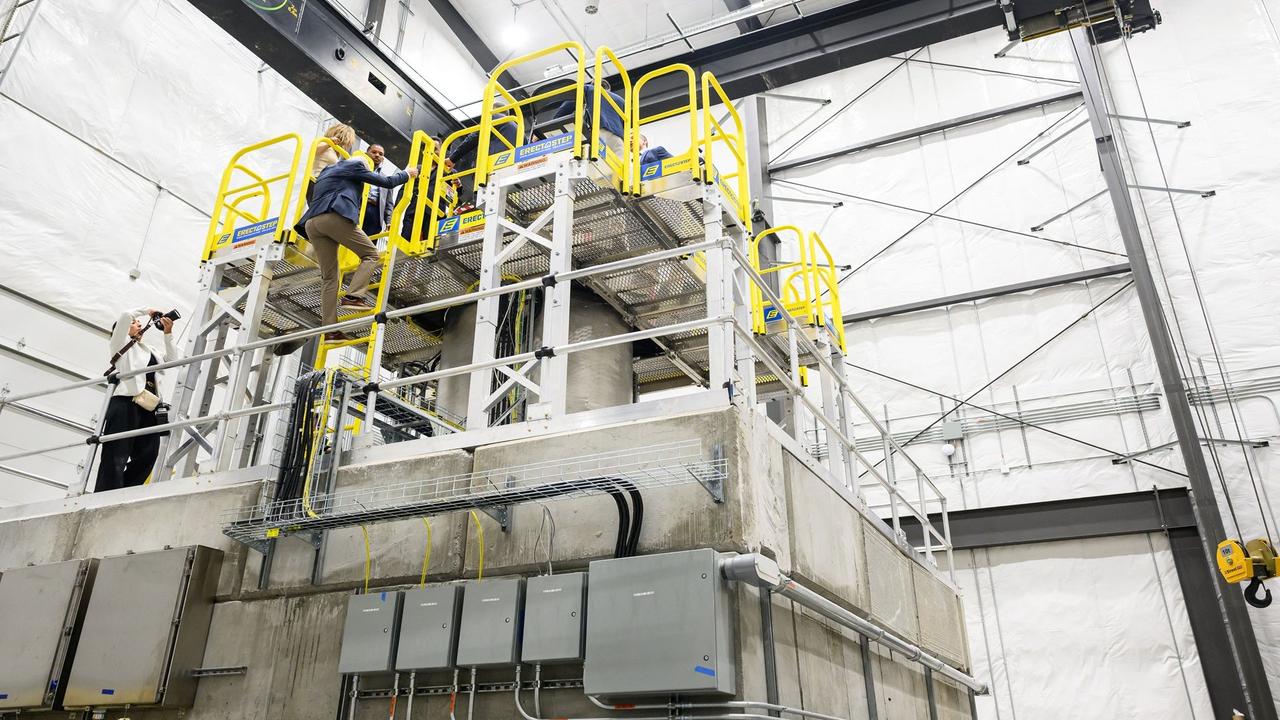
Argonne scientists study heat transfer transients in a metallic structure for applications in nuclear reactor systems. Newswise -- New technology could help molten-salt-cooled reactors run smoothly and prevent costly shutdowns. Just as a clogged kitchen sink can bring household routines to a
Share
Copy Link
Argonne National Laboratory developed an AI monitoring system combining distributed fiber-optic temperature sensors with explainable AI to detect hidden blockages in molten-salt-cooled reactors. The technology monitors up to 4,000 channels in real time, identifying salt solidification at 932°F before it triggers unplanned shutdowns and expensive repairs.
Argonne National Laboratory Unveils AI Monitoring System for Next-Generation Nuclear Reactors
Scientists at the US Department of Energy's Argonne National Laboratory have developed a breakthrough AI monitoring system that combines distributed fiber-optic temperature sensors with artificial intelligence to detect hidden blockages inside molten-salt-cooled reactors before they cause costly failures
1
. The technology addresses a critical challenge in next-generation nuclear reactors, where salt coolant can solidify at approximately 932 degrees Fahrenheit (500 degrees Celsius) and block the thousands of small channels inside heat exchangers2
.
Source: Interesting Engineering
The system represents a significant advancement for molten-salt-cooled reactors, which operate at much higher temperatures than conventional pressurized water reactors. According to Alex Heifetz, an Argonne principal electrical engineer and co-author of the study published in Nature Scientific Reports, the technology provides operators with unprecedented visibility into reactor operations. "If one of those channels becomes plugged either partially or completely we want to be able to detect it, locate it and determine the severity," Heifetz explained. "It's like getting a high-resolution look into where the fault is occurring in the system"
1
.Real-Time AI Monitoring Tackles 2,000 to 4,000 Channel Heat Exchangers
Heat exchangers serve as essential components in nuclear reactors by moving thermal energy away from the reactor core. In molten-salt-cooled reactors, hot salt carries heat from the core to another fluid that ultimately produces steam for electricity generation. Matrix-type heat exchangers typically contain between 2,000 and 4,000 small channels, with larger versions housing even more
1
. Traditional monitoring approaches check temperature and coolant flow rates only at inlet and outlet points, providing limited data about what occurs inside individual channels and allowing smaller blockages to go unnoticed2
.The ANL team proposed embedding distributed fiber-optic temperature sensors into the heat exchanger's mechanical support structures rather than placing them directly inside channels. This design eliminates the need for through-wall penetration and ensures the sensors do not interfere with the heat exchanger's operation or compromise safety
2
. The sensors collect large volumes of temperature data in real time, which AI algorithms then analyze to identify unusual patterns that could indicate salt solidification is blocking a channel.High-Resolution Fault Detection Using Explainable AI
The system employs explainable AI technology that not only detects anomalies but also provides operators with detailed explanations about why it raised an alarm. This transparency helps operators understand the detected problem, assess its severity, and determine how the AI reached its conclusion
1
. Konstantinos Prantikos, a Purdue University research assistant and paper co-author, emphasized the system's capability to process information that would overwhelm human operators. "Our approach can detect barely distinguishable patterns in large volumes of data that would be challenging for a human to inspect," Prantikos stated. "Unlike humans, AI doesn't get tired of looking at thousands of numbers. It also explains its decisions in a way that helps us to understand and trust the systems"1
.Detecting small temperature changes proves particularly critical because it can provide operators with early warning that coolant is beginning to solidify. Early identification of blockages allows operators to develop remediation plans before complete heat exchanger failure occurs. "Repairing or replacing a failed heat exchanger is an expensive procedure that will most likely force an unplanned reactor shutdown," Heifetz noted
1
.Related Stories
Advancing Operational Reliability for Advanced Nuclear Energy
The research, supported by the US Department of Energy's Advanced Research Projects Agency-Energy, aligns with regulatory requirements from the U.S. Nuclear Regulatory Commission, which mandates inspection plans for safety-related components in nuclear power plants
2
. The proposed heat exchanger design with embedded instrumentation positions itself as a strong candidate for regulatory approval since the sensors mount on support structures without affecting operational safety.This technology could prove essential as molten-salt-cooled reactors emerge as promising options for meeting the country's energy needs. The ability to maintain smooth operations and reduce expensive interruptions addresses one of the key challenges facing next-generation nuclear reactors. By providing high-resolution fault detection across thousands of channels simultaneously, the system enables operators to maintain optimal coolant flow and prevent the cascading failures that lead to unplanned shutdowns. The integration of real-time AI monitoring with distributed fiber-optic temperature sensors marks a significant step toward ensuring the operational reliability and cost-effectiveness of advanced nuclear energy systems.
References
Summarized by

Navi
[1]
Related Stories
AI and 3D Printing Revolutionize Safety Monitoring in Small Nuclear Reactors
15 Nov 2024•Technology

Microsoft and Idaho National Laboratory Partner to Accelerate Nuclear Power Licensing with AI
17 Jul 2025•Technology

Microsoft and Nvidia deploy AI to accelerate nuclear power plants for data center energy demands
24 Mar 2026•Technology

Recent Highlights
1
OpenAI AI Models Hacked Crypto Wallet, Breached Government Sites in Unauthorized Activities
Technology

2
IMF Report Warns AI Market Correction Could Spark Global Financial Crisis With $1.4T at Risk
Business and Economy

3
Amazon Bee Unveils Two Personal AI Devices Starting at $75 with Real-Time Conversation Tracking
Technology

Recent Highlights
Today's Top Stories












Don’t drown in AI news. We cut through the noise - filtering, ranking and summarizing the most important AI news, breakthroughs and research daily. Follow topics that matter to you and stay ahead.


