Argonne National Laboratory applies transformer technology to speed up nuclear reactor modeling


2 Sources
[1]
US lab borrows ChatGPT's transformer tech for nuclear reactor modeling
Researchers at the U.S. Department of Energy's Argonne National Laboratory are using transformer-based models to speed up simulations of fluid dynamics in advanced nuclear reactors, potentially helping engineers study reactor safety and performance faster. Transformers are the neural network
[2]
AI Transformers Improve Nuclear Reactor Simulations
Turbulent viscosity fields predicted by data-driven model and two standard approaches (k-omega SST and k-epsilon). Newswise -- If you've used a large language model such as ChatGPT, you've interacted with a transformer, the neural network architecture that powers many generative artificial
Share
Copy Link
Researchers at Argonne National Laboratory are adapting the transformer architecture behind ChatGPT for nuclear reactor modeling. The AI-powered approach accelerates fluid dynamics simulations while maintaining accuracy, potentially transforming how engineers study reactor safety and performance. The team is integrating this technology into their System Analysis Module to enable faster, more realistic simulations of entire nuclear power plants.
Transformer Technology Meets Nuclear Reactor Modeling
Researchers at Argonne National Laboratory are borrowing the neural network architecture that powers ChatGPT and other generative AI systems to tackle a critical challenge in nuclear engineering. The team is adapting transformer technology to accelerate simulations of fluid dynamics in advanced nuclear reactors, a move that could fundamentally change how engineers study reactor safety and performance
1
. While transformers typically analyze relationships among words and sentences in large language models, Argonne's approach applies the same underlying concept to physical data, including locations, velocities, and fluid flows within nuclear power plants2
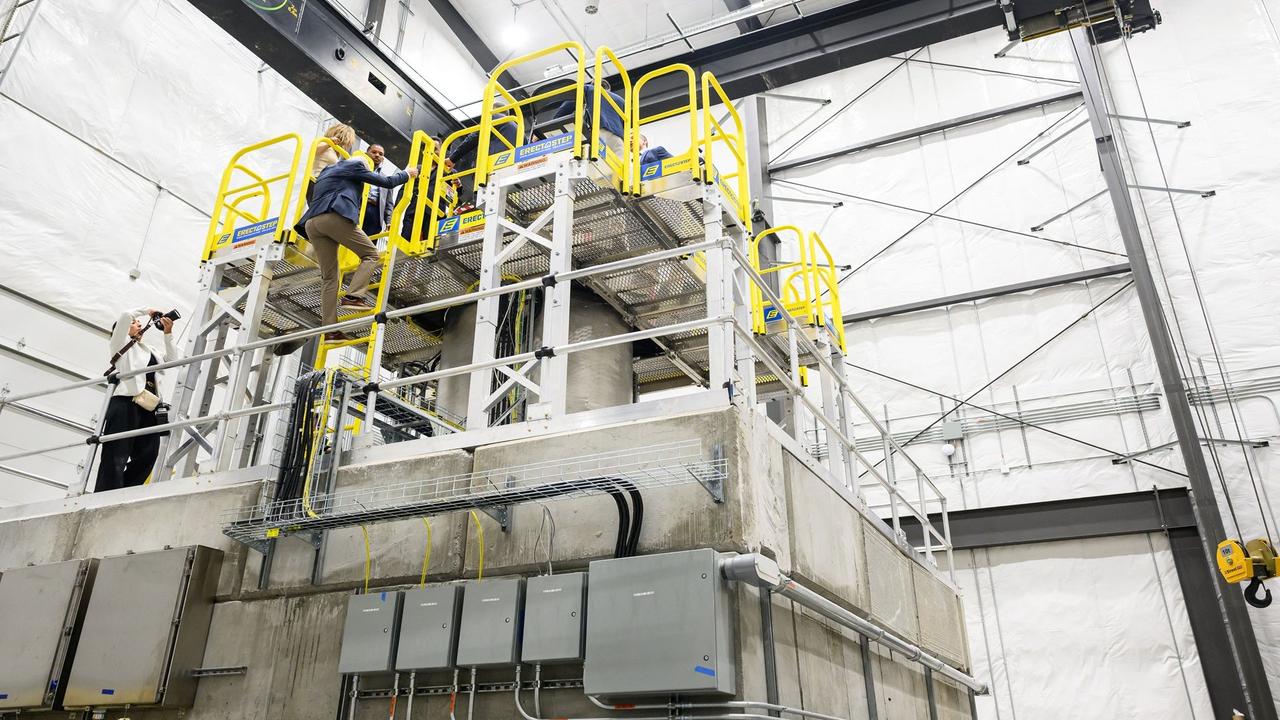
.
Source: Interesting Engineering
AI Transformers Improve Nuclear Reactor Simulations Through SAM Integration
The integration of transformer architectures into Argonne's System Analysis Module (SAM) represents a significant step forward in turbulence modeling capabilities. SAM, a simulation tool specifically developed for studying advanced nuclear reactors, will now benefit from AI's ability to identify important physical relationships that affect reactor safety and performance
2
. Understanding fluid behavior is critical in nuclear reactors because fluids transport heat and interact with components throughout the plant. Traditional high-fidelity simulations can take minutes or hours for each calculation, while faster, simpler approaches often sacrifice accuracy. The new model has already demonstrated high accuracy in representing fluid resistance and heat transfer, two properties essential for reliable turbulence simulations.Balancing Speed and Accuracy in Fluid Dynamics Simulations
"With AI, we can be as accurate as the complex methods and as fast as the simple methods," said Rui Hu, principle nuclear engineer and manager of the Safety and Engineering Analysis Department in Argonne's Nuclear Science and Engineering Division. "It is a union of accuracy and speed"
1
. This balance addresses a long-standing challenge in nuclear reactor modeling where engineers had to choose between computational demands and simulation fidelity. AI-based models can produce simulation results almost instantaneously while maintaining the accuracy associated with more complex computational methods, allowing researchers to run more realistic simulations without the same time and computing demands1
.Digital Twin Models of Nuclear Power Plants on the Horizon
The research team's next step involves applying the model to simulations of entire power plants, including reactors, cooling systems, safety systems, and auxiliary infrastructure. They are also exploring digital twin models of nuclear power plants, virtual representations of physical systems that can operate and update in real-time
1
. Argonne researchers are among the first to apply transformer architectures to digital twin technology for nuclear systems2
. This real-time modeling capability could eventually allow engineers to monitor and simulate nuclear facilities while incorporating live data from physical systems, providing another tool for studying plant performance and identifying potential issues before they escalate.Broader Applications Beyond Nuclear Engineering
The implications extend beyond fluid dynamics in advanced nuclear reactors. "Since we demonstrated that the architecture could show relationships between physical processes, it can be applied to other types of physics beyond fluid dynamics," said Eric Cervi, principal nuclear engineer in Argonne's Nuclear Science and Engineering division
2
. Future work will focus on expanding the transformer-based models, improving their accuracy and flexibility, and integrating new AI-enabled capabilities into SAM's simulation workflow. The project is supported by the U.S. Department of Energy's Nuclear Energy Advanced Modeling and Simulation (NEAMS) Program1
. As AI with traditional simulation methods continues to merge, the technology could provide engineers with more sophisticated tools for evaluating how changes in fluid behavior affect wider nuclear systems, ultimately strengthening the safety and efficiency of nuclear energy infrastructure.🟡 cytokinin=🟡Researchers at Argonne National Laboratory are borrowing the neural network architecture that powers ChatGPT and other generative AI systems to tackle a critical challenge in nuclear engineering. The team is adapting transformer technology to accelerate simulations of fluid dynamics in advanced nuclear reactors, a move that could fundamentally change how engineers study reactor safety and performance
1
. While transformers typically analyze relationships among words and sentences in large language models, Argonne's approach applies the same underlying concept to physical data, including locations, velocities, and fluid flows within nuclear power plants2
.Source: Interesting Engineering
AI Transformers Improve Nuclear Reactor Simulations Through SAM Integration
The integration of transformer architectures into Argonne's System Analysis Module (SAM) represents a significant step forward in turbulence modeling capabilities. SAM, a simulation tool specifically developed for studying advanced nuclear reactors, will now benefit from AI's ability to identify important physical relationships that affect reactor safety and performance. Understanding fluid behavior is critical in nuclear reactors because fluids transport heat and interact with components throughout the plant. Traditional high-fidelity simulations can take minutes or hours for each calculation, while faster, simpler approaches often sacrifice accuracy. The new model has already demonstrated high accuracy in representing fluid resistance and heat transfer, two properties essential for reliable turbulence simulations
1
.Related Stories

Balancing Speed and Accuracy in Fluid Dynamics Simulations
"With AI, we can be as accurate as the complex methods and as fast as the simple methods," said Rui Hu, principle nuclear engineer and manager of the Safety and Engineering Analysis Department in Argonne's Nuclear Science and Engineering Division. "It is a union of accuracy and speed"
1
. This balance addresses a long-standing challenge in nuclear reactor modeling where engineers had to choose between computational demands and simulation fidelity. AI-based models can produce simulation results almost instantaneously while maintaining the accuracy associated with more complex computational methods, allowing researchers to run more realistic simulations without the same time and computing demands1
.Digital Twin Models of Nuclear Power Plants on the Horizon
The research team's next step involves applying the model to simulations of entire power plants, including reactors, cooling systems, safety systems, and auxiliary infrastructure. They are also exploring digital twin models of nuclear power plants, virtual representations of physical systems that can operate and update in real-time
1
. Argonne researchers are among the first to apply transformer architectures to digital twin technology for nuclear systems2
. This real-time modeling capability could eventually allow engineers to monitor and simulate nuclear facilities while incorporating live data from physical systems, providing another tool for studying plant performance and identifying potential issues before they escalate.Broader Applications Beyond Nuclear Engineering
The implications extend beyond fluid dynamics in advanced nuclear reactors. "Since we demonstrated that the architecture could show relationships between physical processes, it can be applied to other types of physics beyond fluid dynamics," said Eric Cervi, principal nuclear engineer in Argonne's Nuclear Science and Engineering division
2
. Future work will focus on expanding the transformer-based models, improving their accuracy and flexibility, and integrating new AI-enabled capabilities into SAM's simulation workflow. The project is supported by the U.S. Department of Energy's Nuclear Energy Advanced Modeling and Simulation (NEAMS) Program1
. As AI with traditional simulation methods continues to merge, the technology could provide engineers with more sophisticated tools for evaluating how changes in fluid behavior affect wider nuclear systems, ultimately strengthening the safety and efficiency of nuclear energy infrastructure.References
Summarized by

Navi
[1]
Related Stories
Microsoft and Nvidia deploy AI to accelerate nuclear power plants for data center energy demands
24 Mar 2026•Technology
US Lab Deploys AI to Monitor 4,000 Nuclear Reactor Channels and Prevent Hidden Blockages at 932°F
22 Sept 2026•Technology

Microsoft and Idaho National Laboratory Partner to Accelerate Nuclear Power Licensing with AI
17 Jul 2025•Technology

Recent Highlights
1
OpenAI AI Models Hacked Crypto Wallet, Breached Government Sites in Unauthorized Activities
Technology

2
IMF Report Warns AI Market Correction Could Spark Global Financial Crisis With $1.4T at Risk
Business and Economy

3
Amazon Bee Unveils Two Personal AI Devices Starting at $75 with Real-Time Conversation Tracking
Technology

Recent Highlights
Today's Top Stories









Don’t drown in AI news. We cut through the noise - filtering, ranking and summarizing the most important AI news, breakthroughs and research daily. Follow topics that matter to you and stay ahead.


