Vectorial Raises $3M to Simulate How Users React Before Product Launch


2 Sources
[1]
Vectorial raises $3M to simulate how users react before launch
Vectorial has built a human behavior simulation platform. It lets product, design and marketing teams test digital experiences against thousands of modeled users in minutes. AI is making building and launching products exponentially faster, but current user research is still painfully slow,
[2]
AI startup Vectorial lands $3M in funding to simulate human behavior for consumer research
Consumer research is a slow and cumbersome challenge that few companies do well, but if Vectorial AI Inc. is successful, they'll never have to worry about doing it again. The startup today said it has raised $3 million in seed funding to propel the launch of its new artificial intelligence-driven
Share
Copy Link
Vectorial secured $3 million in seed funding to accelerate its AI-driven human behavior simulation platform. The startup enables product, design, and marketing teams to test digital experiences against thousands of modeled users in minutes. Backed by Smilegate, SenseAI Ventures, and UC Berkeley ecosystem funds, Vectorial aims to replace slow, expensive consumer research with real-time simulations powered by its SAPIENS behavior model.
Vectorial Secures Seed Funding to Transform User Research
Vectorial raises $3M in seed funding to accelerate its AI-driven human behavior simulation platform that fundamentally changes how companies conduct consumer research
1
2
. The round was jointly led by Smilegate and SenseAI Ventures, with additional backing from UC Berkeley ecosystem funds including Berkeley SkyDeck and Berkeley AI Research Lab, Stanford-led funds such as Stanford GSB fund and Dent Capital, and angel investors from Meta, Shopify, and Mastercard1
. The funding reflects the startup's deep academic backbone with AI ecosystems spanning Stanford's StartX, CMU's Venture Bridge, and UC Berkeley1
.
Source: The Next Web
How Vectorial's AI Simulation Platform Works
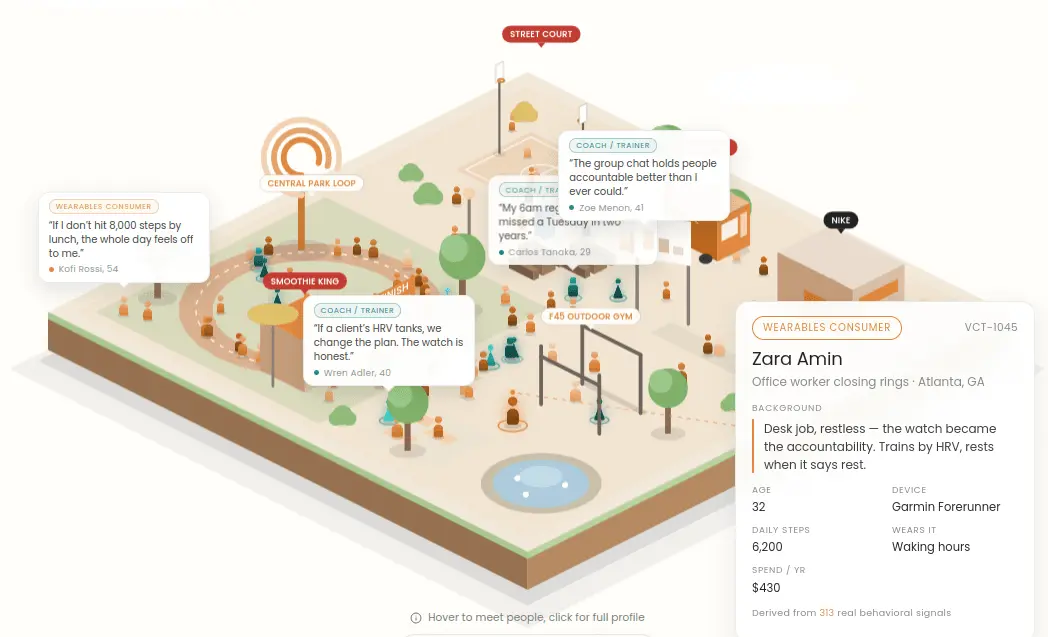
The platform lets product development, design, and marketing teams test digital experiences against thousands of modeled users in minutes, watching their target customers react before a single real user touches the product
1
. Vectorial has already modeled more than 2.5 million real people and run more than 30,000 simulations across its customer base1
. These simulated audiences are powered by SAPIENS, a behavior model that learns latent socio-demographic, psychographic, and behavioral traits of target customers1
. The SAPIENS behavior model is 30 percent more accurate in predicting consumer behavior than general-purpose LLMs and outperforms academic behavior models such as Be.FM and Centaur1
2
.
Source: SiliconANGLE
Addressing Critical Bottleneck in Product Development
While AI tools generate massive amounts of code and accelerate software development exponentially, current user research remains painfully slow, expensive, and biased
1
2
. Even with AI-moderated interviews, getting user feedback from 50-100 participants still takes days, which is far too slow when companies iterate on product development and launch in hours1
. This bottleneck leads many companies to skip user research at important steps, resulting in what the industry calls AI slop1
. According to co-founder and CEO Taranveer Singh, smaller startups often avoid doing consumer research altogether and simply assume or hope they know what consumers want, leading to wasted time and money on products no one needs2
.The Bold Bet on Simulation Technology
The founders are making a bold bet that within four years, running a behavior simulation with audience models before building or launching a consumer product will become the norm
1
. While simulations have been common in aerospace, manufacturing, and chip industries, consumer products touching billions of people still launch on gut instinct and limited experiments with live users1
. Singh believes AI is creating two distinct frontiers: one focuses on reasoning and solving complex problems, while the other focuses on simulations and decoding human behavior1
2
. The missing pieces are the ability to simulate many scenarios and bring users into the same room as teams build1
.Why Existing Solutions Fall Short
Vectorial distinguishes itself from other approaches that have attempted to solve the consumer research challenge. AI-moderated interviews still require multi-day studies with small participant groups, making them slow, expensive, and biased
1
2
. Simulated user agents using synthetic users provide instant answers but lack grounding in real behavior data, which fails to build trust with customers1
2
. Other simulation companies focus on market research for strategic decisions but don't help with downstream decisions or integrate users inside the product development loop1
. By contrast, Vectorial's audience is grounded in real behavior data at massive scale and fits inside the product development, launch, and build workflow1
.Related Stories

Early Traction and Customer Adoption
Vectorial's customers span healthcare, gaming, and e-commerce sectors, including public companies and billion-dollar enterprises such as Midi Health, GoodRx, Suki, Boat, Everkind, and Concrete Software
1
2
. These customers run an average of 600 simulations per month, receiving constant feedback on every design change and feature implementation2
. When compared against real user studies, Vectorial typically achieves accuracy of around 86 percent2
. According to co-founder and Chief Business Officer Jasmine Kaur, enterprises treat a continuously enriched model of their target audience as a strategic investment, with organic adoption across product, design, and marketing teams who all design for the same audience1
.The Team and Future Development
The founding team brings deep domain expertise from Stanford, CMU, ISB, and BAIR in understanding and modeling human behavior and its business applications
1
. CEO Taranveer Singh spent a decade modeling human behavior in defense research and research labs, Chief Product Officer Rahul Garg launched multiple products at unicorn companies and worked on a behavior graph for sales at his previous startup, while Chief Business Officer Jasmine Kaur led synthetic users for marketing at Pfizer1
. The company plans to use the seed funding to expand its behavioral dataset and build a more advanced model called SAPIENS 2.02
. As Rahul Garg explains, a behavior model alone doesn't solve the problem—putting behavior models to work inside the product development loop fundamentally changes how products are designed and built by putting users in the room where teams build1
2
.References
Summarized by

Navi
[1]
Related Stories
Simile AI startup raises $200M at $2B valuation to simulate consumers with digital twins
30 Jul 2026•Startups

Vectorize Launches with $3.6M Seed Funding to Revolutionize RAG Data Preparation
09 Oct 2024•Technology

Antioch raises $8.5 million to build simulation tools that accelerate physical AI development
17 Apr 2026•Startups

Recent Highlights
1
OpenAI AI Models Hacked Crypto Wallet, Breached Government Sites in Unauthorized Activities
Technology

2
IMF Report Warns AI Market Correction Could Spark Global Financial Crisis With $1.4T at Risk
Business and Economy

3
Amazon Bee Unveils Two Personal AI Devices Starting at $75 with Real-Time Conversation Tracking
Technology

Recent Highlights
Today's Top Stories











Don’t drown in AI news. We cut through the noise - filtering, ranking and summarizing the most important AI news, breakthroughs and research daily. Follow topics that matter to you and stay ahead.


