Vinci Raises $250 Million to Scale AI Simulation Software for Chip Design at $1.5 Billion Valuation


4 Sources
[1]
Software startup Vinci raises $250 million at a $1.5 billion valuation
SAN FRANCISCO, Oct 6 (Reuters) - Software startup Vinci said on Tuesday it raised $250 million at a $1.5 billion valuation and is seeking to expand its suite of software used to simulate elements of chip and other hardware design. The Palo Alto, California-based company is entering a market that
[2]
Chip simulation startup Vinci raises $250m at a $1.5bn valuation
Vinci, the AI software company based in Palo Alto that simulates physics for use in chip and hardware design, has raised $250M at a $1.5bn valuation, the company announced on Tuesday. Advent, Temasek and Xora Innovation led the round, while earlier investors Eclipse and Khosla Ventures
[3]
Vinci reels in $250M for its engineering simulation platform
Vinci4D Inc. today announced that it has closed a $250 million funding round at a $1.5 billion valuation. Advent, Temasek and Xora jointly led the Series B deal. They were joined by several startup funds including AMD Ventures. Hardware engineers use simulations to find issues in their product
[4]
Software startup Vinci raises $250 million at a $1.5 billion valuation
The Palo Alto, California-based company is entering a market that includes similar AI-based simulation products from established chip design software firms such as Cadence and Synopsys. Software startup Vinci said on Tuesday it raised $250 million at a $1.5 billion valuation and is seeking to
Share
Copy Link
Palo Alto-based Vinci closed a $250 million Series B round at a $1.5 billion valuation to expand its AI simulation software for chip and hardware design. The 70-person startup, competing with established firms like Cadence and Synopsys, plans to scale from two to 20 pilot deployments while expanding beyond thermal simulation to electromagnetics and vibration testing.
Vinci Secures Major Funding to Challenge Industry Giants
Vinci announced it has raised $250 million at a $1.5 billion valuation in a Series B funding round led by Advent, Temasek and Xora Innovation
1
2
. The round included participation from Eclipse, Khosla Ventures, Madrona, and AMD Ventures, marking a significant milestone for the Palo Alto startup less than a year after emerging from stealth3
. The company previously announced a $46 million raise in December 2025, consisting of a seed round led by Eclipse and a Series A round led by Xora, a venture firm backed by Temasek2
.Engineering Simulation Platform Targets Critical Hardware Challenges
The 70-person startup has developed AI simulation software capable of high-fidelity physics simulation for chip and hardware design, addressing a critical need as AI chips generate enormous amounts of heat and systems grow increasingly complex
1
. Vinci's platform can predict the physical behavior of a design before construction, with the company claiming its model runs simulations up to 1,000 times faster than conventional tools without loss of accuracy2
. The software automates meshing, the time-consuming process of breaking product blueprints into numerous small three-dimensional shapes, and uses custom graphics card kernels to accelerate convergence3
.From Thermal Simulation to Complete System Analysis
Vinci initially focused on thermal simulation for chips but is expanding to simulate entire systems
4
. In February, the company introduced a second simulation type to predict how chip packages bend and warp when heated2
. CEO Hardik Kabaria, who co-founded the company in 2023 with Chief Technology Officer Sarah Osentoski, explained the market demand: "If you ask anybody, what they are interested in -- they want higher and higher fidelity physics simulation"1
. The platform can complete simulations containing hundreds of millions of degrees of freedom in minutes, compared to workloads that typically run for several hours or days3
.Related Stories

Competing in an Established Market with AI-Driven Innovation
Vinci enters a competitive market dominated by established chip design software firms such as Cadence and Synopsys, which offer their own AI-based simulation tools
1
2
. The startup differentiates itself through its foundation AI model, which allows engineers to upload CAD drawings of chips, input related data, and automatically generate simulations3
. This automation addresses a longstanding challenge in hardware engineering where simulations historically required highly specialized skills and significant time investment, causing many teams to use the technology only intermittently3
.Scaling Operations and Expanding Simulation Capabilities
The funding will support computing costs, staff expansion, and development of additional simulation products as Vinci scales from two pilot deployments to 20
1
4
. "It is a foundation model that is proven to work in the field, so now it's about scaling up the operations," Kabaria stated4
. The company plans to expand into other physics simulations including vibration testing and electromagnetics, eventually extending capabilities beyond chips to vehicles, aircraft, and satellites1
3
. Kabaria emphasized the long-term vision: "Vinci is starting by giving engineers the ability to understand physical behavior while they are still designing. From there, we are building toward systems that can identify what should change, bring together increasingly complex engineering domains, and ultimately help engineers create what they could not create before"3
.References
Summarized by

Navi
[2]
[3]
Related Stories
SiMa.ai Secures $150M Series C Funding at $1.45B Valuation for Physical AI Chip Development
28 Sept 2026•Startups
PhysicsX raises $300M Series C funding at $2.4bn valuation, doubling value in under a year
08 Jun 2026•Startups
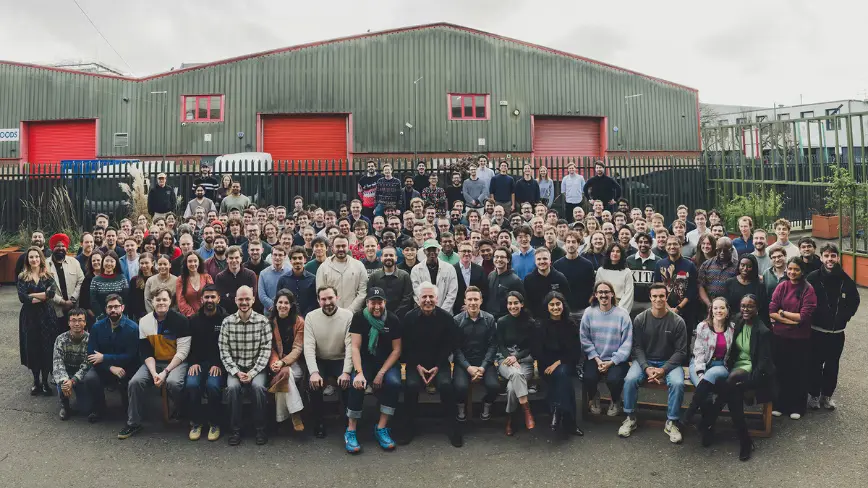
Rescale Secures $115 Million in Funding to Accelerate AI-Driven Engineering Simulations
08 Apr 2025•Technology
Recent Highlights



Recent Highlights
Today's Top Stories






Don’t drown in AI news. We cut through the noise - filtering, ranking and summarizing the most important AI news, breakthroughs and research daily. Follow topics that matter to you and stay ahead.


