Wave Energy Innovation: Eco Wave Power's Pilot Project in Los Angeles Port


3 Sources
[1]
New wave: Sea power turned into energy at Los Angeles port
Floating blue paddles dance on the waves that lap a dock in the Port of Los Angeles, silently converting the power of the sea into usable electricity. This innovative installation may hold one of the keys to accelerating a transition away from fossil fuels that scientists say is necessary if the
[2]
New wave: Sea power turned into energy at Los Angeles port
San Pedro (United States) (AFP) - Floating blue paddles dance on the waves that lap a dock in the Port of Los Angeles, silently converting the power of the sea into useable electricity. This innovative installation may hold one of the keys to accelerating a transition away from fossil fuels that
[3]
New wave: Sea power turned into energy at Los Angeles port
Floating blue paddles dance on the waves that lap a dock in the Port of Los Angeles, silently converting the power of the sea into useable electricity. This innovative installation may hold one of the keys to accelerating a transition away from fossil fuels that scientists say is necessary if the
Share
Copy Link
Israeli start-up Eco Wave Power launches a pilot project in the Port of Los Angeles, converting sea waves into usable electricity. The innovative technology aims to provide renewable energy and contribute to California's carbon neutrality goals.
Innovative Wave Energy Technology Debuts in Los Angeles
Israeli start-up Eco Wave Power has launched a groundbreaking pilot project in the Port of Los Angeles, showcasing a novel approach to harnessing wave energy. The installation features floating blue paddles that convert sea power into usable electricity, potentially offering a key solution in the transition away from fossil fuels
1
.
Source: Tech Xplore
How the Technology Works
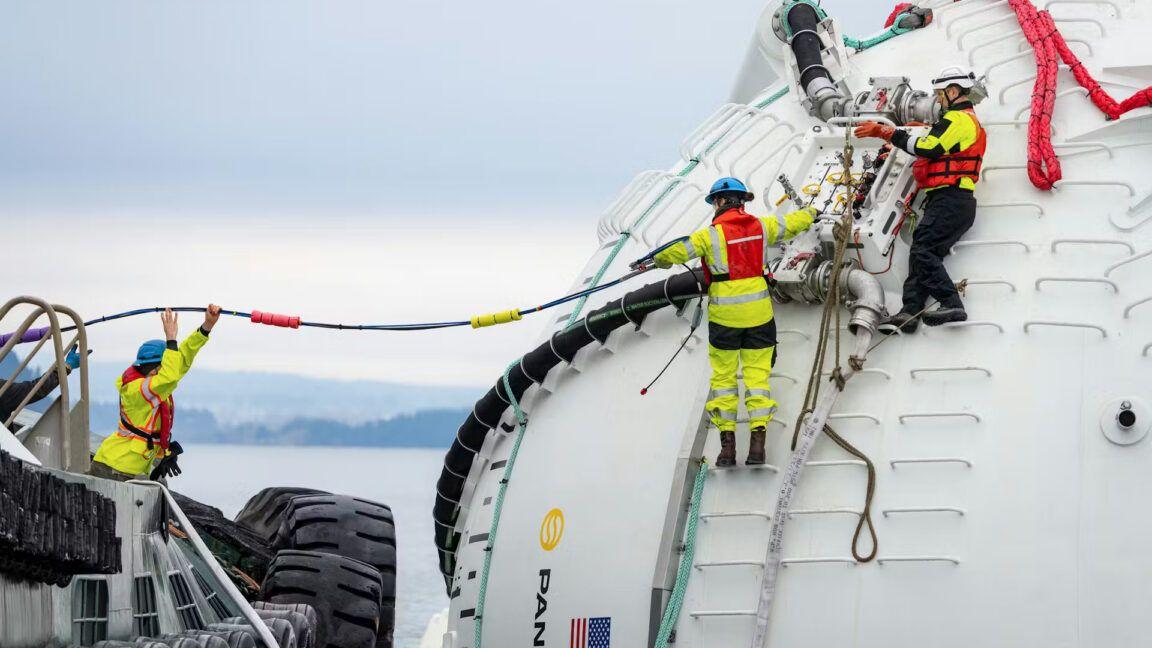
The system employs a simple yet ingenious design. Floaters, resembling piano keys, rise and fall with the waves, activating hydraulic pistons. These pistons push a biodegradable fluid through pipes to accumulators, which then release pressure to spin a turbine, generating electrical current
2
.Potential Impact and Expansion
If successful, the project could be scaled up to cover the entire 13-kilometer breakwater protecting the port. This expansion would generate enough electricity to power 60,000 US homes. Inna Braverman, co-founder of Eco Wave Power, envisions similar installations across the United States and globally
3
.Advantages Over Other Renewables
Wave energy offers distinct advantages over other renewable sources. Unlike solar power, which is inactive at night, or wind power, which depends on weather conditions, the sea is in constant motion. The US Department of Energy estimates that waves off the American West Coast could theoretically power 130 million homes, equivalent to about a third of the country's annual electricity consumption
1
.Overcoming Historical Challenges
The wave energy sector has faced significant hurdles in the past, with many projects failing due to the harsh conditions of the open sea. Eco Wave Power's approach differs by mounting the device on existing structures near the shore, making maintenance and inspection more manageable
2
.Related Stories



Expert Opinion and Future Prospects
Krish Thiagarajan Sharman, a professor of mechanical engineering at the University of Massachusetts Amherst, commends the design for its practicality. While noting that such extensive breakwaters are rare, he acknowledges the potential for smaller-scale applications, such as powering remote islands
3
.Global Expansion and Environmental Impact
Eco Wave Power is already expanding globally, with projects in Israel, Portugal, Taiwan, and India. The company aims to develop 20-megawatt projects to compete with wind power rates. Importantly, Braverman claims the installations have zero environmental impact, as they connect to existing man-made structures
1
.California's Energy Goals and AI Demand
The project aligns with California's ambition to achieve carbon neutrality by 2045. Jenny Krusoe, founder of AltaSea, which helped fund the project, emphasizes the growing energy demands driven by AI and data centers. She believes rapid deployment of this technology along the coastline is crucial for California's sustainable future
2
.References
Summarized by

Navi
[1]
[3]
Related Stories
Recent Highlights



Recent Highlights
Today's Top Stories



Don’t drown in AI news. We cut through the noise - filtering, ranking and summarizing the most important AI news, breakthroughs and research daily. Follow topics that matter to you and stay ahead.


