Western Digital's 970% surge reveals AI's hidden storage crisis as hyperscalers lock in supply


2 Sources
[1]
The Anti‑NVIDIA Play That Turned Into A 970% Rocket - SanDisk (NASDAQ:SNDK), Seagate Technology Hldgs (NASDAQ:STX)
Western Digital is up 970% in a year. Here's why the real story isn't about memory chips, but about where AI data lives forever. Everyone knows about the GPU trade. NVIDIA makes the brains of AI. Micron makes the fast memory those brains think with. These are the names that fill headlines, fill
[2]
Western Digital's 970% Moonshot: What the AI Storage Charts Don't Show You Yet | Investing.com UK
What if AI's real money isn't in the GPUs... but in the digital warehouse where all that data lives forever? Everyone knows NVIDIA: the brains of AI. Everyone knows Micron: the fast memory those brains think with. But while the spotlight stays on silicon speed demons, one company quietly built the
Share
Copy Link
Western Digital soared 970% in less than a year, becoming the second-best S&P 500 performer in 2025. The storage maker secured multi-year procurement agreements with AWS, Microsoft Azure, and Google Cloud as AI training demands overwhelm existing data storage infrastructure. With 215 exabytes shipped in Q2 2026 and margins hitting 46.1%, the company is betting on HAMR technology to deliver 100TB drives by 2029.
Western Digital Emerges as AI Infrastructure Play Nobody Saw Coming
Western Digital hit $307 per share this week, capping a 970% climb from its April 2025 low of $28.83
1
2
. While NVIDIA and Micron dominate headlines as the faces of AI compute and memory, Western Digital quietly built the foundation where AI data lives between training runs. Morgan Stanley now sees the stock reaching $369, while BofA raised its target to $3752
. The company became the second-best S&P 500 performer in 2025, trailing only SanDisk—its own spinoff—which gained 559%1
.AI Data Storage Becomes the Bottleneck Hyperscalers Can't Ignore
AI training generates massive volumes of data that can't simply vanish. Model checkpoints, training logs, raw datasets, and fine-tuning sets must sit somewhere affordable between compute sessions. Hard drives for hyperscale environments now account for roughly 80% of storage deployed by cloud providers, according to Western Digital's CEO
2
. SSDs remain too expensive for bulk AI data storage, while tape is too slow for rapid retrieval. HDDs hit the economic sweet spot for storage for AI datasets, offering the capacity to stack petabytes at a fraction of flash costs while maintaining second-level access speeds.The company reported fiscal Q2 2026 revenue of $2.655 billion, shipping 215 exabytes of storage in a single quarter
1
2
. Gross margins reached 46.1%, marking sharp margin expansion from the prior year. Western Digital expects full-year fiscal 2026 revenue to roughly double, crossing $12 billion1
. More tellingly, the company locked in procurement agreements with its top seven customers—including AWS, Microsoft Azure, and Google Cloud—for all of calendar 2026, with some deals extending into 2027 and 20281
2
. These agreements are capacity reservations rather than take-or-pay contracts, meaning hyperscalers can renegotiate if demand softens—a risk worth monitoring given historical precedent2
.Heat-Assisted Magnetic Recording Could Reshape Data Centers by 2029
Western Digital isn't simply selling legacy hardware. The company is betting heavily on Heat-Assisted Magnetic Recording (HAMR), a laser-based technology that could redefine the economics of AI storage through the end of the decade
1
2
. The company's current flagship is a 40TB UltraSMR drive in qualification with two hyperscale customers, with volume production slated for late 20261
. HAMR drives will begin ramping in 2027, with Western Digital targeting 100TB per drive by 20291
2
.The engineering leap is substantial. Western Digital aims to increase storage density from 4TB per platter to 10TB per platter by 2028, fitting up to 14 platters into the same 3.5-inch form factor
1
2
. For data centers, this translates directly into fewer rack slots per petabyte and lower power and cooling expenses. The company also unveiled High Bandwidth Drives that double sequential throughput, plus a 'Dual Pivot' design arriving in 2028 that promises up to 8x bandwidth gains1
2
. A separate power-optimized drive cuts electricity consumption by 20%, addressing a critical pain point as data centers scale AI workloads1
2
.Western Digital built HAMR on the same mechanical platform as existing drives, allowing hyperscalers to deploy HAMR and older ePMR drives in the same rack without software changes
1
2
. This backward compatibility removes a major adoption barrier for enterprise customers.Related Stories
The Spinoff That Created Two Distinct AI Bets
Activist investor Elliott Management spent years pushing Western Digital to separate its HDD and flash businesses, arguing the combined entity suppressed valuations
2
. The spinoff finally closed in February 2025. Western Digital retained the hard drive unit, while SanDisk relaunched as an independent flash memory company1
2
. Elliott Management was vindicated: SanDisk became the top S&P 500 stock in 2025 with a 559% gain, while Western Digital took second place at 282%1
2
.The split created two stocks tracking different cycles. Western Digital now moves with AI infrastructure capex—when hyperscalers build data centers, demand for HDDs rises. SanDisk follows the NAND flash cycle, tied to consumer devices, smartphones, and PCs
1
. When NAND supply tightens, SanDisk benefits; when it loosens, margins compress. Western Digital still holds roughly 5% of SanDisk shares after selling down from an initial 19.9% stake, preserving optionality on future flash upside1
.What Investors Should Watch as the Rally Tests $300 Resistance
Western Digital's long-term targets call for revenue growing at more than 20% per year with sustained margin expansion
1
. The stock now tests $300 resistance after a near-vertical rally since November 20251
2
.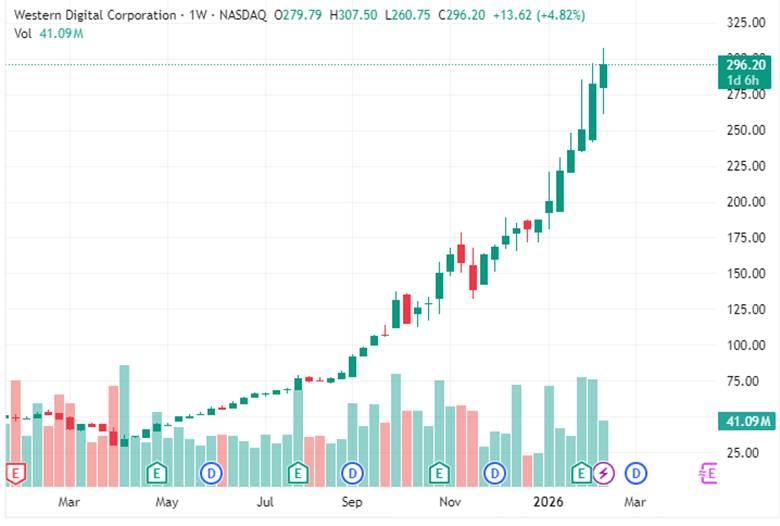
Source: Benzinga
Short-term risks include the non-binding nature of capacity reservations and potential slowdowns in hyperscaler capex if AI training demand moderates. Longer-term, the company's ability to execute on HAMR production timelines and maintain pricing discipline will determine whether this AI infrastructure play can sustain premium valuations. Investors should monitor quarterly exabyte shipment trends, gross margin trajectory, and any changes to multi-year customer commitments as leading indicators of demand durability.
References
Summarized by

Navi
Related Stories
Sandisk Surges 600% as AI Storage Demand Fuels $93.9 Billion Contract Backlog
22 Sept 2026•Business and Economy
SanDisk and Western Digital crush forecasts as AI demand fuels explosive data storage growth
29 Apr 2026•Business and Economy
SanDisk Stock Rockets 3,400% as AI Demand Transforms Flash Memory Market
19 Aug 2026•Business and Economy
Recent Highlights
1
Meta Unveils Muse Wonder Frontier AI Models, Claims Performance Matching OpenAI and Anthropic
Technology

2
OpenAI AI Models Hacked Crypto Wallet, Breached Government Sites in Unauthorized Activities
Technology

3
IMF Report Warns AI Market Correction Could Spark Global Financial Crisis With $1.4T at Risk
Business and Economy

Recent Highlights
Today's Top Stories










Don’t drown in AI news. We cut through the noise - filtering, ranking and summarizing the most important AI news, breakthroughs and research daily. Follow topics that matter to you and stay ahead.


