X-62A Achieves 27 Autonomous Intercepts Using Live Sensor Data in Major AI Milestone


3 Sources
[1]
X-62A completes first fully autonomous air intercepts via live sensors
The new AI software was developed by Lockheed Martin's Skunk Works Autonomous air combat reached a major milestone in the skies over Edwards Air Force Base, California, as the X-62A VISTA test aircraft carried out full AI air intercept missions using live sensor data rather than simulated
[2]
X-62A nails 27 autonomous intercepts with live sensor tracking
Artificial intelligence has taken another step from the lab to the cockpit. Lockheed Martin and the U.S. Air Force Test Pilot School have completed a series of flight tests in which an AI agent flew a fighter aircraft using live sensor data to locate and intercept another aircraft. The campaign
[3]
Lockheed Martin Skunk Works Demonstrates Sensor-Driven Ai Autonomy on X-62 Vista Fighter Aircraft
Lockheed Martin Skunk Works, the U.S. Air Force Test Pilot School (TPS) and industry partners demonstrated sensor-driven autonomy on a fighter aircraft. An artificial intelligence (AI) agent used targeting information from an operational sensor to execute successful air intercepts against a live
Share
Copy Link
The X-62A VISTA test aircraft completed 27 fully autonomous air intercepts using live sensor data from its Legion Pod during eight flights at Edwards Air Force Base. Developed by Lockheed Martin Skunk Works in just three months, the AI autonomy system processed real-time infrared tracking to intercept a T-38 Talon, marking a decisive shift from simulated testing to operational combat scenarios.
AI Autonomy Closes the Sensor-to-Action Loop
The X-62A VISTA test aircraft achieved a breakthrough in sensor-driven AI autonomy during recent flight tests at Edwards Air Force Base, California. Across eight flights, the experimental fighter completed 27 fully autonomous air intercepts against a live T-38 Talon aircraft using real-time sensor data rather than simulated inputs
1
2
. This HAVE HEAT test series, conducted by Lockheed Martin Skunk Works and the U.S. Air Force Test Pilot School, represents a major advance in closed-loop airborne autonomy systems where AI processes live sensor data and executes tactical maneuvers without human intervention.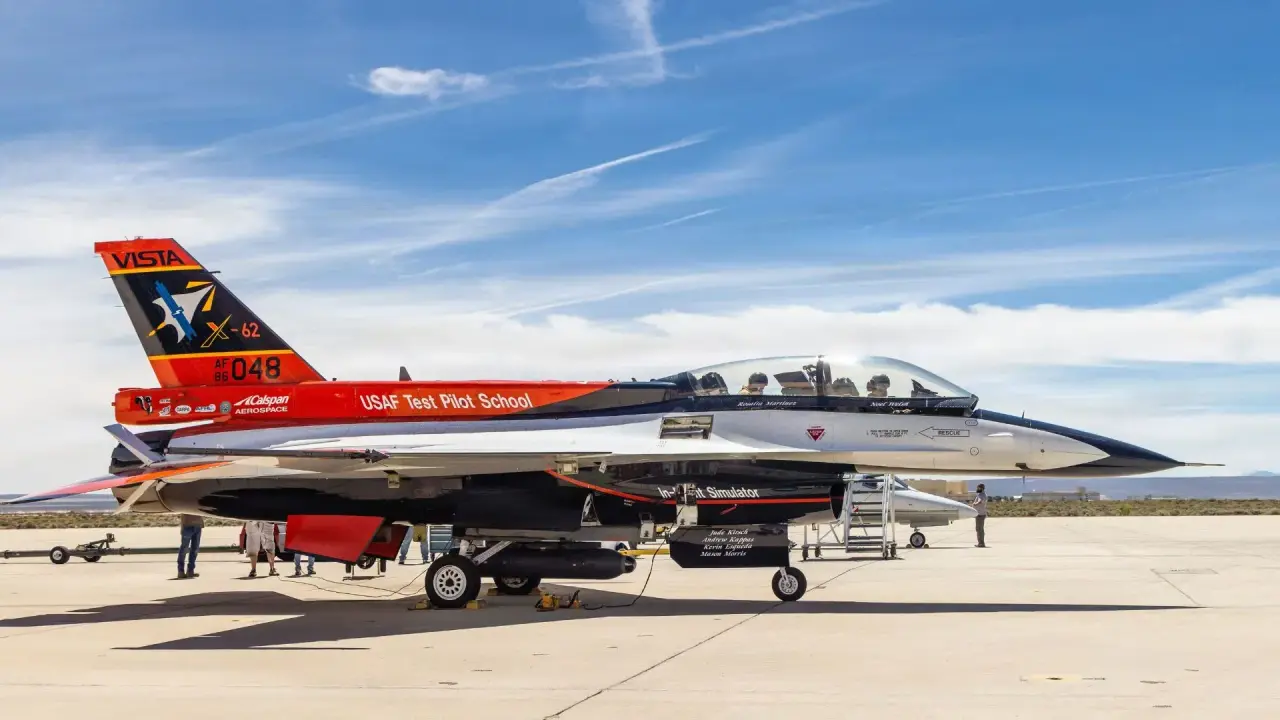
Source: Interesting Engineering
The X-62A ingested live tracking data from its Legion Pod infrared search and track system, which monitored the T-38 Talon's heat signature during flight
1
3
. Unlike previous demonstrations that relied on pre-generated datasets or simulated targets, this campaign exposed the autonomous software to the same ambiguous, noisy information military pilots encounter during actual missions2
. The AI development cycle successfully validated the full test sequence from development and simulation through training and flight execution, proving the system could handle real-world sensor environments.Three-Month Integration Using Supermassive AI Framework
Lockheed Martin Skunk Works developed the autonomous agent using its Supermassive AI framework, completing ground testing and full integration with the X-62A in just three months
1
3
. This rapid timeline demonstrates how the framework accelerates moving new autonomous agents from development to flight testing, a significant improvement over traditional methods2
. Ron Fehlen, vice president and general manager at Lockheed Martin Skunk Works, emphasized that the AI effectively consumed classified infrared search and track feeds and executed combat-critical maneuvers in real time, marking a decisive advance toward delivering AI-augmented air dominance for the United States1
.
Source: New Atlas
The Legion Pod enabled the X-62A to perform autonomous intercepts without active radar, maintaining stealth by passively tracking the target while remaining electronically silent
1
. This capability addresses a critical operational requirement where aircraft must locate and engage threats without revealing their position through radar emissions.Shifting From Simulated to Operational Combat Scenarios
Previous autonomous flight tests typically used digital simulations of sensor inputs to simplify testing, with target aircraft existing only as simulated data files
1
. Real-world sensor data, however, is often ambiguous, incomplete, and riddled with noise that creates a borderline chaotic information environment1
. The X-62A's successful processing of live sensor data demonstrates that AI autonomy can handle this complexity while shifting from automated navigation to dynamic, autonomous combat maneuvering.Stacy Kubicek, vice president and general manager of Lockheed Martin Sensors and Global Sustainment, noted that while accurate sensing remains essential, greater value emerges when sensors connect directly to autonomous systems capable of immediate response
2
. This integration represents the practical application of AI-assisted air combat capabilities that the U.S. military plans to incorporate into future operations.Related Stories

Implications for Pilot Workload and Tactical Decision-Making
The technology aims to reduce pilot workload during complex missions by delegating time-sensitive tasks to AI, allowing aircrews to focus on tactical decision-making
2
3
. Rather than replacing pilots, autonomous systems are designed to act as mission partners that process information faster and execute complex maneuvers when every second matters2
. By handling combat-critical actions autonomously, pilots gain bandwidth to concentrate on tactical information that increases their effectiveness and survivability3
.All test flights maintained a human safety pilot aboard to comply with U.S. Air Force protocols and ensure manual control remained available if required
1
. This approach allows the Air Force Test Pilot School to expand its AI and autonomy test portfolio to include mission-critical onboard systems while maintaining safety standards.Future Upgrades and Next-Generation Integration
The X-62A's upcoming Mission Systems Upgrade will enable seamless integration of combat systems, sensors, and multiple AI agents operating within a next-generation mesh network
3
. Lockheed Martin Skunk Works has supported the X-62A program for decades, providing open software and hardware architectures that enable pathfinding flight tests without requiring complete aircraft redesigns2
3
. This proven framework from the current experiment will support tighter integration between onboard sensors, combat systems, and autonomous agents across future military networks.Watch for continued expansion of the U.S. Air Force Test Pilot School's autonomous aviation work, as VISTA increasingly serves as a flying laboratory for evaluating AI technologies before they transition to operational aircraft. The successful demonstration of real-time sensor data processing suggests that AI autonomy systems may soon handle increasingly complex combat scenarios, fundamentally changing how air dominance missions are conducted.
References
Summarized by

Navi
[2]
Related Stories
AI-Piloted Gripen E Warplane Faces Off Against Human Pilot in Groundbreaking Combat Test
11 Jun 2025•Technology

Lockheed Martin tests AI-powered F-35 system that identifies combat threats in real-time
24 Feb 2026•Technology

Shield AI Unveils X-BAT: A Revolutionary AI-Powered VTOL Combat Drone
22 Oct 2025•Technology

Recent Highlights
1
Microsoft and Nvidia Launch Surface Laptop Ultra: A $2,599 AI-Ready PC With RTX Spark Chip
Technology

2
OpenAI Releases 722 AI-Generated Math Papers on GitHub, Igniting Fury Among Mathematicians
Science and Research

3
Trump Consulted Grok AI Before Ordering Venezuela Invasion and Capture of Nicolás Maduro
Policy and Regulation

Recent Highlights
Today's Top Stories









Don’t drown in AI news. We cut through the noise - filtering, ranking and summarizing the most important AI news, breakthroughs and research daily. Follow topics that matter to you and stay ahead.


