XCENA raises $135M on a bet that AI's real bottleneck is memory, not compute


2 Sources
[1]
This chip startup just raised $135M on a bet that AI's biggest bottleneck isn't compute -- it's memory
Every time you ask ChatGPT a question, your request triggers a data relay race. Information leaves memory, passes through a CPU for preprocessing, travels to a GPU for heavy computation, and then makes its way back -- and that entire journey repeats for every single word the AI generates. The
[2]
XCENA raises $135M for its computational memory controller
XCENA Inc., a startup with a memory device designed to speed up artificial intelligence clusters, today announced that it has raised $135 million in funding. The Series B round was led by Korean funds Atinum Investment and IMM Investment. XCENA says that the raise also included contributions from
Share
Copy Link
XCENA, a chip startup founded by Samsung and SK Hynix veterans, secured $135 million in Series B funding at a $570 million valuation. The company's MX1 chip addresses the AI memory bottleneck by placing compute capabilities directly near DRAM, eliminating costly data round trips between CPUs, GPUs, and memory that slow down AI inference and drive up infrastructure costs.
XCENA Secures Major Funding to Tackle AI Memory Bottleneck
XCENA raises $135M in Series B funding at a valuation of $570 million, bringing its total capital raised to $185 million since its founding in 2022
1
. Seoul-based venture capital firms Altinum and IMM Investment co-led the round, alongside Corstone Asia and existing investors SBI Investment and Mirae Asset Capital1
. The funding arrives as the startup positions itself to address what CEO Jin Kim describes as a fundamental shift in AI infrastructure toward memory-centric architecture1
.Addressing the AI Memory Bottleneck with Computational Memory
Every AI inference request triggers an inefficient data relay race. Information travels from memory through a CPU for preprocessing, moves to a GPU for computation, then returns—a journey that repeats for every word generated by large language models
1
. This structural AI memory bottleneck routes data through expensive, power-intensive chips on every request. XCENA's solution places compute capabilities directly near DRAM, the fast, short-term memory chips that store actively-used data, allowing routine operations to be handled without costly round trips1
. The company operates on the thesis that "inference isn't just a compute problem; it's increasingly a memory scaling problem," according to CEO Kim1
.MX1 Chip Brings Compute to Data
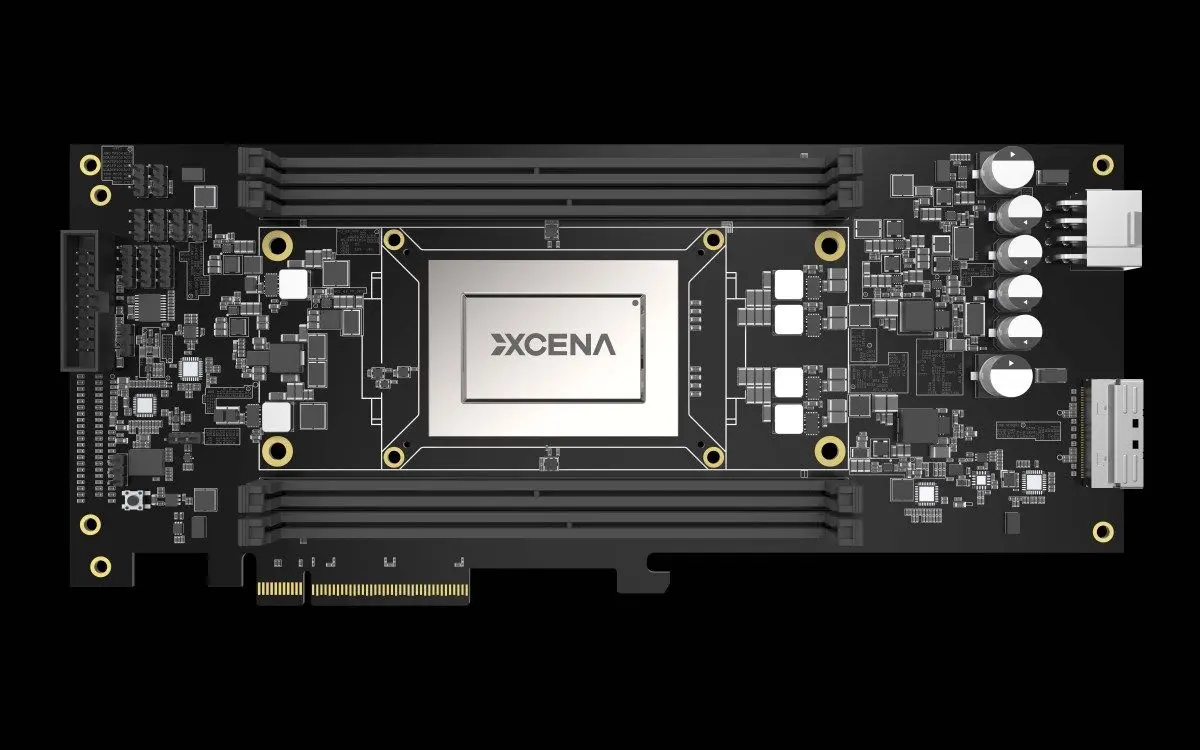
Source: TechCrunch
The MX1 chip functions as a computational memory controller that combines up to two terabytes of DRAM with several thousand CPU cores based on the open-source RISC-V architecture
2
. It connects to processors through CXL (Compute Express Link), processing data before it needs to leave the memory module1
. The device can hold KV caches—the system that stores prior conversation context so models don't reprocess it—and vector databases without the performance issues affecting traditional memory devices2
. XCENA claims what previously required 10 servers could potentially run on just one1
.Targeting AI Infrastructure Costs at Hyperscale
XCENA's ideal customers are hyperscalers spending tens of billions annually on AI infrastructure, where even small gains in memory efficiency translate to hundreds of millions in savings
1
. While GPUs excel at matrix multiplication for AI model training, much of the surrounding data orchestration—including preprocessing, KV cache management, and data caching—still runs on CPUs. The MX1 handles those tasks directly within the memory module itself1
. The chip can also accelerate AI inference workloads and analytics applications such as Apache Spark by reducing data travel times between components2
.Related Stories

From Prototype to Production
The MX1 remains a prototype, with mass production chips scheduled to roll off Samsung's foundry lines using a four-nanometer process by the end of 2026
1
2
. XCENA expects to generate revenue starting in 20271
. The company was founded by Jin Kim (CEO), Dohun Kim (CTO), and Harry Juhyun Kim (CPO), all veterans of Samsung and SK Hynix, the memory giants supplying chips that power Nvidia's GPUs1
. Early-stage conversations with several global memory vendors are underway, though Kim declined to name them1
.Market Timing and Competitive Landscape
Demand for memory solutions has surged since the second half of last year, and recent rises in memory prices point to a broader shift toward memory-centric architectures
1
. This month, the three companies dominating the global memory chip market—Samsung, SK Hynix, and Micron—each crossed a trillion-dollar valuation for the first time1
. XCENA's closest rivals include Astera Labs and Marvell, both Nasdaq-listed companies working on next-generation memory connectivity1
. The company differentiates itself through intellectual property, with "thousands of cores" compared to Marvell's handful of general-purpose cores1
. XCENA designs its own internal memory hierarchy, interconnect bus, and DRAM controller—a level of vertical integration most chip companies typically outsource1
. The company plans to use Series B funding to develop new computational memory products and establish partnerships with key industry players2
.References
Summarized by

Navi
[1]
[2]
Related Stories
MatX AI chip startup raises $500 million to challenge Nvidia's dominance in LLM processing
25 Feb 2026•Startups

Former Google and Meta Executives Launch Majestic Labs with $100M to Revolutionize AI Server Architecture
10 Nov 2025•Startups

Cerebras Systems Raises $1.1 Billion in Pre-IPO Funding Round, Challenging Nvidia in AI Chip Market
30 Sept 2025•Business and Economy

Recent Highlights



Recent Highlights
Today's Top Stories






Don’t drown in AI news. We cut through the noise - filtering, ranking and summarizing the most important AI news, breakthroughs and research daily. Follow topics that matter to you and stay ahead.


