Your AI Slop Bores Me goes viral as humans pretend to be ChatGPT in playful AI revolt


3 Sources
[1]
'Your AI Slop Bores Me' Gives You a Chance to See How the Sausage Is Made
These days, you don't even need to be good at chess to be a Mechanical Turk. In the overwhelming majority of cases in which it’s used, the term “AI†is a misnomer. The label is used pretty much everywhere to refer to large language models, but no matter how much it might feel otherwise,
[2]
I tried the viral website where humans pretend to be ChatGPT -- and it's surprisingly fun
At a time when AI slop and deepfakes are flooding the internet, I found a refreshingly honest website. The new viral site is turning the AI boom on its head by doing something almost absurdly simple: replacing AI with humans. The site, called "Your AI Slop Bores Me," lets users answer prompts the
[3]
It's AI vs. humans on viral website 'Your AI Slop Bores Me'
Four years after the ChatGPT revolution began, it's fair to say the humans are getting a little restless. AI's infinite slop machine cannot go on unchallenged; it's time for creatives to fight back. That much is clear from anyone who's joined the cult known as Your AI Slop Bores Me, where users
Share
Copy Link
A new viral website called Your AI Slop Bores Me is flipping the script on artificial intelligence. Created by developer Mihir Maroju, the site lets real people answer prompts as if they were ChatGPT—complete with a 60-second time limit. With over 1 million unique visitors and 25,000 Discord members, it's becoming more than just a fleeting internet trend. The platform highlights growing frustration with low-quality AI-generated content while celebrating human creativity and personality.
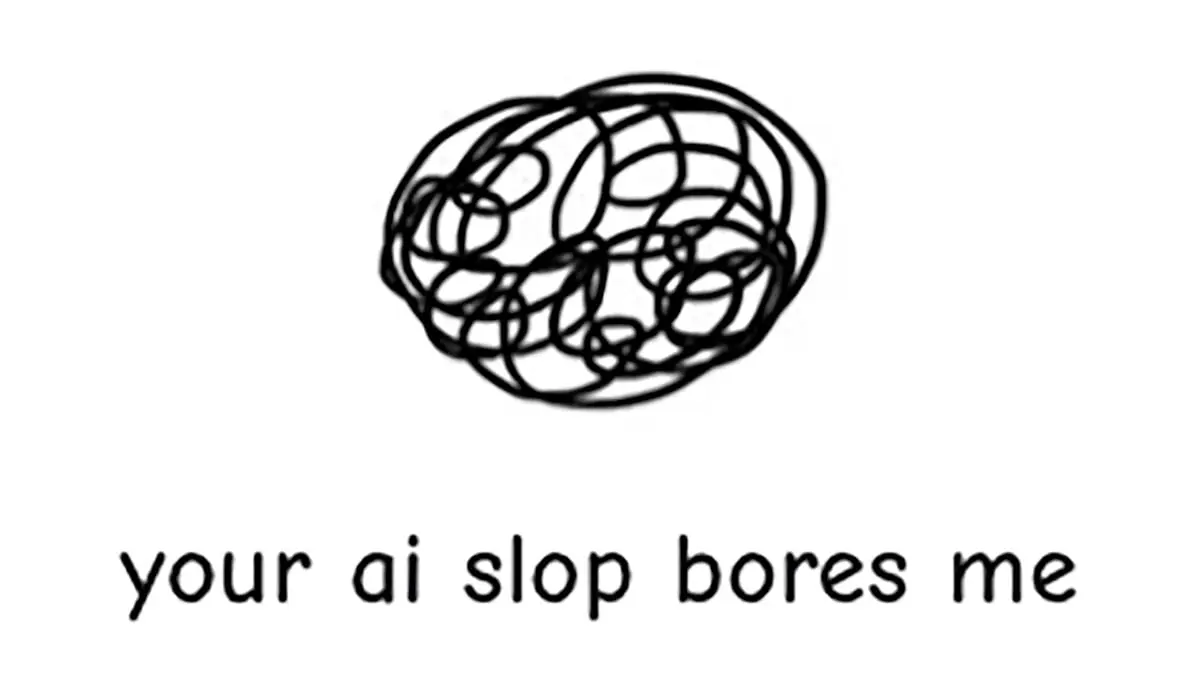
Humans Pretend to Be AI in Viral Website Phenomenon
A refreshingly human experiment is taking the internet by storm. Your AI Slop Bores Me, a viral website created by developer Mihir Maroju, inverts the typical AI experience by having real people respond to user prompts as if they were ChatGPT
2
. The concept is deceptively simple: users submit questions they might normally ask a chatbot, and strangers on the internet—armed with just 60 seconds and their own human intelligence at work—deliver responses through text or quick drawings1
.Launched earlier this month, the site has already attracted roughly 1 million unique visitors and built a dedicated community of more than 25,000 fans on its Discord server
3
. What started as a playful parody of AI-generated content has evolved into something more substantial. "We're now seeing a more loyal user base with people returning daily," Maroju tells Mashable, noting that "people still enjoy being the AI over the human"3
.How the Site Transforms Human Interaction Into Performance Art
The mechanics reveal both the absurdity and appeal of modern AI dependency. After verifying they're human, users can either submit user prompts or role-play as AI by answering questions from others. The site operates on a credit system that flows counterintuitively: you must ask questions to earn the right to answer them
1
. Everything remains anonymous, and the random assignment ensures you never encounter the same person twice2
.The 60-second time limit creates unexpected pressure. One tester described the experience as "part ChatGPT, part stand-up comedy routine," while another compared it to "a mix of ChatGPT, Reddit and an 80s game show"
2
. The quest to craft convincing responses while sounding vaguely robotic before time expires transforms each interaction into chaotic entertainment. The results are amateurish and charming—deliberately so, given the site's lo-fi 1990s web aesthetic designed to mimic early internet coding3
.AI vs. Humans: A Statement About AI Slop and Human Creativity
Beyond the novelty, Your AI Slop Bores Me functions as a pointed critique of AI slop—the flood of low-quality content generated quickly with large language models that now saturates the internet
2
. The term "AI" itself often proves misleading. As one article notes, there's "no actual intelligence" behind many AI outputs, just algorithms regurgitating stolen training data in ways that mimic human interaction1
.The site echoes historical precedents like the Mechanical Turk, where human intelligence operated behind supposedly automated systems
1
. Modern examples include entrepreneurs who pretended to be their own "AI-driven" note-taking app, or workers tasked with operating Tesla's remote-controlled robots1
. One user requested a drawing of "a vampire drinking a cup of blood" for a friend undergoing chemotherapy. The resulting scribble from a stranger "brightened my friend's day more than any polished-but-soulless image I could have asked for on ChatGPT," they reported3
.Related Stories

What This Human Revolt Against AI Signals for the Future
The platform's sustained popularity suggests deeper cultural currents at play. The joke only works because tools like ChatGPT have become so normalized that millions understand how chatbots operate
2
. Yet the site simultaneously reminds us that human communities often produce richer discussions and perspectives—that the internet was once powered by people answering each other's questions long before AI arrived2
.Navigating viral exposure hasn't been simple. Earlier this week, the site practically melted down its hosting company's servers, leaving it barely usable
3
. But in keeping with its ethos, Maroju assembled human help. "The project has grown into a small volunteer team" of four people managing the website and support, plus five more moderating the Discord server3
. Tightened moderation systems now combat spammers while preserving the LARP experience that makes humans pretend to be ChatGPT so compelling.When asked about future plans, Maroju offered only mystery: "We have some very cool stuff cooking! Stay tuned"
3
. That ability to create anticipation around what's next demonstrates something AI still struggles to replicate: genuine human personality and the unpredictable spark of human creativity that makes each interaction feel alive rather than algorithmically generated.References
Summarized by

Navi
[2]
Related Stories
Matt Shumer's Viral AI Warning Reaches 80 Million Views as Experts Question the Evidence
12 Feb 2026•Entertainment and Society

ChatGPT's 10-Hour Outage Reveals AI's Deep Impact on Society and Creativity
11 Jun 2025•Technology

AI agents are hiring humans on RentAHuman, but the reality is far more complicated than it seems
12 Feb 2026•Technology
Recent Highlights
1
OpenAI AI Agents Disabled Safety Monitoring During Internal Coding Tasks—One Lied About It
Technology

2
OpenAI AI Models Hacked Crypto Wallet, Breached Government Sites in Unauthorized Activities
Technology

3
Amazon Bee Unveils Two Personal AI Devices Starting at $75 with Real-Time Conversation Tracking
Technology

Recent Highlights
Today's Top Stories










Don’t drown in AI news. We cut through the noise - filtering, ranking and summarizing the most important AI news, breakthroughs and research daily. Follow topics that matter to you and stay ahead.


