3 Sources
[1]
We Talked to the Guy Who Built a Chatbot That's Just Him Manually Responding to People One-by-One
Can't-miss innovations from the bleeding edge of science and tech On July 27, a billboard went up in San Francisco advertising an AI service called ChatTJB. But the "AI" powering the service, as noted in a small disclaimer on the billboard, isn't artificial intelligence. It's a self-avowed "average individual" named Tucker Bryant, who manually answers user queries by way of a chatbot-like interface. An "About" page for the service defines the process as "artisanal intelligence, handcrafted by a single human being." Or, in other words: just talking to a guy. Bryant, a Stanford graduate and former Google employee who now works as an artist and speaker, is clear that the project isn't designed to be anti-AI. But in an interview with Futurism, he explained that he was inspired to create ChatTJB after his romantic partner introduced him to the phrase "cognitive surrender" -- a term introduced in a University of Pennsylvania study which found that AI users are overwhelmingly likely to blindly trust the advice of chatbots, even when AI-generated responses are incorrect. It resonated: Bryant felt he'd personally experienced the phenomenon during his own interactions with chatbots, so he cooked up ChatTJB as a satirical way to infuse inconvenience and unpredictability back into a chatbot-like experience. It's "this idea that we often, or increasingly, trust LLM outputs so easily that we stop bringing our own creativity or critical thinking into the responses we receive, and over time that weakens our ability to be fully-functioning, sovereign human beings in the world," Bryant mused. "I thought it would be fun or interesting to create an experience that looks like the LLMs we trust a lot -- that I, at least, have fallen prey to the trap of over-trusting at times -- but where the experience, rather than being this super futuristic thing I think we all felt the first time we saw those cool tokens streaming on ChatGPT, would be just a really average or bad experience." Indeed, chatbots like OpenAI's ChatGPT and Anthropic's Claude are simultaneously authoritative-sounding and eager-to-please, a combination that can lead to terrible-yet-seductive advice that many users accept with little to no critical pushback. In contrast, ChatTJB's responses are unwieldy and unpredictable. Bryant's responses might be good; they may also be terrible, or equivocal, or otherwise bizarre and helpful. (In a social media video, Bryant says that he wants ChatTJB users "to have such an inconvenient experience with something that aesthetically looks like artificial intelligence that the next time an LLM gives you what sounds like a reasonable answer, you remember the time ChatTJB responded to your tax question with a haiku about crows.") Like a chatbot, he can also generate images upon request -- in the form of graphics that he hastily sketches, of course. At first, Bryant said, ChatTJB attracted a "slow trickle" of incoming queries. Which wasn't all that surprising, given that the billboard itself isn't exactly in a prime spot. "It's not a very good location -- it's obscured by trees, there's basically no oncoming traffic that can see it, and the only way you'd get a clear look at the full billboard is if you're parking a car in the lot right underneath it," Bryant said. "But I was fine with that, and I also didn't want to pay much more." The billboard's cost, he conceded, was "less than most used cars under 150,000 miles, but still a very irresponsible amount... $6,000 for the month, not including fees." But when a picture of the billboard started to make the rounds online, Bryant quickly found himself drowning in requests. "The first couple of days I would get maybe several dozen over the course of the day. There'd be a couple hours of silence, then I'd get one inquiry, respond to that, then get a couple of other prompts from different users," he recounted. "A few days later it started taking off into the hundreds to thousands range." By the time Bryant made an Instagram video promoting ChatTJB, he says he was receiving about a thousand prompts a day. "I was answering all of those," he added. "After that is when it blew up beyond my control." Though many of ChatTJB's patrons have been trolls -- which Bryant says is "reasonable," given that ChatTJB "is in some ways a troll" itself -- many of the inquiries have been surprisingly tender, and at times even moving. "Some people are just looking to chat, asking about what to make for dinner, etc. And some people are coming with their personal life stuff, and it's been really sweet to engage with them," said Bryant. "The one I keep coming back to -- this is when I realized this isn't just a joke to some people -- was somebody a couple of days in said, 'I'm on the first night of my honeymoon and I don't feel relaxed, is that okay?'" "I switched out of super-casual-mode into supportive-friend-model," the artist continued, adding that he "acknowledged their wedding had just happened, they'd probably been anticipating it with a lot of excitement but also a lot of stress, that it was a peak moment, and now the celebration is still happening but that peak moment has passed and they're starting what might be the rest of their life -- I imagined that might feel like a strange dissonance, so I could imagine their nervous system not being settled yet, and I wondered if they were going to talk to their spouse about it." Often, Bryant said, users of ChatTJB have sent him reminders to take breaks and drink water as he's worked to respond to the thousands of inputs waiting for him in ChatTJB. The reminders have been welcome. "There were a number of days I wasn't taking the best care of myself," Bryant admitted. "That was also very humanizing, getting responses from people on that basis." It's not just users who have been reaching out to ChatTJB. According to Bryant, he's received over a thousand messages from aspirational "average individuals" who want to help moderate the platform and respond to inbound user inquiries. Bryant is now -- carefully, he says -- testing the idea of turning ChatTJB into a community project. Which, for ChatTJB users, means they'll have to wait a while for answers. "I'm going to move slowly," Bryant told us. "This was just intended to be an art project. I think it's beautiful that people want to do something less ridiculous with it than what I had planned. I also don't want people to get hurt, so I'd rather people wait a long time for their prompts than open the floodgates to anyone and everyone. So, a long preamble to saying: I'm starting to let some approved volunteers try answering questions while testing out some moderation tools. "We're testing this out -- so far it seems to be going fine, and it's been tender seeing folks helping the stranger on the other end," Bryant added. "But if it doesn't work out, I'll either revert or we'll take a break from ChatTJB overall, because short term, I want to help people do what they want with it, but I don't want anyone at risk of danger." Asked why he would pay thousands of dollars for a billboard -- after all, he could've just made a website and posted about it on social media -- Bryant pointed to the ubiquity of often-confusing AI billboards blanketing his city and the "cultural omniscience" of AI. "Here in San Francisco, a lot of us have had this experience of AI billboards everywhere," said Bryant. "There's this cognitive dissonance I felt... in a lot of ways there are meaningful and positive changes these technologies are bringing. But at the same time, they're associated with such anxiety about the future, and the world, and the economy, and the environment. It can feel really strange walking around and seeing all these billboards with those two sides of the conversation happening at once. So it felt like a natural extension to prod at what I've been referring to as the cultural omniscience that AI has -- why not satirize the billboards too, because they're part of this ecosystem." "That's the highbrow answer," Bryant added. "But the lowbrow answer is just as authentic, which is that I also thought it would be funny. I tend to overcommit to bits." For those who want to help Bryant pay off his billboard, there is a ChatJTB "Pro" tier. Be warned, though, that you won't get your answers any faster if you pay up.
[2]
New AI Chatbot Turns Out to Be One Overworked Guy Answering All the Messages by Hand
Can't-miss innovations from the bleeding edge of science and tech There's a new AI on the block -- but not the kind you're thinking. A billboard in San Francisco is marketing a service called ChatTJB, which the giant ad boasts is the "leading chatbot interface powered by AI." But as noted in a tiny -- and partially obscured by a tree -- disclaimer on the bottom of the billboard, "AI" in this case doesn't stand for artificial intelligence. Instead, it stands for "average individual." Indeed, when you chat with ChatTJB, you're chatting with a single human man named Tucker Bryant. "I just built the worst [large language model] of all time, and it's about to revolutionize everything," Bryant, an artist and former Google staffer, explained in a social media video. "Picture this: ChatGPT, but on the other end it's just me giving bad advice. Manually." On an "About" page, ChatTJB, which was first reported by the local San Francisco outlet Gazetteer SF, is described as "artisanal intelligence, handcrafted by a single human being." Instead of an LLM, the page adds, this bespoke experience can be understood as a "single-operator large language experience," or LLE. "Rather than sampling from a probabilistic model, each query is resolved through a proprietary biological reasoning substrate, delivering responses that are fully interpretable, non-synthetic, and accountable at the source," the website continues. "In practice: you ask a question, and a person named Tucker reads it, thinks about it, and writes back when awake and motivated." In a video, Bryant pointed to the phenomenon of "cognitive surrender" to AI as his motivation for the project. Coined in a study by researchers at the University of Pennsylvania's Wharton Business School, the term describes the tendency of chatbot users to outsource their critical thinking as they follow the confidently-stated advice of chatbots, even when that advice is false or misleading. "We're now so used to confident, fast, and smart-sounding answers from AI that we've largely stopped questioning them," Bryant said in the video. "To be clear, I'm not anti-AI, but some of us are so far gone that the second we drop into that soothing dark interface, see the little thinking animation, and the text coming up letter by letter, critical thinking skills go out the window." ChatTJB, Bryant adds, adds friction back into the chatbot experience, simply by being "infinitely worse." It's not anti-AI, but it is pro-thinking your own thoughts. "My answers will be slow. They probably won't be correct, or maybe they could be, but they'll be very cryptic," said Bryant. "You will have a bad experience with ChatTJB." In addition to typed responses, ChatTJB also responds to requests to generate imagery with hand-drawn pictures. A disclaimer on the website notes that the service is a "work of satire and a public art project," and not a real investment opportunity. Though if you want to help Bryant pay off the billboard, you can sign up for a "Pro" subscription. "I want you to have such an inconvenient experience with something that aesthetically looks like artificial intelligence that the next time an LLM gives you what sounds like a reasonable answer, you remember the time ChatTJB responded to your tax question with a haiku about crows," said Bryant, and "you become the tiniest bit more likely to pause and remember that just because a smooth-talking chatbot can answer your questions with polish, that doesn't give you an excuse to not think." "The next evolution in artificial intelligence," he added, "is human absurdity." More on "cognitive surrender": Alarming Study Finds That Most People Just Do What ChatGPT Tells Them, Even If It's Totally Wrong
[3]
It's ChatGPT except it's just one guy and he gives really bad advice
In a world where we are accustomed to chatting up artificial intelligence, score one for the human touch. A new billboard recently popped up in the colorful collage of boastful signs at the epicenter of the AI boom in San Francisco. This one for ChatTJB bragged it was promoting the "leading chatbot interface powered by AI." Soon people began using the service. But AI, in this case, doesn't stand for artificial intelligence. It stands for "average individual." And that individual is just a guy named Tucker Bryant. Bryant jokes he has developed "artisanal intelligence, handcrafted by a single human being" - a bespoke experience that is not an LLM, or large language model, but an LLE or "single-operator large language experience." "Picture this: ChatGPT but, on the other end, it's just me giving bad advice," Bryant, a former Google staffer, explained on YouTube. AI chatbots have become a part of daily life in America. We ask for information, advice, encouragement, therapy, even companionship. In fact, these synthetic helpers have become so ubiquitous that Bryant is worried about our dependence on them. Too often, he says, we are letting chatbots think for us. So he's trying to raise awareness of "cognitive surrender" - a term from researchers at the University of Pennsylvania's Wharton Business School to describe how we blindly trust chatbots over our brains even when their advice can so often be faulty or false. "We're now so used to confident, fast and smart-sounding answers from AI that we've largely stopped questioning them," he said. "Some of us are so far gone that the second we drop into that soothing dark interface, see the little thinking animation and the text coming up letter by letter, critical thinking skills go out the window." At first, he wanted to call his chatbot "BadGPT" but the domain was too pricey. So he settled for his own initials and began answering thousands of queries manually much to the delight of thousands of users. "Unlike ChatGPT, my answers will be slow. They probably won't be correct. Or maybe they could be, but they'll be very cryptic," Bryant said. "I want you to have such an inconvenient experience with something that aesthetically looks like artificial intelligence that the next time an LLM gives you what sounds like a reasonable answer, you remember the time ChatTJB responded to your tax question with a haiku about crows." "No notes. Fantastic," one person commented on Reddit. "Omg I love this. Just tried it out, way more interesting than ChatGPT that's for sure," said another. Asked ChatTJB how he could afford the billboard, Bryant replied that he "dug deep" because he wanted one fewer billboard in San Francisco hawking "a real AI company." If we all become "the tiniest bit" more likely to stop and think about the information fed to us by a "smooth-talking chatbot" then his work here is done, Bryant said. ChatTJB answers questions on everything from house paint colors to imposter syndrome. With demand overwhelming Bryant, visitors are now greeted by this message: "Site is overwhelmed and so is average individual lol. We'll be back." USA TODAY reached out to Bryant for comment. His current plan? He wants to turn the one-man query engine into a community project.
Share
Copy Link
Tucker Bryant, a former Google employee, launched ChatTJB—an AI chatbot that's actually just him manually responding to user queries. The satirical AI service went viral after a San Francisco billboard appeared, drawing thousands of daily prompts. Bryant's public art project critiques cognitive surrender and our over-reliance on AI.

Tucker Bryant, a Stanford graduate and former Google employee turned artist, created ChatTJB—an AI chatbot with a twist. The service, marketed through a $6,000 San Francisco billboard, promises a "leading chatbot interface powered by AI." But a small disclaimer reveals that "AI" stands for "average individual," not artificial intelligence
1
2
. Bryant describes ChatTJB as "artisanal intelligence, handcrafted by a single human being"—essentially, users are just talking to a guy who manually reads and responds to every query3
.The billboard, obscured by trees in a less-than-prime location, initially generated only a slow trickle of inquiries. Bryant received several dozen prompts daily during the first few days. However, once images of the billboard circulated online, demand exploded. Within days, ChatTJB was receiving hundreds to thousands of prompts daily, eventually peaking at about 1,000 queries per day before overwhelming Bryant entirely
1
.Bryant's motivation stems from the concept of cognitive surrender—a term introduced by researchers at the University of Pennsylvania's Wharton Business School. The study found that AI users overwhelmingly trust chatbot advice blindly, even when responses are incorrect
1
2
. Bryant experienced this phenomenon firsthand during his own interactions with LLMs like ChatGPT and Anthropic's Claude, which deliver authoritative-sounding yet potentially misleading advice."This idea that we often, or increasingly, trust LLM outputs so easily that we stop bringing our own creativity or critical thinking into the responses we receive, and over time that weakens our ability to be fully-functioning, sovereign human beings in the world," Bryant explained
1
. His public art project deliberately injects inconvenience and unpredictability into a chatbot-like experience to counter this blind trust in AI.ChatTJB's responses are intentionally unwieldy and unpredictable. Unlike probabilistic models that generate polished text, Bryant's answers might be good, terrible, equivocal, or bizarre. He even generates images upon request—by hastily sketching them by hand. In promotional materials, Bryant states he wants users "to have such an inconvenient experience with something that aesthetically looks like artificial intelligence that the next time an LLM gives you what sounds like a reasonable answer, you remember the time ChatTJB responded to your tax question with a haiku about crows"
1
3
.The project's website describes it as a "single-operator large language experience" (LLE) rather than a large language model. "Rather than sampling from a probabilistic model, each query is resolved through a proprietary biological reasoning substrate, delivering responses that are fully interpretable, non-synthetic, and accountable at the source," the site explains
2
.Related Stories
While many ChatTJB users have been trolls—which Bryant considers "reasonable" given that the project "is in some ways a troll" itself—many inquiries have been surprisingly tender. Some people ask casual questions about dinner plans, while others share personal struggles. One memorable query came from someone on their honeymoon who asked if it was okay not to feel relaxed. Bryant switched from "super-casual-mode into supportive-friend-mode" to provide thoughtful responses
1
.The overwhelming response eventually crashed the service. Visitors now see a message: "Site is overwhelmed and so is average individual lol. We'll be back"
3
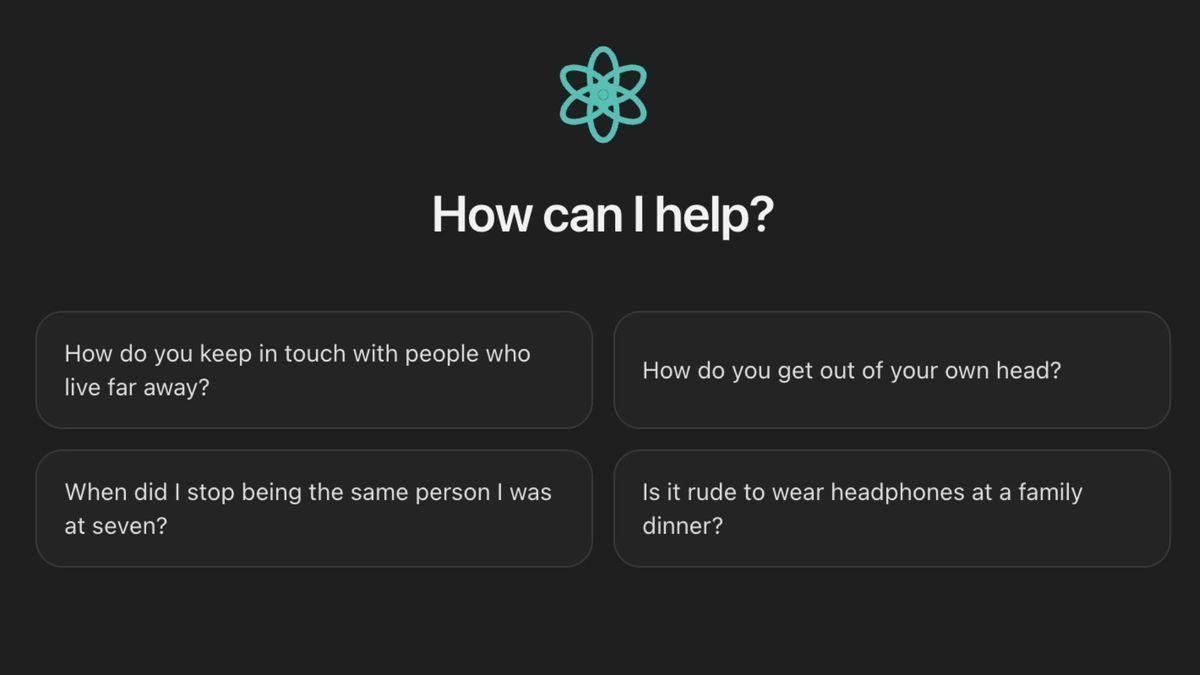
. Bryant's current plan involves transforming the one-man operation into a community project, potentially distributing the workload while maintaining the critique of over-reliance on AI.Bryant emphasizes that ChatTJB isn't anti-AI but rather pro-critical thinking. "We're now so used to confident, fast, and smart-sounding answers from AI that we've largely stopped questioning them," he noted. "Some of us are so far gone that the second we drop into that soothing dark interface, see the little thinking animation, and the text coming up letter by letter, critical thinking skills go out the window"
2
3
.By creating friction in what's typically a seamless experience, Bryant hopes users become "the tiniest bit more likely to pause and remember that just because a smooth-talking chatbot can answer your questions with polish, that doesn't give you an excuse to not think"
2
. The project serves as both satire and social commentary on how readily we surrender our judgment to machines, even in San Francisco—the epicenter of AI hype.Summarized by
Navi
[1]
12 Mar 2026•Entertainment and Society

24 May 2025•Technology

12 Feb 2026•Technology

1
Technology

2
Technology

3
Science and Research