A smartwatch's speaker and mic can now track your whole body


2 Sources
[1]
Ultrasound and AI turn off-the-shelf smartwatch into full-body tracker without cameras
For the first time, researchers can track the movement of a person's entire body with ultrasonic sound waves, using just an off-the-shelf smartwatch and a lightweight artificial intelligence model -- all while ensuring privacy and efficiency. The new technology, called EchoMotion, was developed by
[2]
Your smartwatch can already do full-body motion tracking. Researchers just unlocked it at zero cost on Wear OS.
No camera, no extra sensors. Just your smartwatch's speaker, its mic and a lot of echoes. This story is part of Tech for Change: an ongoing series in which we shine a spotlight on positive uses of technology, and showcase how they're helping to make the world a better place. Updated less than 1
Share
Copy Link
Cornell's EchoMotion turns a smartwatch into a full-body motion tracker using ultrasonic echoes. No cameras, no extra sensors, and fitness features are next.
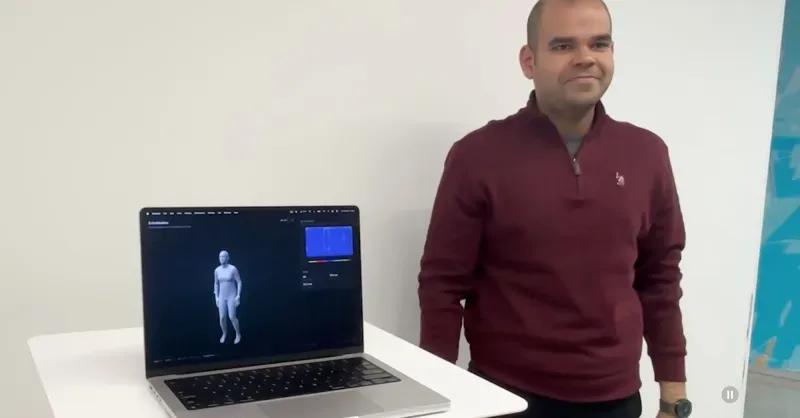
Cornell's SciFi Lab, a research group led by Cheng Zhang that builds wearable interfaces, has built a system that tracks a person's full-body pose using only a smartwatch's built-in speaker and microphone. The watch emits ultrasonic waves and reads the echoes bouncing off the wearer's limbs, sonar-style. The team presented the work, called EchoMotion, at the International Symposium on Wearable Computers, part of the UbiComp conference series, in Shanghai on October 13, and it appears in the Association for Computing Machinery's Proceedings on Interactive, Mobile, Wearable and Ubiquitous Technologies
1
. Lead author Saif Mahmud, a Cornell doctoral student, calls it "a very important jump for body tracking"1
.
Source: Digital Trends
Why a watch needs sonar
Today's wearables carry accelerometers and gyroscopes that sense only the watch's own movement, so tracking a whole body has traditionally meant cameras or a pile of extra devices such as phones, earbuds or virtual-reality headsets
1
. EchoMotion needs none of that. A deep learning model listens to the echoes and predicts where 12 joints sit, from the head down to the ankles1
.In a first test, 10 volunteers wore a 3D-printed prototype while doing 18 exercises, with poses checked against camera footage
1
. On a stock Samsung Galaxy Watch 6, 15 more participants averaged per-joint error under 4 inches before calibration1
. A one-time 12-minute calibration cut that by more than a third, to about 2.4 inches1
. The same model then ran without retraining on a Galaxy Watch 7 and a Google Pixel Watch 3, with only a slight dip in accuracy2
.
Source: Tech Xplore
Power is what makes this practical on a real watch. Sensing used roughly 12 milliwatts, about a fortieth of what a wearable camera draws
1
. A half-hour session on a Galaxy Watch 6 took 5 to 6% of the battery1
. The whole software package is under 30MB and runs on Wear OS watches with no custom hardware, adding nothing to the bill of materials, per Digital Trends2
.Where it wobbles
The weak spot showed up in crowded spaces. In a narrow hallway, echoes bounced off other people and accuracy dipped slightly, although furniture and even noise from a nearby road caused no trouble
1
. Mahmud expects that training on thousands of users rather than the dozens tested so far will fix it1
.Related Stories

Fitness features come next
Fitness is the near-term target. In a demo reported by Digital Trends, the system recognized 20 gym workouts, from dumbbell lateral raises to squats, with 95.4% accuracy
2
. It kept working in real gyms with music playing at about 76 decibels2
. The team is now building rep counting and form correction, something that today, per Digital Trends, means an in-person trainer or a camera-based remote service2
. It is also exploring smart glasses that pair the sonar with a camera view to track objects in your hand1
. Because the system captures joints and angles rather than just wrist motion, the researchers believe it could suit workouts that need precise feedback, like Pilates, tai chi or yoga1
. They also see a role in at-home rehabilitation1
.Mahmud says the team worked hard to make the system run on ordinary commercial watches so that adoption would be easy
1
. "In the very near future, with wearables like smartwatches or smart glasses, a personal agent will write a description of your whole day -- what you did, what you ate," Mahmud said, framing body tracking as one part of that vision1
.References
Summarized by

Navi
[1]
Related Stories
MobilePoser: Revolutionary AI-Powered Motion Capture App for Smartphones
16 Oct 2024•Technology

MIT's ultrasound wristband lets users control robotic hands and play piano with 120ms delay
24 Jun 2026•Science and Research

AI-Powered Smartwatches Achieve 78% Accuracy in Identifying Daily Activities, Paving the Way for Advanced Health Monitoring
15 Aug 2025•Science and Research

Recent Highlights
1
Jensen Huang's Affair with Suspected Chinese Spy Exposes $7 Billion AI Chip Smuggling Network
Policy and Regulation

2
Anthropic Launches Claude Meetings and AI-Powered Office Tools to Challenge Microsoft and Google
Technology

3
Samsung Smart Glasses With Google Gemini AI Open for Pre-Orders November 12th
Technology

Recent Highlights
Today's Top Stories








Don’t drown in AI news. We cut through the noise - filtering, ranking and summarizing the most important AI news, breakthroughs and research daily. Follow topics that matter to you and stay ahead.


