Agentic AI Transforms Payments Industry as Banks Navigate Intelligence-First Decision Making


2 Sources
[1]
Agentic AI meets payments: The new standard for intelligence in banking
Payments infrastructure has entered an unprecedented era. Agentic AI provides a compelling path forward. Amidst a progressively fragmented payments ecosystem -- comprising innumerable rails, real-time networks, and platforms -- payments operations are becoming one of the most complex areas of a
[2]
Payments Execs Say AI Forces New Payments Decisions
The Intelligence Around the Transaction Becomes the New Prize Payment infrastructure has traditionally created value by executing an instruction accurately and efficiently. Artificial intelligence makes the decision surrounding that instruction more valuable. "Payment execution alone is
Share
Copy Link
Agentic AI is fundamentally changing how banks handle payments, shifting value from transaction execution to intelligent decision-making. As payment ecosystems grow more fragmented, AI-driven payments promise autonomous orchestration and improved operational resilience, but success depends on proper governance and infrastructure integration.
Agentic AI Redefines Value in Payment Processing
The payments industry is experiencing a fundamental shift as AI in payments moves beyond simple transaction execution toward intelligent decision-making. Payment infrastructure now operates within increasingly fragmented payment ecosystems comprising numerous rails, real-time networks, and platforms, making payments operations one of the most complex areas of banking infrastructure
1
. By embedding agentic AI into live payment flows, banks are achieving substantial improvements in automation, predictability, exception resolution, and straight-through processing rates1
.Andrew Ng, Head of Payments and Embedded Finance at Tungsten Automation, captured this transformation: "Payment execution alone is increasingly commoditized. The durable value as I see it today is in making the right payment decisions"
2
. This represents a critical evolution where the intelligence surrounding a transaction becomes more valuable than the transaction itself.
Source: PYMNTS
AI-Driven Payments Unlock Hidden Optimization Potential
Large merchants and enterprises operating across multiple processors, payment service providers, geographies and payment methods generate vast amounts of data about authorization rates, routing, costs and fraud. The challenge has always been converting this information into action quickly enough to improve subsequent transactions. Adam Hiatt, Executive Vice President of Product Strategy at Spreedly, emphasized: "There's a ton of payments optimization potential in these payments rails, particularly in complex multi-PSP environments"
2
.AI forces new payments decisions by enabling real-time analysis and response. Mike Magennis, Senior Director of Strategy, Networks at FIS, explained that "as an AI agent begins to assist with purchasing decisions, the payment ecosystem has to make that value chain machine-readable. An agent needs to understand not just whether a payment credential works, but which choice delivers the best relevant outcome for that consumer"
2
. This requirement for machine-readable data is pushing the entire industry toward standardization and interoperability.Infrastructure Complexity Becomes the New Constraint
While intelligence in banking promises autonomous payment orchestration, implementation faces significant hurdles. Chris Trainor, Head of Platform Strategy, Innovation and AI at Paymentus, noted: "There's tremendous attention right now on what AI can say, but there's a lot less attention to what AI can actually reach"
2
. An AI agent may understand customer intent but must navigate customer data in one application, billing rules in another, payment credentials in a third, and communications preferences elsewhere. Every additional system creates another integration, permission structure, and set of business rules that agents must navigate2
.This fragmented architecture built over decades of financial technology now constrains AI deployment. The technologies with greatest potential for AI-driven payments optimization are often the less glamorous infrastructure components: common commerce protocols, financing options, authentication, and proof of intent. Dave Ruda, Vice President of Product at Billtrust, prioritized "the global compliance piece" as foundational, adding that "if you can't get that done, then you're not going to make it to the second round"
2
.Related Stories



Governance and Authentication Define Safe AI Deployment
As agentic AI capabilities expand, AI system management and governance become critical. Trainor emphasized that "authentication remains foundational in an AI landscape. The mistake that many have is expecting that model itself to become the system of record or a transaction processing engine. The future is not unconstrained artificial intelligence. It is governed agency"
2
.Hiatt introduced a new concept: "There are good bots, and there are bad bots. And so, KYA, the know your agents model, that idea as a business is a new category"
2
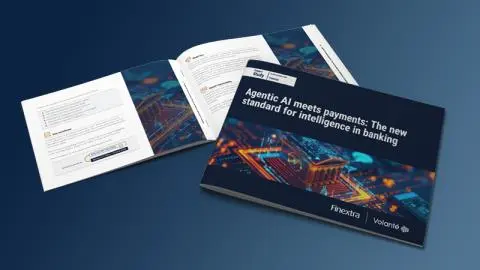
. This know your agents framework mirrors traditional KYC requirements but applies to autonomous systems making financial decisions.A Finextra impact study in association with Volante highlights that banks achieving the best results will be those that delegate effectively during implementation, ensuring full control through appropriate guardrails while entrusting AI deployment, integration, and operations to third-party experts
1
.
Source: Finextra Research
Strategic Implications for Banking's Competitive Future
The shift toward intelligent decision-making is moving economic battlegrounds away from traditional checkouts. Mike Storiale, Senior Vice President of AI Technology and Transformation at Synchrony, warned: "If you're not focused on that today, if you're not prepping your brand to show up in these platforms, if you're showing up 10th there, but first in traditional search, that's the place you got to be putting your priorities"
2
.Innovation is driving the industry toward a future where fully autonomous payment orchestration, agent-to-agent payment decisioning, and intelligent workflow management become standard. However, operational resilience depends on banks developing intimate understanding of how to implement and manage AI systems safely
1
. The competitive advantage increasingly sits in understanding enough about each transaction to decide how it should happen, making the boring plumbing strategically valuable in ways previously unimaginable.References
Summarized by

Navi
[1]
Related Stories
Recent Highlights
1
Microsoft and Nvidia Launch Surface Laptop Ultra: A $2,599 AI-Ready PC With RTX Spark Chip
Technology

2
Google Unveils Gemini 4 Argon AI Model, Restricts Access to Trusted Cyber Defenders
Technology

3
Trump Consulted Grok AI Before Ordering Venezuela Invasion and Capture of Nicolás Maduro
Policy and Regulation

Recent Highlights
Today's Top Stories






Don’t drown in AI news. We cut through the noise - filtering, ranking and summarizing the most important AI news, breakthroughs and research daily. Follow topics that matter to you and stay ahead.


