Agility Robotics Makes Nasdaq Debut as First Pure Humanoid Robot Company With $465M Capital Raise


2 Sources
[1]
Agility is the first pure humanoid robot company on the stock market. Are you buying?
Almost a year ago to the day, Figure AI CEO Colby Adcock responded to some gentle social media taunting from rival robotics company Agility with a prediction: "You'll be bankrupt in <12 months." Instead, Agility is going public through a reverse-merger that will see it become a publicly-traded
[2]
Agility Robotics co-founder on its Nasdaq debut, lessons from Amazon, and the future of work
Agility Robotics of Salem, Ore., made its Nasdaq debut Thursday as the first publicly traded U.S. company devoted solely to humanoid robots -- offering an ambitious vision for how the technology will change work, and a cautious view of how long it will take. "Maybe we'll never have
Share
Copy Link
Agility Robotics became the first publicly traded U.S. company focused solely on humanoid robots, debuting on Nasdaq through a reverse-merger SPAC that raised $465 million. The company unveiled Digit 5, designed to work alongside humans in warehouses and factories without barriers, securing a $300 million contract from an undisclosed customer for 1,000 units.
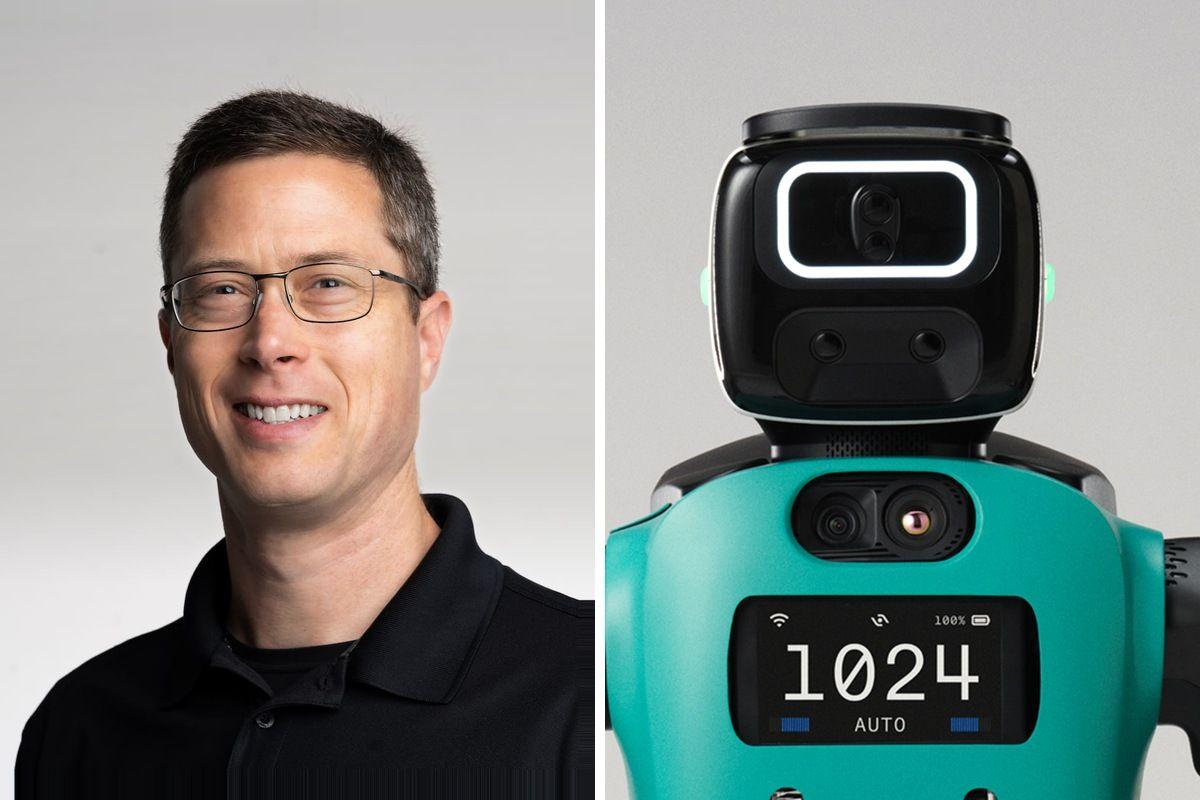
Agility Robotics Becomes First Pure Humanoid Robot Company on Public Markets
Agility Robotics made history by becoming the first publicly traded U.S. company devoted solely to humanoid robots, debuting on Nasdaq through a reverse-merger SPAC with Churchill Capital Corp XI.
1
2
The transaction valued the Salem, Oregon-based company at $2.5 billion before new investment and brought in approximately $465 million in gross proceeds. Trading under the ticker AGLT, shares closed at $11.51 on debut day, up 2.2%, defying a broader market downturn where the Nasdaq fell 5.5%.2
Spun out of Oregon State University in 2015, Agility Robotics has focused on deploying robots in industrial settings rather than chasing viral demonstrations. CEO Peggy Johnson emphasized this approach: "You don't see a lot of dancing robots or backflipping robots from Agility. We stuck to our strategy, which [are] these manual, very repetitive jobs, that it's hard to find humans to do."
1
The company has deployed its Digit robots with nine customers including Schaeffler, GXO, Toyota Motor Manufacturing Canada, and Mercado Libre, moving more than 100,000 totes at a GXO logistics facility.1
Digit 5 Breakthrough: Humanoid Robots Work Alongside Humans Without Barriers
The unveiling of Digit 5 in September marks what co-founder and chief robot officer Jonathan Hurst calls "the scaling moment" for Agility Robotics.
2
Standing 5-foot-11 and weighing 284 pounds, Digit 5 represents a fundamental shift in how humanoid robots can be deployed in warehouses and factories. The robot can lift 50 pounds, reach 7.2 feet high, and work more than 20 hours in a 24-hour day.2
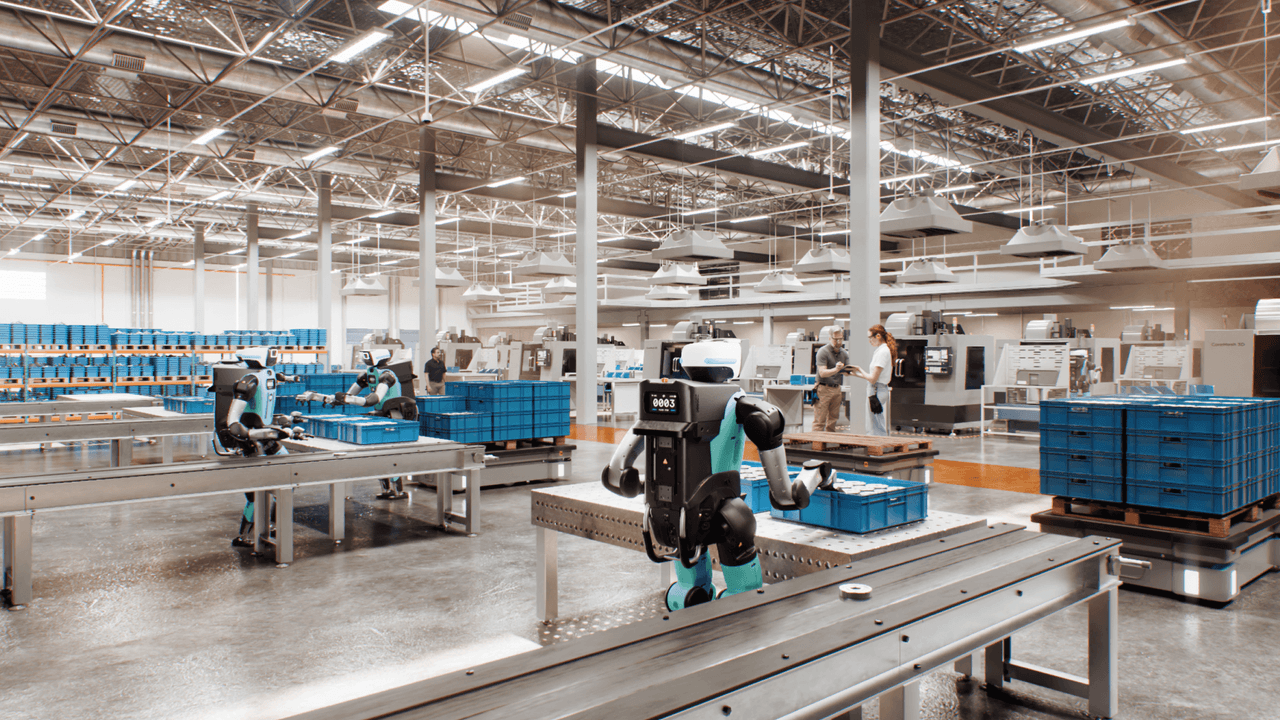
What sets Digit 5 apart from earlier versions is its ability to work alongside humans without requiring safety barriers—a capability that took years of engineering and standards development to achieve. The robot uses AI-driven sensors, including cameras and antennas in its head and safety-rated sensors throughout its body, to detect nearby people. Depending on the situation, it steers around workers, stops, or sits down, with visual and audio cues signaling its intentions.
2
Amazon Partnership Shaped Safety Standards and Design Philosophy
Lessons from Amazon, an early investor that tested prior versions of Digit in its warehouses, proved instrumental in developing Digit 5's safety capabilities. While earlier Digit models performed useful work moving and stacking bins at Amazon facilities, the e-commerce giant couldn't scale deployment due to safety certification challenges. Amazon showed Agility Robotics the three to four years it took to certify its own wheeled robots and expressed uncertainty about how a balancing robot would ever meet those standards.
2
"The safety case to do this is unbelievably hard," Hurst explained. "Nobody has ever deployed a dynamically stable balancing machine, and it brings new risks."
2
This feedback drove Agility to co-author ISO safety standards for the category and work with insurance companies and warehouse operators to prove safety through concrete data. Amazon made an initial deposit in 2024 toward a $1.05 million purchase of five robots, and Agility recorded about $1.04 million in net sales from Amazon in 2025, representing 58% of its total revenue that year.2
$300 Million Contract Signals Market Confidence in Future of Work
Agility Robotics secured a $300 million, three-year contract from an undisclosed customer for 1,000 Digit 5 robots, a deal Johnson described as "one of the driving factors" behind the decision to go public.
1
The robots will be rented under a robot-as-a-service model, with the commitment subject to milestones including throughput, uptime, and accuracy of placement. The customer receives warrants that vest as robots are deployed.2
Agility's pitch centers on saving companies $100,000 annually per robot under its service model, with even greater savings for outright purchases. Johnson gave the example of lifting 50-pound objects—an informal workplace safety threshold—explaining that "Digit can do that over and over and over. You don't want to give a human that job. You want to give that to the robot."
1
The company has built about 10 Digit 5 robots so far, with prototypes just coming off the production line. Its Salem factory was designed to eventually produce 10,000 robots annually.2
Related Stories

Financial Reality Check: Revenue Growth Versus Operating Losses
Despite its market debut, Agility Robotics faces significant financial challenges. The company generated just $174,000 in revenue during the first six months of 2026, mostly from related parties, while losing $362 million in the same period.
1
Annual revenue for 2025 totaled $1.78 million, with losses of $71.8 million that year.2
Stock-based compensation, an accounting charge for employee equity awards, rose by approximately $252 million year-over-year in the first half of 2026.2
With just $14.7 million in cash at the end of June before the deal closed, management had expressed substantial doubt about the company's ability to continue operating without additional funding.
2
The $465 million raised provides breathing room, though Johnson wouldn't project whether it would be sufficient for self-sustainability.1
Prospective customers must spend $500,000 for on-site proof of concept before full deployment, with four customers signed up as of May 2026.1
Technical Hurdles and the Race for Generative AI Integration
While Agility Robotics can pick up heavy loads and place them with 98% accuracy, its humanoid robots still lack the complex manipulation capabilities needed for handling diverse items—a limitation shared across the industry.
1
The timeline for generative AI and transformer architectures to unlock greater dexterity remains uncertain. Training systems based on video and teleoperation data haven't yet produced reliable general autonomy, though adapting transformer architectures to different modalities shows promise to physical AI researchers.1
"There's no internet of physical data of robot movements, and that's why you see so many people trying to simulate the data using a variety of things, and we use all of those techniques as well," Johnson explained. "They have their pros and cons, but we also have... 65,000 hours of real operational data from real customers in real facilities...that helps us accelerate the training of Digit."
1
Digit 5 prototypes will be demonstrated at CES 2027, with wide availability expected by the end of that year.1
Hurst offered a measured perspective on the future of work and humanoid robots: "Maybe we'll never have faster-than-light travel. Maybe we'll never have transporters from Star Trek. But we absolutely will have machines that can do all of the physical work that a person can do." However, he cautioned, "It's not going to be next year or five years from now. It's really a grand challenge."
2
References
Summarized by

Navi
Related Stories
Agility Robotics Unveils Digit 5 Humanoid Robot That Works Safely Alongside People
15 Sept 2026•Technology
Agility Robotics Targets $400M Funding Round for Humanoid Warehouse Robots
02 Apr 2025•Technology

Agility Robotics Selects Nvidia IGX Thor to Power Digit 5 Humanoid Robot With Over $300M in Orders
22 Oct 2026•Technology
Recent Highlights



Recent Highlights
Today's Top Stories









Don’t drown in AI news. We cut through the noise - filtering, ranking and summarizing the most important AI news, breakthroughs and research daily. Follow topics that matter to you and stay ahead.


