2 Sources
[1]
AI Adoption Accelerates in India, But Workforce Readiness Falls, Finds Kyndryl Study
The report illustrates what leaders are doing right to ride the AI surge, and that AI success is not driven solely by different strategies, use cases or technologies - it's driven by whether organizations redesign work and manage those changes throughout their organizations. Kyndryl announced the release of its second annual People Readiness Report, a global study of 1,100 senior business and technology leaders across eight countries including India, revealing a notable drop in workforce AI readiness and a widening gap between AI expectations and execution. The report illustrates what leaders are doing right to ride the AI surge, and that AI success is not driven solely by different strategies, use cases or technologies - it's driven by whether organizations redesign work and manage those changes throughout their organizations. The data also shows that trust in AI can be built through deliberate operating model and governance changes. According to the India report, only 25% of organizations believe their workforce is adequately prepared to successfully leverage AI - 12 point decline from 2025. The findings show a widening gap between AI ambitions and workforce readiness, as organizations continue to grapple with the challenge of equipping employees with the skills and capabilities required to thrive in an AI-driven environment. At the same time, enterprises are taking significant steps to prepare for this shift. 69% of organizations surveyed in India have redesigned roles within or across functions to support AI adoption, while 33% have implemented formal budgets and proactive upskilling strategies. However, the pace of organizational transformation appears to be outstripping the development of governance, trust, and oversight frameworks. "India has consistently demonstrated leadership in technology adoption, and enterprises are moving quickly to integrate AI into their operations," said Lingraju Sawkar, Asia Pacific President, Kyndryl India. "While organizations continue to invest in AI technologies and expand use cases, scaling impact will require businesses to rethink how work gets done, redesign roles, build new capabilities and establish governance frameworks that foster trust and responsible adoption." The findings come as companies accelerate AI adoption and invest heavily to realize value at scale. "Worldwide spending on AI is forecast to total $2.52 trillion in 2026, a 44% increase year-over-year, according to Gartner®, Inc., a business and technology insights company." "This is a critical moment for global enterprises as they race to adopt AI, redesign workflows and pursue innovation, yet they're finding that their greatest assets - their people - need more attention," said Kim Basile, CIO, Kyndryl. "The data shows that the organizations investing in people - whether it's rethinking roles and workflows, dedicating resources for upskilling and retraining, or guiding employees through change - are experiencing positive outcomes at a much higher rate." "AI's ability to reshape work is challenging organizations to reshape their workforce more rapidly than ever before," said Mark Paulek, Chief Human Resources Officer, Kyndryl. "The leaders pulling ahead are aligning skills, roles and decision-making with how work is actually changing. When people understand their role in that system, trust and performance scale together." The study identifies a Pacesetters group, the 9% of global organizations that have done three things: they redesign roles around AI, implement change management so the workforce understands its new operating model and has guardrails in place, and have built workforce readiness. These three behaviors are the operational foundations that consistently distinguish the organizations achieving the strongest results from AI. As they do these things, at each stage they are building the important governance frameworks. Pacesetters are roughly twice as likely to have fully implemented every governance dimension measured.
[2]
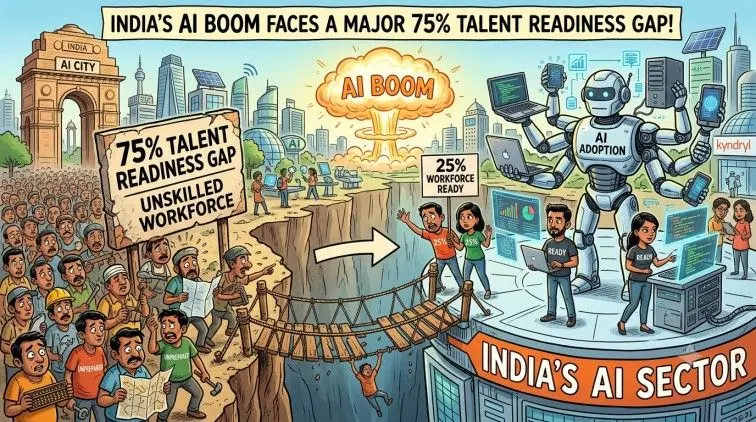
Kyndryl: India's AI Boom Faces a Major 75% Talent Readiness Gap
81% of India leaders concerned on AI advancement outpacing their workforce capabilities, governance frameworks and operating models, 69% of India organizations are redesigning roles to support AI adoption Kyndryl announced the release of its second annual People Readiness Report, a global study of 1,100 senior business and technology leaders across eight countries including India, revealing a notable drop in workforce AI readiness and a widening gap between AI expectations and execution. The report illustrates what leaders are doing right to ride the AI surge, and that AI success is not driven solely by different strategies, use cases or technologies - it's driven by whether organizations redesign work and manage those changes throughout their organizations. The data also shows that trust in AI can be built through deliberate operating model and governance changes. According to the India report, only 25% of organizations believe their workforce is adequately prepared to successfully leverage AI - 12-point decline from 2025. The findings show a widening gap between AI ambitions and workforce readiness, as organizations continue to grapple with the challenge of equipping employees with the skills and capabilities required to thrive in an AI-driven environment. At the same time, enterprises are taking significant steps to prepare for this shift. 69% of organizations surveyed in India have redesigned roles within or across functions to support AI adoption, while 33% have implemented formal budgets and proactive upskilling strategies. However, the pace of organizational transformation appears to be outstripping the development of governance, trust, and oversight frameworks. "India has consistently demonstrated leadership in technology adoption, and enterprises are moving quickly to integrate AI into their operations," said Lingraju Sawkar, Asia Pacific President, Kyndryl India. "While organizations continue to invest in AI technologies and expand use cases, scaling impact will require businesses to rethink how work gets done, redesign roles, build new capabilities and establish governance frameworks that foster trust and responsible adoption." Key India findings: * AI adoption accelerates, but readiness remains a challenge: 56% of Indian organizations report AI is deployed broadly or embedded in core business processes, compared to 36% respondents saying AI was fully integrated across their organisations in 2025. However, only 25% say their workforce is fully ready for AI, reflecting a 12-point decline year-over-year. * AI ambitions are outpacing organizational readiness: 81% of Indian leaders are concerned that AI advancement will outpace their workforce capabilities, governance frameworks and operating models. * AI agents introduce new governance considerations & trust gap: 84% of Indian organizations expect autonomous AI agents to make material decisions within the next 12 months, while only 28% fully trust autonomous AI systems operating without human oversight. The findings come as companies accelerate AI adoption and invest heavily to realize value at scale. "Worldwide spending on AI is forecast to total $2.52 trillion in 2026, a 44% increase year-over-year, according to Gartner®, Inc., a business and technology insights company." "This is a critical moment for global enterprises as they race to adopt AI, redesign workflows and pursue innovation, yet they're finding that their greatest assets - their people - need more attention," said Kim Basile, CIO, Kyndryl. "The data shows that the organizations investing in people - whether it's rethinking roles and workflows, dedicating resources for upskilling and retraining, or guiding employees through change - are experiencing positive outcomes at a much higher rate." "AI's ability to reshape work is challenging organizations to reshape their workforce more rapidly than ever before," said Mark Paulek, Chief Human Resources Officer, Kyndryl. "The leaders pulling ahead are aligning skills, roles and decision-making with how work is actually changing. When people understand their role in that system, trust and performance scale together." The study identifies a Pacesetters group, the 9% of global organizations that have done three things: they redesign roles around AI, implement change management so the workforce understands its new operating model and has guardrails in place, and have built workforce readiness. These three behaviors are the operational foundations that consistently distinguish the organizations achieving the strongest results from AI. As they do these things, at each stage they are building the important governance frameworks. Pacesetters are roughly twice as likely to have fully implemented every governance dimension measured. According to the global study, Pacesetters are: 1.5 times more likely to achieve AI-related revenue growth. 1.6 times more likely to report better innovation for products and services. Global business leaders consistently rank workforce readiness among the most challenging aspects of AI adoption: Just 23% of organizations think their workforces are fully ready for AI, a six-point drop from last year. And 79% agree that the speed of AI will outpace their organizations' workforce, governance and operating models. The risk of falling behind is increasing as more organizations adopt autonomous AI agents. 81% of global organizations expect AI agents to make impactful decisions for their organizations within the next year, but today just 25% completely trust AI systems operating without human oversight. Readying Workforces for AI-enabled Workplaces The report identifies actions that organizations are taking to get their workforces ready for an AI-enabled workplace: Redesigning roles for the future: 61% say their organizations have already redesigned roles, and 24% are creating new roles focused on AI management. Addressing skills gaps: Half of leaders (52%) say it has become more challenging to find employees with the right skills to advance their AI strategy, and a third have fully implemented training programs focused on helping employees effectively collaborate with AI tools. Building trust through governance: A third of organizations (33%) claim they have clear policies on which decisions AI can and can't make, and 27% are using a registry and monitoring capabilities for all their AI systems. Organizations with stronger governance assert their workforces trust more in AI strategy and execution, and high-trust organizations are significantly more likely to report transformative outcomes from their AI investments.
Share
Copy Link
Kyndryl's second annual People Readiness Report reveals a troubling disconnect in India's AI landscape. While 56% of organizations have embedded AI in core operations, only 25% believe their workforce is ready—a 12-point decline from 2025. The study of 1,100 leaders across eight countries shows 81% of Indian executives fear AI advancement is outpacing their workforce capabilities and governance frameworks.
Kyndryl has released its second annual People Readiness Report, exposing a critical talent readiness gap as Indian organizations race to integrate artificial intelligence into their operations. The global study surveyed 1,100 senior business and technology leaders across eight countries, revealing that only 25% of Indian organizations believe their workforce is adequately prepared to leverage AI—a sharp 12-point decline from 2025
1
2
. This dramatic drop underscores a widening chasm between AI ambitions and workforce readiness, even as 56% of Indian organizations report AI is deployed broadly or embedded in core business processes, up from 36% who said AI was fully integrated in 20252
.
Source: CXOToday
The Kyndryl study arrives at a moment when global AI spending is forecast to reach $2.52 trillion in 2026, representing a 44% year-over-year increase according to Gartner
1
. Yet the research demonstrates that AI readiness in India faces significant headwinds. A striking 81% of Indian leaders express concern that AI advancement will outpace their workforce capabilities, governance frameworks, and operating models2
. This anxiety reflects the reality that organizational transformation is moving faster than the development of trust frameworks and oversight mechanisms needed to support sustainable AI adoption.Despite the readiness challenges, enterprises are implementing concrete measures to bridge the gap. According to the People Readiness Report, 69% of organizations surveyed in India have redesigned roles within or across functions to support AI adoption, while 33% have implemented formal budgets and proactive upskilling strategies for AI
1
2
. These organizational redesign efforts signal that business leaders recognize the need to fundamentally rethink how work gets done in an AI-driven environment.Lingraju Sawkar, Asia Pacific President at Kyndryl India, emphasized that "while organizations continue to invest in AI technologies and expand use cases, scaling impact will require businesses to rethink how work gets done, redesign roles, build new capabilities and establish governance frameworks that foster trust and responsible adoption"
1
. The statement highlights that technology investments alone cannot deliver AI success without parallel investments in people and processes.The research uncovered a significant trust deficit that could hinder AI adoption momentum. While 84% of Indian organizations expect autonomous AI agents to make material decisions within the next 12 months, only 28% fully trust autonomous AI systems operating without human oversight
2
. This disconnect between deployment expectations and trust levels introduces new considerations for governance frameworks and change management approaches.
Source: DT
Kim Basile, CIO at Kyndryl, noted that "organizations investing in people—whether it's rethinking roles and workflows, dedicating resources for upskilling and retraining, or guiding employees through change—are experiencing positive outcomes at a much higher rate"
2
. The data suggests that building trust requires deliberate operating model adjustments rather than purely technical solutions.Related Stories
The Kyndryl study identified a select group called Pacesetters—just 9% of global organizations that have mastered three critical behaviors: redesigning roles around AI, implementing change management so the workforce understands its new operating model with guardrails in place, and building workforce readiness
1
2
. These operational foundations distinguish organizations achieving the strongest results from their peers.Pacesetters demonstrate measurable advantages: they are 1.5 times more likely to achieve AI-related revenue growth and 1.6 times more likely to report better innovation for products and services
2
. Critically, these leaders are roughly twice as likely to have fully implemented every governance dimension measured, suggesting that systematic attention to people and processes creates competitive advantage.Mark Paulek, Chief Human Resources Officer at Kyndryl, explained that "the leaders pulling ahead are aligning skills, roles and decision-making with how work is actually changing. When people understand their role in that system, trust and performance scale together"
2
. For Indian organizations watching their workforce readiness decline even as AI spending accelerates, the Pacesetters model offers a blueprint for closing the talent readiness gap and converting AI investments into measurable business outcomes.Summarized by
Navi
18 Jun 2026•Business and Economy

04 Mar 2025•Business and Economy

17 Dec 2024•Business and Economy

1
Technology

2
Policy and Regulation

3
Policy and Regulation