AI Breakthrough Deciphers 2,000-Year-Old Herculaneum Scroll Carbonized by Vesuvius


15 Sources
[1]
Villa of the Papyri treasures resurface: AI restores lost works after 2,
UK scientists used AI to "virtually unroll" ancient scrolls charred by Mount Vesuvius nearly 2,000 years ago. UK scientists made a breakthrough in deciphering ancient scrolls charred by the eruption of Mount Vesuvius nearly 2,000 years ago, using artificial intelligence to "virtually unroll" the
[2]
AI helps researchers read ancient scroll burned to a crisp in Vesuvius eruption
Writing on PHerc. 172 papyrus, found at Roman mansion in Herculaneum, revealed after 3D X-rays and software competition Researchers have peered inside an ancient scroll that was burned to a crisp in the volcanic eruption that destroyed Pompeii nearly 2,000 years ago. The scroll is one of hundreds
[3]
AI Unlocks 2,000-Year-Old Herculaneum Scroll Carbonized by Vesuvius
An method driven by artificial intelligence is making it possible to read texts scorched and left buried by the eruption of Mount Vesuvius in 79 CE. Researchers at the University of Oxford's Bodleian Libraries and the Vesuvius Challenge have deciphered yet another scroll carbonized by the eruption
[4]
AI gives first tantalising look inside a 2,000- year-old Roman scroll
The scroll was discovered in the town of Herculaneum, a town destroyed in the volcanic eruption that buried neighbouring Pompeii. The contents of a 2,000-year-old burnt scroll from the Roman town of Herculaneum have been seen for the first time with the help of artificial intelligence (AI) and
[5]

AI and scientists unite to decipher old scrolls charred by the Vesuvius volcano
Scientists hope a mix of artificial intelligence and human expertise will help decipher ancient scrolls carbonized by a volcanic eruption 2,000 years ago. Hundreds of papyrus scrolls were found in the 1750s amid the remains of a lavish villa at the Roman town of Herculaneum, which along with
[6]

Lost words of 2,000-year-old volcano-charred scroll revealed using AI
However, a major breakthrough has been made, allowing experts to begin reading the texts and bringing them closer to unlocking the secrets of the past. The Herculaneum scrolls, stored in a mansion in the ancient Roman town of Herculaneum, were found among the ruins in the mid-18th century. These
[7]

'Incredible moment in history:' Particle accelerator and AI offer first peek inside 2,000-year-old Herculaneum scroll
The Herculaneum scroll was buried by Mount Vesuvius' eruption 2,000 years ago. (Image credit: Vesuvius Challenge) A Herculaneum scroll buried by Mount Vesuvius' eruption almost 2,000 years ago is finally legible, now that researchers have used artificial intelligence (AI) and a particle
[8]

AI and scientists unite to decipher old scrolls charred by the Vesuvius volcano
LONDON -- Scientists hope a mix of artificial intelligence and human expertise will help decipher ancient scrolls carbonized by a volcanic eruption 2,000 years ago. Hundreds of papyrus scrolls were found in the 1750s amid the remains of a lavish villa at the Roman town of Herculaneum, which along
[9]

AI and scientists unite to decipher old scrolls charred by the Vesuvius volcano
LONDON (AP) -- Scientists hope a mix of artificial intelligence and human expertise will help decipher ancient scrolls carbonized by a volcanic eruption 2,000 years ago. Hundreds of papyrus scrolls were found in the 1750s amid the remains of a lavish villa at the Roman town of Herculaneum, which
[10]

Volcano-scorched Roman scroll is read for the first time in 2000 years
A papyrus scroll carbonised by the eruption of Mount Vesuvius two millennia ago is slowly being read once again thanks to X-ray imaging and machine learning An ancient Roman scroll has been read for the first time since it was charred in the volcanic eruption of Mount Vesuvius two millennia ago,
[11]

Herculaneum scrolls breakthrough: Scientists digitally "unroll" 2,000-year-old scroll scorched by Mount Vesuvius
London -- The Herculaneum scrolls have remained one of the many tantalizing mysteries of the ancient world for almost 2,000 years. Burnt to a crisp by lava from Mount Vesuvius in A.D. 79, the reams of rolled-up papyrus were discovered in a mansion in Herculaneum -- an ancient Roman town near
[12]

These ancient scrolls were charred by a volcano - are they now revealing their secrets?
UK scientists say they have made a historic breakthrough in their efforts to decipher 2000-year-old papyrus scrolls that were burned when Mount Vesuvius erupted. Ancient scrolls charred by a volcanic eruption 2,000 years ago may finally be starting to reveal their secrets. UK scientists say they
[13]

AI and Scientists Unite to Decipher Old Scrolls Charred by the Vesuvius Volcano
This undated image made available by Vesuvius Challenge shows a papyrus scroll as one of hundreds of papyrus scrolls found amid the remains of a lavish villa at the Roman town of Herculaneum, which along with neighboring Pompeii was destroyed when Mt. Vesuvius erupted in A.D. 79. (Vesuvius
[14]

Scientists look inside burnt scroll for first time in 2,000 years
Scientists have been able to read a badly burnt ancient Roman scroll for the first time in 2,000 years. The scroll was found in the Roman town of Herculaneum and was burnt by the volcanic eruption of Mount Vesuvius in 79AD, making it too fragile to ever be physically opened. But now, scientists
[15]
First glimpse inside burnt scroll after 2,000 years
A badly burnt scroll from the Roman town of Herculaneum has been digitally "unwrapped", providing the first look inside for 2,000 years. The document, which looks like a lump of charcoal, was charred by the volcanic eruption of Mount Vesuvius in 79AD and is too fragile to ever be physically
Share
Copy Link
Scientists use AI and advanced imaging techniques to read ancient scrolls charred by the eruption of Mount Vesuvius in 79 CE, offering new insights into Roman history and literature.

AI-Powered Breakthrough in Ancient Text Decipherment
In a groundbreaking development, researchers have successfully used artificial intelligence (AI) and advanced imaging techniques to decipher ancient scrolls carbonized by the eruption of Mount Vesuvius nearly 2,000 years ago
1
. This achievement marks a significant milestone in the field of archaeology and digital humanities, offering new insights into Roman history and literature.The Vesuvius Challenge and Technological Innovation
The Vesuvius Challenge, launched in 2023 by computer scientist Dr. Brent Seales and backed by Silicon Valley sponsors, has been instrumental in driving this progress
2
. The competition encourages the development of innovative methods to read the Herculaneum scrolls without physically unrolling them. A team of three students - Youssef Nader, Luke Farritor, and Julian Schilliger - won the 2023 grand prize of $700,000 for their breakthrough in reading over 2,000 Greek letters from a scroll2
.Advanced Imaging and AI Techniques
The process involves using X-ray tomography at facilities like the Diamond Light Source synchrotron in Oxfordshire, England, to create 3D scans of the scrolls
3
. These scans are then analyzed using AI algorithms and computer vision techniques to detect traces of ink and virtually unroll the documents. The AI works by identifying patterns in the scan data that indicate the presence of writing on the papyrus fibers4
.The PHerc. 172 Scroll
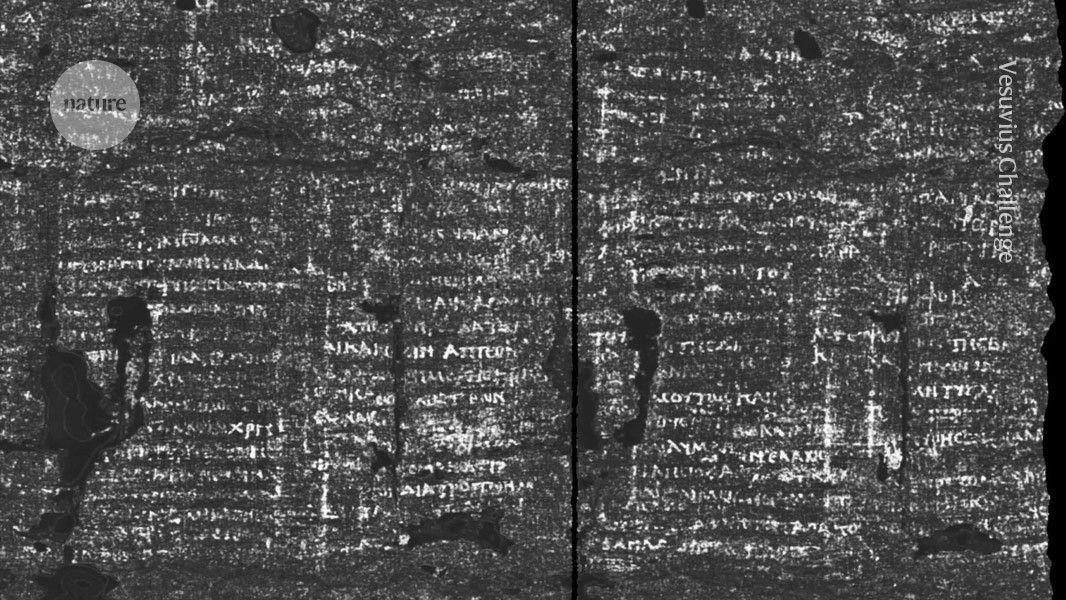
One of the most recent successes is the decipherment of scroll PHerc. 172, housed at the Bodleian Libraries of the University of Oxford
1
. This scroll, gifted by Ferdinand IV of Naples and Sicily in the early 19th century, has revealed multiple columns of text. Notably, the Ancient Greek word "διατροπή" (meaning "disgust") has been identified twice within a few columns2
.Historical Context and Significance
The scrolls were discovered in the 1750s in a Roman villa in Herculaneum, believed to have belonged to Julius Caesar's father-in-law
5
. The eruption of Mount Vesuvius in 79 CE carbonized these papyri, preserving them but rendering them unreadable for centuries. The texts are thought to be related to the school of Epicureanism, with some potentially authored by the philosopher Philodemus1
.Related Stories

Ongoing Challenges and Future Prospects
While this breakthrough is significant, much work remains. Peter Toth, curator at the Bodleian Library, emphasizes the need for better images and improved software methods to read the entirety of this and other Herculaneum scrolls
4
. The core of the papyrus, including potentially the work's title, has yet to be deciphered3
.Collaborative Efforts and Implications
This project exemplifies the power of interdisciplinary collaboration, bringing together librarians, computer scientists, and classical scholars
1
. Richard Ovenden, director of the University Libraries, hails it as "an incredible moment in history" that allows us to look inside scrolls unread for almost two millennia2
. The success of this method opens up possibilities for deciphering hundreds more scrolls held in Naples, potentially revolutionizing our understanding of ancient literature and philosophy5
.References
Summarized by

Navi
[1]
Related Stories
AI reads entire ancient scroll from Herculaneum for first time, revealing lost Stoic philosophy
25 Jun 2026•Science and Research

AI Deciphers 2,000-Year-Old Vesuvius Scroll, Revealing Lost Greek Philosophical Work
07 May 2025•Science and Research
AI Breakthrough: Deciphering Ancient Scrolls from Pompeii's Ruins
29 Aug 2024

Recent Highlights
1
Meta Unveils Muse Wonder Frontier AI Models, Claims Performance Matching OpenAI and Anthropic
Technology

2
IMF Report Warns AI Market Correction Could Spark Global Financial Crisis With $1.4T at Risk
Business and Economy

3
Eight States Sue OpenAI Over ChatGPT Safety Concerns and Unlawful Collection of Children's Data
Policy and Regulation

Recent Highlights
Today's Top Stories







Don’t drown in AI news. We cut through the noise - filtering, ranking and summarizing the most important AI news, breakthroughs and research daily. Follow topics that matter to you and stay ahead.


