AI reads entire ancient scroll from Herculaneum for first time, revealing lost Stoic philosophy


9 Sources
[1]
Ancient Roman scrolls destroyed by Mount Vesuvius digitally unrolled in full for first time
This Silicon Valley-backed venture is unraveling the mangled remains of scrolls ruined by the 79 C.E. eruption of Vesuvius that destroyed Herculaneum and Pompeii How do you read a book you can't open? That's precisely what Brent Seales, a professor at the University of Kentucky, has spent his
[2]
Lost books by ancient philosophers recovered from 'unreadable' scrolls
Scrolls from the Roman library of Herculaneum that were carbonised by a volcanic eruption have been read in their entirety for the first time, thanks to scans and AI software Long-lost works of ancient philosophy have been recovered from papyrus scrolls that were scorched by the AD 79 eruption of
[3]
They read the scroll thing! AI helps decipher ancient document charred by Vesuvius
A sealed scroll from the Roman town of Herculaneum, which was destroyed by Mount Vesuvius' eruption nearly 2,000 years ago, has finally given up its secrets, thanks to a combination of machine learning and high-resolution CT scans. In 2023, researchers managed to decipher a few words from among
[4]
Complete text of carbonised Herculaneum scroll unlocked for first time
ROME, June 25 (Reuters) - Researchers using artificial intelligence and advanced imaging said on Thursday they had achieved the first complete reading of a closed Herculaneum scroll burnt by the eruption of Mount Vesuvius nearly 2,000 years ago. The breakthrough marks a major step toward
[5]

AI just helped researchers read a 2,000-year-old Mount Vesuvius scroll that's too charred to ever be opened -- as X-ray images reveal ancient stoic philosophy
* The Vesuvius Challenge is decoding scrolls hit by the 79 AD eruption * Another scroll has just been partially read by AI * This is despite the scroll being rolled up and severely burned Look at the ancient PHerc 1667 scroll, recovered from the ancient Roman town of Herculaneum that was
[6]

AI helps read papyrus scroll burnt to crisp during Vesuvius eruption
Previously hidden text revealed without unrolling scroll discusses stoic philosophy on ethics, art and human behaviour The surviving part of an ancient scroll that was burnt to a crisp when Mount Vesuvius erupted nearly 2,000 years ago has been virtually unwrapped and read with help from
[7]

AI helps scientists decipher papyrus scroll burnt in Vesuvius eruption
The scroll was first discovered in the 1750s but was too fragile to open. Using AI, scholars deciphered the full text and discovered a philosophical treaties on ethics and human progress. An ancient scroll that survived the eruption of Mount Vesuvius in 79 AD has finally revealed its
[8]

Scientists decipher new secrets from ancient scrolls scorched by Vesuvius eruption: "Finally able to read them"
Kerry Breen is a news editor at CBSNews.com. A graduate of New York University's Arthur L. Carter School of Journalism, she previously worked at NBC News' TODAY Digital. She covers current events, breaking news and issues including substance use. A University of Kentucky project using artificial
[9]

AI helps recover complete text of Herculaneum scroll burnt by Mount Vesuvius
Researchers using artificial intelligence and advanced imaging said on Thursday they had achieved the first complete reading of a closed Herculaneum scroll burnt by the eruption of Mount Vesuvius nearly 2,000 years ago. The breakthrough marks a major step toward deciphering hundreds of ancient
Share
Copy Link
Researchers have achieved the first complete reading of a sealed Herculaneum scroll carbonised by Mount Vesuvius in 79 AD. Using AI-powered 3D scanning and advanced X-ray imaging, the Vesuvius Challenge team digitally unrolled the charred papyrus without physically opening it, uncovering 1.5 meters of text on Stoic philosophy dating back over 2,000 years.
AI Achieves Breakthrough in Reading Vesuvius Scrolls
Researchers working with the Vesuvius Challenge have accomplished what seemed impossible just years ago: reading an entire carbonised Herculaneum scroll without physically opening it
1
. The scroll, known as PHerc. 1667, was among hundreds of documents destroyed when Mount Vesuvius erupted in 79 AD, burying both Herculaneum and Pompeii2
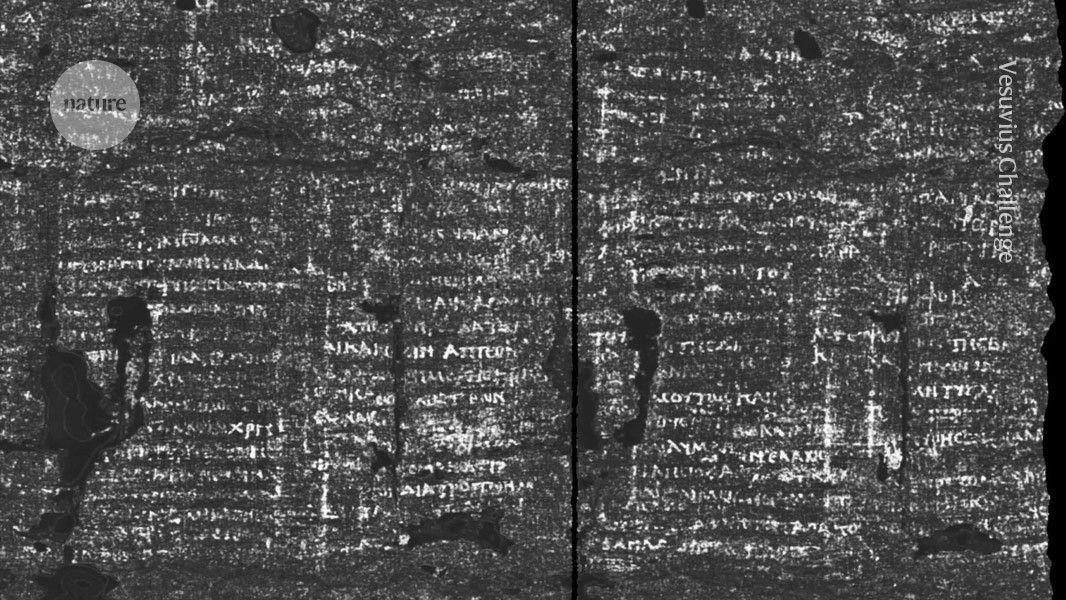
. Using AI and high-resolution phase-contrast X-ray microtomography performed at the European Synchrotron Radiation Facility in France, the team has digitally unrolled ancient Roman scrolls and extracted nearly all the text, making it legible for the first time in nearly 2,000 years3
.
Source: New Scientist
How Machine Learning Transforms Digital Archaeology
The breakthrough relies on a technique called Volume Cartographer, pioneered by Brent Seales, a professor at the University of Kentucky who has spent decades developing methods to decipher ancient documents
1
. This approach takes 3D scans of manuscripts layer by layer, then flattens them into 2D images that can be read. The scans use synchrotron scanners—massive particle accelerators that beam high-power X-rays at objects, revealing inner layers down to the atomic level. Machine learning has accelerated the process dramatically by detecting subtle differences between papyrus fibers and ink on charred papyrus, building label sets far more effectively than manual methods1
. AI coding agents also enable the research team to test new techniques much faster than traditional programming would allow.
Source: Scientific American
Non-Invasive Ancient Text Recovery Unlocks Lost Philosophy
The newly readable scroll contains 1.5 meters of text across 22 columns, exploring ethics, arts and human behavior through the lens of Stoic philosophy
2
. Dated to 200-300 BC, it represents the oldest Herculaneum scroll yet unwrapped4
. Federica Nicolardi, lead papyrologist for the Vesuvius Challenge, notes that the scroll's nephew of Greek Stoic philosopher Chrysippus is mentioned, making Chrysippus himself "the most natural candidate for authorship"2
. Chrysippus is regarded as one of the architects of Stoicism, but almost all his work was lost to history. According to Thomas Coward at the University of Bristol, having access to source text rather than quotes and summaries "is very important," likening the discovery to uncovering lost works by Isaac Newton or Albert Einstein2
.Unlocking Historical Artifacts From Villa of the Papyri
The scrolls come from the Villa of the Papyri, the world's only surviving intact library from antiquity, discovered in 1752
3
. Some 400 papyrus scrolls remain intact, and more than 600 unopened scrolls await decoding1
4
. The villa is presumed to have belonged to Lucius Calpurnius Piso Caesoninus, Julius Caesar's father-in-law, who sponsored works by the Epicurean philosopher Philodemus2
. Among the newly identified texts is "On Gods, Book 8" by Philodemus, extending his previously known work to at least an eight-book series1
. Another scroll revealed 70 columns from "On Vices, Book 1," also attributed to Philodemus4
.
Source: The Register
Related Stories


Vesuvius Challenge Accelerates Ink Detection Technology
Nat Friedman, former CEO of GitHub and one of the Challenge's main backers, announced that the team would place all data, code and models online and offer a $1 million prize to the first person or team to read any other scroll in full
4
. The Vesuvius Challenge has already awarded $1.8 million in prizes, including a $700,000 grand prize in early 2024 to Luke Farritor, Youssef Nader and Julian Schilliger for recovering passages from scroll PHerc.Paris.43
. The new higher-resolution images taken at 2 micrometres make words directly visible for the first time, providing independent confirmation of earlier algorithmic detections3
. Nicolardi reported that progress is accelerating rapidly—researchers recently unwrapped the full length of one scroll in just 24 hours, producing about 140 columns of new text, compared to uncovering only 10% of columns until recently4
.What This Means for Understanding Ancient Worlds
The ability to read these scrolls matters because it transforms our access to ancient thought. Nicholas Freer at the University of Newcastle calls the findings "extraordinary progress" that could "radically transform" our understanding of ancient worlds
2
. "What we're seeing now isn't just a single, spectacular breakthrough. We're witnessing the beginning of what could be a decades-long process of recovery," Freer notes. Seales believes the technology has reached a turning point: "Just a year ago it would have been crazy for any of us to believe that there would be a complete scroll read completely non-invasively with hundreds of columns of text. Today we have shown you that that is possible. I believe we're going to read every single one of the scrolls in the collection"4
. Large parts of the villa remain unexcavated, raising the possibility that more scrolls could yet be found4
. As Seales puts it, the focus is shifting from proving the technology works to "restoring the lost voices" and discovering what the scrolls actually reveal about philosophy and ancient life2
.References
Summarized by

Navi
[1]
Related Stories
Recent Highlights
1
Microsoft and Nvidia Launch Surface Laptop Ultra: A $2,599 AI-Ready PC With RTX Spark Chip
Technology

2
Trump Consulted Grok AI Before Ordering Venezuela Invasion and Capture of Nicolás Maduro
Policy and Regulation

3
Scientists Build AI Model That Reconstructs Images From Brain Scans in Record Time
Science and Research

Recent Highlights
Today's Top Stories







Don’t drown in AI news. We cut through the noise - filtering, ranking and summarizing the most important AI news, breakthroughs and research daily. Follow topics that matter to you and stay ahead.


