AI Deciphers 2,000-Year-Old Vesuvius Scroll, Revealing Lost Greek Philosophical Work


5 Sources
[1]
AI reveals title of 'unreadable' Vesuvius scroll for first time
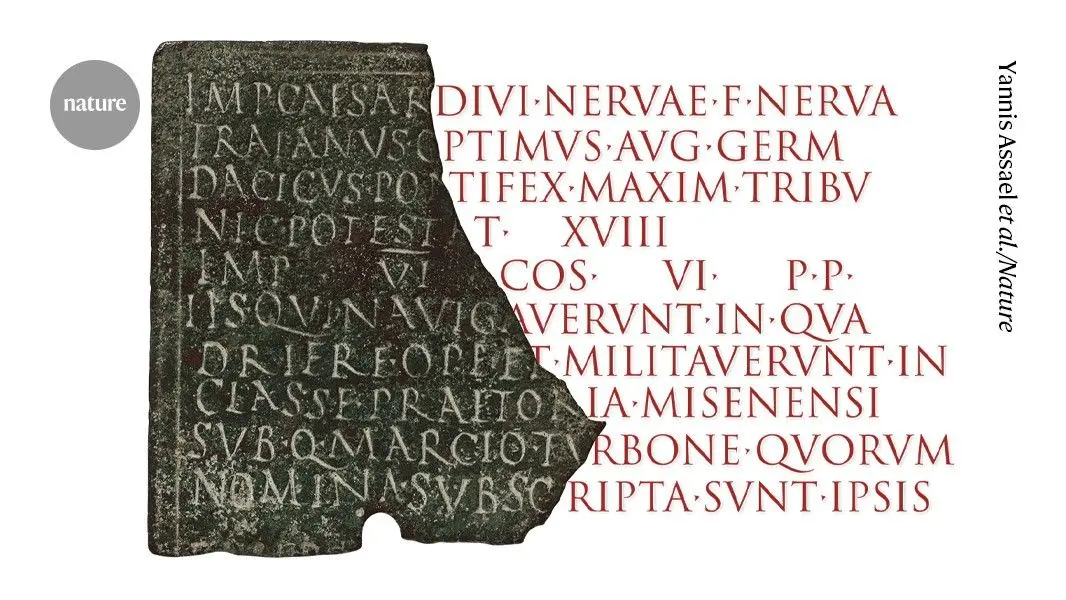
Two researchers in the field of machine learning have won US$60,000 for being the first to reveal the title and author of a sealed papyrus scroll carbonized by the eruption of Mount Vesuvius in Italy in AD 79. The crucial lines identify the work as part of On Vices by the Greek philosopher
[2]
AI Identifies Author of Charred Scroll Buried by Vesuvius for 2,000 Years
A sealed Herculaneum scroll yields its secretsâ€"revealing a lost philosophical treatise by Philodemus through virtual unwrapping. For the first time, researchers have identified the author and title of a document that’s been locked inside a charred scroll for nearly 2,000 yearsâ€"without
[3]
AI decodes 2,000-year-old Greek scroll's secrets without opening it
The scroll was scanned in July at Diamond Light Source, the UK's national synchrotron facility in Oxfordshire. Unusually, traces of ink appeared in the X-ray images, enabling researchers to identify the text. Now part of the Vesuvius Challenge -- a global initiative launched in 2023 to read the
[4]
AI decodes 2,000-year-old burned, still-rolled scroll: Reveals title and author after centuries
In a remarkable confluence of classical scholarship and modern innovation, researchers have finally uncovered the author and title of a charred scroll that lay unread for nearly 2,000 years. Buried beneath the volcanic fury of Mount Vesuvius in 79 AD, this blackened relic from the Roman town of
[5]

AI deciphers text of charred scroll in Vesuvius challenge
The scroll named PHerc. 172, one of three from Herculaneum housed at the Bodleian Libraries in Oxford, was scanned last July. A charred scroll recovered from a Roman villa buried under ash during the eruption of Mount Vesuvius in 79 CE was identified as a work by the ancient Greek philosopher
Share
Copy Link
AI technology has successfully identified the author and title of a charred scroll from Herculaneum, buried by Mount Vesuvius in 79 CE, without physically opening it. The scroll contains a work by Greek philosopher Philodemus, titled "On Vices".

AI Breakthrough in Ancient Text Decipherment
In a groundbreaking achievement, artificial intelligence has successfully deciphered the contents of a 2,000-year-old scroll without physically unrolling it. The scroll, known as PHerc. 172, was recovered from the ruins of Herculaneum, an ancient Roman town buried by the eruption of Mount Vesuvius in 79 CE
1
.The Vesuvius Challenge and AI Innovation
The decipherment was part of the Vesuvius Challenge, a global competition launched in 2023 to develop AI models capable of reading carbonized texts without causing damage
2
. Researchers Marcel Roth and Micha Nowak, along with Vesuvius Challenge researcher Sean Johnson, used high-resolution scans and machine learning to virtually "unwrap" the papyrus3
.Revealing the Lost Work of Philodemus
The AI analysis revealed that the scroll contains a work titled "On Vices" by the Greek Epicurean philosopher Philodemus
4
. This discovery marks the first time a title has been read from an unopened Herculaneum scroll, providing a missing piece in Philodemus' philosophical puzzle.Advanced Imaging Techniques
The scroll was scanned at the Diamond Light Source, the UK's national synchrotron facility in Oxfordshire. Unusually, traces of ink were visible in the X-ray images, enabling researchers to identify the text
5
. The team used convolutional neural networks and transformer models to detect and reconstruct text within the scrolls2
.Implications for Classical Studies
This breakthrough has significant implications for classical studies and our understanding of ancient philosophy. Dr. Michael McOsker, a papyrologist from University College London, expressed excitement about the rapid pace of progress in deciphering these texts
5
. The discovery not only reveals lost philosophical works but also demonstrates the potential of AI in archaeological research.Related Stories
Challenges and Future Prospects
Despite this success, challenges remain in converting the massive scan data into coherent text. Dr. Brent Seales, co-founder of the Vesuvius Challenge, highlighted the current bottleneck in organizing and enhancing the data for interpretation
5
. However, with ongoing research and technological advancements, experts are optimistic about uncovering more ancient texts in the near future.The Intersection of Ancient Wisdom and Modern Technology
This discovery represents a remarkable confluence of classical scholarship and cutting-edge technology. As AI continues to breathe life into ancient texts, it opens new avenues for exploring the intellectual richness of the classical world, bridging millennia of human thought and innovation
4
.References
Summarized by

Navi
[3]
[4]
[5]
Related Stories
AI reads entire ancient scroll from Herculaneum for first time, revealing lost Stoic philosophy
25 Jun 2026•Science and Research

AI Breakthrough Deciphers 2,000-Year-Old Herculaneum Scroll Carbonized by Vesuvius
06 Feb 2025•Technology

AI Breakthrough: Deciphering Ancient Scrolls from Pompeii's Ruins
29 Aug 2024

Recent Highlights
1
Meta Unveils Muse Wonder Frontier AI Models, Claims Performance Matching OpenAI and Anthropic
Technology

2
IMF Report Warns AI Market Correction Could Spark Global Financial Crisis With $1.4T at Risk
Business and Economy

3
Eight States Sue OpenAI Over ChatGPT Safety Concerns and Unlawful Collection of Children's Data
Policy and Regulation
Recent Highlights
Today's Top Stories










Don’t drown in AI news. We cut through the noise - filtering, ranking and summarizing the most important AI news, breakthroughs and research daily. Follow topics that matter to you and stay ahead.


