AI Model Predicts Disease Onset Up to 20 Years in Advance


3 Sources
[1]
AI uses medical records to accurately predict onset of disease 20 years into the future
You have full access to this article via Jozef Stefan Institute. Artificial intelligence (AI) has long been a focus of science-fiction novels and films, some of which explore the associated ethical and philosophical complications. In the past few years, the technology has moved rapidly from the
[2]
An AI tool is trying to predict your risk of getting many diseases years in advance - here's how it works
University of Warwick provides funding as a founding partner of The Conversation UK. Being able to instantly and accurately predict the trajectory of a person's health in the years to come has long been seen as the pinnacle of medicine. This kind of information would have a profound effect on
[3]
AI Delphi-2M Predicts 1000+ Disease Risks -- Benefits & Risk
Delphi-2M, a new generative artificial intelligence (AI) model, estimates an individual's risk for more than 1000 diseases up to 20 years in advance by analyzing electronic health records and lifestyle data. Developed by the European Molecular Biology Laboratory in Germany and the German Cancer
Share
Copy Link
Researchers have developed Delphi-2M, an AI tool that can predict the onset of over 1,000 diseases up to 20 years into the future. The model uses electronic health records and lifestyle data to forecast an individual's health trajectory with unprecedented accuracy.
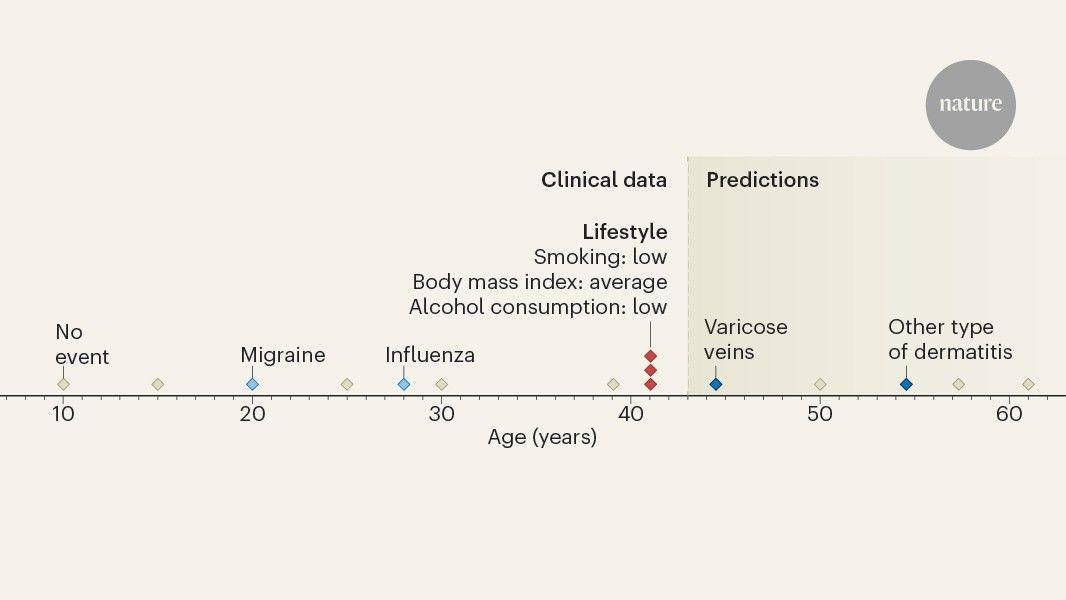
AI Model Predicts Disease Onset Up to 20 Years in Advance
In a groundbreaking development, researchers have created an artificial intelligence (AI) tool called Delphi-2M that can predict the onset of over 1,000 diseases up to 20 years into the future. This innovative system, developed by a European research team, utilizes electronic health records and lifestyle data to forecast an individual's health trajectory with unprecedented accuracy
1
.How Delphi-2M Works
Delphi-2M employs a modified version of the transformer model, the same technology that powers large language models like ChatGPT. The system uses positional embedding to understand the relationships between diagnoses and life events, similar to how language models interpret the sequence of words in a sentence
1
.The AI model considers various factors, including:
- Demographics (age, sex)
- Body Mass Index (BMI)
- Smoking and alcohol consumption habits
- Prior medical diagnoses
By analyzing these inputs, Delphi-2M can predict not only which diseases might arise but also when they are likely to occur
2
.Training and Validation
The researchers trained Delphi-2M using data from nearly 403,000 individuals in the UK Biobank. To validate its performance, they tested the model on 1.9 million electronic health records from the Danish National Patient Registry, spanning five decades of hospitalization data
3
.Accuracy and Performance
Delphi-2M demonstrated an impressive average accuracy of 70% across all disease categories, with an area under the curve (AUC) of 0.7. The model performed particularly well in predicting conditions with more predictable courses, such as certain cancers and myocardial infarction. However, its accuracy was lower for psychiatric disorders, pregnancy complications, and rare diseases with variable trajectories
3
.Related Stories




Potential Applications and Benefits
The development of Delphi-2M opens up exciting possibilities for healthcare:
-
Improved preventive care: By identifying disease risks early, healthcare providers can focus on prevention rather than treatment
2
. -
Clinical decision support: The model could aid in treatment planning and resource allocation
1
. -
Digital twins: Delphi-2M could be adapted to create virtual representations of individuals, simulating treatment outcomes and health trajectories
1
. -
Identifying new disease correlations: The model may uncover previously unrecognized connections between different health conditions
3
.
Limitations and Ethical Considerations
While Delphi-2M shows promise, experts caution about several important factors:
-
Data quality: The accuracy of predictions relies heavily on the quality and representativeness of the training data
2
. -
Bias and discrimination: AI models in medicine must address potential biases to ensure fair and equitable predictions
3
. -
Informed consent: Patients have the right to choose whether they want to know their predicted disease risks
3
. -
Interpretation of results: It's crucial to communicate that these predictions are not definitive outcomes but rather guidance for preventive or therapeutic decisions
3
.
As AI continues to advance in healthcare, tools like Delphi-2M highlight the need for ongoing discussions about the ethical implementation and regulation of these technologies in medical settings.
References
Summarized by

Navi
[2]
Related Stories
Recent Highlights



Recent Highlights
Today's Top Stories






Don’t drown in AI news. We cut through the noise - filtering, ranking and summarizing the most important AI news, breakthroughs and research daily. Follow topics that matter to you and stay ahead.


