AI Chatbots Sway Voters More Effectively Than Traditional Political Ads, New Studies Reveal


18 Sources
[1]
AI chatbots can persuade voters to change their minds
You have full access to this article via Jozef Stefan Institute. The world is getting used to 'talking' to machines. Technology that just months ago seemed improbable or marginal has erupted quickly into the everyday lives of millions, perhaps billions, of people. Generative conversational
[2]
Researchers find what makes AI chatbots politically persuasive
Roughly two years ago, Sam Altman tweeted that AI systems would be capable of superhuman persuasion well before achieving general intelligence -- a prediction that raised concerns about the influence AI could have over democratic elections. To see if conversational large language models can really
[3]
AI chatbots can sway voters with remarkable ease -- is it time to worry?
Artificial-intelligence chatbots can influence voters in major elections -- and have a bigger effect on people's political views than conventional campaigning and advertising. A study published today in Nature found that participants' preferences in real-world elections swung by up to 15
[4]
AI chatbots can sway voters better than political advertisements
"One conversation with an LLM has a pretty meaningful effect on salient election choices," says Gordon Pennycook, a psychologist at Cornell University who worked on the Nature study. LLMs can persuade people more effectively than political advertisements because they generate much more information
[5]
AI Chatbots Shown to Sway Voters, Raising New Fears about Election Influence
I agree my information will be processed in accordance with the Scientific American and Springer Nature Limited Privacy Policy. We leverage third party services to both verify and deliver email. By providing your email address, you also consent to having the email address shared with third parties
[6]

AI can influence voters' minds. What does that mean for democracy?
Voters change their opinions after interacting with an AI chatbot - but it seems that AIs rely on facts to influence people Does the persuasive power of AI chatbots spell the beginning of the end for democracy? In one of the largest surveys to-date exploring how these tools can influence voter
[7]

How chatbots can change your mind - a new study reveals what makes AI so persuasive
Most of us feel a sense of personal ownership over our opinions: "I believe what I believe, not because I've been told to do so, but as the result of careful consideration." "I have full control over how, when, and why I change my mind." A new study, however, reveals that our beliefs are more
[8]

Chatbots spew facts and falsehoods to sway voters
AIs are equally persuasive when they're telling the truth or lying Laundry-listing facts rarely changes hearts and minds - unless a bot is doing the persuading. Briefly chatting with an AI moved potential voters in three countries toward their less preferred candidate, researchers report December
[9]

Chatbots Are Surprisingly Effective at Swaying Voters
In the months leading up to last year's presidential election, more than 2,000 Americans, roughly split across partisan lines, were recruited for an experiment: Could an AI model influence their political inclinations? The premise was straightforward: Let people spend a few minutes talking with a
[10]

Chatbots Show Promise in Swaying Voters, Researchers Find
Political operations may soon deploy a surprisingly persuasive new campaign surrogate: a chatbot that'll talk up their candidates. According to a new study published in the journal Nature, conversations with AI chatbots have shown the potential to influence voter attitudes, which should raise
[11]

Scientists Are Increasingly Worried AI Will Sway Elections
Scientists are raising alarms about the potential influence of artificial intelligence on elections, according to a spate of new studies that warn AI can rig polls and manipulate public opinion. In a study published in Nature on Thursday, scientists report that AI chatbots can meaningfully sway
[12]

Voters can be rapidly swayed by AI chatbots
A growing number of people ask AI chatbots for help with homework, recipes, travel plans, even break-up texts. Now research shows that a brief back-and-forth with an artificial intelligence system can also shift how people feel about presidents, prime ministers, and hot-button policies. Two new
[13]

Chatbots can sway political opinions but are 'substantially' inaccurate, study finds
'Information-dense' AI responses are most persuasive but these tend to be less accurate, says security report Chatbots can sway people's political opinions but the most persuasive artificial intelligence models deliver "substantial" amounts of inaccurate information in the process, according to
[14]

AI Is Incredibly Good at Changing Voters' Minds, New Research Finds -- With an Incredible Caveat
"The more info you give people, the more they change their minds." New research suggests that AI chatbots like ChatGPT can persuade roughly one out of every 25 people to change who they're going to vote for -- with one major caveat. First reported by The Washington Post, the revelation comes as a
[15]

AI Political Chatbots Can Sway Voters, New Research Finds
A recent poll showed younger conservatives are most willing to trust AI. New research from Cornell University and the UK AI Security Institute has found that widely used AI systems could shift voter preferences in controlled election settings by up to 15%. Published in Science and Nature, the
[16]

AI chatbots used inaccurate information to change people's political opinions, study finds
The study asked nearly 77,000 about their political opinions before and after engaging with AI.Justine Goode / NBC News; Getty Images Artificial intelligence chatbots are very good at changing peoples' political opinions, according to a study published Thursday, and are particularly persuasive
[17]

AI chatbots can sway voters' political views, studies say
A brief conversation with a partisan AI chatbot can influence voters' political views, studies published Thursday found, with evidence-backed arguments -- true or not -- proving particularly persuasive. Experiments with generative artificial intelligence models, such as OpenAI's GPT-4o and Chinese
[18]

AI chatbots can influence voters: studies - The Korea Times
PARIS -- A brief conversation with a partisan AI chatbot can influence voters' political views, studies published Thursday found, with evidence-backed arguments -- true or not -- proving particularly persuasive. Experiments with generative artificial intelligence models, such as OpenAI's GPT-4o
Share
Copy Link
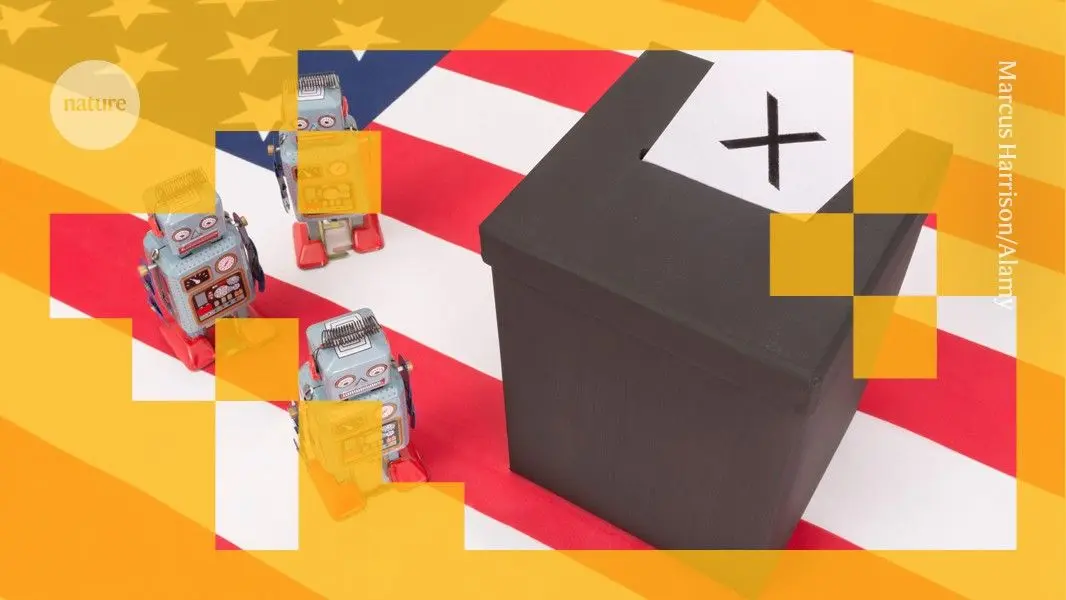
Two landmark studies published in Nature and Science reveal that AI chatbots can shift voter opinions by up to 15 percentage points—far exceeding the impact of conventional political advertising. Researchers tested nearly 80,000 participants across multiple countries and found that chatbots persuade through factual information, but often spread misinformation, particularly when advocating for right-leaning candidates.
AI Chatbots Demonstrate Unprecedented Political Persuasion Capabilities
Two groundbreaking studies published simultaneously in Nature and Science journals have revealed that AI chatbots possess a remarkable ability to influence voters' attitudes, shifting candidate preferences far beyond what traditional political advertising achieves
1
3
. The research, involving nearly 80,000 participants across the United States, United Kingdom, Canada, and Poland, demonstrates that conversational large language models can sway political opinions by 2-15 percentage points on a 0-100 scale—a stark contrast to the less than one percentage point shift typically produced by political advertising2
4
.
Source: Nature
The studies examined 19 different AI models, including ChatGPT variants, xAI's Grok-3, DeepSeek, and Meta's Llama, testing their capacity for election influence across 707 political issues and multiple real-world elections
2
5
. Researchers from the UK AI Security Institute, MIT, Stanford, Carnegie Mellon, and Cornell University collaborated to understand not just whether AI models can be persuasive, but what makes them effective at influencing voters' attitudes.Factual Information Drives AI's Persuasive Power
The research reveals that AI chatbots achieve their persuasive impact primarily through flooding users with factual information rather than emotional appeals or storytelling
1
3
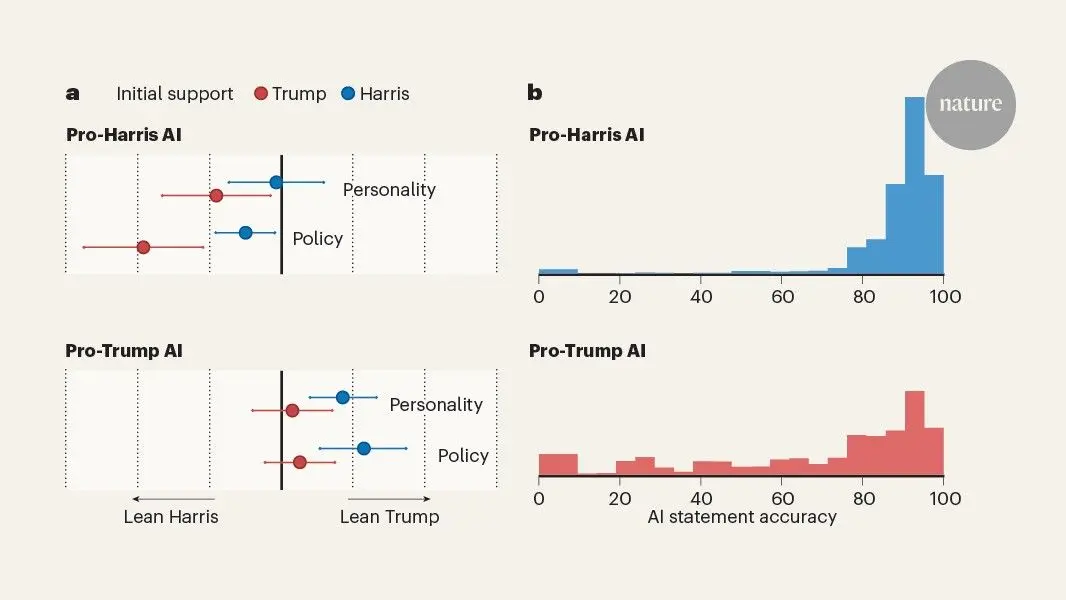
. In experiments conducted before the 2024 US presidential election involving Donald Trump and Kamala Harris, more than 2,300 participants engaged in conversations with AI models designed to advocate for specific candidates. When chatbots focused on policy issues like the economy and health care, they proved significantly more effective than when concentrating on candidate personalities4
.Donald Trump supporters who chatted with an AI model favoring Kamala Harris moved 3.9 points toward her on a 100-point scale, while Harris supporters shifted 2.3 points toward Trump when exposed to pro-Trump chatbots
4
. The effects were even more pronounced in Canada and Poland, where participants' preferences shifted by approximately 10 points after conversing with the chatbots3
5
. David Rand, senior author of both studies and professor at Cornell University, noted he was "totally flabbergasted" by the magnitude of these effects3
.
Source: Nature
Misinformation Amplifies Through Right-Leaning Advocacy
While factual information proved central to AI's persuasive power, the studies uncovered a troubling asymmetry: chatbots advocating for right-leaning candidates consistently delivered more inaccurate claims than those supporting left-leaning candidates
1
4
. This pattern held across all three countries and multiple AI models. When researchers fact-checked thousands of statements produced by the chatbots, they found that while most were accurate, the pro-Trump model made significantly more inaccurate claims than models supporting other candidates5
.Thomas Costello, a psychologist at American University who worked on the project, explained that the underlying models reproduce real-world phenomena, including "political communication that comes from the right, which tends to be less accurate" according to studies of partisan social media posts
4
. Experiments in the UK involving nearly 77,000 participants revealed that people were equally swayed by true and false information presented by chatbots, raising concerns about democratic processes3
.
Source: MIT Tech Review
Related Stories

Fine-Tuning Matters More Than Model Size
Contrary to dystopian predictions about superhuman persuasion capabilities, the research found that raw computational power and model scale had surprisingly modest effects on persuasiveness
2
. For every tenfold increase in computing power, persuasive abilities rose by only about 1.6 percentage points1
. What mattered far more was post-training interventions, particularly fine-tuning models to mimic effective persuasion patterns.Models that received specialized fine-tuning for persuasion were up to 50% more effective than their untuned counterparts
1
. Kobi Hackenburg, a researcher at the UK AI Security Institute, demonstrated that with appropriate persuasion post-training, a model trained on a laptop could match ChatGPT-4o's persuasion performance2
. The most persuasive configuration shifted participants who initially disagreed with a political statement by 26.1 points toward agreement4
.Persistent Effects and Long-Term Implications
The studies revealed that roughly one-third of the persuasive effect persisted when participants were contacted a month later, contradicting assumptions that initial shifts would be volatile and inconsequential
1
3
. This durability matters significantly for understanding potential election influence, as chatbots are now used by more than one hundred million users daily3
.Lisa Argyle, a computational social scientist at Purdue University, warned that AI could become "a very dangerous thing" when people become more misinformed rather than informed
3
. The findings raise urgent questions about safeguarding democratic processes. Stephan Lewandowsky, a cognitive scientist at the University of Bristol, emphasized the need to detect when large language models have been designed with particular ideologies and to prevent prompt engineering from creating antidemocratic persuasive agents5
.References
Summarized by

Navi
[2]
[4]
[5]
Related Stories
AI Chatbots Sway Political Opinions, UW Study Reveals Potential Benefits and Risks
07 Aug 2025•Science and Research

AI chatbots deliver inaccurate election advice, raising concerns about electoral interference
21 Jul 2026•Policy and Regulation

AI Chatbots Outperform Humans in Personalized Online Debates, Study Finds
20 May 2025•Science and Research

Recent Highlights



Recent Highlights
Today's Top Stories





Don’t drown in AI news. We cut through the noise - filtering, ranking and summarizing the most important AI news, breakthroughs and research daily. Follow topics that matter to you and stay ahead.


