9 Sources
[1]
Rethinking MDR as Attackers and Defenders Embrace AI
For most of the past decade, managed detection and response was the answer to a real problem. Security teams couldn't staff around the clock, couldn't hire enough analysts, and needed someone else to handle the alert queue. MDR stepped in. It worked well enough. Until now. The threat landscape has changed faster than the MDR model can adapt. Attackers are using AI to move faster, generate more convincing phishing at scale, automate reconnaissance, and create malware variants that evade signature-based detection. The attack surface has expanded from endpoint to cloud, identity, and network simultaneously. And yet MDR is still doing what it always did. Routing alerts to human analysts who triage what they can, in the order they can get to it. That is no longer enough. The data we share below proves it and security leaders might consider exploring whether they have outgrown their MDR. MDR's 24/7 promise doesn't cover 60% of your alerts MDR promised 24/7 human coverage. What it delivered was a 24/7 human capacity to triage high-severity alerts. Those are not the same thing. Across the industry, approximately 60% of alerts go unreviewed. That's not a performance failure. Human teams, whether in-house or outsourced to an MDR, cannot process the volume of alerts that modern environments generate. So they do what any rational person does. They prioritize. P1s and P2s get worked. P3s and P4s pile up. But this is exactly where attackers hide. Analysis of 25 million alerts across global enterprises in 2025 found that nearly 1% of real threats originate in low-severity and informational alerts. In an enterprise generating 450,000 alerts annually, that translates to roughly 54 real incidents per year, about one per week, sitting in the deprioritized queue where no one is looking. The breaches hiding in that backlog are not theoretical. They are happening right now, in organizations that believe they have coverage. Note: The math behind the above statement assumes 450K annual alerts, of which 60% are not investigated and of those, 2% are real incidents. Of those real incidents, 1% originate in low-severity alerts. Investigation quality varies by who is on shift Even for alerts that do get reviewed, MDR investigation quality is not consistent. It is bounded by the experience of the analyst on duty, the queue depth at that moment, the time of day, and whether the team is fully staffed. A P1 at 3 am gets a different investigation than the same alert at 10 am. This is not a criticism of MDR analysts. It is a description of what happens when any human-executed process runs at high volume, under pressure, around the clock. Variance is unavoidable. The consequences are real. When an investigation is shallow, threats get classified as noise. When follow-through is inconsistent, early-stage lateral movement looks like routine behavior. The attacker who got in on a low-severity alert keeps moving undetected because no one had the time or context to connect the signals. Detection engineering is not a closed loop In most MDR deployments, detection engineering is a periodic exercise. Rules get tuned when customers complain about alert volume. New coverage gets added when a major CVE makes news. Otherwise, the detection posture drifts. The core problem is architectural. MDR investigation and detection engineering operate in separate silos. When an analyst investigates an alert and closes it as a false positive, that insight rarely feeds back into the detection system. Broken rules stay broken. Noisy rules keep generating noise. New attacker techniques arrive without matching detections. The result is a detection posture that degrades faster than it improves. Real coverage, measured against the MITRE ATT&CK framework, can be far lower than teams assume. You can't audit what you can't see Most MDR services are a black box. Customers receive escalations and summaries. They do not get to see the investigation logic, inspect the evidence trail, verify the verdict, or audit what the analyst actually reviewed before closing a case. In an era where accountability and transparency are security requirements, this is a genuine liability. When an incident is missed, you cannot diagnose why. When a verdict is wrong, you cannot trace the reasoning. When regulators ask what was investigated and how, there is no answer. The AI savings are going to the vendor, not to you AI is reducing the operational cost of MDR. Providers are using it to automate portions of triage, reduce analyst hours, and increase margins. Those efficiency gains do not flow through to customers as lower prices or expanded coverage. The buyer still pays the same rate, or more. The provider keeps the savings. But the coverage gap stays the same. The human scaling constraint stays the same. Only the provider's cost structure has improved. You don't own what was built in your name Detection rules, triage logic, case history, and investigation learnings accumulate inside the MDR vendor's platform over the life of the contract. When the contract ends, that knowledge does not move with you. The years of tuning, the accumulated context about your environment, and the detection improvements built from your data all stay with the vendor. This creates two problems. First, organizations that switch providers start from scratch, rebuilding institutional knowledge that took years to develop. Second, organizations that want to bring security operations in-house, a trend that is accelerating as AI SOC tools mature, find themselves starting with no foundation. MDR providers, for obvious reasons, are not incentivized to help customers build internal capability. Their model depends on retaining the work. Your MDR contract may block you from using Claude for your SOC The above-mentioned knowledge lock-in is no longer just a switching-cost problem. It's also an AI readiness problem. When you try to deploy an AI agent for SOC work, it needs a knowledge foundation to reason over. Detection rules, case history, behavioral baselines, and forensic verdicts. If those live in your MDR vendor's platform, your agent is starting from near zero. Additional MDR gaps worth noting Aside from the above, MDR has a set of smaller gaps that compound over time. Every customer gets the same generic playbook regardless of their specific risk profile, compliance obligations, or data sensitivity. Integration tools like SOAR, which were supposed to streamline MDR findings into internal workflows, largely failed to deliver on that promise because human-driven investigation doesn't produce the structured, consistent outputs that automation requires. And when a real incident surfaces and a customer needs to talk to someone who understands their environment, they often reach an AI chatbot or a ticketing queue instead of a person. What the AI-powered attacker era actually requires The attackers of 2026 are not waiting for alert queues to clear. AI-generated phishing campaigns hit inboxes at a volume and quality that bypass conventional gateways. Credential stealers like Agent Tesla and LummaC2 move fast. EDR tools are being actively evaded, with research showing that more than half of confirmed compromised endpoints had already been marked as "mitigated" by the EDR vendor. The attacker has already won a round that the defender didn't know was being played. Meeting this moment requires a different operating model. One where investigation speed is measured in seconds, not hours. Where every alert gets examined, regardless of severity or time of day. Where the output is an evidence-backed verdict, not an analyst's judgment call under pressure. This is what an AI SOC is designed to deliver. An operating model shift where AI executes and humans supervise The core idea behind an AI SOC is simple. Move investigative execution out of the human queue and into AI, so that humans can focus on decisions rather than discovery. In practice, this means 100% of alerts, including endpoint, identity, cloud, network, phishing, and SIEM, are triaged and investigated automatically. Not sampled. Not filtered by severity. All of them. The AI applies the same forensic depth to a P4 alert at 3 am that a senior analyst would apply to a P1 in the afternoon. Intezer's platform data across 25 million alerts shows this is achievable. Less than 2% of alerts required human escalation. The over 98% that resolved autonomously did so with sub-minute median triage time and 98% verdict accuracy. For a large enterprise with 450K annual alerts, that means roughly 441K alerts per year are fully investigated and resolved without human intervention and 54 genuine threats that would have been missed under traditional MDR coverage are now caught with actional remediation recommendations. Forensic depth is what makes AI autonomy trustworthy AI can summarize an alert. That's useful. AI can enrich with threat intelligence. Also useful. But neither of those activities is investigation. They are pre-processing. Genuine AI-driven investigation requires forensic-level interrogation. When an alert fires, the question is not "does this look suspicious?" It is, what actually executed, where did it originate, what did it do, and is there evidence of compromise in memory that the alert itself didn't surface? This matters because the most dangerous threats are specifically designed to evade surface-level detection. Fileless malware lives entirely in memory and writes nothing to disk. Code injection hides inside legitimate processes. Early-stage credential theft looks like normal authentication. Without memory forensics, binary analysis, and code reuse detection, an AI investigation is only as deep as the alert data it was handed. Forensic depth is also what creates the trust threshold, the point at which AI verdicts are accurate and evidence-backed enough to act on without human validation. Below that threshold, AI assists analysts. Above it, AI can safely take on the full investigative workload and escalate only when evidence warrants it. Closed-loop detection engineering changes everything One of the most significant structural advantages of a true AI SOC is the closed loop between investigation and detection. Every alert investigation surfaces information about detection quality. Which rules are firing accurately, which are generating noise, and which attacker techniques have no coverage at all? When this feedback flows continuously into detection engineering, the posture improves without waiting for an annual audit or a customer complaint. Noisy rules get tuned. Broken telemetry gets flagged. New coverage for emerging techniques gets deployed in days, not months. The detection system gets smarter alongside the investigation system. This is how MITRE ATT&CK coverage moves from a static baseline to a dynamic, improving map of what an organization can actually detect. It is the difference between coverage that reflects what was set up two years ago and coverage that reflects what attackers are doing today. Pricing that aligns with full coverage The economics of an AI SOC should match the coverage it provides. Per-alert pricing, still common among AI copilot tools that rely heavily on LLMs, forces customers to be selective about which alerts to send. The result is the same cherry-picking problem that MDR created. High-severity alerts get the attention, low-severity alerts accumulate in a deprioritized queue. Per-endpoint pricing changes this entirely. The cost is fixed to the number of monitored endpoints, not to alert volume. There is no economic penalty for investigating every alert. Full coverage becomes the default, not a premium option. This also matters for budget predictability. Alert volumes spike unpredictably during active incidents or when new detections deploy. Endpoint counts are stable. For finance teams trying to plan security spend, the difference is significant. What ownership looks like under an AI SOC Detection rules, investigation history, and organizational context should belong to the organization, not to the vendor. This means every detection deployed to a customer's SIEM is the customer's rule. Investigation evidence is available for audit at any time. If the organization decides to expand internal capability, build its own AI agents, or switch tools, they take everything with it. This is not just a contract term. It is a prerequisite for security maturity and for broader adoption of AI tools like Claude for your security team. Organizations that want to eventually supervise AI systems rather than outsource to vendors need a knowledge foundation to build on. That foundation cannot exist if it lives inside a vendor's platform. The transition from MDR to AI SOC Moving from MDR to an AI SOC is not necessarily a rip-and-replace decision for most organizations. The practical path might be augmentation first. Bring in an AI investigation alongside the existing MDR contract, observe what the AI surfaces that the MDR was missing, and let the comparison build the case for a clean transition at renewal. By the time the MDR contract is up for renewal, the organization typically has months of evidence showing what full alert coverage looks like, what the escalation rate was under AI triage, and what it would cost to maintain the old model versus the new one. The decision is no longer theoretical. The question security leaders need to answer The MDR model was designed for a world where attackers operated at human speed, and the primary challenge was staffing coverage. That world is gone. Attackers are running AI-assisted campaigns, moving through environments faster than human triage queues can respond, and specifically targeting the low-severity signal space where MDR leaves blind spots. The question for every CISO and security leader evaluating their current operations is straightforward. Of the 60% of alerts your team isn't reviewing, how confident are you that none of them contain a real threat? The answer, informed by Intezer's analysis of 25 million real alerts, is that roughly 54 of them do. Every year. One per week. In the pile that no one is looking at. The AI SOC doesn't promise to eliminate all threats. No platform does. But it closes the coverage gap that the MDR model structurally cannot. Every alert, every severity, every hour of the day, is investigated with forensic depth, in under a minute. That is what security operations in the AI era look like.
[2]
Why AI-driven threats are exposing the limits of MSP security stacks
AI is transforming the speed and scale of cybercrime in ways traditional security operations were never designed to handle. Gartner predicts AI agents will cut the time it takes to exploit account exposures by 50% by 2027. Phishing campaigns that once took days to craft can now be generated in minutes, free of the telltale errors that once gave them away, while vulnerabilities that once required manual reconnaissance can now be identified and exploited automatically. For MSPs, the stakes are clear. Those still relying on a fragmented security stack will not just be slower to respond but will also struggle to prove to clients that their environments are fully protected. Keeping pace with AI-driven threats requires a more unified, AI-powered approach that strengthens security, simplifies operations and delivers greater value without putting additional pressure on margins. The growing gap between attackers and defenders AI is accelerating nearly every stage of the modern attack lifecycle. Verizon's 2026 Data Breach Investigations Report found that threat actors are already deploying generative AI across multiple stages of the attack chain from reconnaissance and initial access through to malware development. What once demanded significant time and expertise can now be executed faster and at far greater scale. Meanwhile, many MSP technicians are still jumping between disconnected tools to piece together what is happening. An alert fires in the EDR console, but verifying backup status requires a separate login. Patching data lives in the RMM, while remediation steps have to be manually validated across platforms. Every minute spent switching between tools is a minute attackers use to escalate privileges, move laterally and deepen their foothold. The business cost is just as significant. Fragmented operations inflate technician workloads, slow incident response and make it harder to scale cybersecurity services without adding more headcount and tools. All this compounds pressure on margins. In an AI-driven threat environment, security outcomes are increasingly determined by operational speed and coordination, not just the quality of individual tools. What modern endpoint security operations need Modern endpoint security depends on three capabilities: speed of detection, coordinated response and fast recovery. Achieving all three across multiple disconnected platforms is increasingly difficult. That is why more MSPs are consolidating around unified environments where security, automation, monitoring and recovery operate as a single coordinated workflow. Deep integration Most MSP security tools are connected through lightweight integrations. Data may sync between platforms, but response workflows remain disconnected, making it harder to correlate data quickly and act on threats in real time. Modern endpoint security demands tighter operational integration, where every step of the response process works together automatically. For example, when a ransomware activity is detected, a deeply integrated environment can isolate the device, alert technicians, verify backup integrity, trigger remediation workflows and surface recovery progress from a single interface. This level of coordination reduces time-to-containment, minimizes downtime, and makes compliance reporting significantly simpler. Automation and AI-assisted response Many MSP environments still depend heavily on manual effort during security incidents. That dependence creates dangerous delays when response windows are measured in minutes. Automation closes those gaps by continuously patching vulnerabilities, enforcing security policies, detecting anomalies earlier and triggering remediation without waiting for a technician to act. This matters not just for speed, but for scale. As attack volumes grow and response windows shrink, automation prevents security teams from being overwhelmed during active incidents and allows MSPs to deliver consistent protection across a larger client base without proportional increases in staffing. Reducing tool sprawl Automation and speed are difficult to sustain when security operations are weighed down by too many disconnected products. Over time, many MSPs have layered on new tools to address emerging threats, client requirements or compliance obligations. The result is overlapping functionality, fragmented workflows, and mounting operational overhead that erodes both efficiency and profitability. Cutting unnecessary complexity allows teams to move faster, respond more consistently, lower licensing costs and deliver a clearer, more confident security story to clients. Security as a growth engine for MSPs As the MSP market matures, security has emerged as one of the clearest drivers of consistent revenue growth and client retention. The 2026 Kaseya State of the MSP research shows 71% of MSPs reported year-over-year cybersecurity revenue growth, the highest of any service category, while 61% say most or all of their clients rely on them for cybersecurity guidance. But the biggest barrier to expanding security services is not demand. It is the combination of tool complexity and talent constraints. Hiring experienced security professionals is expensive and layering in new products to keep pace with evolving threats increases operational overhead while making environments harder to manage. MSPs need security operations that scale without requiring proportional increases in labor, complexity or cost. That is where unified security platforms with truly integrated AI and automation capabilities become operational multipliers. Faster remediation, cleaner visibility and stronger reporting allow MSPs to demonstrate security value more effectively, building the kind of trust that deepens client relationships and creates durable revenue. Why unified platforms are gaining traction Many MSPs are reaching the limits of what fragmented security stacks can efficiently support. Managing separate products for endpoint protection, backup, RMM, patching, MDR and ransomware recovery creates operational silos that slow response and increase administrative burden. Modern all-in-one platforms address this by bringing security, management, and recovery workflows under a single operational model. Kaseya 365 Endpoint reflects this approach. It combines RMM, endpoint security, patch management, backup, ransomware protection, MDR or 24/7 SOC services in one platform. The value is not just fewer tools, but that prevention, detection, response and recovery can operate as a coordinated whole, reducing visibility gaps and enabling faster response with less overhead. As tool complexity and cybersecurity talent shortages continue to limit security growth, Kaseya 365 Endpoint directly addresses both by simplifying operations and helping teams manage security more efficiently without adding specialized staff. Endpoint security in the age of AI AI is changing endpoint security on both sides of the fight. Attackers are using AI to launch faster, more sophisticated threats, while MSPs are under growing pressure to respond and recover more quickly. As attack timelines shrink, clients are judging MSPs not only on their ability to detect threats, but on how quickly they can respond, recover systems and communicate clearly during an incident. Integrated security platforms support this by bringing visibility, response and recovery into a more connected operational model. Faster remediation, clearer reporting and reduced operational overhead will help MSPs demonstrate security value more effectively, strengthening client trust and supporting long term recurring revenue growth. AI-driven threats demand smarter security. Join the Kaseya partner community.
[3]
Security in the Post-Mythos Era
Why the Fundamentals You Ignored Are the Only Things That Will Save You In 2023, a colleague and I wrote a cybersecurity guide for businesses of any size. It was not glamorous work. Nobody was asking for another whitepaper about multi-factor authentication (MFA) and network segmentation. The industry had heard it all before: Harden your devices, segment your networks, deploy endpoint detection and response (EDR), centralize your logs, test your backups, validate your designs. These are not revolutionary ideas. They are the kind of recommendations that get polite nods in client meetings and then get quietly dismissed somewhere between budget approval and implementation. We wrote the guide anyway. Not because I thought we were saying something new, but because after years of incident response work, I kept walking into the same rooms, looking at the same gaps, and having the same conversations with organizations that had just been breached. The attack vectors changed and the tooling evolved, but the reason organizations got hurt was almost always the same - the basics were not in place. In that paper we posed questions that, when answered honestly at the strategic level, could reveal the real state of an organization's defenses. We covered endpoints, networks, cloud services, physical security, staffing, and logging. It was designed to be useful whether you had a team of 500 security analysts or a single IT person wearing multiple hats. The core thesis was that patching alone is not a security strategy. You need a foundation that holds when patching fails - because eventually, patching will fail. This scenario eventually arrived in April 2026. Anthropic announced Project Glasswing and Claude Mythos Preview, an AI model that autonomously discovered thousands of high-severity zero-day vulnerabilities across every major operating system and web browser. Not theoretical weaknesses or potential issues - working, exploitable vulnerabilities. One was undiscovered for 27 years in OpenBSD, the operating system chosen specifically because it is said to be among the most secure in the world. This is what happens when vulnerability discovery stops being a human-speed activity. It dawned on me everything we wrote about in 2023 - every recommendation, every question we posed -had just become dramatically more urgent, as speed is the new factor in the traditional risk triad. Cisco set out the strategic version of this argument in its Shields Up guidance after working with Mythos Preview. What follows is its operational companion. The new math Before Mythos and other frontier large language models (LLMs), the vulnerability lifecycle had a rhythm that most security teams had internalized. A researcher discovers a vulnerability, and weeks or months pass while an exploit gets developed. After a vendor releases a patch, organizations deploy it on their own schedule. There was slack in the system, which gave organizations time to triage, test, and be slow but still survive. After AI and LLMs, the first two stages of that lifecycle collapsed to near-simultaneity. AI discovers the vulnerability and writes the exploit in minutes, not weeks. But the last two stages, patch release and patch deployment, remain human-driven processes operating at human speed. The gap between discovery/exploit and patch/deploy has widened from a manageable delay into a structural gap. The numbers make this concrete. The FIRST 2026 Vulnerability Forecast projects a median of roughly 59,000 new CVEs this year, with a 90% confidence interval reaching up to 118,000. In 2025, 48,185 CVEs were published, a 21% increase over the year before, which works out to roughly 131 new vulnerabilities disclosed every single day. NIST acknowledged that CVE submissions grew 263% between 2020 and 2025. Starting April 2026, NIST announced it would only prioritize enrichment for CVEs appearing in CISA's Known Exploited Vulnerabilities (KEV) catalog, software used by the federal government, and critical software under Executive Order 14028. Everything else goes to the back of the line. When talking about this data in customer briefings, I framed it around three factors: the minutes from discovery to exploit, the thousands of zero-days discovered, and how AI accelerates attackers and defenders equally. The Cloud Security Alliance was explicit about this in their April 2026 analysis. The ability to discover vulnerabilities at AI scale is not intrinsically a defensive capability. It is a dual-use capability whose effect depends entirely on who has access and what constraints govern their use. We are lucky that frontier models take responsibility for how they are used, but there are many open-source models with less oversight. When vulnerability management fails, who do you fall back on? The way I think about post-frontier model defense, and the way I have been presenting it to security leaders, follows a three-stage fallback model. The first pillar is vulnerability management. Scan, prioritize, patch, repeat. This is where most organizations have concentrated their security spending for two decades. Patch velocity cannot match AI-driven discovery rates. With 59,000+ CVEs projected for 2026 and growing, the volume exceeds organizational capacity to triage, test, and deploy (in production, live). Not all vulnerabilities even have patches on day zero; some are deemed as "operational risk," or it would take years to redesign systems or hardware. Vulnerability management is not dead, but it is no longer the primary line of defense; it is now one input among many. This is where Cisco IQ becomes essential. Its digital interface provides complete asset visibility, security hardening insights, and risk assessments, allowing you to proactively identify vulnerabilities and harden your systems in the face of mounting CVE volumes. Automating what you can will be key to resilience acceleration. When patching fails, you fall back to the second pillar: the "old school" hardening that seems to be forgotten in era of EDRs. This is where the 2023 whitepaper becomes a guide: * MFA everywhere, especially VPN and admin access, because credential theft is the most common way attackers establish initial access and MFA is the control that most reliably stops it. * Device hardening via CIS benchmarks and golden images, because a hardened system with unnecessary services removed and Credential Guard enabled has dramatically fewer exploitable paths than a default installation. * Network segmentation to limit blast radius, because a single zero-day should not cascade across your entire infrastructure. We recommended building golden images that incorporate appropriate security logging, refreshing them every 6 to 12 months, and applying the latest hardening standards. The whitepaper from 2023 asks questions that most organizations still cannot answer confidently: Are well-known security standards for hardening followed consistently across all devices? When was the last time core system golden images were reviewed for weaknesses? Are golden images part of security reviews? The third pillar is detection and response. Hardened systems do not prevent exploitation, but make it harder, slower, noisier, and survivable. Detection and response are what catches the exploitation that gets through, and in a post-AI exploitation world, some exploitation will get through. This is given and needs to be assumed. This means EDR, NDR, and XDR for visibility across layers. Behavioral detection is critical when zero-days outpace signature updates. An attacker using an AI-discovered vulnerability still needs to execute code, establish persistence, move laterally, and exfiltrate data. Those actions produce behavioral signals that a properly configured EDR can detect regardless of whether the specific vulnerability was previously known. It means that we can use threat hunting to find what automation misses. It also means you need incident response capability for when prevention fails. New attacks will emerge. The question is not whether you will be compromised. It is now how quickly you can detect, contain, eradicate, and recover. Validation is not optional Having the right products deployed is necessary, but not sufficient. You also need to know how they work - and here is where most organizations have a blind spot the size of a continent. The question every security leader should be asking right now is "Do my controls actually work? Not on paper, but under real-world attack conditions?" Penetration testing answers that question. So does assessing your configurations against CIS benchmarks and hardening what falls short. Threat modeling takes it further by mapping the attack paths a real adversary would use against your specific architecture, not a generic risk matrix. Breakout assessments deserve special attention. They test the boundaries between network segments. Can an attacker move from a compromised endpoint to critical infrastructure? From IT to OT? From one business unit to another? In a post-AI world where a zero-day can provide initial access to network segment, the integrity of those boundaries is arguably the most important architectural property of your network. Finding out they are broken before a real adversary does is the difference between a containable incident and an existential crisis. Then there is the response side, and this is where I see the widest gap between what organizations think they have and what they actually have. IR playbooks that have never been tested are not playbooks. They are hopes. Purple team exercises are what turn those hopes into muscle memory, the kind that determines whether your team freezes or acts when a real incident hits. Proactive threat hunts catch what your automation missed. When everything has been tested and still was not enough, emergency incident response is the capability that gets you from compromised to recovered. The full picture is a cycle. You want to prevent security issues with products and hardening, validate with testing and assessment, and respond with hunting and incident response - all of it backed by threat intelligence, and all of it working together as a system, not as disconnected point solutions checked off a compliance spreadsheet. What did not change AI will not get tired of system exploitation, so risk will get realized much faster than in the past. Because of this, we now add "speed" to risk equation. It becomes Risk = likelihood x impact x speed as opposed to just Risk = likelihood x impact. AI does not change the principles of cybersecurity. MFA still blocks credential theft; segmentation still prevents exploit cascading into the environment; EDR still detects exploitation behavior, memory abuse, and attempts to "write" to memory segments; centralized logging still records events for detection and investigation; and tested backups still enable recovery. Those statements were true before any LLM/AI vulnerability discoveries, they are true after LLM/AI, and they will remain true after whatever comes after current stacks. Because they operate at a layer of the security stack that is independent of how fast vulnerabilities are discovered. They work whether the attacker used a known CVE or a fresh zero-day, and whether the exploit was written by a human researcher over three weeks or by an AI in three minutes. This is the structural insight built around the whitepaper in 2023. Nobody had predicted that LLM/AI vulnerability discovery explosion, but we had seen, over and over again in incident response engagements, that the organizations that survived breaches were not the ones with the fastest patching cycles. They were the ones that had built their security foundations before the breach arrived. The current AI acceleration does not wait for budget cycles, board approvals, or strategic plans. It rewards preparation and it punishes delays.
[4]
Security at machine speed: why the SOC must be rebuilt for the AI era
AI-driven attacks are accelerating agentic SOC transformation At RSAC 2026, the SANS Institute delivered a defining statement. For the first time in the conference's 25-year history, every dangerous attack technique on its annual list involved AI. In live demonstrations, attackers moved from initial access to full domain control in less than a minute using AI-driven workflows. The attack lifecycle has compressed to the point where many organizations cannot operationalize a response before the outcome is already determined. This is the uncomfortable reality enterprises must confront: beyond detection capabilities, the defining constraint in cybersecurity is organizational speed. Cyber resilience now depends as much on organizational responsiveness as technical detection capability. Enterprises must be able to adapt, deploy, and operationalize defenses at the pace attacks unfold. That requirement extends far beyond the SOC itself. Procurement cycles, governance approvals, security reviews, deployment bottlenecks, and operational change management are now part of the internet security control plane whether organizations recognize them or not. A twelve-month procurement cycle was inefficient when attackers needed weeks to move laterally across an environment. Now that AI-enabled attacks can traverse cloud, SaaS, and identity management infrastructure in minutes, that same cycle becomes a material risk factor. Most organizations still budget cybersecurity purchases twelve months in advance. Only a minority of projects go live within six months of contract approval, while some large enterprises take a year or longer to operationalize new capabilities after signing contracts. That delay creates exposure. Organizational change velocity has become a compensating security control. Why Legacy SOC Architectures Are Breaking The traditional SOC was engineered for a fundamentally different threat model defined by known signatures, perimeter-based controls, and human-led investigation workflows. It assumed that the analyst was the primary reasoning engine, but obviously, that now no longer holds. The deeper problem is operational architecture. Legacy security operating models were built around deliberate process cadence: layered approvals, segmented ownership, sequential investigations, quarterly planning cycles, and extended deployment timelines. Those structures were survivable when defenders and attackers operated at roughly human speed. AI has broken that balance. Posture-based prevention technologies like CNAPP and CSPM reduce exposure but offer limited value against active cloud threats unfolding in real time. Legacy SIEM platforms aggregate raw data but were not designed to reason across hundreds of SaaS applications, multiple cloud environments, and sprawling networks of human and non-human identities at machine speed. Investigation workflows remain largely sequential. Analysts triage alerts, pivot between consoles, reconstruct activity manually, and escalate findings through multiple operational layers. Every transition introduces latency. In an AI-driven attack chain, latency compounds into compromise. Attackers don't need zero-day exploits anymore. They're walking through the front door using OAuth abuse, API integrations, SaaS-to-SaaS trust relationships, session hijacking, and identity compromise. They blend into legitimate workflows while moving across cloud, SaaS, AI, and identity systems with precision and speed. Alert volume only magnifies the structural problem. One major managed SOC reported processing an average of two alerts per minute throughout 2025. That is not simply a staffing challenge. It is evidence that the underlying operating model no longer scales against machine-speed offense. The Rise of the Agentic SOC The legacy SOC requires a structural reset toward the Agentic SOC: an operating model designed to match adversaries on speed, automation, and adaptability. In this model, AI systems handle high-volume investigative work autonomously. They correlate evidence across disparate systems, generate hypotheses, validate attack paths, and recommend or execute response actions within defined guardrails. Human analysts remain accountable, but their role shifts toward oversight, business judgment, exception handling, and strategic decision-making. Detection, investigation, and response collapse into a continuous operational pipeline rather than separate stages divided by escalation queues and manual pivots. Forensic data is ingested and correlated in real time, producing unified attack timelines without the friction of console switching or fragmented tooling. AI agents can conduct continuous investigations, compressing response times from hours to seconds. Critically, the Agentic SOC is an organizational redesign centered around execution velocity. Organizations using the Agentic SOC will build operating models capable of continuously deploying and adapting those tools. They will reduce friction between security, procurement, governance, engineering, and operations so defensive capability can evolve at the pace threats evolve. That distinction matters. Many enterprises already possess capable technologies but remain constrained by internal change velocity. Security teams identify gaps quickly but cannot operationalize solutions fast enough to matter. In practice, organizational inertia becomes an adversary's advantage. SaaS Expansion and the Visibility Problem The attack surface continues to expand aggressively across SaaS ecosystems. Enterprises now rely on hundreds of interconnected applications, each introducing distinct identity models, integrations, permissions structures, and potential misconfigurations. These environments create ideal conditions for rapid compromise and lateral movement. Posture management tools frequently miss the initial compromise and the live attack activity that follows. Identity blind spots, OAuth abuse chains, and fragmented telemetry create conditions where attackers can operate with near invisibility. A major constraint is the SaaS visibility gap. Many enterprises still fail to meaningfully collect and operationalize SaaS telemetry across their environments. Even when logs are ingested, they are frequently dumped into SIEM platforms as raw data that analysts struggle to normalize, correlate, and investigate at machine speed. The result is massive telemetry volume with limited operational visibility precisely when attackers are moving fastest. Delayed deployment cycles compound the problem further. Security capabilities that take months to evaluate, approve, and operationalize often arrive already behind the threat landscape they were intended to address. In the AI era, execution velocity becomes part of the defensive architecture itself. What Boards, CIOs, and CISOs Must Do Now Boards and executive leadership teams must recalibrate around a new reality: organizational tempo is now inseparable from cyber resilience. Rigor around vendor evaluation, governance reviews, contract diligence, and implementation planning remains necessary. But those cycles must compress to align with the material risk introduced by AI-speed attacks. Leadership teams should start with realism. Measure actual mean time to respond (MTTR), not the theoretical number documented in a playbook, but the real number demonstrated across recent incidents. Then ask whether that timeline would contain an AI-enabled attack capable of traversing cloud and SaaS infrastructure in under twenty minutes. If the answer is no, the organization is facing a structural problem rather than an isolated tooling gap. Equally important, organizations must begin measuring change velocity itself. How long does it take to move from identifying a security gap to deploying and operationalizing a capability in production? How long do procurement approvals take? How long do integrations stall in testing environments? How many operational dependencies exist before a security control becomes active? Those timelines should be tracked, benchmarked against threat speed, and reported alongside MTTR and dwell time metrics. Organizations should establish fast-track evaluation and deployment frameworks for security technologies, particularly cloud-native and AI-native platforms where the risk of delayed deployment may exceed the risk introduced by accelerated diligence. Security leaders should also audit their own environments for operational latency. How many manual pivots does an analyst perform during an investigation? How long does it take to transform raw telemetry into a correlated attack timeline? Every friction point represents adversary dwell time by another name. And critically, organizations must acknowledge the limitations of posture-based security. Configuration reduces exposure, but it does not stop an active attack already moving through the environment. The SOC that succeeds in the AI era will not be the one with the cleanest posture dashboard. It will be the one capable of detecting and containing live threats before operational impact occurs. We list the best ITSM tools. This article was produced as part of TechRadar Pro Perspectives, our channel to feature the best and brightest minds in the technology industry today. The views expressed here are those of the author and are not necessarily those of TechRadarPro or Future plc. If you are interested in contributing find out more here: https://www.techradar.com/pro/perspectives-how-to-submit
[5]
AI is supercharging cyberattacks -- and most companies aren't ready | Fortune
As companies rush to adopt AI across their operations, attackers are exploiting the same technology against them. From automated hacking to AI‑powered scams, the new threats are forcing companies to rethink their broader approach to security. Beyond hardening technical defenses, companies operating in the AI age need to examine a wide range of practices, say industry experts, updating the way software patches are deployed and rebuilding the human layer of security. "Everybody needs to be on a war footing right now," Mayank Upadhyay, chief security and trust officer at Snowflake, told Fortune. The attack surface across a typical enterprise -- network, laptops, cloud infrastructure, logins -- is now generating so much data that human teams can't hope to triage without help from AI, he said. For years, most organizations managed cyber risk on a predictable schedule. Security teams would discover flaws in their software, vendors would bundle fixes into periodic updates, and companies would decide when to install those patches -- often weekly, monthly, or even quarterly. That slower, batch‑style approach existed, in part, because updating critical systems can mean taking them offline, and there is always a risk that a new patch breaks something important. Now, widely accessible AI systems can scan codebases at scale, automatically generate exploits for the vulnerabilities they find, and in some cases deploy those exploits to infiltrate networks and steal data or take control of systems. This AI‑accelerated vulnerability discovery allows threats to be identified and weaponized in hours rather than days or weeks, outpacing the traditional patching cycle. Experts and industry leaders say the answer is to fight AI with AI. "You have to use AI. It's not even a choice, because there's just so much data," said Upadhyay. "If you're being attacked by AI, there's not enough security specialists you can put in place to fight that." Anthropic's new Mythos model, although currently available only to select companies, is a prime example of the critical role AI can play as a defensive tool. Steve Schmidt, Amazon's chief security officer, told Fortune that Mythos not only helps to patch individual bugs but also helps to permanently close whole classes of weaknesses that have been lurking in their systems. "Everything we've seen has shown that we are far more effective using AI as defenders than adversaries are using it for attacks," he said. "The experience we have with...the Mythos model is that it is a significant advantage to the defender." However, he said, the model only really performs when it's paired with experienced engineers, adding that left to run on its own, even the most advanced systems throw off so many false alarms that developers eventually stop trusting what they see. A new era of workforce risk The economics of attacks are shifting too. Sophisticated, tailored intrusions used to be reserved for high-value targets; small and midsize companies could rely on relative obscurity. AI changes that calculus, lowering the cost and skill required to launch a customized attack against almost any organization, said Hugh Thompson, executive chairman of the RSA Conference. "The fact that these tools can go after so many potential victims at once is a game changer in mindset," he said. And while a lot of attention has been given to AI models' ability to exploit technical vulnerabilities, there's been less conversation about the risks around social engineering -- using psychology to manipulate people into giving attackers data or access. Social engineering attacks utilize things like phishing emails crafted to mimic a colleague's writing style; vishing -- voice calls impersonating IT support or a vendor; business email compromise, in which an attacker poses as a senior executive to authorize a fraudulent wire transfer; and increasingly, deepfake audio or video calls designed to convincingly replicate a real person. In one high‑profile case, criminals used an AI‑generated video and voice clone of a company's finance chief on a live video call to trick an employee into wiring roughly $25 million to fraudulent accounts. Preparing workers for these AI risks requires more than prerecorded training videos or the occasional phishing email test. And instead of thinking about the risk of one or two employees being targeted by a sophisticated phishing attack, companies need to be prepared for all employees to be regularly targeted. According to research from Charlemagne Labs, an AI-security startup, AI models already widely available can now sustain believable, multi-turn deception -- conversations that span many back-and-forth exchanges rather than a single message -- which is the hardest part of real-world scams. AI models, the research found, may enable convincing, automated end-to-end scams within 12 to 24 months. "Because most AI researchers are more familiar with technical hacking and exploits, we believe social engineering -- still the attack genesis for the vast majority of attacks -- has gotten too little attention," says Jeremy Philip Galen, a former Meta product manager and CEO of Charlemagne Labs. One way that Galen's startup is trying to address this is with a system named Charley that uses AI to monitor incoming messages and warn users about likely scams, acting as a kind of always‑on scam filter in the background. "You can't really train people, and that's scary. You can't teach people to identify threats, which means we're entering a new era of workforce risk," he said. Snowflake's Upadhyay says his team is already running daily "war room" exercises that bring together application security, cloud infrastructure, IT, and security operations teams. The aim is to remove silos so they're prepared to react at "AI speed," using the same AI‑powered tools as they test their defenses and find gaps before attackers do. Upadhyay says teams should be establishing what is a four-step cycle powered by AI: Set up defenses, monitor them for breaches, contain and clean up any attacks or vulnerabilities that break through, and then build new controls so the same weakness can't be exploited again. "Just automating that entire life cycle -- it's using AI to fight AI. This is the thing that everybody should be rushing to do at this moment," he said.
[6]
The vulnerability crisis: How AI is shrinking the window for defense
"Microsoft Patch Tuesday, exploit Wednesday" used to be a joke. Now it's reality. Adversaries use LLM disassemblers to reverse-engineer patches, identify underlying flaws, develop exploits, and begin scanning the internet for targets -- all within a day of publication. Five months ago that window was four days. The problem isn't new attack methods. It's patching speed. Very few organizations can patch in a day. CISA gives even the most critical US organizations 30 days to patch internet-facing vulnerabilities. If you have Fortinet, Ivanti, Cisco, or Microsoft infrastructure facing the internet, the question is not whether you will be hit, but when. That is not a prediction. It's simple arithmetic. Protection can't close the gap The reason organizations need resilience is that protection has failed. Not occasionally -- routinely. Security teams' instinct is to respond with more protection: better EDR, more threat intelligence, faster patching cycles. All of that is necessary, but none of it is sufficient. Across every incident my team has responded to, all the companies whose data was encrypted had an up-to-date EDR solution in place. It didn't matter. There are at least eight known methods for evading EDR tools. The most common involves deploying a vulnerable kernel module via an initial exploit that sits above the firmware, where detection capabilities are effectively blind. This is the standard playbook, not an edge case. Threat intelligence has the same structural problem. By definition, intelligence about adversary behavior lags behind that behavior. Even threat intelligence-led patching strategies -- where organizations prioritize vulnerabilities based on known exploitation activity -- have a built-in delay. The intelligence arrives after the window has already opened. AI is also accelerating attacks in the phishing space, though in a different way. AI can analyze how individuals construct their emails and generate impersonations convincing enough to fool colleagues. Business email compromise attacks that once required significant skill and access can now be assembled quickly and at scale. Adversaries were always doing this. AI just lowered the barrier considerably. The conversation organizations need to have Companies need to embrace an unsettling truth: Attacks are going to land no matter how exceptional the security team is. Some CISOs still believe otherwise. They will tell their board that given enough budget and headcount, the company can be protected. But breaches at even the largest, best-funded organizations show that assumption is not grounded in reality. Most security leaders still avoid having that conversation with the business. They should be leading with it. AI isn't introducing fundamentally new attack techniques. It's accelerating ones adversaries were already using. And if protection was already failing before AI, the case for building genuine resilience is stronger than ever. Mature security planning starts not with how to prevent every attack but with accepting that some will inevitably succeed. That shifts the discussion from an unrealistic hope of closing all vulnerabilities to how to continue operating when an attack succeeds. Three places to start: Whether an exploit takes four days to develop or one, the resilience strategy is the same: identify the most essential services before a crisis hits, maintain them under duress, and rebuild trust at every level -- network, identity, access -- before declaring the environment safe. When vulnerabilities are exploited in hours, not days, security stops being about prevention alone. It becomes about how quickly an organization can operate through failure. In a world of "exploit Wednesday," resilience -- not speed -- determines who stays operational. We've featured the best endpoint protection software. This article was produced as part of TechRadar Pro Perspectives, our channel to feature the best and brightest minds in the technology industry today. The views expressed here are those of the author and are not necessarily those of TechRadarPro or Future plc. If you are interested in contributing find out more here: https://www.techradar.com/pro/perspectives-how-to-submit
[7]
81% of teams ship broken code: Mythos made that inexcusable
For years, cybersecurity was a numbers game. Find more vulnerabilities than attackers can exploit. Patch faster than they can move. Stay vigilant and stay ahead. But what the latest generation of AI models has shown (especially Claude Mythos) is that AI has become dangerously good at understanding how systems actually work together. It can trace connections across applications, APIs, identities, cloud services, and third-party components. It doesn't just find bugs. It exploits hidden fault lines across the enterprise and waits for the right moment to trigger the quake. Meanwhile, most organizations still operate as if shipping code with known security flaws is an acceptable risk. Last year, a staggering 81% of global AppSec leaders who responded to a Checkmarx study said they knowingly ship vulnerable code. This happens not because the risk is small, but because the volume is overwhelming. Teams do not have the time, capacity, or resources to fix everything. Exposure is constantly deferred and absorbed into day-to-day operations. In practice, the complexities of the stack limit how often certain vulnerabilities are used in real attacks. Until now. Anyone Can Be a Hacker Now AI is changing how quickly and easily vulnerabilities can be turned into working exploits. Tasks that once required deep technical knowledge can now be done with tools that guide, accelerate, and in some cases automate parts of the process. This has direct implications for assessing risk. Many vulnerabilities have historically been deprioritized because exploiting them was impractical for hackers. But as the learning curve to wreak havoc drops, those same vulnerabilities are becoming viable entry points. This puts pressure on the way we've always prioritized risk. Severity scores tell you how dangerous a vulnerability looks in isolation. They don't tell you how easy it's become to exploit in the real world. These are now two different calculations, and confusing them is exactly how attackers get ahead. AI is a Double-Edged Sword A small percentage of insecure code sounds manageable. But multiply it across millions of lines and it becomes a massive potential attack surface. Every line of code generated at machine speed is another line that needs to be secured at machine speed. Coordinated disclosure and patch management efforts help at the margins, but don't touch the mountain of vulnerabilities already sitting in production: dormant, deprioritized, and increasingly easy to reach. Most organizations already face a backlog of unresolved vulnerabilities. But what's new is the pressure to find them. As the new ADLC (Agentic Development Life Cycle) takes shape, the gap between identification and remediation is expanding fast. Security programs that focus heavily on finding vulnerabilities without improving how they are prioritized and fixed will struggle to keep pace. This is Not Your Father's AppSec Traditional AppSec was designed for a world that no longer exists. What's needed now is security that's continuous, embedded directly into development workflows, and capable of assessing real-world exploitability and remediating it in real time. Fixed cycles and delayed feedback are luxuries the current threat landscape can't afford. The attack surface in modern software development doesn't have a single-entry point, it has four: ● At the moment of code creation in the IDE, where agents generate code faster than any review process was designed to absorb. Security has to live where the code lives. ● In the build and CI/CD phase, where every commit, every dependency update, and every AI-generated change must be assessed for exploitability in context, not just flagged for existence. ● Across the AI supply chain: the models, SDKs, MCP servers, and third-party packages your teams are pulling in, often without realizing it. Deterministic discovery is the only reliable layer here, because AI models cannot audit their own supply chain. ● And at runtime, where deployed applications face live threats, security must close the loop between what was shipped and what is being actively exploited. The Goal Was Never to Find Everything Protecting these phases takes more than just bolting on another AI tool. One of the most critical actions an organization needs to take is to keep the security system structurally separate from the AI systems it's meant to govern. When the same LLM writing your code is also the one judging whether it's safe, you've handed the student the answer key and asked them to grade their own exam. What the AI era demands instead is a hybrid agentic security control layer, one that combines deterministic, rule-based analysis with AI-augmented reasoning, but where the deterministic layer remains the ground truth. That separation isn't a legacy constraint. It's the architectural property that makes the security signal trustworthy. Even before AI, and now with AI, the goal was never to find every vulnerability. Rather, it was to stop the ones that matter before they're used against you. The organizations that understand that shift and act on it will be better defended and still standing when everyone else is explaining how it happened. We list the best no-code platforms. This article was produced as part of TechRadar Pro Perspectives, our channel to feature the best and brightest minds in the technology industry today. The views expressed here are those of the author and are not necessarily those of TechRadarPro or Future plc. If you are interested in contributing find out more here: https://www.techradar.com/pro/perspectives-how-to-submit
[8]
How AI is outpacing cybersecurity and what firms must do next
AI is rapidly transforming cybersecurity risks and financial firms' defense As attention remains focused on generative AI and productivity tools, a more urgent question is emerging across financial services and the wider technology sector which is can cybersecurity realistically keep pace with machine-speed threats? Recent discussion around Anthropic's "Mythos" system has intensified these concerns, with cybersecurity specialists warning about how quickly advanced AI capabilities could move beyond controlled development environments into real-world use. The system, reportedly capable of autonomously identifying software vulnerabilities, highlights how AI is accelerating cyber risk. For cybersecurity teams, the challenge is no longer just the sophistication of attacks, but the shrinking gap between vulnerability discovery and exploitation. At the same time, regulators and financial institutions are beginning to respond. FINRA, the U.S. self-regulatory organization overseeing brokerage firms and securities professionals to enforce market integrity and investor protection standards, has launched its Financial Intelligence Fusion Center (FIFC) to improve real-time sharing of cyber threat and fraud intelligence. Together, these developments point to a wider shift in cybersecurity strategy. For firms operating across U.S. and international markets, this is already visible in day-to-day operations, particularly where legacy systems meet rapidly evolving threats. Organizations are moving away from trying to prevent everything and focusing more on resilience which involves spotting issues early, containing them, and recovering quickly. The question is whether that's enough when attacks can now run on their own and happen almost instantly. AI is accelerating vulnerability discovery Cybersecurity has always been a race between attackers and defenders, but AI is speeding it up. Tasks like vulnerability scanning, system mapping, and exploit development that once took days or weeks can now be done in hours, as AI processes huge volumes of code and infrastructure data far faster than humans. This is a particular challenge for financial services firms, where legacy systems sit alongside modern platforms and third-party tools. The risks aren't isolated but system-wide exposures that often go unnoticed until they're exploited. The BBC has reported growing concern among financial leaders that vulnerabilities in complex banking systems may now be identified faster than they can be fixed. This aligns with warnings from the UK's National Cyber Security Centre (NCSC) , which states that AI-enabled tools are likely to increase both the volume and speed of cyberattacks against systems that have not been updated with security fixes. The NCSC cautions that by 2027, the time between vulnerability discovery and exploitation could shrink to days, creating material risks for critical infrastructure and financial supply chains. In highly interconnected financial environments, even minor weaknesses can quickly become systemic risks. The limits of intelligence sharing Initiatives like FINRA's FIFC show regulators recognize the scale and speed of cyber risk. The platform aims to improve visibility across financial institutions by identifying emerging attack patterns earlier and speeding up threat intelligence sharing. However, more intelligence does not always mean faster action. Many organizations are still held back by ageing systems, fragmented technology, and slow governance processes. AI-driven attacks do not wait for long patch cycles or infrastructure upgrades. Even when threats are identified quickly, many firms cannot respond at the same pace. Why prevention is no longer enough Cybersecurity has traditionally focused on prevention, blocking attacks, finding vulnerabilities, and patching systems before exploitation. That model is now under pressure. AI is compressing the attack lifecycle, leaving less time to fix vulnerabilities before they are exploited. The World Economic Forum has noted that AI is pushing response times beyond what traditional patch cycles can handle. Cybersecurity is therefore shifting toward resilience. This assumes that some attacks will succeed, even in well-defended systems. The focus moves to limiting impact, containing disruption, and maintaining critical services during incidents. In simple terms, prevention aims to stop failure. Resilience assumes it will happen and focuses on recovery. This thinking is increasingly reflected in regulatory expectations around operational resilience, especially in financial services, where firms must demonstrate that can keep operating under stress. Legacy systems remain the structural challenge Legacy infrastructure remains a major challenge in financial services cybersecurity. Many institutions still rely on decades-old systems, creating tightly connected environments with complex dependencies across internal platforms and external vendors. These systems are slow to update and difficult to secure fully. Firms are therefore focusing on stronger segmentation, risk-based patching, and building recovery into core operations rather than treating it as a backup. Modernization also needs to reduce reliance on legacy systems without disrupting critical services. The key question is shifting from whether systems can be fully secured to whether they can keep running under attack. Conclusion The emergence of AI systems such as Mythos reflects a wider shift in cyber risk. The challenge is no longer just the sophistication of attacks, but their speed. Regulators are responding through initiatives like FINRA's FIFC, but intelligence sharing alone will not close the gap. Cybersecurity is increasingly being redefined as resilience: the ability to absorb disruption, limit impact, and keep critical services running under pressure. We've featured the best encryption software. This article was produced as part of TechRadar Pro Perspectives, our channel to feature the best and brightest minds in the technology industry today. The views expressed here are those of the author and are not necessarily those of TechRadarPro or Future plc. If you are interested in contributing find out more here: https://www.techradar.com/pro/perspectives-how-to-submit
[9]
The Future of Enterprise Security: AI, Automation, and Managed SOC Services
AI adoption in companies has been gaining ground at an unprecedented rate in the last few years. The use of technologies such as intelligent process automation and predictive analytics has already become commonplace in many businesses, yet the rapid development of AI is also contributing to the emergence of a brand-new threat landscape. Cybercrime has taken another evolutionary step. Every company today is embracing its digital transformation journey, and it is inevitable that the digital infrastructure required will keep increasing in complexity. For many, partnering with -wide has become a practical way to ensure that technology foundations remain secure, scalable, and aligned with evolving business needs. As for cybercrime, hackers are no longer content with using manual means and taking advantage of accidental loopholes. Instead, they now apply artificial intelligence technologies for discovering vulnerabilities, crafting convincing phishing messages, and launching large-scale attacks. This is why the capabilities of cybersecurity teams have to catch up with attack vectors. The current approach to managing corporate security is outdated and was designed for a different era. Modern businesses need a more advanced security infrastructure than they had before, and they need to implement it soon.
Share
Copy Link
AI is transforming cyberattacks at a pace traditional security can't match. Managed Detection and Response services now miss 60% of alerts, while AI compresses attack timelines from weeks to minutes. Security leaders face a stark reality: human-speed defenses can no longer counter machine-speed threats, forcing a fundamental rethink of MDR, SOC operations, and vulnerability management.
The threat landscape has fundamentally shifted as AI-driven threats compress what once took weeks into minutes. At RSAC 2026, the SANS Institute reported that for the first time in 25 years, every dangerous attack technique on its annual list involved AI
4
. Live demonstrations showed attackers moving from initial access to full domain control in under a minute using AI-driven workflows4
. Gartner predicts AI agents will cut the time to exploit account exposures by 50% by 20272
. Phishing campaigns that once required days can now be generated in minutes, free of telltale errors, while automated hacking identifies and exploits vulnerabilities without manual reconnaissance2
.Verizon's 2026 Data Breach Investigations Report found threat actors deploying generative AI across multiple attack chain stages, from reconnaissance and initial access through malware development
2
. The economics of attacks are shifting dramatically. Sophisticated intrusions once reserved for high-value targets can now be launched against almost any organization at lower cost and skill requirements5
.
Source: BleepingComputer
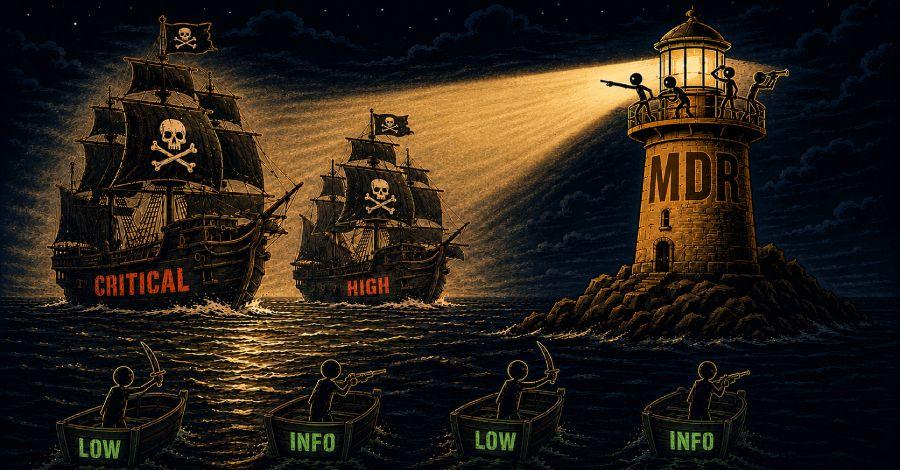
Traditional Managed Detection and Response (MDR) promised 24/7 human coverage, but analysis reveals approximately 60% of alerts go unreviewed
1
. Human teams, whether in-house or outsourced, cannot process the volume of alerts modern environments generate. They prioritize P1s and P2s while P3s and P4s accumulate, creating precisely where attackers hide. Analysis of 25 million alerts across global enterprises in 2025 found nearly 1% of real threats originate in low-severity and informational alerts1
. In an enterprise generating 450,000 alerts annually, that translates to roughly 54 real incidents per year sitting in deprioritized queues where no one is looking1
.
Source: Hacker News
Investigation quality varies by analyst experience, queue depth, time of day, and staffing levels. A P1 alert at 3 am receives different treatment than the same alert at 10 am
1
. When investigations are shallow, threats get classified as noise. When follow-through is inconsistent, early-stage lateral movement appears routine. Most MDR services operate as black boxes, providing escalations and summaries without investigation logic, evidence trails, or audit capabilities1
.Anthropic announced Project Glasswing and Claude Mythos Preview, an AI model that autonomously discovered thousands of high-severity zero-day vulnerabilities across every major operating system and web browser
3
. One vulnerability remained undiscovered for 27 years in OpenBSD, chosen specifically for being among the most secure operating systems3
. The FIRST 2026 Vulnerability Forecast projects a median of roughly 59,000 new CVEs this year, with a 90% confidence interval reaching up to 118,0003
. In 2025, 48,185 CVEs were published, a 21% increase over the previous year, equating to roughly 131 new vulnerabilities disclosed daily3
.Before frontier AI models, vulnerability discovery took weeks or months while patches deployed on organizational schedules. After AI in cybersecurity, discovery and exploit development collapsed to near-simultaneity, while patch release and deployment remain human-driven processes
3
. NIST acknowledged CVE submissions grew 263% between 2020 and 2025, announcing it would only prioritize enrichment for CVEs in CISA's Known Exploited Vulnerabilities catalog, federal government software, and critical software under Executive Order 140283
.
Source: Cisco
Legacy Security Operations Centers (SOC) were engineered for known signatures, perimeter-based controls, and human-led investigation workflows
4
. One major managed SOC reported processing an average of two alerts per minute throughout 2025, evidence that the underlying operating model no longer scales against machine-speed offense4
. Investigation workflows remain largely sequential as human analysts triage alerts, pivot between consoles, reconstruct activity manually, and escalate findings through multiple operational layers4
.The Agentic SOC represents a structural reset where AI systems handle high-volume investigative work autonomously, correlating evidence across disparate systems, generating hypotheses, validating attack paths, and executing response actions within defined guardrails
4
. Detection, incident response, and response collapse into continuous operational pipelines rather than separate stages divided by escalation queues. For MSPs, fragmented security stacks create dangerous delays as technicians jump between disconnected tools2
. The 2026 Kaseya State of the MSP research shows 71% of MSPs reported year-over-year cybersecurity revenue growth, the highest of any service category2
.Related Stories
Mayank Upadhyay, chief security and trust officer at Snowflake, stated that the attack surface across typical enterprises now generates so much data that human analysts can't triage without AI assistance
5
. Steve Schmidt, Amazon's chief security officer, reported that Mythos helps patch individual bugs and permanently close whole classes of weaknesses lurking in systems5
. However, he noted the model only performs effectively when paired with experienced engineers, as even advanced systems generate false alarms that erode developer trust when run autonomously5
.The limitations of traditional security extend beyond technical detection. Procurement cycles, governance approvals, security reviews, and deployment bottlenecks now constitute part of the security control plane
4
. A twelve-month procurement cycle becomes material risk when AI-enabled attacks traverse cloud, SaaS, and identity infrastructure in minutes4
.While technical exploits receive attention, AI-driven social engineering poses escalating risks. Research from Charlemagne Labs found widely available AI models can sustain believable, multi-turn deception across many back-and-forth exchanges, potentially enabling convincing automated end-to-end scams within 12 to 24 months
5
. Deepfake audio and video calls convincingly replicate real people, as demonstrated when criminals used AI-generated video and voice clones of a finance chief on a live video call to trick an employee into wiring roughly $25 million to fraudulent accounts5
. Organizations must prepare for all employees to be regularly targeted rather than one or two facing sophisticated phishing campaigns5
.Security in the AI era requires examining practices beyond technical defenses, including software patch deployment and rebuilding the human security layer
5
. The AI-driven threat landscape demands fundamentals like multi-factor authentication and network segmentation, recommendations that get polite nods but quiet dismissal between budget approval and implementation3
. When vulnerability management fails, organizations fall back on foundational controls that hold when patching fails3
.Summarized by
Navi
[1]
[2]
[3]
28 Jan 2026•Technology

24 May 2025•Technology

12 May 2026•Technology

1
Technology

2
Business and Economy

3
Health