AI-Driven Drug-Target Interaction Prediction Shifts From Benchmarks to Real-World Drug Discovery


2 Sources
[1]
AI-driven drug-target interaction prediction moves toward real-world workflows
Chinese Academy of SciencesAug 20 2026Reviewed Drug-target interaction prediction can help researchers explain mechanisms of action, identify candidate targets, reposition existing medicines and prioritize compounds before costly laboratory work. Yet the field still faces uneven structural
[2]
AI Maps a Clearer Path to Drug-Target Discovery | Newswise
Credit: Medical Journal of Peking Union Medical College Hospital Newswise -- Drug-target interaction prediction can help researchers explain mechanisms of action, identify candidate targets, reposition existing medicines and prioritize compounds before costly laboratory work. Yet the field still
Share
Copy Link
Chinese researchers published a comprehensive review showing how AI-driven drug-target interaction prediction is evolving from algorithm-focused benchmarks toward practical pharmaceutical research workflows. The study addresses translational barriers including data quality issues and calls for experimentally testable predictions that support candidate screening and drug repurposing.
AI-Driven Drug-Target Interaction Prediction Faces Critical Transition
A comprehensive review published on July 20, 2026, in the Medical Journal of Peking Union Medical College Hospital (DOI: 10.12290/xhyxzz.2026-0399) reveals that AI-driven drug-target interaction prediction is reaching a turning point where performance on benchmarks matters less than usefulness in actual drug discovery workflows
1
2
. Researchers from the School of Artificial Intelligence at Beijing University of Posts and Telecommunications and the Shandong Computer Science Center examined how DTI prediction can help identify candidate targets, reposition existing medicines, and prioritize compounds before costly laboratory work begins, but warned that current systems still struggle with fundamental data quality and generalization problems1
.Deep Learning and Multimodal Models Expand Predictive Capabilities
The review traces three technical stages shaping pharmaceutical research. Traditional machine learning approaches relied on similarity-based methods, matrix factorization, network-based models, and engineered-feature models
2
. Deep learning systems now automatically extract local sequence patterns, molecular topology, long-range dependencies, and semantic representations learned through large-scale pretraining1
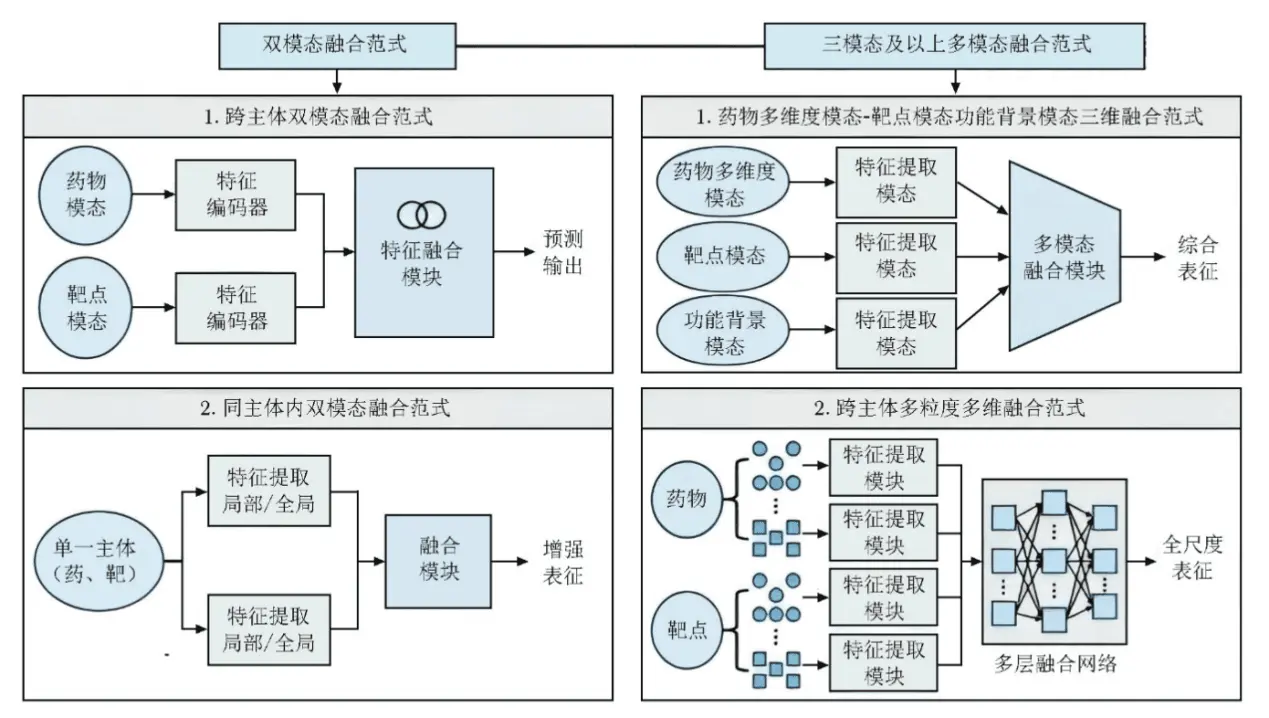
. Multimodal models integrate drug, protein, disease, side-effect, perturbation phenotype, and knowledge-network data, with graph neural networks, attention mechanisms, Transformer architectures, and pretrained representations capturing both molecular structure and biological context2
. Yet the authors emphasized that adding more data types is not automatically beneficial: each modality must be relevant, well aligned, and strong enough to improve biological reasoning rather than merely increase model complexity1
.
Source: Newswise
Benchmark Resources Mask Real-World Performance Gaps
The field still faces uneven structural coverage, scarce high-quality negative examples, inconsistent activity labels, and strong bias toward well-studied drugs and targets
2
. Models that perform well on familiar benchmark datasets may lose accuracy when evaluating a new compound, a new protein family, or data collected under different experimental conditions1
. The review compared benchmark resources across tasks ranging from binary interaction classification to quantitative affinity prediction and structure-based virtual screening, finding that performance cannot be compared fairly without consistent datasets, split protocols, and metrics2
. Random splits exaggerate success by placing highly similar examples in training and test sets, while more realistic cross-distribution, target-family, and cold-start evaluations are needed to reveal whether models can generalize beyond familiar chemical and biological space1
.Related Stories
Experimentally Testable Predictions Define Next Milestone
The authors stated the next advance should not be measured only by a higher score on a benchmark, arguing that useful DTI systems must show where their evidence comes from, remain reliable when data distributions change, and generate hypotheses that researchers can test
2
. Predictions become more valuable when they narrow candidate lists, suggest plausible binding mechanisms, and guide molecular docking, structural modeling, and laboratory experiments1
. The framework could support faster candidate screening, drug repurposing, lead optimization, and potential risk assessment, but the review treats AI as a decision aid rather than a replacement for experiments2
. A credible workflow would connect target biology, computational ranking, structural modeling, and staged validation through binding assays, cellular studies, and animal research1
. The authors foresee specialized biomedical foundation models and intelligent agents that could integrate literature, databases, candidate generation, and validation design within one traceable workflow, positioning AI-driven drug discovery as a practical tool that accelerates drug discovery while maintaining experimental rigor2
.References
Summarized by

Navi
Related Stories
AI-Powered Chemical Language Model Predicts Dual-Target Compounds for Drug Discovery
24 Oct 2024•Science and Research

AI Revolutionizes Drug Discovery: KAIST's BInD Model Designs Optimal Cancer-Fighting Molecules
12 Aug 2025•Science and Research

AI Breakthrough: PepMLM Targets 'Undruggable' Proteins, Opening New Avenues for Disease Treatment
13 Aug 2025•Science and Research

Recent Highlights



Recent Highlights
Today's Top Stories



Don’t drown in AI news. We cut through the noise - filtering, ranking and summarizing the most important AI news, breakthroughs and research daily. Follow topics that matter to you and stay ahead.


