2 Sources
[1]
The Rise of Anti-AI AI Slop
Anti-AI sentiment is genuine, but its online expression looks stranger and stranger. Americans are wary of AI in general, and they are especially suspicious of the AI data centers that are popping up across the country like enormous mushrooms. A majority do not want a new data center built in their town. Across the country, community groups have organized to protest individual projects, and activists have successfully lobbied local and state politicians to place moratoriums on the facilities' construction. But online, the movement has been mutated by some of the same forces it's protesting. Defenders of the AI industry have claimed that the social-media conversation about the dangers of AI is inauthentic -- that, in fact, it's AI-generated -- and to some extent, they're right. There is a lot of anti-AI AI slop. Much of it is very strange. Read: Inside the dirty, dystopian world of AI data centers Last week, I perused dozens of local anti-data-center groups on Facebook, and in almost every one, I found people sharing AI-generated materials. Even in these groups, users posted screenshots of AI-generated summaries as backup for their arguments. In the comments under a post about data centers in Texas, a woman shared her concern about the fact that data centers use human stem cells. When someone called her a 🤡, she replied with a screenshot of a Google AI summary for the search Do data centers use stem cells. One Australian start-up is experimenting with the idea, but the AI summary made the practice sound widespread: "Yes, pioneering facilities are starting to utilize living human neurons grown from stem cells as biological processors," it said. The same week, a town supervisor on Long Island had to debunk a rumor about a new data-center project after an inaccurate AI-generated search summary attracted so much attention that residents planned a protest (which they promoted with a flyer that itself appeared to be AI-generated). A weirder, more disturbing type of AI-generated anti-AI content started proliferating on Facebook in March. The memes, which show broadly nostalgic images of the American countryside, are shared on state-themed pages with names such as "Life in Michigan" and "North Carolina Life." In one repeating format, someone has mowed a spiky message into their grass or crops: "NOT WORTH GIVING UP AN INCH OF THIS TO A DATA CENTER," for instance. (Sometimes they also mow a middle finger.) Another meme shows a boxy new industrial building -- presumably a data center -- right next door to a beautiful old farmhouse. An accompanying caption will generally call out the unique qualities that make the state in question so worth fighting for: "quiet roads stretching beside cornfields and barns 🌽," "Friday night football and county fairs 🎡," "dark skies over peaceful countryside ✨." Which state is that? Almost any of them. They're all the same, but they're all very special. AI data centers must not infringe on Indiana's "quiet country roads, golden cornfields, old barns, peaceful sunsets, and the feeling of home that comes with them." Nor should they be allowed to tarnish Kentucky's "quiet country roads, golden fields, old barns, peaceful sunsets, and the feeling of home that comes with them." By far the most common template pairs an aerial image of pristine farmland with a copy-pasted story about a proud farmer making headlines after turning down a data-center developer's offer of millions of dollars for his or her land. Although many commenters recognize that the stories are fake, many others offer apparently credulous responses: "Thank you"s and "God bless you"s and "#Respect". One commenter gently fact-checked a post about an Alabama farmer, based on similar content that he'd come across in other places: "It was actually a Pennsylvania farmer that rejected the $15 million offer," he wrote, "but there is supposedly a farmer in my home state of Kentucky that rejected a $33 million offer for his 650 acres." (Actually, one farmer in Kentucky did reportedly turn down a huge offer from an unnamed company in March, but it was for $26 million, and the farmer was a woman.) That many of these posts are AI-generated is not in question. They are not typically photorealistic. Some images include a deformed (or upside-down) state outline. Others name a state in the image that doesn't match the one named in the caption. I found one in which the poster seemed to have forgotten to cut out some extra AI-generated text before sharing: "Here's a Michigan version in the same style," it says at the top. I also saw a depiction of Pennsylvania with a New York flag flying over the landscape. And in a picture of Texas residents coming together to protest a new data center on the Gulf Coast, one activist holds a sign that says, nonsensically, PRESERVE BEFORE CLOUDS. Who is making this stuff, and to what end? Maybe foreign actors are to blame. (Kevin O'Leary, the entrepreneur and Shark Tank star, has suggested that opposition to a 40,000-acre data-center project he is developing in Utah has been seeded by the Communist Party of China. The groups he has accused deny this.) When I showed some anti-AI slop posts to William Marcellino, a senior behavioral scientist at the RAND Corporation who has studied China-sponsored disinformation, he told me that both AI slop and state-by-state geographic-targeting campaigns are common in modern disinformation campaigns. But he didn't see any particular reason to believe that these posts were part of one. The deepfake expert and Meta adviser Henry Ajder told me last week that he thinks that blaming such material on geopolitical rivals is a "convenient explanation" for the AI industry "rather than the most likely" one. This was the first time Ajder had seen this kind of slop, but he guessed that people were creating and posting it to get attention on Facebook pages in order to make money. An anti-AI AI post is set up to get tons of engagement because people will comment and share approvingly when they're fooled, and they'll comment and share angrily when they're not. Even the ironic fact of AI being used to rail against AI might be only another reason for sharing. I sent direct messages to many of the slop-producing accounts -- so many, in fact, that Facebook locked my account, and I had to submit a video selfie proving that I am a human being. Exactly one content producer responded to my queries, a poster who had put up fake images of Pennsylvania cornfields, rivers, and shoreline (Lake Erie, I guess?) with anti-data-center messages. "I actually live in Bangladesh," the account runner told me. "But Pennsylvania has always been one of the U.S. states I've found most interesting online." Meta's monetization program, which rewards views, comments, and other interactions, has long incentivized low-quality, lowest-common-denominator swill. The pages currently posting AI slop about AI also post AI slop about other geographically targeted mundanities, such as the humidity in Alabama and how confused Texas drivers get by roundabouts. (An analysis that was posted recently by a pseudonymous Substacker found that a lot of this U.S.-state-themed engagement bait comes from Bangladesh.) "I imagine the people that are posting this content are in most cases dispassionate to the issues they're posting about," Ajder said. "They just want to see the numbers going up each month on their payments on the platform." The anti-AI slop creator who claimed that he has always had a thing for Pennsylvania also told me that he doesn't really care about U.S. data centers and is interested simply in sharing "relatable" content. (He also said that he is supporting his family with his monetized social-media accounts, but he declined to share any proof of that income and did not provide a way for me to verify his identity when I requested it.) Meta has said that it tries to label content that was produced using AI so that users will know when media is manipulated or totally made-up, but none of the posts I saw had labels, and few of the pages that hosted them made any reference to AI in their descriptions. When the pages were tied to "people," the people seemed to be fake: One Texas-themed page was itself an administrator of the group "Born & Raised in Texas." The other two listed admins for that group were a page called "I Love America" and a woman named Alice whose profile photo shows a Pakistani actor who was found dead last year. (A spokesperson for Meta told me that Facebook can't label all AI-generated content.) Whatever the source of anti-AI AI slop, thousands of people care enough about the issue it addresses to share and comment on the slopit. They have legitimate concerns about the mysterious facilities straining their local utilities, taking over large open spaces, and likely providing very few long-term jobs to their community in exchange. In some cases, they may even understand that the images are fake and repost them anyway. Before this year, "a lot of people probably didn't really give a toss about AI," Ajder said. (He's British.) When it was just a new feature on our phones and computers, people could take AI or leave it. Now the same technology has an unavoidable and creepy physical presence in the form of huge, windowless buildings humming with machines -- "alien monoliths that land in your pristine, bucolic countryside," as Ajder put it. Some of the people who are most put off by those buildings' presence are getting taken in by AI output. That may be ironic, but it also shows how right they are to say that the world they've known and understood is disappearing.
[2]
AI Grifters Are Making Anti-Data Center Slop With AI
There are hundreds of anti-data center Facebook pages churning out AI-generated slopaganda. If you want a barometer of American political concerns you could do worse than checking what spam accounts are turning into AI-generated slop on Facebook. There are now hundreds of pages with names like "Life in Texas," "History of Wisconsin," and "Life Is Idaho" churning out dozens of AI-generated images playing into anti-data center sentiment across the country. One of the most ubiquitous styles of anti-data center slop I've seen is a vast tract of farm land with a message like "not worth giving up an inch of this to a data center" mowed into it. The image is tailored to fit the target audience in each state. "Our great lakes. Our forests. Our communities. Our future," said the Michigan version in the field surrounded by a massive lake and a water tower that helpfully read "Michigan." The Kentucky version repeated the message but added "bluegrass, bourbon, and horses. Kentucky" to the mowed grass. The caption of the post explained that a rural farmer in the state mowed the letters into their field as a form of protest against proposed data centers. There are hundreds of these pages, all themed around life in individual states, sharing similar versions of the same images. "Wow. According to FB, every farmer in every state has done this. Enough with the AI," said a comment below one of the images on the "Life in Kentucky" Facebook page. People hate data centers. Local and state communities around the country are passing moratoriums on their construction. Data centers are noisy and their neighbors have pressing concerns about water use, increased electricity bills, and the quality of the jobs developers are promising to create. Some areas, like Ypsilanti Township where the University of Michigan is planning a large data center, are even worried about becoming targets in future wars. These anxieties are now the focus of AI spam farms on Facebook. This is the same algorithmically boosted "shrimp Jesus" style AI spam scheme we've reported on before. There are people, some of them in foreign countries, who churn out hundreds of AI-generated images across multiple pages to engage users and turn a profit on ads and links. It's impossible to know who, exactly, is putting up all these state-themed anti-AI pages. I reached out to several of the pages through Facebook Messenger but got no response. Many of the pages provide the same contact email but I didn't receive a response when I contacted it. What's clear is that the people who study American culture and profit from selling it back to Americans via Facebook have figured out there's profit in sharing content about how much we hate data centers. Many of the images I found had been liked thousands of times and shared hundreds more. Comments under the slop ranged from staunch support of the anti-data center movement to anger that AI housed in a data center had been used to create anti-data center propaganda. Like all AI slop, these Facebook pages aren't great with the facts. The "Fans of Alabama Crimson Tide" shared an AI-generated image of a woman standing in farmland at sunset. The Alabama flag rippled in the wind behind her. "An Alabama mother and daughter turned down $26 million to prevent their 1,200 acre farm from being converted into an AI data center," the caption said. The Facebook post didn't name the woman or provide details but she's real and her name is Delsia Bare and the story is mostly true. She and her mother turned down a $26 million dollar offer to build a data center on their farmland. The data center would have been 2,000 acres not 1,200. Also, this all happened in Kentucky, not Alabama. An AI spammer took Bare's story and her image, which appeared to come from local news coverage of her case, then repurposed it as a piece of anti-AI content to generate engagement from football fans in a different state. "Whether you agree with the decision or not, one thing is undeniable -- standing firm against a $26 million offer takes incredible conviction. Alabama pride runs deep, and this story is another reminder that for many families, their land is more than property... it's home," said the caption on the Facebook page. As of this writing, the post had generated 56 likes and been shared 5 times. "This was in Kentucky wasn't it?" said a comment in the replies. The people organizing against data centers have noticed the tide of slop. "Across the country, we're hearing from local officials in conservative and liberal areas that their community can finally unite behind one thing -- opposing the expansion of data centers," Michael Whitesides, deputy communications director of Local Progress, a nonprofit that works with elected officials at the local level, told 404 Media. "AI slop usually followed a very predictable pattern. They're either designed to provoke intense reactions to play to a very middle of the road audience. The fact that Facebook content farms have switched to producing AI-generated images opposing data centers shows just how universal and uncontroversial this opposition is," Whitesides added. "The irony shouldn't be lost that said images are being created with the help of data centers, but all the more underscores what local elected officials here all across the country -- no one wants these." That's not entirely true. There's a lot of billionaires, contacts, and other monied interests in America that are bullish on data centers. Construction of these massive computer warehouses is driving the American economy. Think tanks like Brookings have published massive studies calling the build out a "gold rush." But the people who live in the communities where data centers are going up do not want them. They're noisy, drive up the costs of electricity and water for neighbors, and disrupt the beauty of the natural landscape. Local, state, and national resistance to the construction of the data centers is building and it seems to have caught some of the boosters and investors by surprise. A counter-narrative to the backlash is building. American law enforcement is warning about anti-tech extremism centered around the data center resistance movement. A Congressional intelligence agency is tracking "recent threats and attacks likely linked to grievances concerning data centers," according to reporting from Ken Klippenstein. Billionaire Canadian TV Star Kevin O'Leary, shocked by opposition to his $70 billion data center in Utah, is laying the blame on China. "There's a war going on, I guess a PR war or whatever you want to call it," O'Leary said in a recent video posted to X. "Is what you're suggesting that these entities are taking funds from the Chinese Communist Party and using those funds to run a digital blackmail campaign against your project?" someone off camera asked O'Leary. "I'm not suggesting it, it's an irrefutable fact,' O'Leary said. Data centers are going to be one of the major political issues in America for the next few election cycles. Battle lines are being drawn and narratives are taking shape. And in the middle of it all are people using AI to do what it does best: boiling the human experience down into cheap slop so it can be served back to us. Another version of the Bare story got the facts correct, but removed her and her family from the picture. "Family rejects $26 million offer for their Kentucky land amid AI data center plan. A clash between tradition and technology," text said above an AI-generated image of a middle aged couple in denim with dirty blond hair and Taylor Sheridan-TV show good looks. This couple that does not exist stares into the camera, clutching two children tight. Bare, the real person who rejected the $26 million buyout, is not mentioned or pictured.
Share
Copy Link
Hundreds of AI-powered spam pages are exploiting genuine anti-AI sentiment by flooding Facebook with fabricated stories and memes opposing data centers. These pages, with names like "Life in Texas" and "History of Wisconsin," generate thousands of likes while spreading disinformation about farmers rejecting multimillion-dollar land offers—stories that are either entirely fake or repurposed from different states.
A peculiar contradiction has emerged across social media: AI-generated content is now fueling anti-AI sentiment. Hundreds of Facebook pages with state-themed names are churning out AI slop—low-quality, fabricated images and stories—to capitalize on growing public wariness of AI data centers
1
2
. The irony is stark: the very technology communities are organizing against is being weaponized to amplify their concerns, often with misleading or entirely false information.
Source: The Atlantic
The anti-data center sentiment itself is authentic. A majority of Americans do not want new data centers built in their towns, and community groups have successfully lobbied for moratoriums on construction
1
. Residents express pressing concerns about noise pollution, water use, increased electricity bills, and job quality. Some communities, like Ypsilanti Township where the University of Michigan is planning a large facility, even worry about becoming targets in future conflicts.The most common format shows pristine farmland from an aerial view, paired with fabricated stories of farmers rejecting multimillion-dollar offers from data center developers. These AI-generated memes and fake stories follow predictable patterns: messages mowed into crops reading "NOT WORTH GIVING UP AN INCH OF THIS TO A DATA CENTER," or images of industrial buildings placed next to idyllic farmhouses
1
.
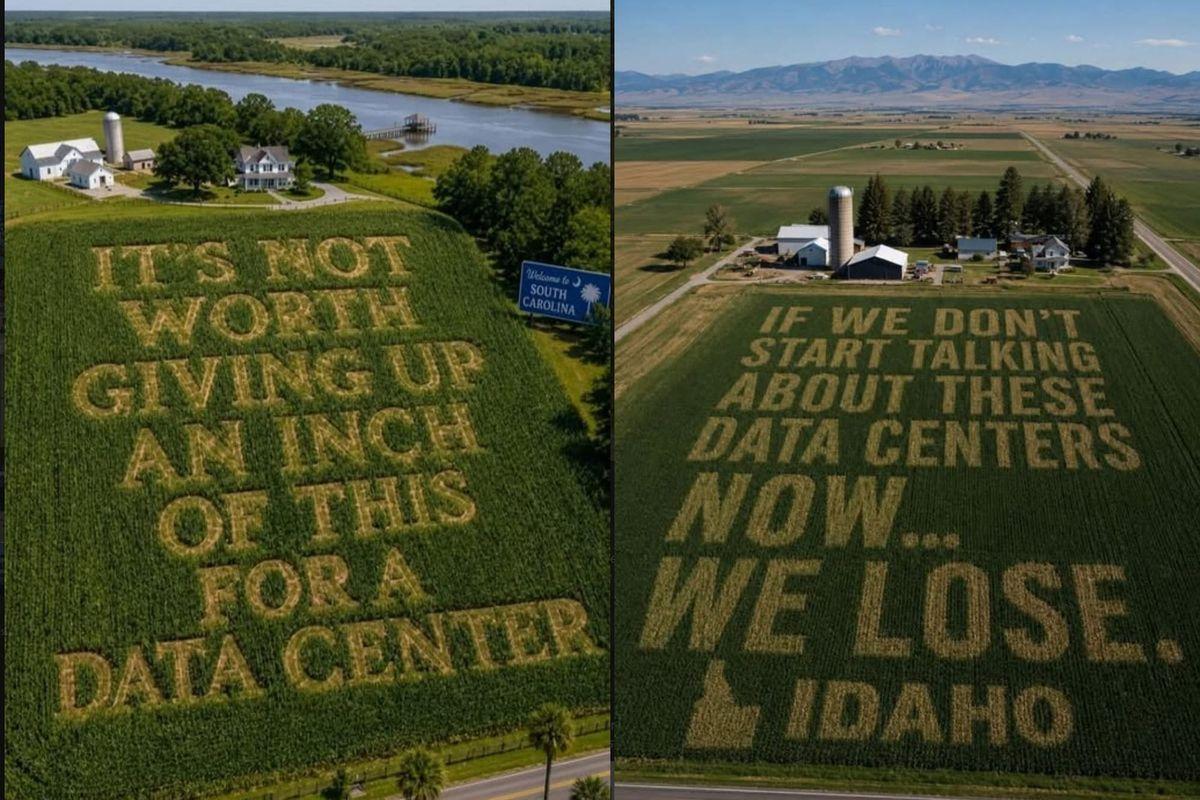
Source: 404 Media
Pages like "Life in Michigan" and "North Carolina Life" share nearly identical content, merely swapping state names while praising "quiet country roads, golden cornfields, old barns, peaceful sunsets, and the feeling of home"
1
. The slopaganda is often poorly executed—some images include deformed state outlines, mismatched flags, or nonsensical text like "PRESERVE BEFORE CLOUDS" on protest signs1
.One recurring narrative involves farmers heroically turning down enormous sums. The "Fans of Alabama Crimson Tide" page shared an AI-generated image claiming an Alabama mother and daughter rejected $26 million to prevent their 1,200-acre farm from becoming a data center. The story was real but completely misrepresented: Delsia Bare and her mother did turn down $26 million, but they're from Kentucky, not Alabama, and the proposed data center would have covered 2,000 acres, not 1,200.
Commenters frequently recognize the deception. "Wow. According to FB, every farmer in every state has done this. Enough with the AI," one user wrote beneath a Kentucky post. Yet many others respond with apparently credulous "Thank you"s and "God bless you"s, suggesting the disinformation successfully manipulates some audiences
1
.Related Stories
These operations follow the same algorithmically boosted "shrimp Jesus" style spam scheme previously documented on Facebook. Grifters, some operating from foreign countries, create hundreds of AI-generated images across multiple pages to drive engagement and profit from ads and links. Many images receive thousands of likes and hundreds of shares, demonstrating the scheme's effectiveness.
Who creates this content remains unclear. Multiple pages share the same contact email, but inquiries go unanswered. Defenders of the AI industry have claimed that social-media conversation about AI dangers is inauthentic—that it's AI-generated—and to some extent, they're right
1
. Speculation about foreign actors has emerged, though concrete attribution remains elusive1
.The phenomenon reveals how those who study American culture and profit from selling it back to Americans via Facebook have identified anti-data center activism as lucrative content. Michael Whitesides, deputy communications director of Local Progress, told 404 Media that communities across political divides are uniting against data center expansion.
Yet this unity is being undermined by the very technology activists oppose. Even within local anti-data-center groups on Facebook, users share AI-generated summaries to support their arguments. One woman concerned about data centers using human stem cells cited a Google AI summary suggesting the practice was widespread, when only one Australian start-up is experimenting with the concept
1
. A Long Island town supervisor had to debunk rumors from an inaccurate AI search summary after residents planned a protest promoted with what appeared to be an AI-generated flyer1
.The short-term impact is clear: legitimate concerns about data centers are being drowned in a sea of fabricated content, making it harder to distinguish fact from fiction. Long-term, this threatens to delegitimize authentic grassroots movements as observers struggle to separate genuine activism from algorithmically amplified slopaganda. Watch for how platforms respond to this exploitation, and whether communities can maintain momentum despite the disinformation polluting their cause.
Summarized by
Navi
[1]
[2]
28 Jan 2026•Policy and Regulation

05 Mar 2026•Business and Economy

29 May 2025•Technology

1
Technology

2
Business and Economy

3
Health