AI in China Triggers Mass Layoffs as 160 Beijing Coders Lose Jobs in Automation Push


4 Sources
[1]
Workers in China worry over being replaced as they adapt to the growing impact of AI on jobs
HONG KONG (AP) -- Computer programmer Fei Zhaojun's boss asked him if artificial intelligence could soon replace humans in coding jobs. Two weeks later, he was laid off from his job in Beijing, together with about 160 of his colleagues. It's an increasingly common scenario as artificial
[2]
China's humanoid robots are stealing the show, but a quiter machine revolution is unfolding
"I take a nap and the world changes," says Chen Tianyu. His world certainly does. The 28-year-old keeps up with the latest technology by spending his spare time in factories that are switching to automation. That way he knows what to prioritise when teaching his class about artificial intelligence
[3]
His boss asked if AI could replace human coders. Two weeks later, he and 160 colleagues were laid off in Beijing | Fortune
Computer programmer Fei Zhaojun's boss asked him if artificial intelligence could soon replace humans in coding jobs. Two weeks later, he was laid off from his job in Beijing, together with about 160 of his colleagues. It's an increasingly common scenario as artificial intelligence, supported by
[4]
China's workers worry over being replaced as they adapt to growing impact of AI on jobs
Computer programmer Fei Zhaojun's boss asked him if artificial intelligence could soon replace humans in coding jobs. Two weeks later, he was laid off from his job in Beijing, together with about 160 of his colleagues. It's an increasingly common scenario as artificial intelligence, supported by
Share
Copy Link
Computer programmer Fei Zhaojun and 160 colleagues were laid off two weeks after his boss questioned if AI could replace human coders. As China accelerates AI adoption through its AI Plus initiative, workers face mounting displacement risks while the nation's slowing economy grapples with automation's mixed effects on employment and consumer confidence.
AI Could Replace Human Coders: Beijing Programmer's Warning Becomes Reality
Computer programmer Fei Zhaojun faced an ominous question from his boss: could artificial intelligence soon replace humans in coding jobs? Two weeks later, the 40-year-old and approximately 160 colleagues were laid off from their Beijing positions
1
3
. This scenario reflects the growing impact of AI on jobs across China's massive workforce, where rapid adoption supported by government policies is fundamentally reshaping China's job market. Until recently, Fei doubted AI could perform programming work perfectly, but his employers deemed it close enough. "Mid-level coders' jobs are essentially replaceable in most of the cases," Fei acknowledged, adding that workers must adapt because "everyone else is using it"1
. Now he's creating vlog-style videos about ordinary people's lives during his career transition, hoping to help others navigate similar disruptions.
Source: Fortune
AI Adoption in China Surges as Government Pushes Automation
China stands at the vanguard of AI adoption, with government policies actively encouraging businesses and individuals to integrate AI applications and robotics into all aspects of life
1
. The numbers tell a striking story: the share of Chinese industrial enterprises using AI models and agents jumped to 47.5% last year from just 9.6% in 2024, according to market intelligence firm IDC1
3
. Under the AI Plus initiative and its five-year plan through 2030, Beijing is pushing to infuse AI across multiple industries, aiming to gain advantage in the technology rivalry with the United States1
. "What is specific to China is that the government is really into diffusing AI across the economy, so AI may get into different domains more quickly comparing to other countries," explained Zilan Qian, a research associate at Oxford China Policy Lab1
. The country now operates more than two million industrial robots in its factories—more than anywhere else globally—and continues scaling up at extraordinary speed2
.AI Reshaping China's Job Market Across Multiple Sectors
AI job displacement extends far beyond programming. Part-time translator Du Qinchun has been helping train AI translation models, which temporarily increased his workload but came at a cost. "The pay in the industry has been cut by more than half compared to what it was years ago," said Du, based in Chengdu
1
. The trend has become so pronounced that college programs in foreign languages have fallen out of favor as AI-powered translation tools proliferate. Humanoid robots now sort parcels in postal centers and perform tasks like directing traffic and making coffee, while food delivery robots threaten the livelihoods of millions of Chinese delivery workers1
. Generative AI has particularly disrupted China's short drama industry, where the number of live-action short and vertical video series designed for mobile phones fell approximately 75% in the first quarter of this year compared to a year earlier1
. "Tasks that once required specialized training can now be performed by almost anyone with access to AI tools," noted Shujing He, senior analyst at advisory firm Plenum1
.Workforce Displacement Meets Demographic Crisis
AI-driven automation arrives as China confronts a shrinking population and aging workforce. By 2035, more than a third of China's population will be over 60, according to official estimates
2
. The country will lose nearly 60 million people in the next decade—almost equivalent to France's population2
. At CRP Technology in Chengdu, which employs around 300 people building robotic arms, engineer Pang Kai articulated this urgency: "We need these kinds of robots because maybe in 10 years, we won't have enough workers in China"2
. The company's robotic arms can be programmed to perform more than 90% of repetitive tasks in factories building cars, electronics, or wind turbines. Automation risks fall disproportionately on certain groups. An International Labor Organization report found women face higher risks of losing employment due to AI than men, as they tend to work in areas more suitable for automation, such as assembling electronics, and remain underrepresented in science and technology1
.Related Stories

Economic Uncertainty Deepens as Consumer Spending Lags
The transformation carries significant implications for China's slowing economy. Consumer spending has lagged partly because people are reluctant to spend amid fears of losing their jobs, compounding problems from a prolonged housing market downturn that has undermined household wealth
1
. Some economists believe AI-driven workforce displacement might eventually undermine the overall strength of the world's second-largest economy1
. Yet "there appears to be far less anti-AI sentiment in China than elsewhere," observed Shujing He from Plenum. "Most people seem either positive, neutral, or mildly interested in AI"1
. Individuals worried about replacement often eagerly experiment with AI-enabled businesses and independent ventures, she noted.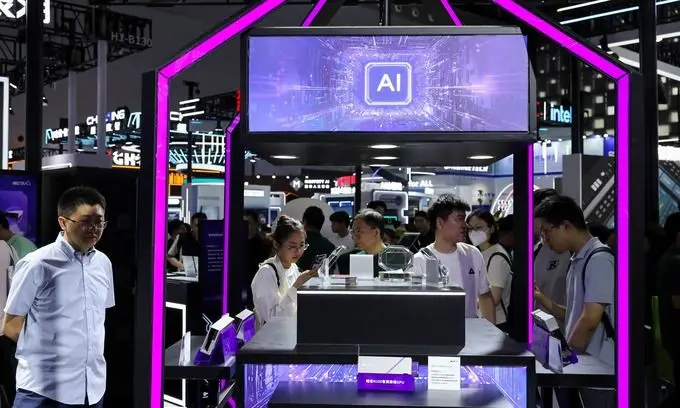
Source: VnExpress
Training the Next Generation for AI-Driven Future
China is simultaneously preparing workers for this transformation through massive investments in vocational schools. At the Hangzhou Technician Institute, part of President Xi Jinping's $20 billion plan to position China at the innovation forefront, instructor Chen Tianyu tells his 30 students studying AI and robotics: "If you are not needed by the world of AI and robotics, then you'll definitely be among those eliminated"
2
. The 28-year-old keeps current by spending spare time in factories switching to automation. Students program industrial robots and develop robotic medical instruments on a campus built specifically to churn out tech-savvy engineers. China now produces more than half of the world's industrial robots2
. "China's vibrant open-source model ecosystem fosters greater AI application innovation in industrial settings, gradually closing the gap between foundational model capabilities and real-world enterprise value creation," said Yanze Du, IDC senior research manager in Beijing1
. As global manufacturing, trade, and innovation increasingly depend on Chinese production, the world watches how this massive automation experiment will reshape not just China, but international labor markets and economic structures for decades to come.
Source: AP
References
Summarized by

Navi
Related Stories
China bets on artificial intelligence to create jobs and rejuvenate economy amid global concerns
11 Mar 2026•Policy and Regulation

AI's Job Displacement: Economic Implications and Global Tech Race
19 Aug 2025•Technology
AI's Effect on the Work Force Shows Up in Wages, Not Unemployment—Gen Z Hit Hardest
16 Sept 2026•Business and Economy
Recent Highlights
1
Microsoft and Nvidia Launch Surface Laptop Ultra: A $2,599 AI-Ready PC With RTX Spark Chip
Technology

2
OpenAI Releases 722 AI-Generated Math Papers on GitHub, Igniting Fury Among Mathematicians
Science and Research

3
Trump Consulted Grok AI Before Ordering Venezuela Invasion and Capture of Nicolás Maduro
Policy and Regulation

Recent Highlights
Today's Top Stories










Don’t drown in AI news. We cut through the noise - filtering, ranking and summarizing the most important AI news, breakthroughs and research daily. Follow topics that matter to you and stay ahead.


