8 Sources
8 Sources
[1]
The one piece of data that could actually shed light on your job and AI
Within Silicon Valley's orbit, an AI-fueled jobs apocalypse is spoken about as a given. The mood is so grim that a societal impacts researcher at Anthropic, responding Wednesday to a call for more optimistic visions of AI's future, said there might be a recession in the near term and a "breakdown of the early-career ladder." Her less-measured colleague Dario Amodei, the company's CEO, has called AI "a general labor substitute for humans" that could do all jobs in less than five years. And those ideas are not just coming from Anthropic, of course. These conversations have unsurprisingly left many workers in a panic (and are probably contributing to support for efforts to entirely pause the construction of data centers, some of which gained steam last week). The panic isn't being helped by lawmakers, none of whom have articulated a coherent plan for what comes next. Even economists who have cautioned that AI has not yet cut jobs and may not result in a cliff ahead are coming around to the idea that it could have a unique and unprecedented impact on how we work. Alex Imas, based at the University of Chicago, is one of those economists. He shared two things with me when we spoke on Friday morning: a blunt assessment that our tools for predicting what this will look like are pretty abysmal, and a "call to arms" for economists to start collecting the one type of data that could make a plan to address AI in the workforce possible at all. On our abysmal tools: consider the fact that any job is made up of individual tasks. One part of a real estate agent's job, for example, is to ask clients what sort of property they want to buy. The US government chronicled thousands of these tasks in a massive catalogue first launched in 1998 and updated regularly since then. This was the data that researchers at OpenAI used in December to judge how "exposed" a job is to AI (they found a real estate agent to be 28% exposed, for example). Then in February, Anthropic used this data in its analysis of millions of Claude conversations to see which tasks people are actually using its AI to complete and where the two lists overlapped. But knowing the AI exposure of tasks leads to an illusory understanding of how much a given job is at risk, Imas says. "Exposure alone is a completely meaningless tool for predicting displacement," he told me. Sure, it is illustrative in the gloomiest case -- for a job in which literally every task could be done by AI with no human direction. If it costs less for an AI model to do all those tasks than what you're paid -- which is not a given, since reasoning models and agentic AI can rack up quite a bill -- and it can do them well, the job likely disappears, Imas says. This is the oft-mentioned case of the elevator operator from decades ago; maybe today's parallel is a customer service agent solely doing phone call triage. But for the vast majority of jobs, the case is not so simple. And the specifics matter, too: Some jobs are likely to have dark days ahead, but knowing how and when this will play out is hard to answer when only looking at exposure. Take writing code, for example. Someone who builds premium dating apps, let's say, might use AI coding tools to create in one day what used to take three days. That means the worker is more productive. The worker's employer, spending the same amount of money, can now get more output. So then will the employer want more employees or fewer?
[2]
New MIT jobs report: Why AI's work impact will roll in like a rising tide, not a crashing wave
Worried AI is coming for your job? New MIT research suggests a slower shift. AI is improving at work tasks, but its impact may take longer to fully reach the workforce. Rather than "crashing waves" that will shock workers, researchers describe a "rising tide" that gives them more time to adapt. Also: How AI has suddenly become much more useful to open-source developers "AI capabilities are already substantial and poised to expand broadly," the study said. "Most of the tasks that we study could reach AI success rates of 80%-95% by 2029 (at a minimally sufficient quality level), suggesting potentially substantial labor-market impacts as this tide continues to rise." AI-induced job anxiety has become an ever-present reality over the last year as AI agents have gotten more capable (though they come with just as many risks as they do benefits). Even a slightly longer horizon for lasting change could make a huge difference in whether -- and how many -- workers get the chance to upskill for a very different labor market of the future. For the study, MIT referred to 3,000 text-based work tasks from the US Department of Labor's Occupational Information Network (O*NET) database, which is used by many companies, including Anthropic, to map AI's impact on labor. To ensure real-world relevance, researchers focused on tasks where AI could help humans save at least 10% of their time. The study found that LLMs completed 60% of tasks without humans at a "minimally sufficient" level, as determined by a human manager, and only 26% at "superior quality." Still, researchers were impressed by what AI could take on. It's not that AI progress will be slower than anticipated, but that progress will manifest over a longer period of time, "such that individual workers are less likely to be blindsided by AI," they noted. "A rising tide could, however, still be quite disruptive if it happens quickly." Also: I used Gmail's AI tool to do hours of work for me in 10 minutes - with 3 prompts The paper noted that text-based work is especially vulnerable to rapidly evolving AI capabilities and could be automated by LLMs at that "minimally sufficient" level by 2029. But the researchers added that consistent, "near-perfect" performance -- meaning success rates closer to 100% -- could still be years off. "While progress is significant, widespread automation, particularly in domains with low tolerance for errors, may still be some distance away," the researchers wrote. 2029 may not feel very far off for a meaningful uptick in what AI can automate, but given how quickly AI is already evolving, it does mean some extra time for the workforce to adapt. That said, the paper authors also don't think the speediest timeline is a guarantee. AI's evolution could be stymied by limits in compute, which is notoriously expensive to scale, as well as algorithmic and hardware constraints. Maintaining that competitive speed will depend on every component of the AI efficiency machine operating at full tilt. Another MIT study from December 2025 found that current AI systems could automate nearly 12% of the country's workforce as it stands today -- not just tech-specific jobs like coding, which many see as particularly exposed (entry-level developer jobs are already dwindling). That also isn't limited to coastal sectors, and covers roles in finance, HR, office administration, and more. Also: This AI expert says the job apocalypse isn't coming, even if you're a coder - here's why But whether that comes to fruition or not depends on how and where companies actually adopt AI, which is a whole different factor that puts projections all over the map. For example, in contrast to MIT's 12%, a January Forrester report estimated 6% of US jobs could be automated -- not now, but by 2030. At the end of February, Block CEO Jack Dorsey announced the company's decision to lay off nearly half its workforce based on what he said AI tools could handle internally. While there's no way to verify that's the case (and not just some savvy stock juicing), it set a tone: Will companies chasing efficiency gains and wanting to appear cutting-edge follow suit with mass layoffs? There are two camps in this debate. One, occupied by figures like Elon Musk, is driven by the belief that AI can put all humans out of work. In the other, experts think AI will change or augment work (a view supported by findings from Gartner) rather than replace human workers themselves. Career development expert Keith Spencer said he's seeing more of the latter: less job replacement and more augmentation and "uneven, role-specific change" that isn't uniform across the job market. He added that AI is also creating new opportunities in freelance and gig work for some (which AI itself hasn't been great at thus far). Also: I built an app for work in 5 minutes with Tasklet - and watched my no-code dreams come true "As certain tasks become faster and easier to complete, more work is being broken into smaller, project-based assignments that can be done independently," Spencer said. "That's opening the door for workers to take on additional income streams, even as they navigate uncertainty in their primary roles." Still, that augmentation has its costs. "When parts of your job are automated or reduced, it can feel like you're slowly being made obsolete, even if your role still exists," he said. "While the long-term trajectory may include both job creation and job displacement, the immediate experience for many workers is that the ground is shifting beneath them, and that's what's shaping behavior." Where AI isn't fully replacing human workers, it's extending the bounds of work itself. A February report from Harvard Business Review found that AI tools in the workplace don't necessarily save time or reduce work, as so many hoped, but actually intensify it. Workers reported using AI tools on lunch breaks and experimenting with prompts after hours to get ahead on projects. That doesn't sound negative, but that creep can have cumulative impacts on workers. Also: 7 AI coding techniques I use to ship real, reliable products - fast "Research from cognitive and organizational psychology has shown that restorative breaks are necessary; without them, cognitive performance and attention decline rapidly," said Tara Behrend, a professor of labor relations at Michigan State University. "This could be extremely dangerous depending on the kind of work being done." Mal Vivek, CEO at digital strategy company Zeb, thinks recent layoffs from Meta and Oracle are less about AI itself and more a response to a composite picture of the economy. "Many of these layoffs were more driven by AI applying market pressure rather than true enterprise AI adoption and automation driving the jobs away," she told ZDNET. "The jobs eliminated were jobs the company always believed it could live without -- with or without AI." Still, Vivek agreed that the layoffs are a growing trend and can be based on AI's capabilities. "We are seeing that AI is on average as good or better at many intellectual tasks, and the efficiency gains from it are just too promising for companies to ignore -- especially when their competitors are capitalizing," she said, speaking from experience at her own company. Also: I built two apps with just my voice and a mouse - are IDEs already obsolete? Spencer isn't seeing a decline in available jobs based on AI's impact yet, though. "We're seeing clearer changes in expectations than in job volume, at least for now," he said. "One of the biggest shifts is the growing importance of AI fluency. Employers are increasingly expecting workers to understand how to use AI tools, not necessarily at an expert level, but as part of their everyday workflow." Either way, data shows AI-induced job anxiety is high. According to a Resume Now survey of 1,000 adults in the US in December 2025, 60% of workers think AI will axe more jobs than it creates in 2026, and over half are concerned they'll lose their jobs because of AI this year. Another Resume Now survey conducted during the same time found that 41% of respondents believe AI "is replacing, devaluing, or overlapping with parts of their job," while 29% think of AI as a competitor that "could effectively complete at least half of their daily work tasks," rather than act as a copilot. Despite many real accounts of workers learning more with AI in the passenger seat, that's not everyone's experience: more than half of workers polled said AI hasn't impacted the growth of their skills or how they apply them. Also: Reinventing your career for the AI age? Your technical skill isn't your most valuable asset At the same time, however, at least one survey suggests 92% of young workers are using AI for professional development and that it's giving them confidence at work. The split could be generational. Only the latter Resume Now survey mentioned respondent demographics, which were nearly evenly split between men and women, but were just 15% Gen Z, with the rest split evenly between millennials, Gen X, and baby boomers. Spencer's advice echoes similar sentiments across the industry: identify what only you can offer, and what parts of your work are most and least susceptible to automation. Also: AI will accelerate tech job growth - former Tesla president explains where and why "Shift the focus from what AI might replace to where you add value that is harder to replicate," he said, citing skills like judgment, communication, and real-world context. "This is less about reacting to fear and more about understanding where your strengths fit into a changing landscape."
[3]
The AI job loss story is all about bundles
Welcome back to The AI Shift, our weekly exploration of how AI is reshaping jobs and work. Sarah is away this week, so stepping into her shoes is the FT's AI editor, Madhumita Murgia. For this edition we are revisiting the big question of whether AI has already started to take white-collar jobs, in light of a flurry of new research and evidence. John writes Today's edition was sparked by a new paper from economists Leland Crane and Paul Soto of the US Federal Reserve, which represents the first time to my knowledge that official labour market statistics have corroborated the story from detailed private payroll data that AI is reducing employment in some pockets of the economy. We have previously reported on research showing a dip in employment for young software developers, based on fine-grained analysis of millions of payroll records, but the finding wasn't matched by labour force survey data. That gap has now closed. By using an expanded definition of coders -- crucially including the large contingent of contractor software developers as well as coders outside the tech industry -- Crane and Soto find a very similar result using the flagship US labour force survey as Stanford's Erik Brynjolfsson and co-authors did using payrolls. Both estimate that around half a million fewer coders are working today than would have been if pre-LLM-era employment trends had continued. It's worth noting that this is not an absolute decline in coder employment, but a marked slowdown in growth. Just as interesting as the headline findings is the fact that nuances in these results align neatly with several recent papers setting out frameworks for thinking about how AI job displacement is likely to play out and highlighting weaknesses with simple occupation-based or task-based models. A paper last month by LSE professor Luis Garicano and co-authors extends the idea that jobs are bundles of tasks, to consider whether the different activities in a job are a tightly bound bundle or something more akin to an itemised list of discrete activities. In the context of software, a contractor or junior hire generally falls into the latter group: these jobs are weak bundles, with daily work consisting mainly of writing code to spec -- tasks that could be given to someone else (or AI) without any disruption to the workflow or the quality of the final product. Here, AI breaks off a large chunk of the job and leaves a role with substantially diminished scope (or obviates the need for that hire or contract). But senior developers, or coders working outside the tech industry in roles where their programming skills are combined with domain-specific expertise, tend to have jobs comprising tightly enmeshed and cross-functional tasks. Here extracting the coding part of the job from all the rest is much harder, so the bundle of tasks remains intact. Instead of becoming a competitor AI becomes an assistant, enhancing rather than eroding the job. This fits with the findings from Brynjolfsson and our own analysis that hiring for senior software roles continues to hold up better than for junior ones. The bundling framework is also explored in recent papers by Lukas Freund and Lukas Mann, and by Joshua Gans and Avi Goldfarb, who move beyond the size and interconnectedness of a job's task bundle to consider the importance of the surviving tasks left after one is automated. When coding is done by AI, senior developers have more time to spend on the many other valuable parts of their job, like translating business needs into product specifications or making judgment calls based on years of accumulated expertise. AI automates a relatively lower-value part of their job and acts as a multiplier on all the rest. But take away coding from a junior developer or contractor and you're left with very little. In this way, the same technological capability shrinks one job while expanding another -- moreover it erodes the junior version of a job even as it enhances the senior version. Between the now-consistent picture on junior coding employment and the expanded framework of jobs as bundles of tasks, it feels to me like we're developing an increasingly coherent picture of AI job displacement. Madhu writes This new data comes at an interesting moment, John. OpenAI released a policy blueprint this week that proposes some radical changes to the social contract, in response to what it casts as inevitable job losses and disruption of entire sectors. Of course, it's in their interest to claim their product will be singularly revolutionary, but I've also spent the last couple of weeks speaking to investors, analysts and executives from a range of white-collar professions for a piece published today on which jobs are resilient -- and which aren't -- in an age of AI agents. The fact that AI is shrinking certain types of employment -- mainly early-career jobs -- is accepted in these circles, although it is being whispered. The recent research is really interesting for two reasons. First, it confirms what AI companies, white-collar professionals and pretty much any AI user I speak to, are telling me: that AI automation is a double-edged sword. On one hand, AI allows you to supercharge your skills if you are already proficient at your job. One person from a frontier AI company described this as tackling a gnarly project by cloning yourself. On the other hand, if you are just starting out, and don't yet have the instincts and knowledge developed through hands-on experience, you are more likely to be replaceable. I find it fascinating that this effect seems to be profession-agnostic. I've heard it repeated from software engineers, but also journalists, musicians, financial services professionals and lawyers. This is partly because of how the technology works: the errors it makes can often seem random, meaning those without the nous to doubt its outputs are caught out by mistakes more easily. It seems using AI effectively is a skill that only comes with mastery of your subject. The other thing the research points to is that AI is picking off clusters of tasks that make up a job, starting with the mundane and working its way up the chain to more cognitively demanding ones. The wave of AI agents that we see today, like Anthropic's Claude Cowork or even OpenAI's Codex, which use AI to write code, can complete multiple tasks simultaneously, extending the complexity of what the technology can accomplish independently. On these topics, I recently sat down with Mark Chen, head of research at OpenAI, who pointed me to the METR benchmark, a metric that measures AI performance in terms of the length of tasks AI agents can complete. This horizon has been expanding rapidly, with an exponential increase over the past months. He told me that a year ago, they were dealing with AI completing tasks that humans could do in minutes. "Now we're dealing with tasks in the hours. And if you extrapolate that forward, we're soon going to be having our models do tasks reliably that would take humans days," he said, referring to building a self-contained, functional piece of software, for example. It struck me that although job displacement currently seems to be impacting junior employees disproportionately, that won't be the case for much longer. The advent of AI agents that can handle higher-level tasks means it is a matter of time before even experienced workers get pushed into being AI project managers, rather than creative thinkers. Do you have a more hopeful outlook, John? John responds Thanks Madhu, it's interesting to hear those industry whispers matching the hard data. There's certainly no sign that the forward march of AI's capabilities is slowing, and that will clearly mean more disruption of jobs. But I'm optimistic on two counts. The first is that I think there's a reason we're still seeing relatively little evidence of job displacement outside of coding (we'll have more on this soon), and I think that will hold for a while yet. The second is that as someone who has increasingly become a manager of agentic AI projects, I've found it more a multiplier of my creativity than a replacement for it.
[4]
Is AI Going to Turn Us All Into Middle Managers?
How is AI changing the way we work? This week on Galaxy Brain, Charlie Warzel is joined by Johnathan and Melissa Nightingale, two experts in management and leadership training. They discuss how chatbots and AI agents are winding their way through the workforce, offering a firsthand view of how companies are (and aren't) adopting AI tools. The conversation covers the gap between AI hype and what's actually happening in offices. It also touches on how overreliance on AI tools may be making bosses worse at their jobs, and how work may be one of the last bastions of sustained social connection in a period of cultural alienation and isolation. Charlie Warzel: I'm Charlie Warzel, and this is Galaxy Brain: a show where today we are going to talk about work. Trying to talk about jobs right now -- how we work, what that work means, what the future of white-collar work looks like -- it is just extremely difficult. We all seem to be situated in this very confusing moment, one that I think is captured very well by my Atlantic colleague Josh Tyrangiel's story. It ran with this rather ominous headline: "America Isn't Ready for What AI Will Do to Jobs." The piece is great, and you should totally seek it out. But the illustration of the piece I found quite apt. It's of this man; he's in a tree. His eyes are two dollar signs, and he's smiling while holding a chainsaw and cutting into the branch that's supporting his own weight. This in many ways is the vibe of 2026. This feeling that this certain subset of people motivated by profit and efficiency are conducting an experiment that, if it succeeds, is not gonna just rewire the economy forever but change the very nature and essence of labor. For the last few years, since the arrival of chatbots, the AI conversation around work has been some version of this. The tools are useful in automating busywork and drudgery. They're getting better. And so what does that mean for jobs? Well, AI executives have been issuing dire warnings. In 2025, for example, Dario Amide -- the CEO of the AI company Anthropic -- told Axios that AI could drive unemployment up 10 to 20 percent in the next one to five years and wipe out half of all entry-level white-collar jobs. Meanwhile, those who are running companies seem quite eager to unleash this technology on knowledge work -- labor force be damned. They're driven by profit incentives and a good amount of FOMO. AI is the future. Get on board or be left behind. What's your AI strategy? In some cases, the fastest way to show results is to simply reduce head count. Workers, especially young workers, are concerned. According to the Federal Reserve Bank of New York, the unemployment rate for college graduates ages 22 to 27 ballooned to 5.6 percent at the end of last year. And as The New York Times notes: "For those who are employed, more than 40 percent held jobs that do not typically require college degrees, the highest level since 2020." You can feel the weirdness in the economy right now. This fear of a kind of job-market stagnation, but no exact sense of what is happening on the ground. How much of all of this is actually AI driven? Simply put, there are huge fears here that AI is not only changing the way we might do our jobs, but it might be changing how we get them, whether we can keep them. AI executives are out here arguing that most of us, no matter the job, are destined to become middle managers for a host of AI agents. And you can take that with a grain of salt as just another tech CEO prognostication. But if there's any truth to it, it would represent a massive change. And the concerns go well beyond the economy into something much more existential. What does it mean to be a human in a world that all of a sudden doesn't value human labor in the same way? So are we all destined to become middle managers? Is AI really ripping through the workforce? What is the value of work in this strange economy? And how can people survive -- maintain dignity, human connection, all of that -- in a world where decision makers driven by dollar signs are pruning the trees for every possible efficiency? Even if we're all just sitting on the branches? Johnathan and Melissa Nightingale are here to help me answer some of these thorny questions. They're the founders of Raw Signal, a leadership and management training firm. Johnathan and Melissa have worked with thousands of executives and managers and companies across tech and other industries, and they're keen observers of the ways that modern white-collar work and workplace communication is broken. But they also offer this clear vision of how work can stay human and humane. They join me now to talk it all through. Warzel: So it is a weird time in the economy, especially in America. We're in this low-hire, low-fire labor market. There's this very amorphous and pressing fear right now about artificial intelligence taking or threatening jobs, especially entry-level jobs. And the labor market just looks increasingly grim and feels increasingly grim to younger workers. The vibes -- they're off, they're not good. I wanted to start just by asking you all: You're talking to businesses, to people. You're on the ground. What are people telling you about the vibes right now? Report on the vibes for me. Melissa Nightingale: I love "Report on the vibes." Johnathan Nightingale: "The vibes" is such a great place to start. Because I don't know if you remember, but it wasn't so many years ago that companies were appointing "chief vibes officers." Melissa Nightingale: Okay; there's a very weird future-of-work moment where everybody was, like, a future-of-work thought leader in 2022. And The New York Times reported they had a big story about chief vibes officers being like... Johnathan Nightingale: Because, like, in 2022, like everybody was fighting. I think junior engineers were getting, you know, 100, 200, 300,000-dollar offer packages because everybody was starved for this tech talent. And that was the story of the moment -- "Wow, how much worker empowerment there is." Melissa Nightingale: And so, we're not trying to make the vibe sad. But it is worth starting with: Where were the vibes as we head into ... like, where are the vibes now? So 2022: still relatively hot labor market; still a lot of competition for talent. Particularly junior talent; particularly junior engineering talent. Johnathan Nightingale: And you could tell that senior leaders were pissed off about them. It was too expensive. These people were too entitled, right? Like, "chief vibes officer" makes good buzz. But you could tell in early 2022 that this was about to get some pushback. Melissa Nightingale: Remember, this was the earliest version of return-to-office mandates. People saying: "We went home. We did amazing work at home. Why do we have to go back? And also, like, if you make me go back, I have another $300,000 job offer lined up tomorrow." Johnathan Nightingale: Just walk across the street. And so, it's funny because people talk about AI and all the layoffs. And there's been, you know, half a million layoffs in the last several years, and technology workers and stuff like that. Those layoffs started before the first ChatGPT release. Melissa Nightingale: What it did was reset the market, right? It recalibrated. Like, you had folks who had that sort of early engineering role. And they got a little bit more skittish about, Should I leave to go across the street, or should I stay put? Should I feel grateful that I have a job, that I have this opportunity? And you started to see people feeling a little bit more nervous, and a little bit more uncomfortable around the market overall. Johnathan Nightingale: These days, AI has sucked all the oxygen out of the room. And people are like: "That's all driven by AI." I'm like: no. First of all, November ChatGPT couldn't count how many Rs there were in strawberry. That's not a reason to turn your whole business upside down. But also, the layoffs happened six months before that too. It's really been part of a pattern of executives in some organizations reasserting power and making sure that, especially, junior workers lose that sense of entitlement. I think vibes-wise, that's happened. They succeeded in that. Warzel: It was such an interesting moment. I wrote back in -- I think it was 2021, but it might've been 2022 -- in that time period of a hot labor market. Also of, as you say, some real worker empowerment. I remember writing this piece that was like: "Do workers, do people even want a career?" Right? Like, do the young, Gen Z people coming up, do they even want a career? They're questioning the idea of the standard thing, because there's just so many different options. And maybe I don't want to work the way that my parents worked. And to compare that feeling to now, where it's like "Could I even get in the door to have a career, or am I going to have to figure out something else completely different?" I think that that's extremely stark in terms of that shift. What are people telling you on the ground now in terms of this moment? Obviously there is that sense of precarity with workers. But in terms of that force, of generative AI, how are people feeling about it? Melissa Nightingale: Johnathan and I both come from tech, right? We've both been working in tech since the first dot-com boom, all the way on through. And we work with a lot of organizations with tech leaders. And what we're hearing from folks is -- on the one hand, you sign up for tech as your industry and as your career, you like working on the cool new stuff, right? Like, we are an industry that loves our toys. We love innovation. We love sort of taking things out and experimenting. Sometimes they last; sometimes they don't last. But as an industry, if that doesn't get you lit up, you've picked the wrong job. But what we're hearing from a lot of folks is that the day-to-day of "We're playing with these tools" is no longer lining up to "What are we supposed to be doing here?" And that playing with the tools has become sort of an end into itself. And a lot of folks are finding: "We're using them, but I don't know -- what are we running toward?" Warzel: Do you get the sense that this is like, if we're going down the chain: This is executives high up on top, see a thing. They're reading a lot about it; there's a lot of hype. They feel, Okay, more than anything, I have to make sure that we do not get left behind here. And then the sort of middle-manager layer is feeling that it's forced on them. Or is there sort of, broadly speaking, a lot of enthusiasm -- but there's just not enough time to figure it out? Melissa Nightingale: All of the above. Like, we met a lady who's a really skilled executive, and she was working in an organization where she's like: "I came in as a fixer, right? My whole job was fixer. And I was really excited about it. Like, the opportunity was cool. Came in, doing the work. And starting to see the impact of that work, right?" And she's like, "And then my CEO got really excited about GPT, and I started sending things that were strategic plans for my division, for my department. And what started coming back from my CEO -- who I report directly into -- wasn't from him. It was clear he hadn't read any of the plans that I was putting forward. He just pushed them through and said, Generate an email in response to this." And she's like, "I went from being so excited about the turnaround potential for this business, for this organization, and for my department and team, to feeling really sad. Like fundamentally -- just having a very hard time figuring out, What am I doing if I'm putting in all this effort?" Johnathan Nightingale: When you look at a story like that -- that's a management failure. It can take one of a couple flavors. One thing you can say is, "That person's work is now useless because GPT replaces it well enough. And so that person should have just been given a firm handshake and a goodbye package and sent out the door." Or you can say "GPT can't replace human ingenuity at the senior levels." And so there's a real dereliction there, because you had a motivated, engaged senior employee, and you burnt them. In either case, that's a management failure. A thing that's coming up a fair bit is that people look at what code generation can do in LLMs today. And they sort of do the "well naturally": Well, naturally, in time, it will write good poems. Well, naturally, in time, it will be your accountant. And well, naturally, in time, it will manage as well or better than most people do. It's just this leap, this linear leap, that is not borne out by what we're seeing on the ground today. Warzel: Do you feel like that's a broader trend of, especially on the executive layer -- and I'm not trying to paint people as caricatures here -- but this idea that, especially with these higher, more like "vision strategy" jobs, where there is a lot of busywork involved in that sense of communication. That, you know, what I've heard is that AI is a perfect CEO, right? Like, it could be -- it's just sort of broad, broad pronouncements -- being able to speak with maybe more confidence than is earned or deserved, right? Johnathan Nightingale: Incredible executive presence. Warzel: Great presence in that sense. And so, naturally, people higher up on the end of the management chain might be enamored with it or the ability of it. Do you feel like CEOs are overly AI-pilled right now? Johnathan Nightingale: I think they're a vulnerable group. I think one of the challenges with being a CEO is that even an incredibly effective CEO shouldn't know more about every function in their business than the people working those functions do. Right? If you're an expert engineer and you become a CEO, you might know a lot about engineering. Melissa Nightingale: But over time, you'll actually know less than the people who are typing on keyboards all day. Johnathan Nightingale: And your head of sales should know more about sales than you do. Your head of marketing should know more about marketing than you do. Right? Like, that part of the job of building a senior team is to make sure those people are, one, lighting you on fire with great ideas, and two, are credible leaders for their own functions in a way that you couldn't be. Because a person can't know everything about everything. And so, it's tempting from that seat to flatten a lot of that work, and to say "If an AI can do that work 80 percent as well, maybe I have to spend some more compute over there in order to get the result I want. But, like, do I even need a marketing department? Do I even need an engineering department? Do I even need a finance department?" They're vulnerable to it if they don't hold on to a sort of core "go touch grass" reality. Which is that it takes a long time to learn some things, and human judgment is valuable. Warzel: Where do you all think we are in terms of adoption? Because again, for someone on the outside, who's not speaking to managers and the rank-and-file types of employees at all times, it's hard to get a good sense. But how much have these tools already changed what is happening day in, day out? Versus how much of it is that feeling of like, I need to be doing this. This is something that we need to have? There is the, you know, the FOMO element. Where do you see the balance there? Johnathan Nightingale: Certainly among the groups that we work with, people in engineering roles have been the most curious about it, and in some cases the most compelled to engage with it. You definitely have people who are very credulous -- "We're playing with it a lot" -- who feel like they're getting super productive about it. We're starting to see studies about how those people are burning themselves out. Right? Those people are really struggling, because they're orchestrating so many bots that they never want to close their laptop. Because they're getting this dopamine hit from productivity. They're not necessarily deepening their skills; they're just doing a bunch of stuff. But like, there you see a ton of adoption. Melissa Nightingale: We're starting to see the fingerprints of AI-adoption mandates in context where it makes no damn sense. So like, prompt saying,"We have a client organization that was building technology to respond to bots infiltrating contact forms on websites." Because so many people were having their agent basically go: "Reach out to this organization; we're trying to get this work done. Can you go figure out a quote for this thing? Like, go write them with a description of what we're trying to get done; have it come back." But the cycle times are considerably longer, in part because the context that you can anticipate a human responding to it needing just isn't there. And so you end up with, like -- it's meant to save a step, but it causes three more. And we've all had the experience of somebody like a junior person sending a shitty email and being like, Fuck, I gotta go unwind that. Right? Like, I gotta go unwind that you sent an email. And, it makes no damn sense. And now I've got 30 people in the organization going on, running and chasing a thing. Johnathan Nightingale: Or "You sent it to a client, and now I gotta go apologize for that." Melissa Nightingale: Right. But imagine that multiplied across many workforces right now. Where you've got a lot of communication and requests flowing that, like, just missed an important key step before they went out the door. And so there's a bunch of weird context and cleanup that's taking longer than the original initial task would have taken to just do the damn thing. Johnathan Nightingale: And there's this rigidity forming, too, which is worth fighting against. Which is that you'll have people farming everything out to GPT -- even really obvious ways, right? You get emails from a colleague, and you're like, "This is not what you sound like. This is obviously GPT. And what am I meant to do with the fact that you didn't bother to write this email?" Right? Warzel: Absolutely. Johnathan Nightingale: And then like the alternative is to say, "Well, screw it. I will never let GPT do that. It's an insult when somebody does it to me; I'm not gonna do that to other people." And from that place, this sort of entrench and say, I refuse to engage with these tools. And then you're putting your refusal up against management pressure. And, it's driving conflict that isn't very helpful. Warzel: When I hear, "Oh, these agents are filling up these contact forms; it's creating a whole bunch of extra work." The guy who's been listening to people in Silicon Valley talk about this technology for a very long time says, "Yes, well; their solution to that is you need agents on both ends, because having agents on just one end is, you know, not balanced." There's this way in which I can see that. People are creating -- it's a very classic tech thing to create a bunch of problems and then offer a technological solution to the problem that you created. Johnathan Nightingale: Yeah. Warzel: That all adds to more problems down the line. I also think, though, that what I wanna highlight there is the way in which this creates these asymmetries and builds these little cracks and pieces of distrust. That seems like something that feels really important in the context of all of this going forward, if you are somebody who cares a lot about what you do and puts a lot of effort into these things. And then you have a group of people who may also care, but they use these tools. And there's not this standardization of work output. And you see somebody respond to your email with something general. I think it's really interesting that it creates that fracture, based off of how AI-pilled you are or how excited you are about the technology. And that feels like a bigger problem than I think people are thinking about right now. Melissa Nightingale: We're seeing that play out across like technology right now. Where you've got folks who feel like maybe you're being incredibly efficient, and you've got like 12 agents working for you, and you're getting a ton of stuff done. And I think, Wow, what a go-getter. Or I think, You're really fucking rude, and you don't give a shit about your work or the impact to my organization on you sending garbage across as a transmission. Johnathan Nightingale: Isn't that interesting? Like, not from a culture war, "red team versus blue team" shit. But like: why? Like, why can so many people nod along to this idea of like, Oh yeah, when you get a GPT email, that feels rude. Like, That feels like the person didn't care. Right. I thought these agents were supposed to be solving all kinds of problems. I thought they were more talented. They're passing the LSATs. They're like, you know -- they're doctors, they're therapists, they're whatever. Like, why would we receive it as rude? It turns out that humans really care about doing work they believe in, with people they care about. And when you hollow those things out, people have these emotional responses to it that I don't see predicted by the marketing materials from the AI companies. Melissa Nightingale: And the hyper-rationalists will fall short on this one every time. Because, fundamentally, being more efficient should, like, it goes -- Johnathan Nightingale: You ought. Melissa Nightingale: You ought to be excited about being 10 times more productive than you were yesterday. You ought to be excited that your colleagues sent you an email that they didn't spend any time on, because you also don't have to spend any time on reading it or consuming it. Like, that should be exciting. Warzel: You're both management and leadership trainers. Which means your job is ostensibly to try to make people better bosses, right? And I wanna ground some of this in asking: What makes a good manager? Or what makes a good middle manager? What are those qualities there? Melissa Nightingale: We have bosses who show up in programs. And they're like, "I am a good manager because my team likes me." Wrong. "I am a good manager because, like ... Johnathan and Melissa Nightingale: "My team is happy." Melissa Nightingale: We're like, "Wrong." Happy is an impermanent state, right? Johnathan Nightingale: And you can't take custody for people's emotions. Melissa Nightingale: No. Fundamentally, you are a good manager if you are making your team more effective. Johnathan Nightingale: And effective feels really mercenary, but it isn't. Because it turns out as you get deeper into this, you learn that the best way to build an effective team is to see them as individuals: to align their personal motivations and aspirations and sense of mastery, the things they want to learn, their curiosity with the things your organization is trying to get done. It turns out that, like, that only happens if there's a high level of psychological safety. If they're able to take risks; if they're able to talk to you about their struggles. Melissa Nightingale: If you're able to give critical feedback on the work, where it is showing up exactly as it should and where it isn't showing up exactly as it should. Johnathan Nightingale: And if they see you engaging as an authentic leader. They don't need you to be perfect, but they need you to not be bullshit, right? It's an important part of how they cohere as a team, and how they find anything that you have to say remotely credible. But many people in management roles lack those skills. And if you're like, "Wouldn't that make work terrible for a lot of people?" Yes. Warzel: There we go. Well, part of the reason I ask is because it seems in this AI conversation, the term management is a skill set that AI companies seem to want to impose on all of us, right? Recently the co-founder of Anthropic, Jack Clark, went on a podcast, he's talking about the way that chatbots and increasingly these coding agents are, you know, going to be sent off to accomplish these tasks. And there's going to be all of what we're talking about, right? These things happening on behalf of us: goose chases, all kinds of stuff. And he had this quote that I thought was striking. It's one of the reasons I wanted to have this conversation with you all. Which is, he says, quote, "Everyone becomes a manager, and the thing that is increasingly limited -- or the thing that's going to be the slowest part -- is having good taste and intuitions about what to do next." What do you make of that line? "Everyone becomes a manager." Johnathan Nightingale: It's such a shallow read on management, isn't it? Like, if you think about it -- let's say he's right. Let's say he's right that when I fire up my Claude Code instance and I say, "Claude, create a marketing team for me. I want a content marketer. Want somebody on social media." Right. Have I done it now? Like, can I transfer those skills over to the humans that are still on my team? Is it the same thing? Can I just go to Tony and be, like, "Tony, get Alex and Sam in a room? You got new jobs. Now. Here's what you're doing." Is that going to work? Nobody thinks that's going to work. Melissa Nightingale: I also think any model for management that doesn't come with employees who have needs and, like, labor and rights -- there's a bunch of pieces that are missing from that mental model. And either that's accidental, or that's on purpose. But we should all be really concerned about a model of labor and a model of management that includes work happening without any capacity for what the people doing that work -- or what the folks who are supposed to be responsible for that output -- need. Johnathan Nightingale: Buddy seems to know a lot about AI. I know the podcast you're talking about. It's cool. He's built something that's very big and seems to be changing a lot of people's lives. And, I hope, some of them for the better. Like, that's super neat. But on management, I'm not convinced he has the range to give anybody advice on what constitutes good management. You can build a very wealthy company and still be cooking a bunch of people inside it. And saying something like that -- I don't know, you can call that an insult, you can call that a threat, but that's not what management is. Warzel: Well, what's interesting is, you know: As you're describing what makes a good manager, and you pause and say, "This could sound mercenary." Right? But what's actually involved in all of this is the very human work of recognition. Of getting to know people. Of caring. Of giving a shit, right? It seems like that idea of "everyone becomes a manager" -- that definition from an AI executive -- it pauses at the mercenary point. It says, "He's with you until that moment where you say, But then it requires all this." And part of the reason why I want to have this part of the conversation is also because my partner, Anne Helen Petersen, and I wrote this book about the rise of remote work in 2020. We spoke to you guys a lot about that book. And one of my broader takeaways from all the reporting is that -- despite being in the boss layer, right? -- the managers and especially middle managers were pretty miserable. Just in general. Just, like, a pretty miserable, core of that thing. Like, maybe miserable in different and unique ways than, you like oppressed rank-and-file workers. But pretty miserable. S So when I hear that we're all gonna become managers? From that, I hear: Man, that's a lot of task switching and a lot of, "I'm getting incoming from two sides of this thing." Like, two groups of people are kind of converging on me. I've got these unhappy people on one side; this unhappy thing on the other side. I kind of have to figure out how to exist in this world. I'm being pulled in a hundred directions. Melissa Nightingale: Charlie, you're selling it. You're making it sound so compelling. Johnathan Nightingale: Strong pitch, strong pitch. Warzel: But that, to me, is like: I don't know. I mean, does it seem as dystopian to you? Or do you just recognize this as, I don't know, a guy pontificating? Without, as you said, the understanding? Melissa Nightingale: We have a working mental model; like, we have a real-world model for where automation takes more of the front seat on management. Amazon warehouses are a good example. Uber drivers are a good example. Johnathan Nightingale: Already being managed by algorithms. The common thread there is this idea that where people are working in Amazon warehouses because they can't automate that piece yet. Right. And so they build all the automation around these little stations where the human stands, and the humans are reaching up and reaching down. That shouldn't be our vision for the future of work. And when you listen to a lot of the people who are like, "Oh, everyone's going to be a manager." You're to have this swarm of agents. Who's doing stuff? Like, what's the end state there? That you're a team of one? That you're a company of one? And so, when you try and sell me this story about a billion-dollar company with one person, I'm like: Think about the best times you've had at work. Best times. You might have had a shit boss. I get it. There's a lot of them. We're working as hard as we can. But, like, the best times you've had at work -- and I guarantee that story involves colleagues. Right? And so when somebody tries to sell you on, "Don't worry; you don't need colleagues anymore," I'm like: What are you doing? Like, that's an anti-signal. I understand your technology is very impressive, but, like, that's a weird thing to sell. Melissa Nightingale: Unless you're annoyed at paying the junior engineers $300,000 a year straight out of school. And then it's a very compelling sell. Warzel: There's a lot here, right? Some of these people who are talking this ... some of them, yes, are people who are inside large companies right now that are building all this. That have this workforce. So I think that argument makes a lot of sense. There's another group, though, of, let's just say "venture capitalists" who are actually on that island, right? A little bit. I mean, yes; there are plenty of people who work in some of these venture firms, no doubt. But the idea is that sort of like, life of the mind. Like "I'm this tech soothsayer." And I think in some sense there is this, "How can I push this to the furthest possible extent?" Right? And there's this idea, always, with the efficiency, right? The reason why the AI bro-type person who's saying this thing about the excitement of the first one-person, you know, unicorn company, I think, speaks to the idea of ... like, this is "efficiency" pushed to its broadest level, right? This is like the cheat code for late-stage capitalism. And I think it ties though to this broader premise of how productive this stuff actually is, right? So there's this recent survey from this company called ActiveTrack. And they analyzed over 10,000 workers across 376 companies. And they did it 180 days before and after AI adoption. And the thing that I think won't be surprising to a lot of people who follow this is: email, up 104 percent. Chat and messaging, up 145 percent. Collaboration time surged 34 percent to an hour a day. Multitasking rose 12 percent. It's that classic, you know, Parkinson's-law, "work expands to fill the time available for its completion"-type thing. What do you make of those types of numbers and the idea of productivity? Melissa Nightingale: We tell bosses all the time: Busy is not the same as effective. Like, you can run your team totally ragged in terms of having them chase every idea that seems like a good idea. But if that's not what we're here to do, then you're wasting their time and your own. Johnathan Nightingale: Yeah, the maximalist arguments are always so weird, right? Like, the thing you could do is say to your team: "This is a cool tool; we should figure out where we can apply it." Melissa Nightingale: Where is there an annoying problem within the organization that you wish someone would fix for you? Where is there an internal tooling thing that would be so cool to have and get a thing out of your way in your workflow? Like, great -- let's go build that. Warzel: Right. Software-size problems. Johnathan Nightingale: That could be the end of a sentence. It doesn't have to be. And then we fire everyone. Like, it doesn't. You can just end. They're like, "Well, but if all your competitors are cutting to the bone and outsourcing all their sort of, you know, friendships to ChatGPT or whatever, then you're going to have margin pressure. And you're going to have to do the same thing." And I'm like, man, "Maybe." But it turns out that creative, resourceful, adaptable humans are good at some shit. And that an LLM -- which however amazing you might find it to be -- is trained on yesterday. It's at some point going to run into problems inventing tomorrow, right? And like, that's a thing people can do. And then tomorrow it'll train on it. But I will bet on people. Again, not like a team thing. It's cool for the people to have tools. "We've got lots of tools." That's great. But it's so weird to bet your business on entirely outsourcing critical thought, creativity, collaboration, partnership to this thing that can generate grammatically correct paragraphs. Like, it just feels like such a weak-sauce version of leadership. Warzel: How hard has it been to give that message to this group of people? Have you been effective in conveying that? Is the siren song of all of this, you know, too difficult to resist? Like, what are you butting up against with this? Melissa Nightingale: Two things. Okay, so it's a great question. Like, on the one hand, you spend a third of your waking hours at work. If you're lucky and have like a normal work schedule, you spend a third of your waking hours at work. So I think for a large number of people, the idea that like one -- we just fully and outright reject the idea that that's how we're going to spend a third of our waking hours, as a collective. Like, absolutely not. Two, we've seen it, and that lends some credibility. In that we've seen inside a lot of organizations, and we talk to a lot of leaders about moments at work that really mattered to them. And it's like: I think the conventional wisdom is nobody would have any moments at work that mattered to them. Nobody would have any moments where a boss saw them, connected with them, brought them up, helped skill them up. Helped unlock the next stage of their career, because work is crappy. We have to spend a third of our life there, and it's always going to be crappy. But the fact of the matter is, you ask people: Do you have one of these moments? Do you have one of these things that happened where work really mattered to you, or was a support or a stability for you at a time where the rest of your life was, like, really rocky? People, by and large, do. And so our starting point, I think, for a lot of folks is that the idea that it could be good for a lot of folks is one, a radical concept, and two, a very welcome idea. Johnathan Nightingale: But when you ask about receptiveness, it's funny. One of the first companies we ever worked with was an AI company. And I remember meeting with the leaders that were going to be coming through a program with us. And this one guy, very sort of eccentric-professor vibes when he came in. Sort of scattered, came in a couple of minutes late. And he said, you know, "I'm coming to this management program. They're sending everybody to this management program. But I need you to know something right up front. I don't believe any human should manage any other human." Warzel: Yeah. Johnathan Nightingale: Cool, fair, yeah, great. He's a bit, "I've never done a program like this before; so you know, I'm open to it. I just want you to know that upfront." By like the third week of the program, he's sitting there reading High Output Management by Andy Grove. Which is sort of, former CEO of Intel; like a standard management text, particularly in tech circles. We're talking about hiring, and he's looking at a job description. And he's like, there's a bunch of gendered stuff in that job description. You're going to end up with a really tilted candidate pool if you keep doing it. Like, he's fully engaged with it, and is really thoughtful and conscientious about how to engage with it. He just didn't know the receptiveness is a really easy sell. It's a surprisingly easy sell. Nobody likes to be in a job that they don't know how to do and feel like they're failing all the time. And if you can give them some stuff, you know, there's this moment where you give them some tools. And they're like, "I don't know if that's going to work." And then you get them back next week, and they're like, "That did work. What else do you have?" Right. And like, it's actually really easy to convince. Warzel: How worried, just hearing you say this, how worried are you guys that these tools, these AI tools, will effectively just act as a Band-Aid for any of these moments? Of "Instead of having to think about it hard, and have that conversation that's ultimately really fruitful and ultimately helps me and everyone else around, I'll press this button instead"? Melissa Nightingale: We come back around again, right? It's like, if I am your direct report and I fucked up in a meeting, like: I'm sorry, I just didn't know that thing, and I said that thing, and I thought it was a good idea at the time. But like, whatever, I screw up in a meeting. And what happens after that meeting is you send me a thing to tell me I screwed up in that meeting, and it is perfectly outlined. Johnathan Nightingale: Lots of em dashes. Melissa Nightingale: It is perfectly structured. And, you know, you've given the feedback to an LLM, but it spit out a thing. And then I get the thing; we're back to the part where I'm like, That's rude as shit. Like, if I screw up, tell me. I am a grown-up; I can absolutely handle it. But you're back to this weird moment in work culture right now. Well, either that's a well-intentioned manager trying to format a thing so that it lands correctly without having to, like, have the like social risk in that moment. Of, like, "If I send it to Melissa and she's upset about it ... well, if GPT wrote it, she's mad at GPT. She's not mad at me. But if I actually put time and effort and energy into it, I might get it wrong. It might not land well. And I might have to spend some time reflecting on, like, That isn't the way I wanted that to go. I want it to go differently next time." Johnathan Nightingale: There's this study. Even if it never touches the employee, even if it's just something that the manager does, you know, they go into their own chat window and say, "Here's what happened. What am I supposed to think about it?" Study came out a little while ago, talking about sycophancy in LLM chats and its effect on sort of attribution of fault during conflict. Right? So I get into a fight with someone, or my direct report is pissed off because they didn't get a promotion. Or I've got hard feedback to give to them, and I gave them the feedback, but it didn't go the way I wanted it to. And so I'm using Chat to help me debug it. And what the study found is that the more sycophantic the LLM is, the more likely I am to feel like I did nothing wrong. The more likely I am to bring that sense that I did nothing wrong into my future interactions with that person. And then you cross-multiply with the studies that are well established now, that LLM use suppresses critical thought and critical reflection. And that a major component for leadership development is critical thought and critical reflection. And you're in a bad spot. Even if the employee never receives that GPT message, just me using GPT as my leadership coach is likely to really impair my sense of my relationship with my people, and also my own reflection. Melissa Nightingale: Outside of management and leadership circles, it may not be obvious why that's such a core component. But basically: If you are in a modern organization today, one of the biggest problems that we have of getting bosses to show up differently in the role is that they are often running from meeting to meeting to meeting to meeting to meeting. So if something goes wrong in my first meeting of the day, I have no opportunity -- other than 2 a.m. when I'm staring at the ceiling -- to think about, like, How did that go, and what do I want to have happen next time? Learning like humans are really freaking good at like: "This went this way; like I touched the hot stove. I don't want to touch the hot stove again. And here's what I'm going to do differently." If they've got time to think about it. The hard part that we have, in our industry and in our sort of line of work, is that for many leaders there's not any of that baked in anymore. Warzel: I want to get here, near the end, of something bigger, though. That we're kind of circling around all this. Which is: this idea of a constant replacement in work, right? Replacing the expectations of how much work should take up someone's life. You know, the expectations of how much dignity someone should be able to derive from it; the expectations of the path of predictable progress in a given career. The technology is often that we put into these spaces, you know, as we said. They free up space that is then used to, you know, fill more in. You keep piling stuff on here, without the attention and as much of the focus on the nourishing qualities that we're talking about here. And the things that might give people some purchase and some connection. And you've all been writing a little bit around this idea lately of social atrophy, and the role that work plays. What is work's role right now in this broader loneliness epidemic? Third-space dwindling, broader-disconnection feeling that a lot of people are experiencing? Melissa Nightingale: We started to see weird glimmers about two years ago. Where a lot of organizations were saying, like: "I'm managing a team, but my team is geo-distributed, right. And so, I'm managing people all over the world. And sometimes I'm managing them, occasionally in office, but sometimes I'm managing them [remotely] ... and we just don't share a lot of overlapping daylight hours. And we work in sort of our own Zoom windows. And for my folks, where I'm managing them, and they're not interacting with a lot of people, things have gone a little bit weird. And what do I do about that?" Like as a management question, right? Would come into our programs and say, like, "It's not a performance problem, per se. They're showing up for meetings. Like, the camera's off, but they're showing up. Things have just gotten wobbly enough that I have an overarching wellness concern. What do I do with that?" Johnathan Nightingale: And the more we looked at it, the more we saw ... you know, Melissa uses this language of work as the last bastion. Robert Putnam wrote Bowling Alone, right, and talked about "People aren't in bowling leagues anymore, but they also aren't in rotary clubs, and they also aren't in churches." That whole sense of, like, our community glue is, you know, eroding. If you want to take the worst version of it. Or certainly evolving. But through all of it -- work is a place that you show up, and you're around other people. And, you know, they see you and appreciate you when you do good things. And give you interesting things to work on. Or at least give you interesting things to talk about while you're getting coffee. When that falls apart, there isn't another backstop. There isn't another place we spend eight hours a day, five days a week. Warzel: So you feel like these tools, as they're further embedded in the workforce -- especially if they're embedded, you know, not critically -- are a real threat to that. Melissa Nightingale: I think if we had community answers for human connection, I would be less worried. But we have eroded most of our social answers that are baked in. We don't live near our relatives anymore. Most of us sort of go away. And then we sort of set up new communities. And maybe we've got some chosen family. But we have a really different context. And our backstop -- for a lot of us, sort of last bastion -- was work. Where we had to go, and we had to socialize. And even when we didn't feel like it, we had to, like, put on our hard pants and get ourselves sorted. And, you know, do the thing. And humans are social creatures. Like, it is core to who we are, the whole way along. Warzel: I fully agree with that. And yet I wanna push back slightly, because I can imagine there's people listening here who are going to say: "Work is work. Work is not family; work should be transactional." Johnathan and Melissa Nightingale: Totally. Yeah. Warzel: And these AI tools depersonalizing work in some way -- in making it so that like, yeah, when Tony sends that email, and it's very clear that he doesn't care, because it's a chatbot -- ultimately, that may be even a better thing, right? Or these tools are going to free people up to not have that time. I think we've sort of debunked that part of it. But this idea that impersonalization is actually a feature, not a bug, right? That these companies ... we were talking earlier about Amazon warehouses and things like that. One of the rebuttals to that from the AI-evangelist guy on X.com is gonna be like, "Who cares, man? It's a business. We're supposed to wring out every inch of productivity, or whatever. And yeah, there'll be more bots in the chain, so that we don't have to hang up ibuprofen because people have repetitive-stress injuries." This is sort of the true mercenary level. But also the mercenary level, I think, on the sense of employees who are like, "I've had it. I've been exploited by the system for so long. I actually like the idea that this is going to feel depersonalized." How do you see that butting up against the last-bastion status? Melissa Nightingale: We meet a lot of those folks. We meet a lot of folks who are like, "I just don't care anymore. I have cared a lot. And I really feel like I'm ready to care less." It's hard. And the reality for those folks is ... it's tricky. You can put yourself into a role in an organization. That you think you'll be fine. And like, you will still manage to get yourself promoted. And they will still figure out that you've got ideas, and you will still find your way to ... like, they often find their way back to, "Okay, I do care about this. I don't necessarily need it to be like my entire waking hours, or my entire personality. I need some space from it, and some other elements in play." But it's hard. It's very hard. A lot of folks have work as a key component, and a core element, of their identity. And you can say, "Well, they shouldn't. Like, they're silly; they're foolish for feeling like that's a moment of profound identity shift." But again, we have to work with humans as they are, and not as we wish them to be. I think it's okay that people care about their work. Johnathan Nightingale: Yeah, when you hear that -- have boundaries. Get out of toxic workplaces, right? Because nobody's saying "Wherever you are, that's where you must be forever. Otherwise, you're ungrateful. Otherwise, you're not applying yourself." Like, that's foolish. Like, if you need to get out, get out. If you need to keep yourself safe, keep yourself safe. But, in a deeper sense, I don't believe you. Like, we do actually care about this shit, and so, like, if you don't care about your job, that's fair. Do whatever you need to do. Capitalism's mean, right? But, you will not sell me on "Nobody cares about their jobs" or that it's not worth caring about your job. Because so many of the people we find who draw so much meaning from it don't see themselves in that at all. Warzel: So to end then, with that in mind, how does that intersect with this idea that, you know, these AI tools are going to destroy knowledge work or white-collar work or whatever? Right? Like, is that a bulwark against it? The idea that there's a lot of people out there that fundamentally give a shit? Like, 'cause it feels to me, if that part is really true, you're going to have this technology come right up against people, like a major pillar of who they are, right? And I don't think that there is a sense that yes, capitalism can sort of just, you know, knock people over, bend people to their whims. But I also think that, it seems to me, like this is all geared to meet some really heavy resistance from people who work. Do you think that's true? Melissa Nightingale: Remember that protest looks a lot of different ways. But like, me feeling like, as an employee, I've got options in terms of where I work. And who my colleagues are, and whether I have colleagues at all. Means that organizations that sort of lend themselves to that -- or sort of specifically go out with a message that says, like: This is what we're doing. We're gonna have colleagues. It's gonna be great. You're gonna love it. Like you're gonna be in an occasional meeting that isn't useful. It'll be okay. Johnathan Nightingale: But there'll be small talk beforehand. And nobody likes small talk. But it is interesting to see, you know, how her vacation went and stuff. Melissa Nightingale: But like, you will see change, I think. Less through walkouts and more through people feeling like the pendulum swings back, and organizations are trying to hire again. And AI companies, in particular, are very skilled at what it looks like to have a very hot talent market and to have to compete on the merits of the organization. Johnathan Nightingale: Isn't that wild? That while they're telling everybody else to lay off your team, and pay the remaining ones as little as possible for doing 10 people's worth of work. Melissa Nightingale: They are having 2021's version of the labor market. Johnathan Nightingale: Like, just throw any amount of money at getting top talent. We need the right people in the door, otherwise we're not going to be able to build the future. Like, what? I thought Claude was doing that. Warzel:  That's it for us here. Thank you again to my guests, Johnathan and Melissa Nightingale. If you liked what you saw, new episodes of Galaxy Brain drop every Friday. You can subscribe on the Atlantic YouTube channel, or on Apple or Spotify or wherever it is that you get your podcasts. And if you wanna support this work and the work of my colleagues, you can subscribe to the publication at TheAtlantic.com/Listener. That's TheAtlantic.com/Listener. Thanks so much, and I'll see you on the internet. This episode of Galaxy Brain was produced by Renee Klahr and engineered by Miguel Carrascal. Our theme is by Rob Smierciak. Claudine Ebeid is the executive producer of Atlantic audio, and Andrea Valdez is our managing editor.
[5]
Economists Are Drawing Stronger Connections Between A.I. and Jobs
Among tech evangelists in Silicon Valley, it has become conventional wisdom that artificial intelligence will rapidly reshape the labor market, for better or worse. Economists, however, have often discussed A.I.'s impact with a skepticism bordering on dismissiveness. Rising unemployment among young college graduates? The result of high interest rates and macroeconomic uncertainty. Dire predictions of widespread job losses? A failure to understand the lessons of past technological revolutions. Even the layoffs that companies themselves blamed on artificial intelligence were often chalked up to "A.I.-washing" from executives looking for something to blame other than their own mismanagement. Recently, however, the message from economists has undergone a subtle change. Most still do not see much evidence that A.I. is disrupting the job market. But they are starting to take seriously the possibility that it could someday soon. If it does, they are worried that policymakers are not ready to respond. "I don't think A.I. has hit the labor market yet, and I don't think it's radically changed corporate productivity yet, either, but I think it's coming," said Daniel Rock, a University of Pennsylvania economist who has studied the economic impact of artificial intelligence. In a working paper published this week, a team of researchers surveyed economists about their outlook over the next five and 25 years. Most expect the economy to grow a bit more quickly as A.I. improves, but not to diverge substantially from historical patterns. If the technology improves rapidly -- a possibility they consider unlikely but plausible -- they envision a far more drastic scenario with faster growth but also greater inequality and the disappearance of millions of jobs. "Economists are certainly taking A.I. seriously," said Ezra Karger, an economist at the Federal Reserve Bank of Chicago who was one of the study's authors. Economists' expectations for the future looked relatively similar to those of A.I. industry insiders, who were also surveyed for the study. Both groups agree the future is uncertain: A.I. could either wipe out whole categories of jobs or cause few job losses. Its effects could be concentrated among entry-level white-collar workers or spread to more experienced workers and those in blue-collar jobs. The changes could upend the economy within years or take decades to play out. Given the potential scale of the disruption, economists say it is time to start considering the policies that could help workers displaced or otherwise harmed by the changing economy -- something that societies often failed to accomplish in past technological transitions. "There's enough conversation around this that we certainly should, as a country, be talking about what sorts of policies make sense in a world where the way employment and careers work now changes a lot in the next two to five years," said Robert Seamans, an economist at New York University. A Paradigm Shift When OpenAI released ChatGPT to the public in November 2022, Alex Imas, an economist at the University of Chicago, did not necessarily see it as an economic game changer, he said. The technology was powerful but limited, prone to mistakes and incapable of producing work with the quality and consistency necessary for most professional applications. "I knew it was important, but I was definitely on the more skeptical side when it first came out," Mr. Imas recalled. For Mr. Imas, the real shift came in late 2024, when OpenAI released a model capable of "reasoning," meaning it could work through a question step by step before producing an answer. That ability greatly expanded the type of problems the model could tackle, and made it more reliable at solving them. "It was just a paradigm shift for me," Mr. Imas said. "And then I started thinking, 'This is potentially an industrial revolution-scale event, if not more.'" For other economists, the shift came just in the past few months, with the release of Claude Code -- a tool from the A.I. company Anthropic that writes computer code from users' prompts -- and the widespread rollout of A.I. "agents," autonomous systems capable of performing tasks directly. Molly Kinder, a senior fellow at the Brookings Institution who studies A.I., said that as she experimented with the new tools, she had a realization: She no longer needed anyone to do the kind of basic research that she ordinarily hired college students and recent graduates to perform -- and that she had performed herself early in her career. "I really don't know anything a college student can bring to my team that Claude can't do," she said. More senior jobs -- ones that require interacting with clients and investors, or making strategic decisions -- may be safe for now, she said. But "if you can do your job locked in a closet with a computer, ultimately you're going to be in trouble." Everywhere but the Statistics Technological advancement alone will not reshape the economy. For that to happen, companies need to adopt the tools and figure out how to use them productively. History shows that the process almost always takes longer than the inventors expect. Legal and regulatory hurdles slow things down. Companies have to retrain workers or hire new ones. Corporate leaders have to develop new processes and overcome resistance from reluctant managers and cautious information technology departments. "These conversations have been, in my opinion, overly focused on what the technology can do," said Martha Gimbel, the executive director of the Budget Lab at Yale University. "There's plenty of technology that could have changed things and didn't." Many hospitals kept patients' health records on paper for decades after the technology existed to digitize them, Ms. Gimbel noted. Videoconferencing tools have existed for years, but it took a pandemic to force companies to embrace them. There are signs that A.I. could flow through the economy more quickly than past innovations. Already, nearly one in five companies reports having used A.I. in the last two weeks, according to data from the Census Bureau, and in some industries the rate is twice as high. Workers report using A.I. at even higher rates, suggesting many may be experimenting with the tools on their own initiative. And while A.I. has not yet had a big impact on aggregate statistics, some economists argue its effects are visible beneath the surface. In a paper published last year, researchers at Stanford University found that employment was declining for entry-level workers in jobs that were highly exposed to A.I. Technological advancements "sometimes take decades" to appear in the economy in the form of increased productivity, said Erik Brynjolfsson, one of the authors of the Stanford paper. "I don't think it's going to be decades this time." 'How Painful Is It Going to Be?' Mr. Brynjolfsson stands out among economists for his confidence in A.I.'s impact. But his forecasts look sober compared with many coming out of Silicon Valley. Dario Amodei, the head of Anthropic, has warned that A.I. could eliminate 50 percent of entry-level white-collar jobs within years. The tech investor Vinod Khosla predicted last year that A.I. would replace 80 percent of jobs by 2030. Elon Musk has said the technology will render work "optional." Many economists dismiss such predictions, arguing that the A.I. debate should focus less on where the economy will wind up in the end and more on the potentially difficult period of transition. "The pressing question is, 'You're going to have a technological shock -- how painful is it going to be?'" said Ms. Gimbel of the Yale Budget Lab. The spread of A.I. does not have to mean large-scale job losses, economists argue. As much as 70 percent of jobs, by some estimates, are in some way exposed to A.I. But that does not necessarily mean those workers are about to be laid off. In a report published on Friday, researchers at Boston Consulting Group estimated that more than half of the jobs in the United States would be "reshaped" by artificial intelligence over the next two to three years but that far fewer would be replaced entirely. Most workers perform a range of tasks in their jobs, only some of which can be done reliably by A.I. And even where it may be possible to replace a worker, companies are proceeding cautiously because the stakes are higher if humans are no longer signing off on the computer's work. "What we're actually seeing is that full-scale replacement of jobs is much, much slower because the implementation is harder," said Greg Emerson, the report's lead author. "Whereas the augmentation and the reshaping of jobs is happening much, much faster." Still, A.I. will almost certainly cause job losses in specific industries as companies adapt. How painful that transition turns out to be, economists say, depends on two factors: speed and breadth. If the A.I. revolution plays out gradually, it will give workers time to adapt. Older workers can finish out careers, while younger ones can learn relevant skills or change careers entirely. If A.I.'s impact is limited to certain sectors, that will make it easier for workers to find opportunities in other parts of the economy. But a broad, rapid change will give workers little time to adapt, and few places to hide. "If speed is slow, then you have time for employment to adjust, for new roles to be created," said Mr. Imas, the University of Chicago economist. "There's disruption, but not something we haven't seen before. But if it's fast, you can get really wacky things start happening." How to Prepare However A.I. affects the labor market, economists say policymakers should act now to modernize programs that could help displaced workers. The unemployment insurance system, for example, excludes many of the new graduates who are likely to be hit first by A.I. Retraining programs are often slow-moving and poorly funded. But some economists worry that such tools are not up to the challenge. "In the past, our social safety net was designed to help people over transitory shocks," said Anton Korinek, an economist at the University of Virginia. "This one might actually be a more permanent shock." Mr. Korinek was an early convert to the idea that A.I. could prove to be a uniquely transformative technology. He remains an outlier among his peers in his willingness to consider more extreme scenarios, such as the possibility that A.I. becomes better than humans at every task. Many economists shy away from such discussions, Mr. Korinek said, an impulse he called "emotionally understandable but practically a really bad idea." "As economists, part of our job is to worry about what are the biggest risks," he said. "What could cause disruptions, and how should we prepare for those disruptions?" Mr. Korinek will continue to make those arguments, but not from an academic perch. At the end of the semester, he will take a leave from the University of Virginia to join Anthropic.
[6]
MIT study challenges AI job apocalypse narrative
Why it matters: This directly pushes back on fear-based narratives coming from some AI leaders and reframes the debate from "when do jobs disappear?" to "how quickly do tasks shift?" State of play: AI is advancing across the workforce more like a "rising tide" than a "crashing wave" -- meaning work will change broadly and gradually, not through sudden job wipeouts in specific sectors, per the study. How it works: Instead of using benchmarks, the study measures whether AI can produce usable work in real-world settings. * The MIT researchers identified 11,500 tasks in the U.S. Labor Department's database and created multiple instances of each. They were then run through more than 40 AI models using workplace-style prompts. * They had workers in those fields evaluate more than 17,000 AI-generated outputs as to whether they were good enough to use without edits. By the numbers: In 2024, AI models could complete roughly 50% of text-based tasks at a minimally acceptable level, rising to 65% by 2025, per the report. * At the current pace, AI could handle 80% to 95% of text-based tasks by 2029 -- though only at a "good enough" level. Yes, but: "Good enough" isn't the same as reliable. * High-quality, error-free work remains much harder and is a gap that continues to trip up real-world deployments. * Recent examples include Deloitte's error-filled AI-generated report for a Canadian province and Klarna's pullback from AI-led customer service. Between the lines: The research finds that we are several years away from AI achieving near-perfect success rates, which means workers may have more time to adapt, making the disruption less abrupt. Zoom in: AI's impact varies by industry but reinforces the need for humans in the loop. * AI has the lowest success rate (47%) in legal work due to the need for precision, judgment and strategic guidance. * It has the highest success rate (73%) across installation, maintenance and repair tasks because of technology's ability to automate the administrative pieces of manual work, like troubleshooting and documentation. * In media, arts and design, AI has a 55% success rate, proving useful for drafting and ideation but lacking in higher-end creative execution, per the report. * Meanwhile, AI has a 53% success rate for managerial tasks like planning, writing and analysis, but is weak when it comes to coordination, judgment, and decision-making. What to watch: Integrating AI into workflows has proven to be hard and costly, which continues to slow AI adoption in the workplace. * March jobs numbers land tomorrow amid rising headlines about AI-linked layoffs. * In February, AI was cited in 10% of job cuts, but so far, a broad job apocalypse hasn't materialized. * Some are using the term "AI-washing" to describe the act of blaming cuts on AI to justify broader restructuring. (See Jack Dorsey's explanation for Block layoffs). The bottom line: The study challenges the idea of a sudden AI-driven employment cliff and instead points to a slower, more uneven reshaping of work. * For now, AI isn't replacing jobs -- it's gradually redefining them. 💠Eleanor thought bubble: This is helpful context for business leaders and communications teams managing the AI transformation inside companies.
[7]
Anthropic's research shows that AI can already do a huge portion of many jobs; its top economist talks about how that could shape the future of work | Fortune
The rapid development of generative AI has gone hand-in-hand with growing anxiety about what the technology might do to the world's white-collar labor force. Amid a steady cadence of conflicting signals on that front in the first few months of 2026, one of the biggest drumbeats was a report released in early March by the AI giant Anthropic. The report, "Labor market impacts of AI: A new measure and early evidence," was based on real-life enterprise usage of Anthropic's popular Claude large-language model. It broke down a host of professions by their "observed exposure" and "theoretical exposure" to AI -- in essence, what share of the work in a given occupation Al systems can already do, and how much more they could theoretically take on. For a wide range of previously secure and well-paying white-collar occupations, including computer programming, market research, and financial management, the theoretical exposure is very high -- and perhaps inevitably, the report stoked worries about a white-collar recession. But to mangle a medical metaphor, exposure to AI is by no means fatal. Peter McCrory, head of economics at Anthropic and one of the principal authors of the labor market paper, makes the case that exposure data could help corporate leaders, policy makers, and individual professionals adapt their workflows and careers to AI -- and perhaps help head off severe job-market disruptions before they become major social problems. McCrory delved deeper into Anthropic's research in a conversation with Fortune in mid-March; the conversation has been edited for brevity and clarity. Matt Heimer, Fortune: One thing that I really found fascinating is the framing around AI "exposure" -- the idea that the extent of a profession's exposure to AI depends on the job tasks inherent to that profession. Could you talk a little bit about the sort of distinction between tasks and the job itself? Peter McCrory, Anthropic: So this idea of jobs as bundles of tasks is a very useful analytic frame for thinking about what impact the technology might have on different types of workers. And because what we see on our platform are discrete actions that people and businesses use Claude for, it's very natural to map in a privacy preserving way that usage back into the jobs themselves. One of the things that we do in the report is distinguish between conceptual exposure to large language models and AI and actual usage. I think this is really important, because we all recognize now that AI is a general purpose technology that is poised to affect every sector of the economy and almost every job, to some extent. But what we have in our data is how that theoretical ability of these models meets the real world, and by tracking it over time, we can have a sense of how the gap between theoretical exposure and actual adoption is taking place. Were there particular industries where the gap between the theoretical and the observed exposure was either bigger or smaller than you anticipated? I was somewhat surprised that the gap between sort of coding in general, which as we point out had something like 94% theoretical exposure, but then based on actual adoption, it was closer to 30% of the tasks across all the jobs in that pocket of the economy. I think that's somewhat surprising, because overall roughly three to four in 10 conversations on claude.ai are coding related. So have this extreme concentration of adoption on our platform in coding-related occupations that are as a whole, only represent 3% of the workforce. So there's this already disproportionate adoption. But then once you look in the underlying details, you realize that there's this extreme concentration of adoption among a small set of a relatively small set of tasks that these sorts of workers do. This helps to reinforce the idea that the impact of AI at present is likely to be very uneven. Some workers have much higher rates of exposure, whereas other knowledge workers have lower rates of exposure, or even the extent to which they are exposed is in ways that might reinforce their own expertise. So you can think about, say, real estate managers who can use Claude to automate some of the administrative aspects of their work, while reinforcing the value of their expertise in interpersonal negotiation, going to community meetings and other sorts of convenings where knowing how to navigate and pursue the work that they need to pursue is key to their success. Another fun example would be microbiologists. Some part of their job is analyzing data and synthesizing and collating information, something that large language models are very good at. Bu t if you to go and collect samples in person, that's something that the model is not able to do. And so [AI] actually reinforces some of the most expert and central tasks of a microbiologist while helping them become more productive and scale up their ability to understand the incredible world of microbiology. And so our motivation in this report was to say, Well, what's a framework that would allow us to monitor the extent to which, if it occurs, widespread displacement should [take place]? So we focus on Claude adoption that is primarily automated for work -elated reasons in tasks that are central to different workers jobs. And so data entry workers show up as an example of high observed exposure, because we see on our platform Claude is used for getting information and plugging it into data systems, and it's very reliable at that, and to the extent that that generates a large rise in unemployment for workers with high AI observed exposure, we would expect it to at least show up in the official statistics that the BLS publishes. We don't see that yet. As an economist, what is the degree of current exposure versus theoretical exposure for your own work? That's a great question. The way that I think about it for my own job, and I think this maybe generalizes more broadly, is you can think about work in terms of asking the right question and sort of directing the work. You can think about an aspect of your job that is pure implementation. So as an economist, that would be mean going and downloading the data, running the statistical analysis, writing up a summary of the results. And then there is a step in the process, which is evaluating the quality of that work in terms of my own work as an economist. I feel that centerpiece of pure implementation increasingly being saturated [by AI]. So if I have the right methodology and I'm asking the right question, I can give that to Claude, and specify, hey, take a prompt, go off, download data. I was looking at some micro data in the CPS [the Current Population Survey, a federal database of labor force statistics], sort of studying a related question of AI exposure and sensitivity to the business cycle,. Claude was able go off and then provide me with some results. And sometimes it was wrong. And I had that the expertise and ability to say, "Actually, no, it looks like you estimated the wrong model, go back and iterate." So that role of expert evaluation is really important. More broadly, in other research we see evidence that for the hardest tasks that Claude is being asked to do, something like sophisticated econometric analysis, that's also where the model tends to struggle the most. And so if you don't have expertise to evaluate the quality of that work, you might not get the productivity gains that you would otherwise expect. On a related point, we also look at the prompt that the human provides in the conversation. How many years of formal education would someone need to understand the prompt? And then we look at what Claude does, and we say, how many years of formal education would you need to understand claude's response? And what's interesting, across tasks, across countries, there's an extremely high correlation between the expertise that is provided by the human in measured in this way, and the sort of sophisticated actions that the model produces. If you're going to get Claude to do machine learning for you, you actually, at present, need to know something about machine learning in order to direct it in the right way. That's fascinating and in some ways heartening to a newbie. These very complex tasks rely on disproportionately more context information. And I think what this illustrates is another aspect of the distinction between potential exposure and actual adoption, which is i which is, as with past technologies, firms will need to make complementary investments to make this technology work well. So that might mean data modernization; if you don't have access to the right contextual information, even if Claude is capable, it won't be able to complete it. Or another example would be organizational workflows, like: If your colleague has information in their minds about that is relevant for a sales strategy that you want to help have Claude develop for you, if Claude doesn't have access to the knowledge in your co workers mind, then it doesn't matter how powerful Claude is, without that information, it won't be able to complete the task. Would it be fair to say that if you're in an industry where the theoretical exposure is very high, you probably need to anticipate that you need to prepare yourself for greater changes? I would respond to that in a two-fold way. It is very clear that this general purpose technology will be very applicable in the types of knowledge worker occupations, and that we're still in the early stages of figuring out how these tools will end up reshaping the nature of this work. I think about the example of the arrival of another important general-purpose technology: Electricity, which initially was just plugged into the factory floor. That generated some productivity benefit, but the really transformative effect was when you changed how the power was supplied. And so electricity being provided right at the point at which it was needed, that that power generation was needed for some aspect of production. And so I think the gap between potential and actual adoption does suggest greater scope for this type of change in all of our jobs. It's also the case that the capabilities are very jagged at the moment. And so I think what I would really recommend people to do is to start using the tool. It doesn't have to be our tool. Just use the technology and get a handle on where it does well and where it falls short, and have a sense for where is your human expertise, your skills that these models themselves can't provide, where that allows you to access greater capabilities. In my own experience, I find that experimentation process to be very rewarding and exciting, and it actually feels like, in some instances, it like broadens out what I'm able to do. So it might be the case that product managers are becoming more like software engineers, and software engineers are becoming more like product managers. Job boundaries and occupational boundaries are likely to change in big ways. Part of the narrative about AI adoption is that it's going to have the most deleterious effect on entry level workers. if you're a college student right now, should you just assume that getting comfortable with AI is going to matter, no matter where you end up? The lesson of history, in some sense, is that being adaptable, and having curiosity and a willingness to try out new technologies and new tools, that's where young people have have flourished the most in the past. This is an incredible technology, and the impact might not be from making us better at what we're already doing, but finding new totally hard to imagine ways to deploy these tools. Earlier I described this framework for asking a question, implementation and evaluation. I also think it is not necessarily the case that you shouldn't learn expert skills. When you do something hard, you develop cognitive endurance. That cognitive endurance is transferable beyond the domain in which you acquire it. And identifying and acquiring transferable skills will be beneficial as you figure out how to use use AI in in your professional career. Any other themes that you'd like to address? This research represents what I think we really need to prioritize, which is mapping what we see in terms of usage and diffusion into what's actually happening in the broader economy. This work is important because we're not just solving a prediction problem. We also have a choice in the matter. So what motivates me, what motivates our work here on the economic research team at anthropic is this recognition that the impact of this technology is will be shaped, not just by the capabilities as they advance, but also the choices that we make, and those choices will help us pursue a vision that the benefits of the technology can be broadly felt, and whatever transition costs associated with this technology are not unequally borne.
[8]
AI angst mutates into 'FOBO' as Fear of Becoming Obsolete fuels quiet resistance across the economy | Fortune
There's a new acronym reshaping how workers think about their careers: FOBO -- the Fear of Becoming Obsolete. Unlike traditional job insecurity, FOBO isn't about getting fired. It's about becoming irrelevant. Four in 10 workers now name AI-driven job loss as one of their primary fears -- a share that has nearly doubled in a single year, according to KPMG. Sixty-three percent say AI will make the workplace feel less human. Skill demands in AI-exposed roles are shifting 66% faster than they did just one year ago. In 2026, FOBO became the defining psychological condition of the American workplace. After Dario Amodei, CEO of Anthropic, claimed last year that AI could eliminate 50% of entry-level white-collar positions within five years, he was joined within months by Microsoft AI CEO Mustafa Suleyman, who offered a similar outlook. More recently, Senator Mark Warner (D-VA) said that AI leaders themselves have been surprised and alarmed at the pace of disruption, and they are "literally consciously pulling back on their predictions because of the short-term economic disruption." Warner put the new college grad unemployment at 35% within two years. These are the predictions feeding FOBO -- and they're landing. A massive new study from MIT wants to pump the brakes. Not on the fear -- FOBO, it turns out, is pointing in roughly the right direction -- but on the timeline. And the timeline, it turns out, changes everything. Researchers at MIT FutureTech published findings this week showing that AI's march through the labor market looks far less like a sudden catastrophe and far more like a slow, rising flood -- serious and accelerating, but not the overnight apocalypse that has dominated headlines and executive anxiety for the past two years. "Rather than arriving in crashing waves that transform a certain set of tasks at a time," the researchers write, "progress typically resembles a rising tide, with widespread gains across many tasks simultaneously." The study, titled "Crashing Waves vs. Rising Tides," is one of the most comprehensive empirical examinations of AI's real-world task performance to date. The team of nine researchers led by Matthias Mertens and Neil Thompson collected more than 17,000 evaluations of LLM outputs from domain-expert workers across more than 3,000 labor market tasks drawn from the U.S. Department of Labor's O*NET classification system. Those tasks spanned everything from legal analysis to food preparation, management to computer science. More than 40 AI models were tested, ranging from GPT-3.5 Turbo to GPT-5, Claude Opus 4.1, Gemini 2.5 Pro, and DeepSeek R1. For anyone gripped by FOBO, the core question the researchers asked is also the most unsettling one: Can AI complete these tasks well enough that a manager would accept the output without any edits? The answer is already yes -- frequently. Across all models and job categories tested, AI successfully completed roughly 50% to 75% of text-based labor market tasks at a minimally acceptable quality level. That's not a future projection. That's today. More specifically, the study found that by the third quarter of 2024, frontier AI models were already hitting a 50% success rate on tasks that take humans about a full workday to complete. The improvement trajectory is steep. Between the second quarter of 2024 and the third quarter of 2025, frontier models went from clearing a 50% success threshold on 3- to 4-hour tasks to clearing the same bar on tasks that take humans an entire week. Failure rates are halving roughly every two to three years across the board, which translates to annual gains of 15 to 16 percentage points in success rates. Extrapolating those trends -- and the researchers are careful to note this represents an optimistic, upper-bound scenario -- AI systems could complete most text-based tasks with 80% to 95% success rates by 2029 at a minimally sufficient quality level. For the majority of survey tasks, which take a few hours for a human to complete, the projected 2029 success rate approaches 90%. MIT doesn't use the phrase but this is FOBO, calibrated. The fear isn't irrational -- it's premature. The water is rising. But the MIT data suggests the floorboards won't be underwater by next Tuesday. The researchers' most consequential line for anxious workers: "Workers are likely to have some visibility into these changes, rather than facing discontinuous jumps in AI-driven automation." The rising tide gives you time to move. The question is whether you're moving. Here's the irony: even as MIT documents AI's sweeping capability gains, most companies have yet to deploy the tools at all. FOBO isn't just a personal condition, then -- it's an organizational one. According to Goldman Sachs economists Sarah Dong and Joseph Briggs, citing Census Bureau data in their March 2026 AI Adoption Tracker, fewer than 19% of U.S. establishments have adopted AI. Goldman projects that adoption will reach only 22.3% over the next six months. Compounding that paralysis: only about one-third of workers say their employer is providing adequate AI training, guidance, or reskilling opportunities -- down nearly 10 percentage points from 2024, according to research from workforce nonprofit JFF. Most companies are leaving workers to manage FOBO alone, without the infrastructure that would actually resolve it. That gap has a measurable cost. Enterprise workers who do use AI are recapturing 40 to 60 minutes per day, according to OpenAI enterprise data from December 2025, and 75% say they can now complete tasks they previously couldn't do at all. "We continue to observe large impacts on labor productivity in the limited areas where generative AI has been deployed," Goldman's economists wrote. "Academic studies imply a 23% average uplift to productivity, while company anecdotes imply slightly larger efficiency gains of around 33%." Put simply: the companies using AI are pulling ahead. And the math is unforgiving. Across a team of 50, that 40-to-60-minute daily time saving translates to 33 to 50 hours of recovered productivity every single day. The race is on, then, but many companies are still strapping on their running shoes and waiting for the whistle to blow. The MIT data lands at a moment when corporate leaders are scrambling to get their arms around a technology that, as one senior executive put it, is "outpacing the ability for humans and businesses to adopt it." Joe Depa, the global chief innovation officer at EY, told Fortune in a recent interview that "the technology is in many ways ready, but it's taking some time for us to ... take advantage of it." Depa, who oversees AI strategy for one of the world's largest professional services firms, described the pressure he sees across industries as relentless. "Every day there's a new headline, every day there's a new, you know, something that we have to get ready for. Every day, I get an email from my boss asking about some new event that happened somewhere in the world that's raising the stakes of how fast things are moving within AI." That pressure is sharpened by a stark internal reality at many companies: 83% of executives -- drawn from a survey of 500 business leaders -- say they lack the right data infrastructure to fully leverage AI. EY's clients, based on 4,500 surveys, say they still lack the right data infrastructure to fully leverage AI. In other words, the technology is racing ahead while the organizational plumbing needed to actually use it lags far behind. That's where the "rising tide" framing offers some reassurance to the many companies grappling with this dynamic. The MIT findings directly challenge research from METR, a prominent AI safety organization, which has argued that AI capabilities surge abruptly for specific sets of tasks -- a "crashing waves" model that implies workers could suddenly find themselves obsolete with very little warning. "We find little evidence of crashing waves," they wrote, "but substantial evidence that rising tides are the primary form of AI automation." The MIT data, drawn from realistic and representative job tasks rather than stylized benchmarks, consistently shows a flatter performance curve. AI doesn't suddenly master a narrow set of tasks and leave everything else untouched. Instead, it gets broadly, incrementally better across nearly all task types and durations simultaneously. "Workers are likely to have some visibility into these changes," the researchers write, "rather than facing discontinuous jumps in AI-driven automation." More broadly, the projection of AI improvement to a near-perfect automation level through the next three years, not the next 18 months of doomsday scenarios, provides what the researchers call "a window for worker adjustment, particularly in tasks with low tolerance for errors." Furthermore, their estimates assume AI progress continues at the pace seen over the last two years, meaning it's an upper-bound or particularly fast scenario. AI just may not keep evolving and advancing as fast as it has recently. That matters for how companies plan and how workers prepare. A crashing-wave model demands emergency triage; a rising-tide model demands strategic adaptation. The MIT researchers argue the latter is the more accurate frame -- though they're emphatic that "gradualism is not inherently protective." There are meaningful differences by profession. Legal work had the lowest AI success rate among the domains tested, at just 47%. Installation, maintenance, and repair work -- for text-based tasks specifically -- topped the chart at 73%. Management tasks came in around 53%; healthcare practitioners at 66%; business and financial operations at 57%. In other words, no white-collar sector is immune, but some are considerably closer to the inflection point than others. Depa said he sees this sorting happening in real time inside EY's own workforce, and humans are acting unpredictably, even strangely at the prospect of this strange new work partner. The firm is the third-largest Microsoft Copilot user in the world, he shared, and the adoption data tells a generational story: junior employees are all in; senior leaders are lagging. "When I look at the breakdown," he said, "two of my junior levels -- high adoption, right out of the gate ... and then when you get to the more senior levels, that's where the adoption starts to drop off." He described a particularly worrying cohort: skilled, experienced workers who are simply refusing to use AI tools. "We've got some software engineers that are 10x, 20x more productive than last year using AI, like, they're just killing it." He said he's seen workers go from "mediocre" to really "at the top of their game" once they master these new tools. At the same time, you have others "that used to be really, really strong software developers that are somewhat resistant to using AI," he said. They have an attitude that they can do it better, so they don't need the tool. "And they've gone from being top of their class to now bottom of the peer group, right. And those are the ones I worry about the most." The fear of becoming obsolete, in other words, is accelerating the very outcome that workers dread most. Left untreated, a serious case of FOBO becomes self-fulfilling. These AI resisters, with tremendous functional skills and experience that are super critical, but productivity lagging their peer group at 10x or even 20x, "at some point, those individuals would have to find a different role," Depa said. "And I think those are the ones that we're trying to figure out." The MIT team is careful not to oversell its own findings. High task-level success rates, they note, don't automatically translate into job displacement. The "last-mile costs" of integrating AI into actual workflows -- organizational friction, liability concerns, the economics of deployment at smaller firms -- remain significant barriers that are poorly captured by any benchmark. Near-perfect AI performance on most tasks also remains years beyond 2029. The flat logistic curve that makes the rising tide gradual also means the final climb toward 99%-plus reliability is a long one, a meaningful buffer for error-intolerant professions in law, medicine, and engineering. "While progress is significant," the researchers write, "widespread automation, particularly in domains with low tolerance for errors, may still be some distance away." The bottom line is more complicated than either the doomers or the dismissers want to admit. AI is already capable, improving fast, and headed for most of your inbox in the next three to five years. But the transformation is likely to arrive as a steady, visible tide rather than a sudden drowning, which means the window to adapt is real, if not infinite. If you want to adapt, that is. FOBO is rational. The MIT data confirms it. But the antidote isn't denial or paralysis -- it's exactly what the workers thriving inside EY are already doing: treating AI as a tool, not a verdict. The window is open. The question is whether you'll walk through it.
Share
Share
Copy Link
After years of skepticism, economists are drawing stronger connections between AI and jobs as Federal Reserve data reveals significant employment slowdowns among software developers. New research from MIT suggests AI's impact on the labor market will unfold gradually rather than catastrophically, but policymakers remain unprepared for the transformation ahead.
The economic community is undergoing a notable shift in how it views AI and jobs. Economists who once dismissed concerns about AI's impact on employment are now acknowledging the technology could fundamentally reshape the labor market
5
. This change comes as new data from the US Federal Reserve corroborates earlier findings showing approximately 500,000 fewer software developers are working today than would have been if pre-LLM-era employment trends had continued3
.Alex Imas, an economist at the University of Chicago, described late 2024's release of reasoning-capable models as "a paradigm shift," calling it "potentially an industrial revolution-scale event, if not more"
5
. The shift reflects growing concern that while AI hasn't yet disrupted the job market at scale, policymakers are unprepared for what could come next.New MIT research offers a more measured perspective on the timeline for job displacement, describing AI's impact on the labor market as a "rising tide" rather than "crashing waves"
2
. The study analyzed 3,000 text-based work tasks from the US Department of Labor's O*NET database and found that large language models completed 60% of tasks at a "minimally sufficient" level and only 26% at "superior quality"2
.
Source: ZDNet
Researchers project that most studied tasks could reach AI success rates of 80%-95% by 2029, suggesting potentially substantial AI's impact on employment as this tide continues to rise
2
. However, consistent near-perfect performance could still be years away, particularly in domains with low tolerance for errors. A separate MIT study from December 2025 found that current AI systems could automate nearly 12% of the country's workforce, spanning roles in finance, HR, and office administration2
.
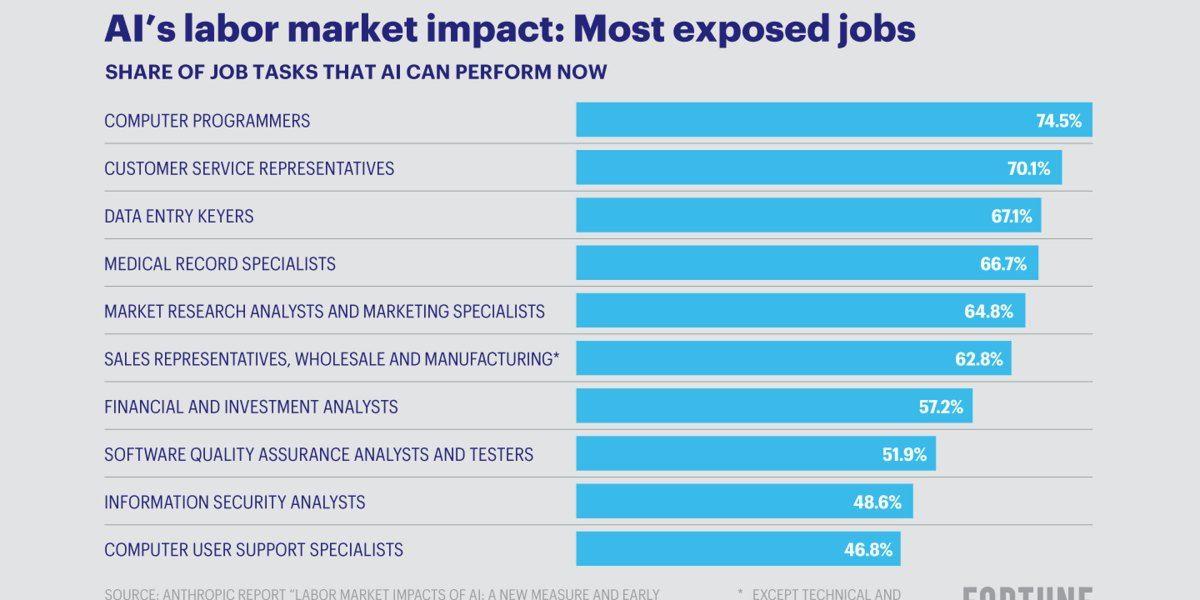
Source: Fortune
Understanding job displacement requires moving beyond simple exposure metrics. "Exposure alone is a completely meaningless tool for predicting displacement," Imas emphasized
1
. Instead, economists are focusing on jobs as bundles of tasks, examining whether those tasks are tightly integrated or loosely connected.Recent research from LSE professor Luis Garicano explores this framework, distinguishing between "weak bundles" and tightly enmeshed roles
3
. Junior software developers and contractors typically have weak bundles—their work consists mainly of writing code to specification, tasks easily extracted and automated. Senior developers, however, combine programming with domain-specific expertise and strategic decision-making, creating tight bundles where automation acts as an assistant rather than replacement. This explains why hiring for senior software roles continues holding up better than for entry-level white-collar roles3
.Within Silicon Valley's orbit, an AI-fueled jobs apocalypse is discussed as inevitable. Dario Amodei, CEO of Anthropic, has called AI "a general labor substitute for humans" that could do all jobs in less than five years
1
. A societal impacts researcher at Anthropic suggested there might be a recession in the near term and a "breakdown of the early-career ladder"1
.These conversations have left many workers anxious, contributing to support for efforts to pause data center construction
1
. The panic isn't being helped by lawmakers, none of whom have articulated coherent plans for the changing nature of work. According to the Federal Reserve Bank of New York, unemployment for college graduates ages 22 to 27 reached 5.6% at year-end, with over 40% of employed graduates holding jobs not typically requiring degrees4
.
Source: MIT Tech Review
The relationship between automation and job transformation isn't straightforward. A developer using AI coding tools might complete in one day what previously took three, dramatically improving productivity
1
. But whether employers respond by hiring more workers to capitalize on increased output or fewer workers to cut costs remains uncertain.Molly Kinder, a senior fellow at the Brookings Institution, experienced this firsthand: "I really don't know anything a college student can bring to my team that Claude can't do"
5
. She noted that basic research tasks she once hired recent graduates to perform are now easily handled by AI agents. The same technological capability can shrink one job while expanding another, eroding junior positions even as it enhances senior ones3
.Related Stories
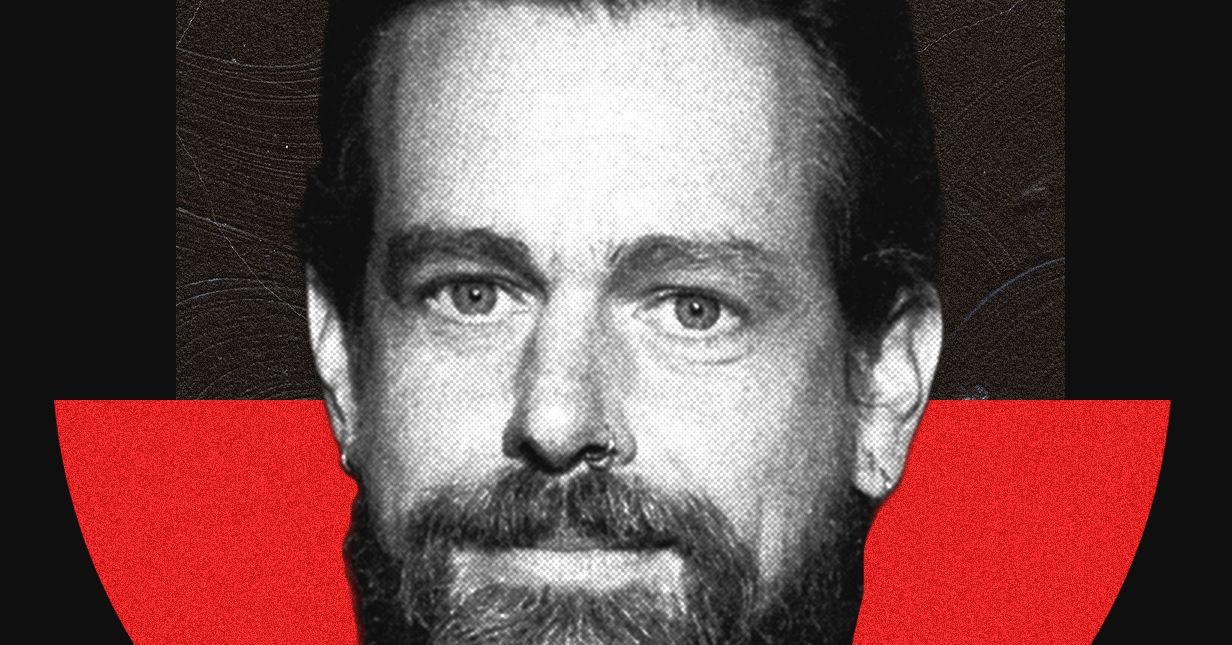
Two distinct camps have emerged in this debate. One, occupied by figures like Elon Musk, believes AI can put all humans out of work. The other thinks AI will augment work rather than replace human workers themselves, a view supported by Gartner findings
2
. Career development experts report seeing more augmentation and "uneven, role-specific change" rather than uniform widespread job displacement across the labor market2
.A January Forrester report estimated 6% of US jobs could be automated by 2030, contrasting with MIT's 12% estimate for current capabilities
2
. Whether these projections materialize depends heavily on how and where companies actually adopt AI—a variable that puts predictions across a wide spectrum. Block CEO Jack Dorsey's decision in late February to lay off nearly half the workforce based on what AI tools could handle internally set a concerning tone for companies chasing efficiency gains2
.In a working paper published this week, researchers surveyed economists about their outlook over the next five and 25 years
5
. Most expect modest economic growth as AI improves, but if the technology advances rapidly—a possibility considered unlikely but plausible—they envision faster growth accompanied by greater inequality and millions of disappeared jobs."There's enough conversation around this that we certainly should, as a country, be talking about what sorts of policies make sense in a world where the way employment and careers work now changes a lot in the next two to five years," said Robert Seamans, an economist at New York University
5
. Imas issued a "call to arms" for economists to start collecting better data on how AI affects individual tasks and skills within jobs, arguing current tools for prediction are inadequate1
. The concern extends beyond economics into existential questions about human dignity and connection in a world that may no longer value human labor the same way4
.Summarized by
Navi
[1]
[2]
[4]
27 Feb 2026•Business and Economy

04 Mar 2026•Business and Economy

05 Mar 2026•Business and Economy

1
Technology

2
Science and Research

3
Technology