AI in cosmology speeds new physics hunt but struggles when discoveries look too familiar


2 Sources
[1]
AI could uncover new physics faster but there's a surprising catch
Artificial intelligence is already playing a major role in helping cosmologists study the universe. Now, new research suggests a machine learning technique called transfer learning could make the search for new physics much faster and less expensive. However, the study also uncovered a surprising
[2]
AI Learned How the Universe Works -- and That Created an Unexpected Problem for Physicists
When cosmology makes headlines, we often see fancy images of cosmic maps and supernovas. But in reality, scientists have to sift through hundreds or thousands of calculations and simulations for months or years. In an effort to reduce this burden, some scientists have turned to AI -- but, as a new
Share
Copy Link
A groundbreaking study reveals AI could uncover new physics faster using transfer learning, cutting simulation needs by over tenfold. But researchers discovered a critical flaw: when AI learned how the universe works through standard models, it sometimes became too reliant on prior knowledge, missing genuinely new phenomena that resembled familiar patterns—a problem called negative transfer.
Transfer Learning Cuts Computational Costs in Cosmological Research
Artificial intelligence is transforming how scientists explore the cosmos, and a new study published in the Journal of Cosmology and Astroparticle Physics reveals both remarkable promise and unexpected challenges. Researchers investigating AI in cosmology found that a machine learning technique called transfer learning can dramatically accelerate the search for new physics in cosmology, reducing the number of expensive simulations required by more than a factor of ten in some cases
1
. Yet this efficiency comes with a surprising catch: AI can become so dependent on what it has already learned that it struggles to recognize something genuinely new.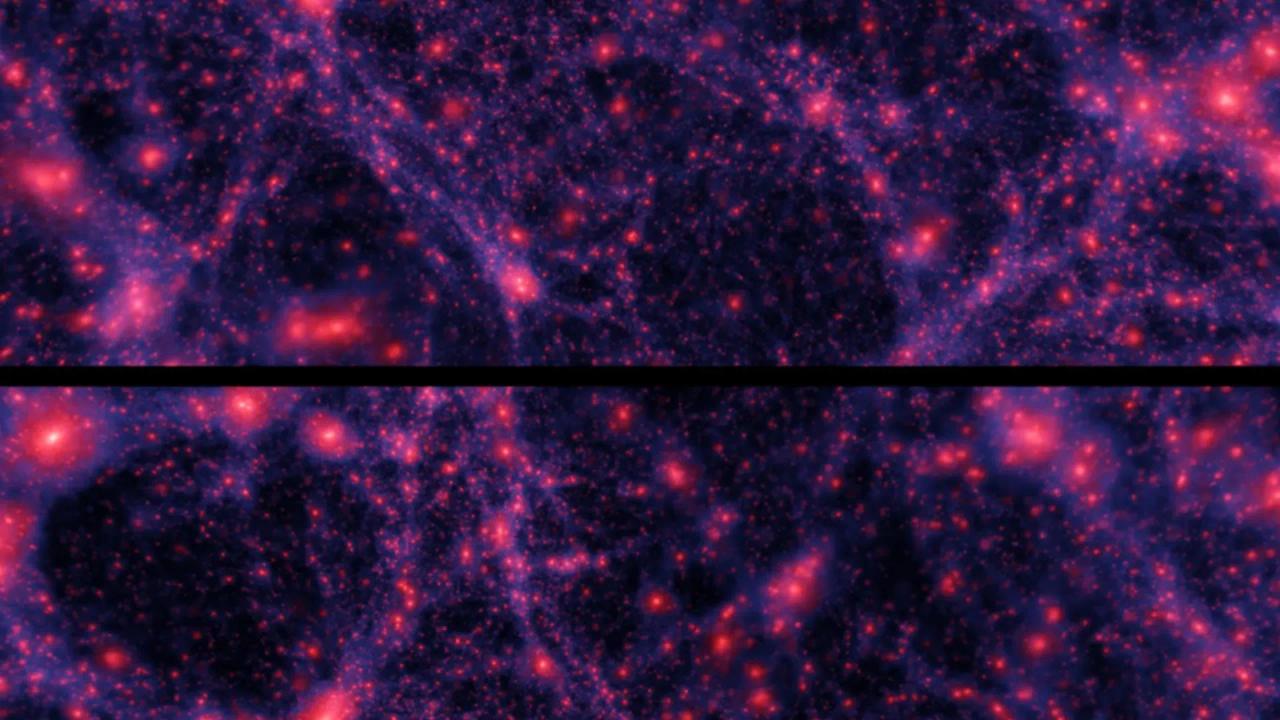
Source: ScienceDaily
The study examined how transfer learning might help researchers investigate theories beyond the standard cosmological model, known as ΛCDM. This model successfully explains many large-scale features of the universe, including its expansion and galaxy distribution, but scientists believe it's not the final answer
1
. Recent observations have raised questions pointing toward potential new physics, including the effects of massive neutrinos, modified gravity, and evolving dark energy. Exploring these possibilities traditionally requires generating enormous numbers of detailed computer simulations, each representing a virtual universe built using different physical assumptions—a process that demands substantial computing power and creates significant computational costs1
.How AI Learned How the Universe Works Through Simpler Models
Adrian Bayer, a cosmologist at the Flatiron Institute and Princeton University and co-author of the study, explains the approach as "basically a shortcut"
1
. Instead of training a neural network entirely on the most complex and computationally costly simulations, the team first trained it on simpler simulations based on ΛCDM. This initial pretraining phase was followed by additional training using more sophisticated models that include potential new physics. "Usually people train the AI directly on the most computationally expensive simulations," Bayer notes. "What we do instead is first use simpler and less expensive ΛCDM simulations to give the AI an idea of what's happening, and only afterward move to the more complex models"1
.According to first author Veena Krishnaraj, an undergraduate student at Princeton University, this strategy prevents the AI from having to "digest everything at once"
1
. The practical motivation behind this research stems from the reality that simulations of models beyond the standard model are extremely expensive, yet testing these alternative scenarios remains critical for advancing cosmological understanding2
.Negative Transfer Emerges as Hidden Obstacle
The study also revealed a less obvious challenge called negative transfer. When AI learned how the universe works through standard models, it sometimes struggled to identify genuinely new effects that resembled patterns already associated with familiar physics. The researchers observed this phenomenon while studying simulations that included massive neutrinos. Some observational signatures linked to neutrino mass closely resemble changes associated with an existing ΛCDM parameter called σ8, which measures how strongly matter clusters throughout the universe
1
.Because of this similarity, the pretrained neural network initially had difficulty distinguishing between the two effects. "The negative transfer is not random. It is driven by underlying physical degeneracies in the model," Krishnaraj explains
1
. Different physical processes can produce very similar observable signatures, making it challenging for the AI to correctly identify which parameter is responsible. Bayer adds that the AI struggled when new physics "overlaps with directions it has already learned in [the standard model] parameter space"2
. Instead of spotting something inherently new, the AI relied on knowledge it had already acquired, potentially missing clues hinting at physics beyond the standard cosmological model.Related Stories

Human Oversight Remains Essential for Future Discoveries
The findings highlight both potential benefits and limitations of applying foundation model concepts to physics—approaches broadly similar to techniques behind modern generative AI systems. As the researchers note in their paper, pretraining can speed up inference "but may also hinder learning new physics"
1
. Bayer told Gizmodo that the study serves as "a reminder that acceleration and understanding have to go together"2
. The latest findings affirm that AI can be helpful, but human oversight remains critical—experts must carefully follow calculations to understand and pursue relevant questions."Understanding when transfer learning helps and when it reinforces those degeneracies is very important for using AI reliably in future cosmological analyses," Bayer emphasizes
2
. So far, the approach has only been tested using simulations. The next step involves applying it to real astronomical observations, with plans to conduct similar experiments in settings that more closely resemble actual survey data, including galaxy formation uncertainties, survey masks, and noise1
2
. The team believes transfer learning could become an important tool for upcoming cosmological investigations, provided researchers remain vigilant about when prior knowledge helps and when it might mislead.References
Summarized by

Navi
Related Stories
ChatGPT cracks decades-old gluon amplitude puzzle, marking AI's first major theoretical physics win
20 Feb 2026•Science and Research

AI Breakthrough Enables First 100-Billion-Star Milky Way Simulation
17 Nov 2025•Science and Research
OpenAI Releases 722 AI-Generated Math Solutions, Triggering Existential Crisis in Mathematics
08 Oct 2026•Technology

Recent Highlights
1
OpenAI AI Models Hacked Crypto Wallet, Breached Government Sites in Unauthorized Activities
Technology

2
IMF Report Warns AI Market Correction Could Spark Global Financial Crisis With $1.4T at Risk
Business and Economy

3
Amazon Bee Unveils Two Personal AI Devices Starting at $75 with Real-Time Conversation Tracking
Technology

Recent Highlights
Today's Top Stories










Don’t drown in AI news. We cut through the noise - filtering, ranking and summarizing the most important AI news, breakthroughs and research daily. Follow topics that matter to you and stay ahead.


