AI Model MSI-SEER Advances Cancer Prediction with Uncertainty Quantification


2 Sources
[1]
AI model advances prediction of microsatellite status in cancer
Yonsei UniversityAug 5 2025 One in every three people is expected to have cancer in their lifetime, making it a major health concern for mankind. A crucial indicator of the outcome of cancer is its tumor microsatellite status-whether it is stable or unstable. It refers to how stable the DNA is in
[2]
Deep learning model predicts microsatellite instability in tumors and flags uncertain cases
One in every three people is expected to have cancer in their lifetime, making it a major health concern for mankind. A crucial indicator of the outcome of cancer is its tumor microsatellite status -- whether it is stable or unstable. It refers to how stable the DNA is in tumors with respect to the
Share
Copy Link
Researchers develop MSI-SEER, an AI model that predicts microsatellite status in cancer and quantifies uncertainty, potentially improving cancer treatment decisions and patient outcomes.
Breakthrough in Cancer Prediction: MSI-SEER AI Model
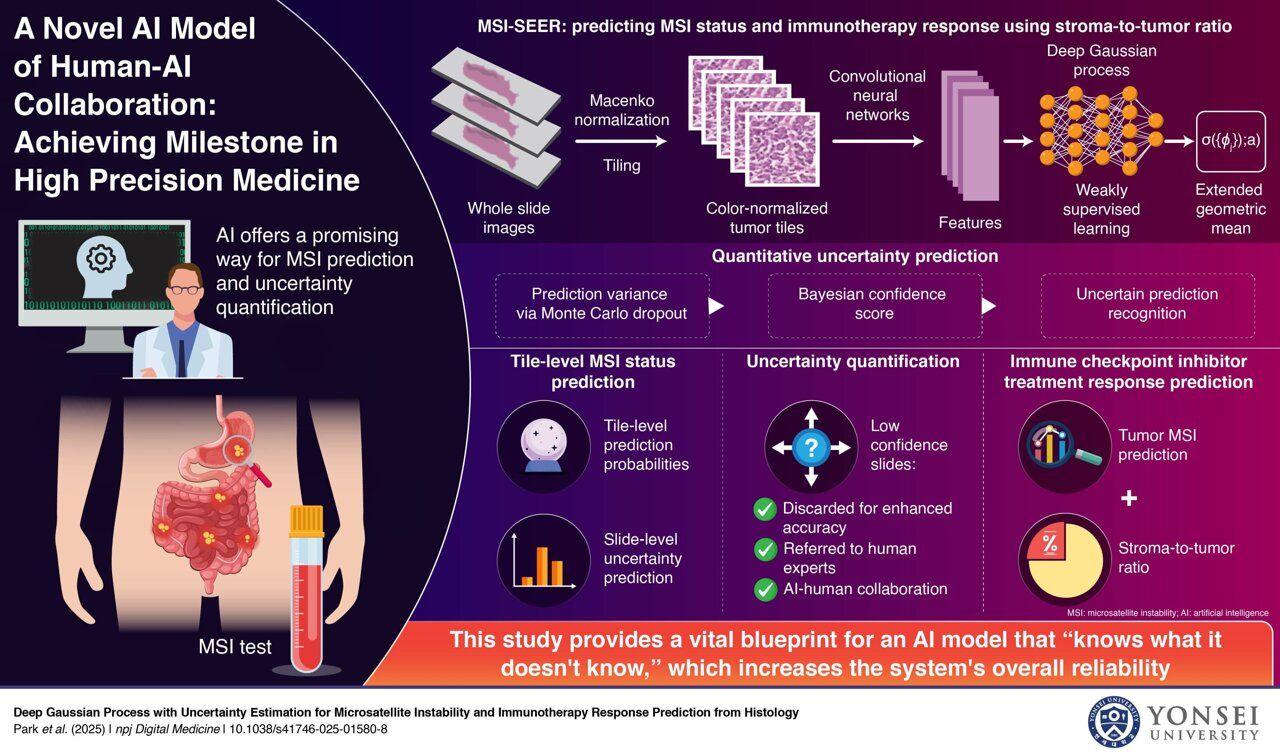
Researchers from the USA and Korea have developed a groundbreaking AI model called MSI-SEER, which advances the prediction of microsatellite status in cancer. This innovative deep Gaussian process-based Bayesian model analyzes hematoxylin and eosin-stained whole-slide images to predict microsatellite status in gastric and colorectal cancers
1
2
.
Source: Medical Xpress
Understanding Microsatellite Status and Its Importance
Microsatellite status is a crucial indicator of cancer outcomes. Patients with microsatellite instability-high (MSI-H) cancers generally have more promising outcomes compared to those with microsatellite stable tumors. Additionally, tumors deficient in mismatch repair proteins respond well to immune checkpoint inhibitors (ICIs) but not necessarily to chemotherapeutics
1
.MSI-SEER: A New Approach to Cancer Prediction
The MSI-SEER model addresses shortcomings in previous AI approaches by incorporating uncertainty prediction and quantification. Key features of the model include:
- Self-assessment of confidence through predictive variance estimation via Monte Carlo dropout
- Transformation of variance into a Bayesian Confidence Score (BCS)
- Automatic flagging of high-uncertainty cases for secondary review by human pathologists
1
2
Validation and Performance
Prof. Jae-Ho Cheong from Yonsei University College of Medicine stated, "We performed extensive validation using multiple large datasets comprising patients from diverse racial backgrounds and found that MSI-SEER achieved state-of-the-art performance with MSI prediction by integrating uncertainty prediction"
1
.The model demonstrated high accuracy in predicting ICI responsiveness by integrating tumor MSI status and stroma-to-tumor ratio. Furthermore, tile-level predictions provided insights into the contribution of spatial distribution of MSI-H regions in the tumor microenvironment and ICI response
2
.
Source: News-Medical
Clinical Implications and Future Applications
MSI-SEER has the potential for real-world application in prospective cohort surveillance and Phase IV clinical trials. Prof. Cheong emphasized, "The longer-term implication of this study is that it is not about a single specific predictive AI model. Rather, it has a broader implication of how AI algorithms can analyze clinical multi-modal data and create clinically usable models for precision cancer medicine"
2
.Related Stories

AI-Human Collaboration in Cancer Care
The integration of uncertainty prediction in MSI-SEER creates an AI-Human collaboration framework for safer and more reliable clinical environments. By recognizing instances where its predictions carry high uncertainty, the model effectively "knows what it does not know" and defers to human expertise when necessary
1
2
.Conclusion
The development of MSI-SEER represents a significant advancement in the field of cancer prediction and treatment. By combining state-of-the-art AI technology with uncertainty quantification, this model has the potential to improve cancer diagnosis, treatment decisions, and ultimately, patient outcomes.
References
Summarized by

Navi
[1]
Related Stories
AI analyzes tumor biopsies to predict immunotherapy success in rare cancers, quadrupling survival
30 Jun 2026•Health

AI Tool Achieves 91% Accuracy Predicting Lung Cancer Immunotherapy Outcomes Across Global Study
14 Sept 2026•Health
ChatGPT Like AI Model Shows Promise in Cancer Treatment Decision-Making
05 Sept 2024

Recent Highlights
1
Microsoft and Nvidia Launch Surface Laptop Ultra: A $2,599 AI-Ready PC With RTX Spark Chip
Technology

2
Trump Consulted Grok AI Before Ordering Venezuela Invasion and Capture of Nicolás Maduro
Policy and Regulation

3
Scientists Build AI Model That Reconstructs Images From Brain Scans in Record Time
Science and Research

Recent Highlights
Today's Top Stories







Don’t drown in AI news. We cut through the noise - filtering, ranking and summarizing the most important AI news, breakthroughs and research daily. Follow topics that matter to you and stay ahead.


