AI-Powered Robot 'Ruyi' to Enhance Care for Seniors with Alzheimer's


2 Sources
[1]
AI-driven robotics research aims to enhance care for older adults with Alzheimer's
Imagine a robot that not only reminds you to take your medication, but helps you navigate your home and offers companionship. This type of artificial intelligence (AI)-powered technology could be a reality for seniors in the not-too-distant future. An interdisciplinary team at Case Western Reserve
[2]
AI-driven robotics research aims to enhance care for older adults with Alzheimer's | Newswise
CLEVELAND -- Imagine a robot that not only reminds you to take your medication, but helps you navigate your home and offers companionship. This type of artificial intelligence (AI)-powered technology could be a reality for seniors in the not-too-distant future. An interdisciplinary team at Case
Share
Copy Link
Case Western Reserve University researchers are exploring how AI-driven robotics can improve caregiving for older adults with early-stage Alzheimer's disease, using a robot named Ruyi in a pilot study at Judson Senior Living in Cleveland.

Innovative AI Robot to Assist Seniors with Alzheimer's
Researchers at Case Western Reserve University are embarking on a groundbreaking study to explore how artificial intelligence (AI) and robotic technology can revolutionize care for older adults, particularly those with early-stage Alzheimer's disease and related dementias (ADRD). The interdisciplinary team, comprising experts from the Weatherhead School of Management, School of Medicine, and College of Arts and Sciences, is focusing on a robot named Ruyi, developed by NaviGait
1
.Ruyi: The AI-Powered Caregiving Assistant
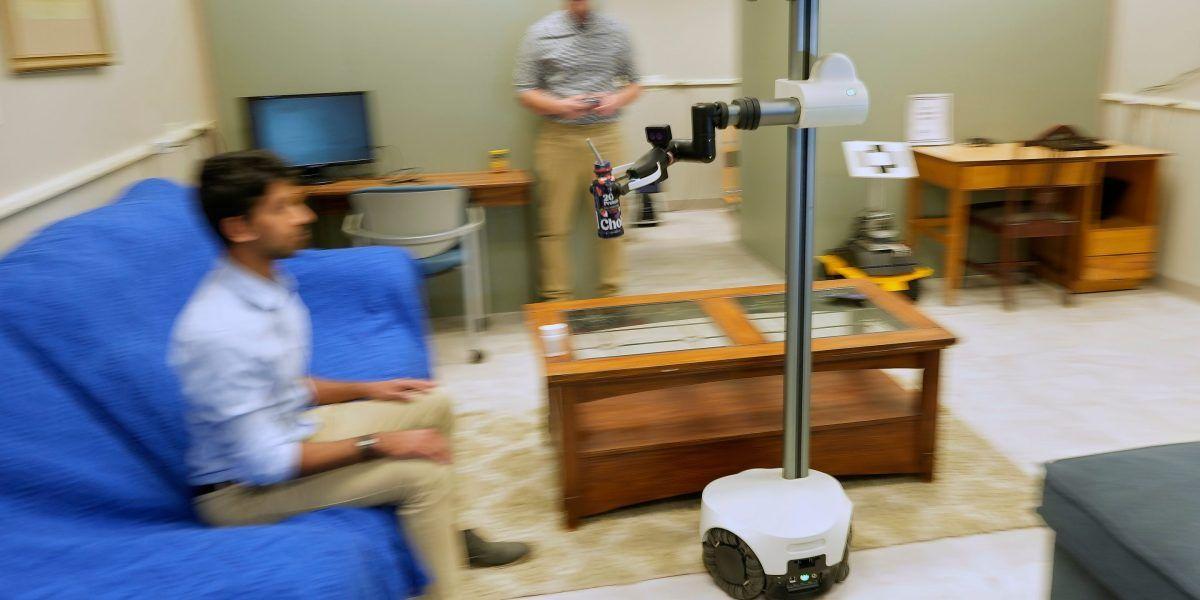
Standing at about 3 feet tall, Ruyi is a wheeled robot reminiscent of Rosie from "The Jetsons" cartoon. This AI-driven robot is equipped with advanced sensors, mobility monitoring capabilities, and interactive features designed to assist older adults at Judson Senior Living in Cleveland
2
.Ruyi's capabilities extend beyond simple reminders for medication. The robot is designed to help seniors navigate their homes, offer companionship, and connect with home technology such as thermostats and the internet. Additionally, Ruyi will provide regular updates on residents' health and comfort to human caregivers, creating a comprehensive care ecosystem
1
.Research Objectives and Methodology
The primary goal of this study is to investigate how AI-powered robotics can bridge the gap between the needs of aging individuals and available caregiving resources. Philip Cola, a professor at both the Weatherhead School and the School of Medicine, emphasizes that the focus is on managing healthcare rather than treating Alzheimer's disease directly
2
.The research will be conducted in three phases, aiming to enhance independence for seniors while alleviating some of the burdens on caregivers and healthcare providers. By integrating AI-driven robotics into senior care, the team hopes to create sustainable caregiving solutions that empower individuals and improve overall care management
1
.Related Stories

Ethical Considerations and Broader Impact
This project goes beyond technological innovation, addressing the ethical implications of AI applications in healthcare. Peter Whitehouse, co-principal investigator and professor of neurology and psychiatry, stresses the importance of designing solutions that genuinely meet the needs of older adults and their caregivers
2
.The interdisciplinary approach, combining insights from medicine, management, and design, represents a fresh perspective on one of healthcare's most pressing challenges. This research is not only about developing groundbreaking technology but also about informing the broader conversation on ethical, human-centered AI applications in healthcare
1
.Funding and Collaboration
The one-year pilot study is funded through the National Institutes of Health and is part of a larger project administered through the AI & Technology Collaboratory (AITC) for Aging Research at Johns Hopkins University. This collaboration highlights the growing interest and investment in AI-driven solutions for elderly care and Alzheimer's management
2
.References
Summarized by

Navi
[1]
Related Stories
Robots in Nursing Homes: Boosting Employee Retention and Enhancing Patient Care
09 Jan 2025•Technology

Robots in home care help elderly and injured navigate daily life as caregiver shortage deepens
01 Jun 2026•Technology
Study Reveals Key Factors for Home-Care Robot Acceptance Across Japan, Ireland, and Finland
11 Dec 2024•Health

Recent Highlights
1
Microsoft and Nvidia Launch Surface Laptop Ultra: A $2,599 AI-Ready PC With RTX Spark Chip
Technology

2
OpenAI Releases 722 AI-Generated Math Papers on GitHub, Igniting Fury Among Mathematicians
Science and Research

3
Trump Consulted Grok AI Before Ordering Venezuela Invasion and Capture of Nicolás Maduro
Policy and Regulation

Recent Highlights
Today's Top Stories











Don’t drown in AI news. We cut through the noise - filtering, ranking and summarizing the most important AI news, breakthroughs and research daily. Follow topics that matter to you and stay ahead.


