Groundbreaking Study Maps Early Triggers of Alzheimer's Protein Aggregation


3 Sources
[1]
New large-scale study maps early triggers of Alzheimer's protein aggregation
Wellcome Trust Sanger InstituteJun 12 2025 A new large-scale study has mapped the first molecular events that drive the formation of harmful amyloid protein aggregates found in Alzheimer's disease, pointing towards a new potential therapeutic target. Published today (11 June) in Science Advances,
[2]
New Map Reveals First Steps of Protein Clumping in Alzheimer's - Neuroscience News
Summary: Scientists have mapped how over 140,000 mutations affect the formation of amyloid beta fibrils, offering an unprecedented look at early events in Alzheimer's disease. By combining DNA synthesis, genetically engineered yeast, and machine learning, they built a detailed energy landscape of
[3]
Large-scale study maps the first step in Alzheimer's protein aggregation
A new large-scale study has mapped the first molecular events that drive the formation of harmful amyloid protein aggregates found in Alzheimer's disease, pointing toward a new potential therapeutic target. Published in Science Advances, researchers from the Wellcome Sanger Institute, Center of
Share
Copy Link
A large-scale study using genomics and AI has mapped the initial molecular events driving the formation of harmful amyloid protein aggregates in Alzheimer's disease, potentially opening new avenues for therapeutic interventions.
Groundbreaking Research on Alzheimer's Protein Aggregation
A new large-scale study has made significant strides in understanding the early molecular events that lead to the formation of harmful amyloid protein aggregates in Alzheimer's disease. Published in Science Advances, the research was conducted by scientists from the Wellcome Sanger Institute, Centre of Genomic Regulation (CRG), and Institute for Bioengineering of Catalonia (IBEC)
1
.
Source: Medical Xpress
Innovative Methodology
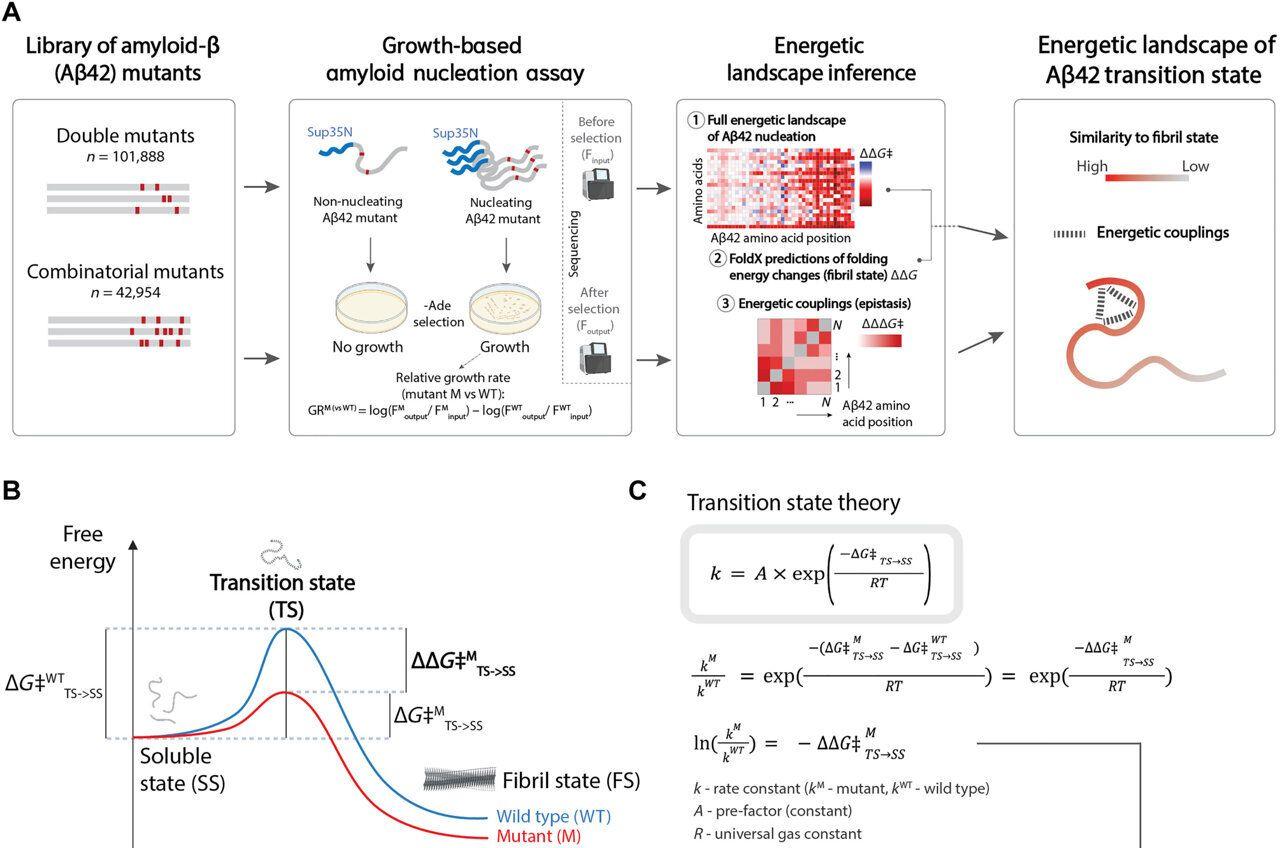
The study employed a combination of cutting-edge techniques to analyze over 140,000 versions of the Aβ42 peptide, which is known to form harmful plaques in the brains of Alzheimer's patients:
- Massively parallel DNA synthesis
- Genetically engineered yeast cells
- Machine learning algorithms
This innovative approach allowed researchers to conduct the study at an unprecedented scale, improving the quality and accuracy of their models
2
.Key Findings
The research team discovered that only a few key interactions between specific parts of the amyloid protein significantly influence the speed of fibril formation. Notably, they found that the Aβ42 aggregation reaction begins at the C-terminal region of the protein, which is one of its hydrophobic cores .
Dr. Anna Arutyunyan, co-first author and Postdoctoral Fellow at the Wellcome Sanger Institute, explained: "By measuring the effects of over 140,000 different versions of proteins, we have created the first comprehensive map of how individual mutations alter the energy landscape of amyloid beta aggregation - a process central to the development of Alzheimer's disease"
1
.Implications for Alzheimer's Treatment

Source: News-Medical
This research represents the first large-scale map of how mutations influence a protein's behavior in the notoriously difficult-to-study transition state. By identifying the interactions that drive the formation of amyloid fibrils, the team suggests that preventing the formation of this transition state could pave the way for new therapeutic strategies
2
.Dr. Benedetta Bolognesi, co-senior author and Group Leader at the Institute for Bioengineering of Catalonia, highlighted the novelty of their approach: "Our 'kinetic-selection' method measures how fast reactions occur - and it does so for thousands of reactions in parallel, capturing the true rate-limiting steps of the aggregation reaction" .
Related Stories




Broader Applications
The researchers emphasize that their method has potential applications beyond Alzheimer's research. It offers a powerful framework to dissect the key initiating steps of many biological reactions, potentially benefiting studies across a range of proteins and diseases
1
.Global Impact of Alzheimer's

Source: Neuroscience News
This research comes at a critical time, as over 55 million people worldwide are affected by dementia, with an estimated 60-70% of these cases being Alzheimer's disease. Most current treatments for Alzheimer's focus on managing symptoms rather than slowing or stopping the disease progression
2
.As this groundbreaking study opens new avenues for understanding and potentially treating Alzheimer's disease, it represents a significant step forward in the fight against this devastating neurodegenerative condition.
References
Summarized by

Navi
[2]
[3]
Related Stories
Recent Highlights
1
Microsoft and Nvidia Launch Surface Laptop Ultra: A $2,599 AI-Ready PC With RTX Spark Chip
Technology

2
OpenAI Releases 722 AI-Generated Math Papers on GitHub, Igniting Fury Among Mathematicians
Science and Research

3
Trump Consulted Grok AI Before Ordering Venezuela Invasion and Capture of Nicolás Maduro
Policy and Regulation

Recent Highlights
Today's Top Stories












Don’t drown in AI news. We cut through the noise - filtering, ranking and summarizing the most important AI news, breakthroughs and research daily. Follow topics that matter to you and stay ahead.


