3 Sources
[1]
Albanese to seek state cooperation on data centres but faces fight with Queensland
Anthony Albanese will outline to national cabinet on Wednesday proposed national legislation for conditions and guardrails around data centres - but faces a fight with Queensland. The legislation covers conditions on sources of energy and water and the locations of centres. It will also set conditions for AI model training in relation to copyright, security, safety and skills development. Among the minimum obligations the commonwealth will impose are that centres: * must not place upwards pressure on energy prices and must make a positive contribution to Australia's energy transition * use innovative, efficient and sustainable solutions to minimise water use, meet infrastructure costs and support transparent reporting on consumption and performance * and minimise community impacts and be appropriate for their size, function and infrastructure requirements, avoiding inappropriate locations near homes, schools and prime agricultural land for potential housing sites. The Commonwealth and Queensland's Liberal and National Party government are at odds over the federal government's insistence that new centres be tied to new renewable energy projects. Queensland is resisting the plan that coal and gas be excluded. Energy minister Chris Bowen said at the weekend the federal government was "not going to let Queensland run a race to the bottom, which would see energy bills go up, reliability go down, because they want data centres at any cost". Opposition leader Angus Taylor said on Monday the Coalition was "absolutely neutral" about fuel sources. "We won't be picking the fuel source. That should be done by people who actually are paying for it and building it. This is the problem with Labor. Chris Bowen has managed to drive electricity prices up by 40% and send industry offshore because he thinks he knows best." In a Tuesday speech to the Business Council's annual dinner, released ahead of delivery, Albanese says Australia is strongly placed to attract data centre investment "but maintaining social license will be essential". "That means ensuring energy bills do not rise, water security is maintained and locations are appropriate. "Getting this right can ensure Australia is the infrastructure partner for our region, aided by our status as a Five Eyes Partner. "It will advance our national sovereignty. And it is essential for our national security, business productivity, science, innovation and resilience." Albanese says the objectives of all governments must be to turn Australia's positive investment settings into a comparative advantage for the nation. "Hosting large scale AI training data centres, and unlocking frontier AI model training, will help Australia capture a larger share of the economic value, technical capability and strategic influence of AI. As well as boost the competitiveness of our start-ups and innovative businesses." He says it's important to establish conditions to attract investment for artificial intelligence training so it is developed safely and in ways that protect copyright, ensuring payment and control to the creative sector. "Australia will be the first to bring the policy response [to AI] into a single national framework, overseen by a central office, located in my own department. "We are leading the world in developing AI best practice, just as we have in the under-16 social media ban." The national legislation for data centres builds on the "expectations" the federal government earlier released for these centres. There have already been discussions of various policy aspects at federal and state ministerial meetings. Both levels of government are alive to community concerns and suspicions about large centres. Albanese rejects calls for GST rethink The prime minister, on his 45th visit to to Western Australia as PM, promised there would be no change in the generous deal that state receives as its share of the GST revenue. This will further annoy premiers from the eastern states, especially NSW Premier Chris Minns. The Productivity Commission recently urged the deal, that dates from the days of then prime minister Scott Morrison, be scrapped. But Albanese told a news conference he was not changing his position: "Well, I've said it multiple times. I've signed people's body parts, for goodness sake."
[2]
Albanese seeks to quell datacentre disquiet as climate expert warns 'we've got one shot to get the rules right'
Prime minister will use national cabinet meeting to assuage premiers over new AI law as AEMO forecasts seven-fold rise in datacentre power use Anthony Albanese will seek to use Wednesday's high-stakes talks with premiers to quell growing unhappiness about national controls on datacentre developments, promising new approval laws will complement state rules. Faced with growing opposition from conservative governments in Queensland and the Northern Territory, Albanese will tell national cabinet he plans a major piece of legislation next year to ensure the economic benefits of AI are shared widely. With potential to be one of the major reforms of Labor's second term, the new law will set tough copyright rules for AI businesses, and impose standards for security, safety and skills development. The meeting on Wednesday will come after the latest forecast from the Australian Energy Market Operator showing datacentre power use is projected to increase seven-fold over the next decade. The industry's rapid growth, driven by increasing reliance on AI and cloud computing, remained one of the most significant causes of growth in electricity demand, according to AEMO's annual Electricity Statement of Opportunities. In addition to 165 datacentres already operating around the country, a further 225 are in development, the report showed, reflecting a substantial increase in new proposals compared to 2025, AEMO said on Tuesday. Datacentre electricity demand was expected to grow from 5 to 34 terawatt hours by 2035-36, the report said, growing from 3% of overall consumption to 13%. AEMO said high datacentre growth could see consumption reach 52 TWh - a 10-fold increase over the decade. But there were high levels of uncertainty, with more than a third of projects listed in 2025 since cancelled, and operating facilities taking years to ramp to full capacity. Daniel Westerman, AEMO's chief executive, said record levels of new generation and storage coming online had improved the outlook for reliability, even with the expected retirement of coal power stations. "The reliability outlook has improved, supported by record levels of new generation and storage, and a strong pipeline of projects expected over the next decade." Climate Council chief executive, Amanda McKenzie, said datacentres were set "to devour an enormous share of Australia's electricity in the coming years". "We've got one shot to get the rules right now and ensure that datacentre growth doesn't strain our grid and push up pollution." Albanese will use national cabinet to strike agreement on a plan to legislate nationally consistent minimum obligations for datacentres, requiring them not to push up energy prices, meet their own infrastructure costs and minimise water use. The rules will also require developers to minimise the effect of new datacentres on local communities, ensuring they are appropriately sized and appropriately located, away from homes, schools and potential housing or agricultural sites. Projects approved for development before the new rules come into place will only be subject to existing state and territory laws. Last month, the prime minister promised "the strongest possible protection" for Australian creatives against misuse of their work by artificial intelligence models. He said it would be "theft" if writers, artists and musicians didn't have control of their work or receive payment for its use in training large AI models. Combining the elements into a single piece of legislation signals the government's ambition on AI, but could also heighten the political risk of getting the bill through parliament ahead of the next election. Queensland premier David Crisafulli and the NT chief minister, Lia Finocchiaro, have signalled opposition to federal rules requiring datacentres to be powered by renewable projects at the exclusion of coal and gas. Albanese is expected to seek broad consensus, but could be challenged by the increasingly outspoken Liberal-National and Country Liberal party leaders. He will also discuss state opposition to the national gun buy-back, which only has support from New South Wales and the ACT so far. Action to curb violence against women and the growing H1 bird flu crisis are also on the agenda. Anger about Western Australia's favourable GST share will also flare. In Perth on Monday, Albanese said he would not change the deal, which costs taxpayers more than $6bn a year. "There will be no change to WA's GST arrangements while I'm prime minister," he said. Promising Australia would do more to unlock frontier AI development in the future, Albanese will tell a Business Council event on Tuesday the government was determined to succeed. "It will advance our national sovereignty. And it is essential for our national security, business productivity, science, innovation and resilience."
[3]
Queensland sets up national cabinet showdown over AI data centre power
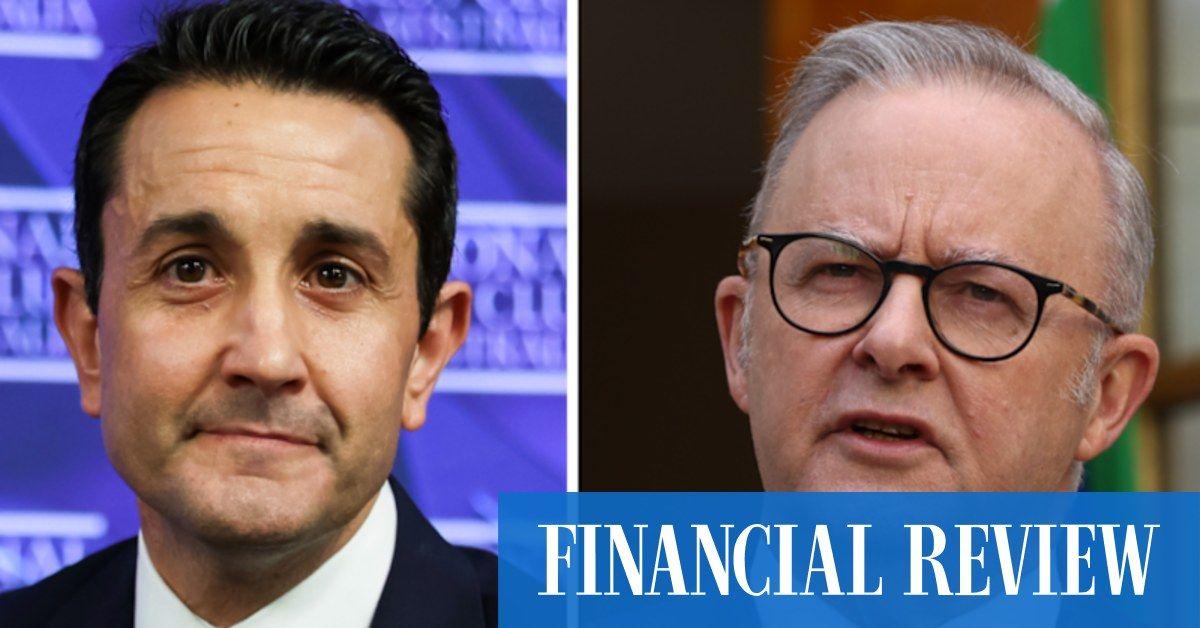
Queensland Premier David Crisafulli will firmly reject federal Labor's push to force large data centres to use renewable electricity when he meets with Prime Minister Anthony Albanese at national cabinet this week, laying the groundwork for a stoush with federal Labor. Under Labor's policy set to be legislated early next year, all next-generation data centres such as those that train and power artificial intelligence agents will be required to use renewable electricity and add more power to the grid than they consume.
Share
Copy Link
Anthony Albanese will present national legislation for AI data centres at Wednesday's cabinet meeting, requiring renewable energy and water efficiency standards. Queensland Premier David Crisafulli opposes federal mandates excluding coal and gas, setting up a political clash as AEMO forecasts datacentre power usage will surge seven-fold by 2035.

Anthony Albanese will outline proposed national legislation for AI data centres
1
at Wednesday's national cabinet meeting, establishing conditions and guardrails around energy sources, water usage, and facility locations. The comprehensive framework represents Australia's first unified policy response to AI infrastructure, overseen by a central office within the Prime Minister's department1
. This national legislation will set minimum obligations requiring centres to avoid placing upward pressure on energy prices while making positive contributions to Australia's energy transition1
.The legislation extends beyond infrastructure to address AI model training, establishing conditions for copyright protections for creatives, security protocols, safety standards, and skills development requirements
1
. Albanese emphasized that protecting Australian writers, artists, and musicians from misuse of their work would be essential, calling unauthorized use "theft" if creators don't maintain control or receive payment2
. The prime minister told the Business Council that hosting large-scale AI training data centres and unlocking frontier model training will help Australia capture greater economic value, technical capability, and strategic influence in AI1
.Queensland Premier David Crisafulli will firmly reject federal Labor's requirement that AI data centres use exclusively renewable electricity when meeting with Anthony Albanese at the national cabinet showdown
3
. Under the proposed policy set for legislation early next year, all next-generation data centres training and powering artificial intelligence agents must use renewable electricity and add more power to the grid than they consume3
. Queensland is resisting the federal government's plan to exclude coal and gas from powering these facilities1
.Energy Minister Chris Bowen stated the federal government "will not let Queensland run a race to the bottom, which would see energy bills go up, reliability go down, because they want data centres at any cost"
1
. Opposition leader Angus Taylor countered that the Coalition remains "absolutely neutral" about fuel sources, arguing decisions should rest with those paying for and building the facilities1
. Northern Territory Chief Minister Lia Finocchiaro has also signaled opposition to federal rules requiring datacentres to be powered by renewable energy projects at the exclusion of coal and gas2
.The Australian Energy Market Operator released its annual Electricity Statement of Opportunities showing datacentre power usage is projected to increase seven-fold over the next decade
2
. AEMO forecasts datacentre electricity demand will grow from 5 to 34 terawatt hours by 2035-36, rising from 3% of overall consumption to 13%2
. Under high growth scenarios, consumption could reach 52 TWh—a 10-fold increase over the decade2
.Currently, 165 datacentres operate across Australia, with a further 225 in development, reflecting substantial increases in new proposals compared to 2025
2
. The industry's rapid growth, driven by increasing reliance on AI and cloud computing, remains one of the most significant causes of electricity demand growth2
. AEMO Chief Executive Daniel Westerman noted that record levels of new generation and storage coming online have improved reliability outlooks, even with expected coal power station retirements2
. However, AEMO acknowledged high uncertainty levels, with more than a third of projects listed in 2025 since cancelled, and operating facilities taking years to reach full capacity2
.Related Stories
The minimum obligations under the national legislation require AI data centres to use innovative, efficient, and sustainable solutions to minimize water use, meet infrastructure costs, and support transparent reporting on consumption and performance
1
. Facilities must minimize community impacts and be appropriately sized for their function and infrastructure requirements, avoiding inappropriate locations near homes, schools, and prime agricultural land designated for potential housing sites1
.Albanese will tell national cabinet that maintaining social license will be essential for attracting data centre investment
1
. This means ensuring energy bills do not rise, water security is maintained, and locations are appropriate1
. Climate Council Chief Executive Amanda McKenzie warned that datacentres are set "to devour an enormous share of Australia's electricity in the coming years," adding "we've got one shot to get the rules right now and ensure that datacentre growth doesn't strain our grid and push up pollution"2
. Projects approved before new rules take effect will only be subject to existing state and territory laws2
.Albanese emphasized that getting renewable energy regulations right can ensure Australia becomes the infrastructure partner for the region, aided by its status as a Five Eyes Partner
1
. He stated this approach will advance national sovereignty and is essential for national security, business productivity, science, innovation, and resilience1
. The government aims to turn Australia's positive investment settings into a comparative advantage, with objectives focused on boosting competitiveness for start-ups and innovative businesses1
.The prime minister told the Business Council that Australia is strongly placed to attract data centre investment and is leading the world in developing AI best practice, similar to its approach with the under-16 social media ban
1
. Combining copyright protections, security standards, and infrastructure requirements into a single piece of legislation signals the government's ambition on AI but could heighten political risk for passing the bill through parliament ahead of the next election2
. The legislation builds on expectations the federal government previously released for these centres, with various policy aspects already discussed at federal and state ministerial meetings1
.Summarized by
Navi
[1]
[2]
[3]
29 Jul 2026•Policy and Regulation

22 Mar 2026•Policy and Regulation

13 Jul 2026•Policy and Regulation

1
Technology

2
Technology

3
Technology