Amazon Issues Stark Warning as 100+ Communities Move to Block AI Data Centers


13 Sources
[1]
Amazon writes scary blog warning communities not to block data centers
Amazon is calling for people to support AI data center projects, or risk irreparable harm to the US economy and national security. In a more than 3,000 word blog posted today, Amazon web services CEO Matt Garman pushed back on public concerns around the impact that data centers may have on jobs,
[2]
Amazon ends secret data center pacts and pledges $1 billion to host towns -- AWS promises 30,000 home efficiency retrofits amid 100 proposed bans
It will also invest more than $1 billion over five years in communities hosting its facilities. Amazon will no longer require nondisclosure agreements (NDA) with government agencies involved in its data center projects and will adhere to its new Data Center Commitment program designed to address
[3]
Amazon warns $68 billion in blocked data centers threatens US AI lead -- AWS CEO decries 100 proposed bans, pledges $1B community fund
Various countries intentionally seeding misinformation in the U.S. about data centers to trick us into slowing down - AWS CEO Amazon has issued grave warnings to communities opposing data centers, stating that their actions could cause irreversible damage to the U.S. economy and national security.
[4]
Amazon is set to spend $1 billion in towns where its data centers operate
Accept data centers or fall behind rivals, Amazon warns the US * Amazon says over 100 pending proposed moratoriums could threaten America's lead in AI * Amazon pledges over $1 billion across five years to data center communities * Amazon abandons Maryland data center campus beside Calvert Cliffs
[5]
Exclusive: Senate Investigation Challenges Big Tech's Case for AI Data Centers
* Custom Feed: See the stories that matter most to you. * Smart Alerts: Get notified about major news as it happens. Twice a week · Essential insights into the unfolding AI revolution. SIGN UP Yes, I agree to receive promotions and news from Time. Please agree to receive promotions to sign
[6]

Amazon Warns Local Communities to Stop Defying Its Massive AI Data Centers
More information Adding us as a Preferred Source in Google by using this link indicates that you would like to see more of our content in Google News results. The tech industry has largely failed to win over the public when it comes to AI. Data centers have become a hot-button topic, with the
[7]

Amazon vows $1 bn for data center towns, decries 'myths'
San Francisco (United States) (AFP) - Amazon on Friday pledged more than $1 billion over five years for US communities that host its data centers, the latest tech giant seeking to win over residents increasingly hostile to the AI-fueled construction boom. The "Built Together" program, unveiled by
[8]

Amazon vows $1 billion for data center towns, warning U.S. "can't afford to lose" AI race
Megan Cerullo is a New York-based reporter for CBS MoneyWatch covering small business, workplace, health care, consumer spending and personal finance topics. She regularly appears on CBS News 24/7 to discuss her reporting. Amazon's cloud computing division on Friday announced a new effort to
[9]
AWS says 100 proposed AI data center bans will cause damage that 'lasts generations' -- as US races towards $10.3 trillion buildout that will eclipse dot-com boom
Big Tech wants America to build the AI future at extraordinary speed, but communities would like to see the plans first Amazon Web Services CEO Matt Garman is warning the more than 100 American communities considering moratoriums on new data centers that stopping their construction now could leave
[10]

AWS CEO says US cannot afford data-center moratoriums
Amazon Web Services CEO Matt Garman urged communities to embrace data centers in a 3,000-word blog post, warning that construction restrictions could cost the United States the AI race. A Wall Street Journal poll released this week found that 62 percent of Americans supported pausing AI
[11]

Amazon AWS CEO warns AI data center backlash could hurt U.S. economy
Americans are pushing back against massive AI data centers, and it might end up shaping far more than their local energy bills or water use. According to a Business Insider report, Amazon (AMZN) AWS CEO Matt Garman is warning of efforts to halt new projects and how that could potentially weaken
[12]

Amazon to invest US$1 billion over five years in U.S. data centre communities
WASHINGTON -- Amazon's cloud computing division said on Friday it would invest more than US$1 billion over the next five years in U.S. communities where it has data centres and vowed to tackle their impacts on electricity and water usage. Data centres, which provide the computing power to train
[13]

Amazon to invest $1 billion over five years in US data center communities
WASHINGTON, Oct 2 (Reuters) - Amazon's cloud computing division said on Friday it would invest more than $1 billion over the next five years in US communities where it has data centers and vowed to tackle their impacts on electricity and water usage. Data centers, which provide the computing power
Share
Copy Link
Amazon Web Services CEO Matt Garman warns that over 100 proposed moratoriums on AI data centers could irreparably damage U.S. competitiveness and national security. As community opposition intensifies nationwide, Amazon pledges $1 billion to host communities while a Senate investigation challenges Big Tech's transparency on costs and benefits.
Amazon Warns of Irreparable Harm as AI Data Center Opposition Surges
Amazon Web Services CEO Matt Garman issued an urgent warning that growing community opposition to AI data centers could cause irreversible damage to U.S. economic competitiveness and national security
1
. In a 3,000-word blog post, Garman stated that more than 100 proposed moratoriums on new data centers are currently under consideration across the country, blocking projects worth $68 billion in the second quarter of 2026 alone3
. The AWS chief framed the issue as a matter of national urgency, claiming that "the countries that lead in AI will shape it and get the most from it in the short and long run"3
. Matt Garman went further, alleging that "there are widespread reports of various countries intentionally seeding misinformation in the U.S. about data centers to trick us into slowing down"1
. This stark messaging comes as support for AI data center projects has plummeted in polls, with nationwide concerns mounting over AI safety and the technology's unchecked societal impact1
.Amazon Unveils Data Center Commitment and $1 Billion Community Investment
In response to the growing nationwide backlash against AI data centers, Amazon Web Services announced its new Data Center Commitment program alongside plans to invest more than $1 billion over five years in communities hosting its facilities
2
. The Built Together program aims to address anti-data center movements by providing tangible economic benefits to host communities. Amazon expects to provide more than 300,000 students with access to free community college education over five years2
. The company plans energy-efficiency upgrades for more than 300 schools and community buildings, plus 30,000 homes, targeting energy-bill reductions of 20%-40% and savings of approximately $700 per household annually2
. Amazon also announced it will end its use of nondisclosure agreements with government agencies involved in data center projects, following scrutiny from Democratic lawmaker Jamie Raskin over secret data center pacts with local officials1
. David Zapolsky, Amazon's chief global affairs and legal officer, acknowledged that "the industry comes from a history of secrecy and so some of that's just reflex," adding that requiring secrecy "just didn't make sense" anymore1
.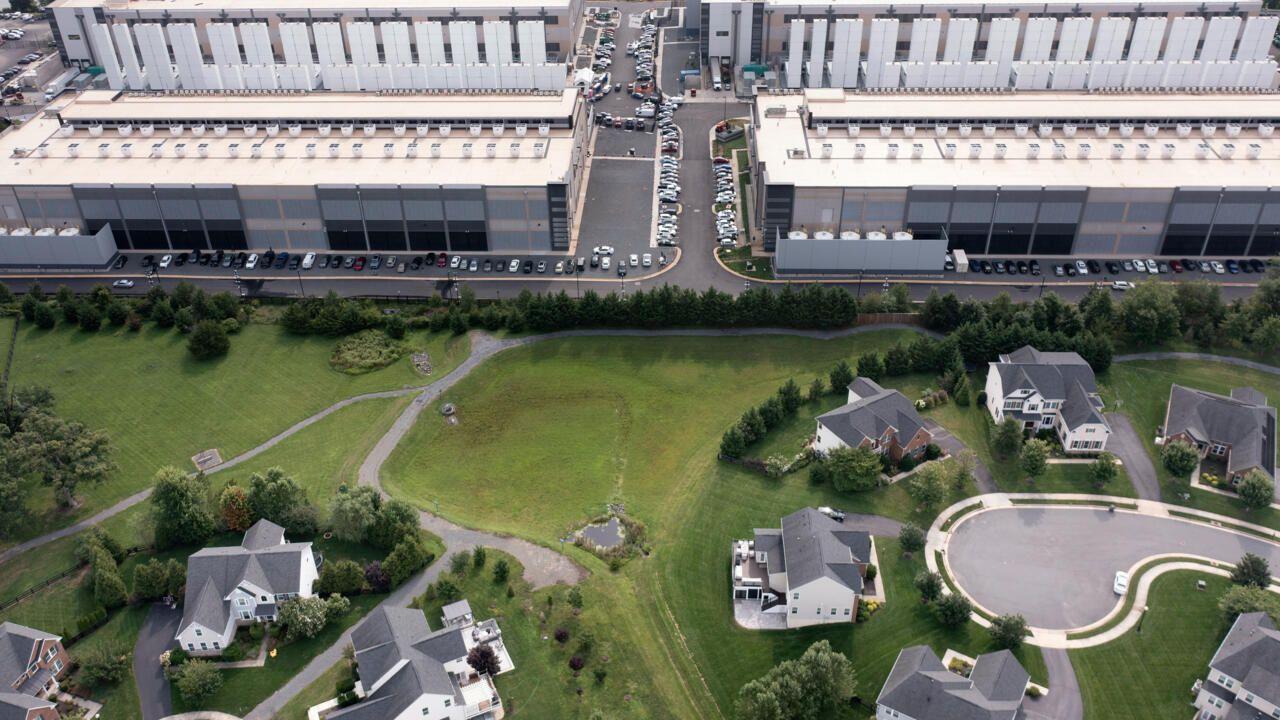
Source: France 24
Senate Investigation Challenges Big Tech's Case for AI Data Centers
A yearlong Senate investigation led by Elizabeth Warren, Chris Van Hollen, and Richard Blumenthal directly challenges Big Tech's case for AI data centers, arguing that companies are misleading the public about true costs and benefits
5
. The investigation focused on seven major developers—Amazon, Google, Meta, Microsoft, CoreWeave, Digital Realty, and Equinix—and found that several companies refused to provide comprehensive information about permanent employment when requested5
. Some companies told investigators that permanent staffing was roughly one worker for every megawatt of power demand, meaning a 100-megawatt data center could consume as much electricity as 100,000 homes while employing only about 100 permanent workers after construction5
. Senator Elizabeth Warren stated, "Congress must hold Big Tech accountable so these companies pay their fair share," calling for a national moratorium on new AI data centers until developers agree to cover full costs5
. The Senate investigation found that the most lucrative tax incentives for data center developers are not property-tax breaks but sales-tax exemptions on computer equipment, with GPUs accounting for an estimated 39% of spending at an average 1-gigawatt AI data center5
. All four major technology companies—Amazon, Google, Meta, and Microsoft—have routinely sought nondisclosure agreements during data center development, with some requesting them from government officials5
. While Microsoft and Amazon have announced they will stop seeking NDAs with local governments, Google and Meta declined to commit to ending the practice5
.Related Stories
Energy Consumption and Environmental Impact Fuel Opposition
Opposition to AI data center projects centers heavily on concerns about energy consumption, water usage, and environmental impact. Amazon reports a global power usage efficiency of 1.14 for 2025, compared with an industry average of 1.25 and 1.63 for on-premises enterprise data centers
2
. The company claims its facilities were 7x more water-efficient than the industry average, with an average Amazon facility using less than 13,000 gallons per day compared to 170,000 gallons for typical U.S. data centers2
. However, Amazon does not distinguish between water consumption at typical AWS data centers and newly built AI data centers packed with power-hungry AI accelerators, which have substantially different cooling requirements2
. Matt Garman dismissed concerns that data centers are driving up energy bills as "misleading and convenient scapegoating," arguing that AI is simply precipitating an expansion of power infrastructure that was always necessary3
. Contradictory reports claim that AI data centers trigger a "massive irreversible" 76% electricity price spike, prompting the U.S. House to pass a bill directing regulators to consider making AI data centers pay for grid upgrades to minimize impact on residents, though the bill was rejected in the Senate3
.Community Opposition Reflects Broader National Security Debate
The mounting resistance to AI data centers reflects a broader debate about who pays for America's AI ambitions and whether the economic benefits justify the costs. Amazon abandoned plans for a Maryland data center campus beside the Calvert Cliffs nuclear facility following community opposition, instead agreeing with Constellation Energy to increase electricity production at the nuclear plant by 190 MW
4
. The Senate investigation found that none of the seven companies would agree to a standard requiring them to pay for new power infrastructure that wouldn't have been needed without their data centers5
. About half of Americans now say that data center construction is bad for the country, according to a recent Economist/YouGov poll5
. Amazon cited considerable tax revenue, positive economic impact, job creation, and education programs as benefits, including an estimated $3 billion in taxes to St. Joseph County, Indiana, over time and more than $1 billion already contributed to communities across the U.S.3
. As both parties harness the issue on the campaign trail, the outcome of this debate will determine whether America's AI infrastructure expansion proceeds at the pace tech companies demand or faces significant regulatory constraints that could reshape the industry's growth trajectory.References
Summarized by

Navi
[2]
[3]
Related Stories
AI Data Centers Face Growing Backlash as Energy Bills Rise and Communities Push Back
28 Jan 2026•Policy and Regulation

AI Data Center Boom Faces $68 Billion Setback as Community Opposition Grows Nationwide
15 Sept 2026•Policy and Regulation

Senators probe tech giants as AI data centers drive electricity costs up, communities fight back
16 Dec 2025•Policy and Regulation
Recent Highlights



Recent Highlights
Today's Top Stories





Don’t drown in AI news. We cut through the noise - filtering, ranking and summarizing the most important AI news, breakthroughs and research daily. Follow topics that matter to you and stay ahead.


