19 Sources
[1]
AMD's datacenter business is booming while gaming takes a backseat
Driven by demand for AI capacity, AMD's data center revenue more than doubled year-over-year in its latest earnings report, reaching $6.7 billion. That's up from $5.8 billion in Q1, and jumping 107 percent from the $3.2 billion it reported for the same period a year ago. At the same time, AMD's gaming revenue fell 31 percent compared to last year, to $779 million, as price hikes and component shortages slowed sales for the Xbox Series X / S, PS5, and Valve's Steam Deck. "Revenue increased 50 percent year-over-year to a record $11.5 billion, driven by continued strength in our Data Center business, which represented 58% of company revenue in the quarter," wrote AMD CFO Jean Hu. Its overall PC and gaming business revenue grew six percent compared to last year, with Client revenue up 23 percent thanks to Ryzen processor sales. "AI is driving a significant expansion in demand for compute across all of our markets, and our leadership portfolio and growing customer visibility position us exceptionally well to capture this expanding opportunity and deliver substantial revenue and earnings growth in the years ahead," said AMD CEO Lisa Su.
[2]
AMD's AI eggs are in too few baskets, Wall Street worries
AMD has posted strong second quarter results and forecast even better future financials once its Helios rack systems and Instinct MI400-series GPUs reach buyers. "In data center AI, the growing number and scale of Helios and MI450-series deployments position the [datacenter] business for significant growth in the second half of the year, with growth accelerating in 2027," CEO Lisa Su told investors on Tuesday during the chip design company's Q2 earnings call. "We now expect data center segment revenue to more than double year over year in 2027," she added. Yet, despite reporting Q2 profits surging 163 percent year-over-year on revenues of $11.5 billion, and several multi-gigawatts worth of Helios commitments from the likes of OpenAI, Anthropic, and Meta in the bag, Wall Street isn't buying it. The company's share plunged 10.5 percent after its results announcement, before settling 8.7 percent below opening price at the time of publication. The apparent cause for concern: AMD's growing exposure to the AI bubble. Much of the company's growth potential across both CPUs and GPUs is tied to AI adoption by a handful of companies that are yet to prove they can operate profitably. On Tuesday's earnings call, Su attempted to assuage investor fears, but in the same breath she said the quiet part out loud. "When we talked about the large frontier-model companies, OpenAI, Anthropic, Meta, they will be consuming through a number of CSPs," Su said. "There are additional customers or lots of customers who are interested in Helios at, let's call it, a more regular scale than gigawatt scale." In other words, while AMD can sell plenty of GPUs, most are sold to a handful of customers. And while other entities have AMD on their shopping lists, they don't buy in bulk. Microsoft, another flagship customer for AMD's latest generation of AI picks and shoves, serves both OpenAI and Anthropic, while Meta is reportedly looking to enter the GPU cloud biz itself. Despite this, AMD remains optimistic about its prospects over the next few quarters. It's not hard to see why because since the launch of its MI300-series GPUs in late 2023, AMD has established itself as the most credible alternative to Nvidia. At its Advancing AI event in San Francisco last month, the company showcased a new rack-scale compute platform called Helios packing 72 Instinct MI455X GPUs each with 432 GB of HBM4 memory on board. On paper, the system meets or beats the performance of Nvidia's Vera Rubin platform on most metrics. The Reg explored these chips in greater detail here. AMD is also eager to cash in on demand for CPUs to power agentic AI sandboxes, which Su anticipates will be the biggest growth driver for Epyc sales before long. Also unveiled at Advancing AI, AMD's Venice Epycs will offer up to 256 cores and 512 threads with support for 16 memory channels at speeds of up to 1.6 TB/s per socket. However, the CPU market isn't the duopoly it once was and AMD now faces its traditional foe Intel, plus new competitors such as Nvidia, Arm, Qualcomm, AWS, Google, and Microsoft. Nonetheless Su remains bullish about AMD's prospects. "Whether it's server CPU, datacenter, AI, or our embedded business, and our PC business, we see them all benefiting from the AI tailwinds," Su said. It seems the AI tides will lift all chips, but let's not forget that tides rise and fall. In any case, while AMD's embedded division is doing quite well with revenues topping $977 million, an increase of 19 percent over this time last year, things aren't looking so hot for the House of Zen's gaming and client computing divisions. While client PC sales were up 23 percent YoY to $3.1 billion during the quarter, AMD warns that the ongoing RAMpocalypse is likely to cut into PC sales over the next few quarters. Meanwhile in gaming, the end of a console sales cycle is hitting AMD hard on semi-custom processor orders, with gaming revenue down 31 percent during the quarter to $779 million AMD's datacenter and AI sales teams therefore get the job of delivering the company's Q3 forecast which calls for revenues of $13 billion plus or minus $300 million. ®
[3]
AMD forecasts upbeat revenue on AI data-center demand, beats quarterly estimates
Aug 4 (Reuters) - AMD (AMD.O), opens new tab forecast quarterly revenue above Wall Street estimates on Tuesday, banking on strong demand for its chips from massive data-center capacity expansions to power AI technologies. The company is regarded as chip giant Nvidia's (NVDA.O), opens new tab closest rival in the market for graphics processing units, as major technology companies and governments worldwide ramp up spending on AI infrastructure. AMD has stepped up its AI product launches and moved beyond selling individual chips to offering AI systems that combine processors, networking gear and related hardware, giving customers an integrated AI infrastructure option and allowing it to better rival Nvidia's rack-scale offerings. The company expects third-quarter revenue of about $13 billion, plus or minus $300 million, while analysts estimate $12.52 billion, according to data compiled by LSEG. Adjusted gross margin is expected to be about 56%, largely in line with the estimate. While GPUs dominate heavy AI training, AMD is also benefiting from growing demand for central processing units, which are used alongside pricey graphics processors in servers. This has helped AMD capture market share from Intel (INTC.O), opens new tab. Supply, however, is constrained by AMD's reliance on TSMC (2330.TW), opens new tab, the world's largest contract chipmaker, where tight advanced packaging capacity continues to be a key hurdle. The forecast suggests that AMD's multi-billion dollar investments to challenge chip giant Nvidia's dominance in the market for AI chips are beginning to pay off, with sales of its data-center processors accelerating sharply. Second-quarter revenue rose 50% to $11.54 billion, beating the estimate of $11.28 billion. Data-center revenue more than doubled to $6.72 billion, also exceeding expectations of $6.48 billion. Adjusted profit came in at $1.66 per share, ahead of the estimated $1.62. At AMD's AI event in July, CEO Lisa Su said the company's second-generation Helios AI servers, featuring the MI455X AI accelerator and "Venice" processor made by TSMC, are in full production and would begin shipping in the coming months. Reporting by Anhata Rooprai in Bengaluru and Max A. Cherney in San Francisco; Editing by Shilpi Majumdar Our Standards: The Thomson Reuters Trust Principles., opens new tab
[4]
AMD's revenue climbs 50% and data center sales doubled, but the stock is down
Advanced Micro Devices reported second-quarter earnings on Tuesday that beat expectations, but the stock slumped in extended trading. Here's how the chipmaker did versus LSEG consensus estimates for the quarter ended June: * EPS: $1.66, adjusted, versus $1.62 expected * Revenue: $11.54 billion versus $11.28 billion expected Overall, AMD revenue climbed 50% from $7.69 billion a year ago, a sign of the company's central position in the market for artificial intelligence chips. AMD's Data Center unit is what is driving the company's growth. Data Center sales were $6.7 billion, up 107% on an annual basis, which the company attributed to central processing unit and graphics processing unit sales. AMD's stock has nearly tripled over the past year, both on optimism that its AI chips, branded Instinct, will take a meaningful amount of a growing market from Nvidia, as well as the resurgence of the CPU -- which AMD sells under the brand name Epyc -- which AI experts now say is an essential component for running agents. AMD said it expects about $13 billion in revenue for the current quarter, plus or minus $300 million, versus LSEG expectations of $12.52 billion. Some analysts had been looking for guidance as high as $14 billion. In July, AMD raised its expectations for the size of the semiconductor industry, saying it could be worth $2 trillion per year by 2028. The chipmaker sees $1.4 trillion of that coming from AI accelerators, or GPUs, up from a previous estimate of $500 billion by 2028. The company will also start shipping Helios, its first rack AI system, to companies like Meta, OpenAI, and Oracle. It's AMD's first rack-scale system, which more directly competes with Nvidia systems, not just its chips. "We expect Data Center sales to accelerate in the second half of 2026, driving stronger overall revenue growth and continued earnings expansion," AMD CFO Jean Hu said in a statement. AMD's business selling CPUs and GPUs for consumer devices like laptops was only up 6% year-over-year to $3.8 billion. Its embedded segment, which includes chips for industrial purposes, grew 19% on an annual basis to $977 million. AMD reported $2.3 billion in net income, or $1.38 per diluted share, versus $872 million in net income, or 54 cents per diluted share in the year-ago period.
[5]
AMD's data center business just more than doubled, and gaming is paying the price
Serving tech enthusiasts for over 25 years. TechSpot means tech analysis and advice you can trust. Bottom line: AMD's latest quarter makes clear where the company's business is shifting: toward data centers and AI workloads. The company reported $6.7 billion in data center revenue in Q2 2026, more than double the $3.2 billion it generated in the same period a year earlier and up from $5.8 billion in the previous quarter. Data center now accounts for 58% of AMD's total revenue, underscoring how much demand for AI compute is driving the business. AMD's overall revenue reached a record $11.5 billion, up 50% year-over-year. "Revenue increased 50 percent year-over-year to a record $11.5 billion, driven by continued strength in our Data Center business, which represented 58% of company revenue in the quarter," AMD CFO Jean Hu wrote. That mix puts data center and AI-related compute at the center of AMD's financial results rather than its traditional PC and gaming lines. On the earnings call, CEO Lisa Su said the company expects this trend to continue. She told analysts that AMD anticipates "data center segment revenue to more than double year-over-year in 2027," pointing to a longer-term build-out of AI infrastructure rather than a short spike in spending. Su tied the current results directly to AI demand: "AI is driving a significant expansion in demand for compute across all of our markets, and our leadership portfolio and growing customer visibility position us exceptionally well to capture this expanding opportunity and deliver substantial revenue and earnings growth in the years ahead." The $6.7 billion data center figure reflects broad use of AMD chips in AI-focused environments - large training clusters, inference systems, and cloud platforms that are layering AI into more services. While AMD did not break out specific AI products in detail in these comments, the revenue growth and forward guidance point to AI workloads as the main driver inside the data center segment. The picture looks different on the gaming side. Gaming revenue fell 31% year-over-year to $779 million. Su said gaming graphics revenue fell compared to a year ago, noting that higher component costs across the industry pushed graphics card prices up and hurt overall demand. Higher costs and price-sensitive consumers weighed on sales tied to consoles such as the Xbox Series X/S and PlayStation 5, as well as devices like Valve's Steam Deck. Even with that decline, AMD's combined PC and gaming business still grew 6% compared to last year, helped by stronger client processor sales. Client revenue rose 23%, driven by Ryzen processors. Those chips are increasingly used in systems that advertise AI-related capabilities, such as local inference and AI-powered features, alongside standard performance metrics. The numbers highlight a company that is now more closely tied to data center and AI spending cycles than to consumer hardware trends. The surge in data center revenue, coupled with AMD's forecast that the segment will more than double year-over-year in 2027, suggests the company will continue investing in dense computing, faster memory, and advanced interconnects to support large-scale AI training and inference.
[6]
AMD's results spotlight risks of putting all your AI eggs in too few baskets
AMD has posted strong second quarter results and forecast even better future financials once its Helios rack systems and Instinct MI400-series GPUs reach buyers. "In data center AI, the growing number and scale of Helios and MI450-series deployments position the [datacenter] business for significant growth in the second half of the year, with growth accelerating in 2027," CEO Lisa Su told investors on Tuesday during the chip design company's Q2 earnings call. "We now expect data center segment revenue to more than double year over year in 2027," she added. Yet, despite reporting Q2 profits surging 163 percent year-over-year on revenues of $11.5 billion, and several multi-gigawatts worth of Helios commitments from the likes of OpenAI, Anthropic, and Meta in the bag, Wall Street isn't buying it. The company's share plunged 10.5 percent after its results announcement, before settling 8.7 percent below opening price at the time of publication. The apparent cause for concern: AMD's growing exposure to the AI bubble. Much of the company's growth potential across both CPUs and GPUs is tied to AI adoption by a handful of companies that are yet to prove they can operate profitably. On Tuesday's earnings call, Su attempted to assuage investor fears, but in the same breath she said the quiet part out loud. "When we talked about the large frontier-model companies, OpenAI, Anthropic, Meta, they will be consuming through a number of CSPs," Su said. "There are additional customers or lots of customers who are interested in Helios at, let's call it, a more regular scale than gigawatt scale." In other words, while AMD can sell plenty of GPUs, most are sold to a handful of customers. And while other entities have AMD on their shopping lists, they don't buy in bulk. Microsoft, another flagship customer for AMD's latest generation of AI picks and shoves, serves both OpenAI and Anthropic, while Meta is reportedly looking to enter the GPU cloud biz itself. Despite this, AMD remains optimistic about its prospects over the next few quarters. It's not hard to see why because since the launch of its MI300-series GPUs in late 2023, AMD has established itself as the most credible alternative to Nvidia. At its Advancing AI event in San Francisco last month, the company showcased a new rack-scale compute platform called Helios packing 72 Instinct MI455X GPUs each with 432 GB of HBM4 memory on board. On paper, the system meets or beats the performance of Nvidia's Vera Rubin platform on most metrics. The Reg explored these chips in greater detail here. AMD is also eager to cash in on demand for CPUs to power agentic AI sandboxes, which Su anticipates will be the biggest growth driver for Epyc sales before long. Also unveiled at Advancing AI, AMD's Venice Epycs will offer up to 256 cores and 512 threads with support for 16 memory channels at speeds of up to 1.6 TB/s per socket. However, the CPU market isn't the duopoly it once was and AMD now faces its traditional foe Intel, plus new competitors such as Nvidia, Arm, Qualcomm, AWS, Google, and Microsoft. Nonetheless Su remains bullish about AMD's prospects. "Whether it's server CPU, datacenter, AI, or our embedded business, and our PC business, we see them all benefiting from the AI tailwinds," Su said. It seems the AI tides will lift all chips, but let's not forget that tides rise and fall. In any case, while AMD's embedded division is doing quite well with revenues topping $977 million, an increase of 19 percent over this time last year, things aren't looking so hot for the House of Zen's gaming and client computing divisions. While client PC sales were up 23 percent YoY to $3.1 billion during the quarter, AMD warns that the ongoing RAMpocalypse is likely to cut into PC sales over the next few quarters. Meanwhile in gaming, the end of a console sales cycle is hitting AMD hard on semi-custom processor orders, with gaming revenue down 31 percent during the quarter to $779 million AMD's datacenter and AI sales teams therefore get the job of delivering the company's Q3 forecast which calls for revenues of $13 billion plus or minus $300 million. ®
[7]
AMD's record quarter is really a bet that open beats Nvidia's moat
Data-centre sales more than doubled to lift AMD to a record $11.5bn, but the number that matters is whether an open software stack can chip away at CUDA's lock-in AMD has had its best quarter yet, as the chipmaker reported record revenue of $11.5bn for the second quarter, up 50% on a year earlier, as demand for AI hardware kept climbing. The engine was the data centre which brought in $6.7bn, more than double last year's figure and now 58% of the company, the clearest sign yet that AMD has a real foothold in the market Nvidia defined. The profits followed the revenue as AMD posted adjusted earnings of $1.66 a share and a non-GAAP gross margin of 56%, and it guided to around $13bn in the current quarter, which would be another 41% jump. Chief executive Lisa Su called it an excellent quarter and said AI was driving compute demand across every market. The rest of the business was mixed, with client chips up 23% and embedded up 19%, while gaming slid 31%. The guidance was the loudest signal. AMD expects around $13bn in the third quarter, a 13% step up in a single quarter, which is the sort of sequential jump that only happens when data-centre orders are stacking up faster than the company can book them. Even so, the comparison with Nvidia is sobering. Nvidia's data-centre business remains several times larger, and it still captures the overwhelming share of AI accelerator spending, which is why a doubling at AMD reads as catching up rather than pulling ahead. Yet the hardware is only half the contest. Nvidia's dominance has never rested on silicon alone, and its real moat is CUDA, the software layer that a generation of AI developers learned first and rarely leaves. That is the wall AMD is trying to lower. Its answer is ROCm, an open-source software stack pitched as the alternative to CUDA's walled garden, and the pitch is aimed squarely at buyers wary of being locked to a single vendor. The argument is strategic, not sentimental. If AI infrastructure standardises on open tooling, the advantage of CUDA's head start shrinks, and a customer can move workloads between chips without rewriting everything. The counter-argument is inertia. A decade of tutorials, libraries and trained engineers all assume CUDA, and matching that ecosystem takes years of unglamorous work, which is why AMD frames the effort as one step after another rather than a single leap. There are signs the pitch is landing. Researchers have begun running serious models on AMD hardware, including a planet-scale AI model out of Cambridge built on AMD rather than Nvidia, the kind of reference win the company needs. The next test is the hardware roadmap as AMD is pushing its MI400 accelerators and Helios rack-scale systems as the answer to Nvidia's densest configurations, and the pitch only works if the open software keeps pace with the silicon. Moreover, AMD has struck a deal to supply Anthropic with two gigawatts of its Helios systems, a marquee customer that anchors its next-generation MI450 accelerators against Nvidia's flagship racks. Deals like that cut both ways, though. AMD's data-centre surge leans on a small number of very large AI buyers, and revenue that concentrated is exposed if any one of them trims its spending. Nvidia, for its part, is not conceding the software ground. It has spent years deepening CUDA and locking partners into its ecosystem, the same playbook rivals such as Google are now copying as they build their own alternatives. AMD has proven it can sell the chips, and the open question, quite literally, is whether openness can pry loose the customers who still reach for CUDA by habit. For now, the momentum is real and the gap is still wide. AMD is closing distance on the hardware while betting the war is won in software, and that bet will take more than one blockbuster quarter to settle.
[8]
'AI PCs will become more important': AMD's Lisa Su remains optimistic about the market despite runaway pricing caused by *checks notes* the AI industry
PC gamers (and PC users as a whole) find themselves in an increasingly expensive landscape, in part due to the AI data centre industry's apparently bottomless appetite for memory. And yet, AMD CEO Lisa Su reckons "AI PCs will become more important" for the average consumer. Lisa Su told investors during AMD's most recent earnings call, "As we go into 2027, I think we have a strong product portfolio that is coming on board to address not just the traditional notebook and desktop markets, but also as you think about a more AI-centric PC experience, like what we have been talking about with the Ryzen AI Halo." To be fair to Su, at the start of the year we did describe the Ryzen AI Max+ 388 as a chip that looks perfect for the ultimate in handheld PC gaming. For more context, AMD has just reported record-breaking total revenue of $11.5 billion in Q2 alone. A decent chunk of that is down to demand from data centres. Even so, AI PCs feel like an odd play when consumers are staring down increasingly runaway hardware costs. Su seemed undaunted speaking to investors, saying, "I remain optimistic about the PC market as an important way for us to reach a broader set of users and our ability to grow ahead of the market." For a little more context, the gaming section of AMD's business has shrunk by 31% in part due to high hardware costs (though the company likely saw that coming). It's perhaps less surprising then that AMD has been selling a lot of lower-end and mobile Ryzen processors this past quarter, rather than the newest gamer-geared GPUs and CPUs. Su reflected on the current volatility of hardware pricing, saying, "The market itself will depend a bit on some of the components. We're all watching the component costs and how that will play out over the next couple of quarters." The client segment of AMD's business, "which primarily includes CPUs, APUs, chipsets for desktops and notebooks," made around $3.1 billion outside of gaming hardware (the client and gaming parts of the business "do not qualify as [...] separate reportable operating" segments, though AMD does still report their financials separately). As such, Su told investors that the client business's "first half performance has been very strong." Though AMD expects the market to see a decline in the second half of 2026, Su went on to say she expects to see year-on-year growth in this more consumer-focussed sector. Even if it doesn't meet these expectations, data centre demand will likely more than buoy the company. Su said, "I think our portfolio and our rising content in enterprise are very positive for our client mix." That's all very well and good, but if big tech continues with its AI infrastructure build-out, that's just going to continue to drive up the price of memory and more besides. If AMD truly believes NPU-equipped AI PCs are the future, who does it think will be able to afford them?
[9]
AMD's AI engine shifts into higher gear as data center revenue more than doubles, Helios ramps & market is confused
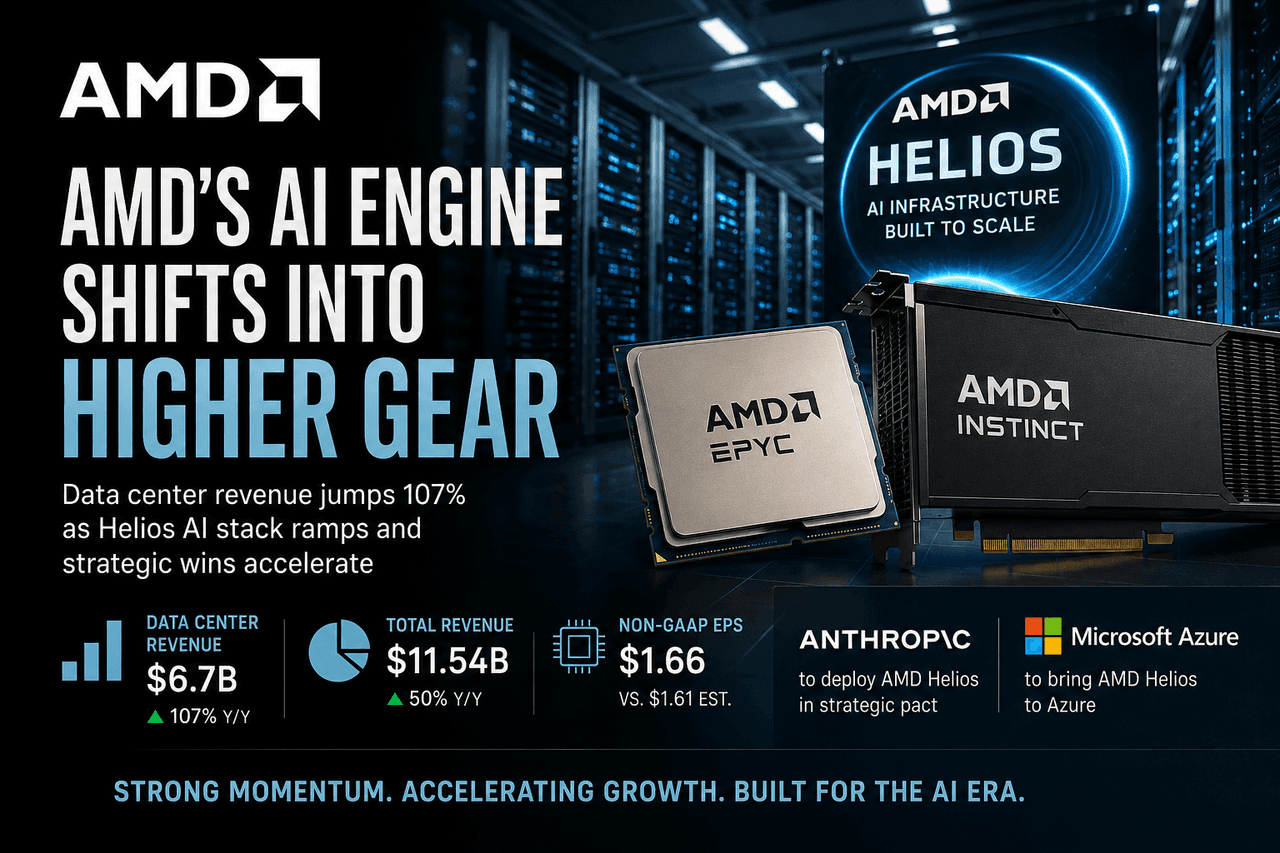
Advanced Micro Devices Inc. delivered another strong quarter Tuesday, beating Wall Street expectations as its artificial intelligence infrastructure business continued its rapid expansion. The company posted 107% year-over-year growth in data center revenue, reinforcing that AMD is becoming a formidable challenger in the race to power enterprise AI. The Santa Clara, California-based chipmaker reported second-quarter revenue of $11.54 billion, up 50% from a year earlier, with net income of $2.3 billion, or $1.38 per share. On a non-GAAP basis, earnings came in at $1.66 per share, ahead of analyst expectations of $1.61 per share on revenue of $11.31 billion. The headline number was data center revenue, which reached $6.7 billion, accounting for 58% of total company revenue and underscoring AMD's continued transition from a diversified semiconductor company into an AI infrastructure powerhouse. "The second half of the year begins with strong momentum as EPYC demand accelerates, Instinct deployments scale and Helios begins to ramp," Chair and Chief Executive Lisa Su said in the earnings release. AI infrastructure strategy takes center stage The results come just weeks after AMD unveiled Helios, its next-generation AI infrastructure platform that integrates CPUs, GPUs, networking and software into a unified rack-scale architecture. The launch represents AMD's most comprehensive response yet to Nvidia Corp.'s dominance in AI computing. AMD also announced a series of strategic wins around Helios, including a partnership with Anthropic to deploy the platform for frontier AI workloads and a major commitment from Microsoft Corp. to bring Helios into Azure. Taken together, the announcements suggest AMD is no longer selling individual accelerators. Instead, it is competing as a full-stack AI infrastructure provider, where integrated systems increasingly determine customer purchasing decisions. That shift appears to be translating into financial results. Data center becomes AMD's growth engine Data center revenue more than doubled to $6.7 billion as adoption of fourth-generation EPYC processors and Instinct AI accelerators continued to expand among hyperscale cloud providers and enterprise customers. Chief Financial Officer Jean Hu said data center revenue is expected to accelerate further during the second half of the year as larger AI deployments move into production. The company's guidance reinforced that outlook. AMD expects third-quarter revenue of approximately $13 billion, plus or minus $300 million, ahead of Wall Street expectations and implying another sequential step higher in AI-related demand. PCs recover while gaming remains under pressure Outside the data center, AMD's client business continued to benefit from a recovering PC market. Client and gaming revenue totaled $3.8 billion, up 6% from a year ago. Within that segment, client processor revenue climbed 23% to $3.1 billion, reflecting stronger commercial and consumer PC demand. Gaming remained the weakest business, however, with revenue declining 31% year over year to $779 million, highlighting continued softness in the discrete graphics and gaming console markets. Embedded revenue rose 19% to $977 million, providing another steady contributor to overall growth. AMD finished the quarter with $13.11 billion in cash and cash equivalents, giving the company ample flexibility to continue investing aggressively in AI products and software. The bigger picture The significance of AMD's quarter extends beyond another earnings beat. The AI infrastructure market is rapidly evolving from a battle over chips to a competition between complete systems. Success increasingly depends on delivering integrated platforms that combine compute, networking, software and developer tools rather than standalone silicon. AMD is positioning Helios as the centerpiece of that strategy. With EPYC CPUs gaining server share, Instinct GPU deployments expanding and Helios entering production, AMD appears to be building the portfolio needed to compete for the next wave of hyperscale AI infrastructure spending. The coming quarters will determine whether those early design wins translate into sustained market share gains against Nvidia. But based on Tuesday's results, AMD's AI business is entering the second half of 2026 with its strongest momentum yet. Deeper Dive - Check out our full coverage at AMD Advancing AI in SF two weeks ago. Full Coverage from their recent event from SiliconANGLE and theCUBE team is here.
[10]
AMD Reported Record Sales on Growing AI Demand. The Stock Is Falling Anyway
Get personalized, AI-powered answers built on 27+ years of trusted expertise. Advanced Micro Devices investors might be getting harder to impress. Shares of AMD (AMD) were down nearly 8% in extended trading Tuesday, despite quarterly results that topped Wall Street's estimates. The stock had climbed 7% in Thursday's regular session ahead of the release, against a backdrop of broader market gains amid growing optimism about a peace deal between the U.S. and Iran. AMD posted adjusted earnings per share of $1.66 on revenue that jumped 50% year-over-year to a record $11.54 billion in the second quarter, above estimates compiled by Visible Alpha, as data center sales more than doubled. Its gross margin came in at 54%, up from 40% a year earlier. CEO Lisa Su told investors in a release that AI is "driving a significant expansion in demand for compute across all of our markets, and our leadership portfolio and growing customer visibility position us exceptionally well to capture this expanding opportunity and deliver substantial revenue and earnings growth in the years ahead." AMD said it expects current-quarter revenue of $12.7 billion to $13.3 billion, also above analysts' estimates, though its gross margin forecast was roughly in line at 56%. Investors may have been looking for more. Ahead of the results, Wall Street analysts were broadly bullish on AMD, with seven of the nine analysts followed by Visible Alpha calling the stock a "buy," compared to two neutral ratings. The shares were up about 140% for 2026 through Tuesday's close, though they've pulled back from their June highs in recent weeks.
[11]
What lies ahead for AMD shares after its record-breaking earnings? - AMD posts record Q2 as AI business powers growth
What lies ahead for AMD shares after its record-breaking earnings? 1/5 AMD posts record Q2 as AI business powers growth Advanced Micro Devices (AMD) delivered its strongest-ever quarterly performance, reporting record second-quarter revenue of $11.54 billion, up 50% year-on-year, while adjusted earnings per share climbed to $1.66, beating Wall Street expectations. The strong performance was driven by booming demand for AI accelerators and data centre chips, reinforcing AMD's position as Nvidia's biggest challenger in the AI hardware race. (Sources: CNBC, The Wall Street Journal, Barron's) 2/5 Data centre business steals the show AMD's Data Center division remained the biggest growth engine, with revenue surging 107% from a year earlier to $6.7 billion. Strong demand for EPYC server processors and Instinct AI GPUs helped the segment account for well over half of the company's total revenue. Management also highlighted increasing deployments of its AI infrastructure platform, Helios, as enterprise AI spending continues to accelerate. 3/5 Strong guidance signals momentum ahead The chipmaker projected third-quarter revenue of around $13 billion, above analysts' expectations, while maintaining an adjusted gross margin of about 56%. AMD expects AI demand to remain robust through the second half of 2026 as cloud providers expand computing capacity and customers ramp adoption of its latest AI products. 4/5 Why did AMD shares tumble despite the beat? Despite delivering better-than-expected earnings and an upbeat outlook, AMD shares fell nearly 9% in after-hours trading. Investors appeared to have priced in exceptionally high expectations after the stock's massive rally earlier this year. Analysts also noted that while AI and data centre businesses were exceptionally strong, growth in the PC and gaming businesses remained relatively modest, prompting profit booking. 5/5 What investors should watch next? AMD's long-term AI story remains intact, with Helios AI servers set to reach major customers including leading cloud and AI companies. Investors will now closely monitor whether AI chip shipments continue accelerating, margins expand further, and enterprise AI spending remains resilient. The company's ability to convert strong demand into sustained earnings growth will likely determine whether the recent stock pullback proves temporary.
[12]
Lisa Su Says AI Boom Is Growing Faster Than Expected - Advanced Micro Devices (NASDAQ:AMD)
AMD CEO Lisa Su Says Wall Street Is Underestimating Its AI Business -- Now She Sees a $2 Trillion Opportunity AMD Sees AI Infrastructure Market Expanding Faster Speaking during the chipmaker's second-quarter earnings call, Su said AMD now sees a larger opportunity across AI accelerators, server CPUs and the broader high-performance computing market. She also indicated analysts may be underestimating the company's data center AI business as deployments ramp over the coming years. Su said AMD's outlook for the AI infrastructure market has changed since its Financial Analyst Day last November. "The overall data center market opportunity is expanding far more rapidly than we projected just six months ago," Su said. AMD reported second-quarter revenue of $11.54 billion, above analyst estimates of $11.28 billion, while adjusted earnings of $1.66 per share topped expectations of $1.61 per share. $1.4 Trillion Market by 2030 Su responded to an analyst's estimate for AMD's 2027 data center AI business by saying, "I think what you're hearing from us is that your data center AI number is probably too low." She said AMD now expects the data center AI accelerator market to grow more than 45% annually to approximately $1.4 trillion by 2030, while the server CPU market is expected to grow more than 50% annually to approximately $220 billion by 2030. AMD Lifts Long-Term Growth Expectations Alongside the higher market forecasts, Su said AMD now expects to outperform the long-term targets it outlined last year. "As a result, we are tracking materially ahead of the long-term financial model we shared at our Financial Analyst Day last November," Su said. "We now see the overall market for high performance and AI computing growing approximately 40% annually over the next several years, approaching $2 trillion by 2030, and we expect to grow well above the market," Su added. Despite the stronger long-term commentary, AMD shares fell after the earnings release. Futurum Group CEO Daniel Newman noted that while AMD's earnings were solid, the market had expected a more optimistic forecast driven by Helios, the company's upcoming rack-scale AI platform. Price action: AMD shares closed Tuesday up 7% at $518.58 and fell 8.69% to $474.50 in pre-market trading on Wednesday, according to Benzinga Pro. Benzinga Edge Rankings place AMD in the 98th percentile for Momentum. While the stock is currently trending lower in the short term, its medium- and long-term price trends remain positive. Disclaimer: This content was partially produced with the help of AI tools and was reviewed and published by Benzinga editors. Photo courtesy: jamesonwu1972 / Shutterstock.com Market News and Data brought to you by Benzinga APIs To add Benzinga News as your preferred source on Google, click here.
[13]
AMD Q2 Earnings: CEO Su Boosts Outlook As Accelerator, CPU Sales Climb
'We now expect revenue to grow substantially above our prior target of greater than 35 percent,' says AMD Chair and CEO Lisa Su. Growing demand for AMD's accelerators and CPUs for artificial intelligence workloads and data centers -- not to mention AMD's ability to navigate increased component prices and tight supply -- gave the vendor's leaders confidence to its revenue outlook. "We now expect revenue to grow substantially above our prior target of greater than 35 percent," Lisa Su, chair and CEO of the Santa Clara, Calif.-based semiconductor maker, said Tuesday on AMD's latest quarterly earnings call, covering its second fiscal quarter, the three months ended June 27. AMD now expects the data center AI accelerator market to grow more than 55 percent annually to about $1.4 trillion by 2030 and the server CPU market to grow more than 50 percent annually to about $220 billion by 2030. "We are still in the early innings of a multiyear AI adoption cycle, and the opportunity ahead is enormous," she continued. "We are exceptionally well positioned to capitalize on this opportunity and deliver significant growth in the coming years." [RELATED: AMD Advancing AI 2026: Top News On AI Chips, CPUs, Robotics] AMD Raises Revenue Outlook On Strong AI Demand Dominic Daninger, vice president of engineering at Burnsville, Minn.-based systems integrator Nor-Tech, told CRN in a recent interview that he is taking note of increased AMD partner coverage with a new AMD sales representative providing additional assistance to his company. "He obviously handles a lot of the areas that we have most of our business in, and he's been helpful," he said. AMD's 2026 partner program goals have included on-boarding about 500-plus qualified partners and making MDF and co-op funds available to more partners beyond just the top tier or those having received funding in the past, according to CRN's 2026 Partner Program Guide. Su also said on the call that AMD sees the overall market for high-performance AI computing growing about 40 percent annually over the next several years, approaching $2 trillion by 2030. "We expect to grow well above the market," she said. Data Center Revenue Doubles On AI Accelerator Traction Although accelerators present a $1.4 trillion total addressable market (TAM), Su said that "both businesses are very significant drivers of our 2027 growth and beyond." AMD now expects its data center segment revenue to more than double year over year in 2027. During the latest fiscal quarter, the data center segment brought in $6.7 billion, a record amount and more than double year over year. The segment grew 16 percent quarter on quarter and now represents 58 percent of AMD's total revenue, up from 42 percent a year ago. "The overall data center market opportunity is expanding far more rapidly than we projected just six months ago," Su said. The segment saw its fifth consecutive quarter of record server CPU revenue, with cloud and enterprise sales each growing more than 70 percent year on year, exceeding AMD's forecast. The enterprise business saw record sales and the fourth consecutive quarter of sales growth, with on-premises adoption growing, Su said. Sales of AMD's Instinct server-grade, data center GPU accelerators more than doubled year on year. Su said AMD saw double-digit growth in unit price and average selling price (ASP) in the segment, with unit sales growth exceeding ASP's growth. AMD usually sees higher ASP growth with higher core count sales. Su told analysts on the call that AMD has seen strong compute market demand in data center accelerators and server CPUs. She expects continued strong growth in the third and fourth quarters. The data center business' operating income was $2.1 billion, 31 percent of revenue, according to AMD. As a signal of AMD's power in the AI market, the vendor disclosed that more than 3 million AI models now run out of the box on its portfolio. Open-source contributions to Radeon Open Compute have increased more than tenfold over the past year, according to AMD. AMD Targets Massive Growth In Server CPU Market Su identified a $220 billion TAM in the server market in 2030 and said on the call that the agentic AI segment is the fastest-growing piece of the market and largest over the next three to five years -- but the smallest piece today. The CEO wants AMD to dominate per-core performance, overall socket performance and other measures that give the vendor "a very strong position across general-purpose agentic AI and also the head nodes for the AI accelerator business." AMD's sixth-generation Venice Epyc server processor family is in production now with every major OEM on track to launch platforms and leading cloud providers planning deployments starting later this year, Su said. AMD is seeing users run more workloads on its Venice chip compared with the predecessor Turin chip. And she expects more workloads to run on the next generation of Epyc than the previous. "That's what gives us the confidence to say that we can grow substantially ahead of the market given the product positioning," Su said. Epyc Sales Shine In Quarter AMD CFO Jean Hu attributed the growth in part to a more than 70 percent year-over-year increase in Epyc computer processor sales. Epyc Turin now powers nearly one-third of the more than 1,600 Epyc public cloud types available globally. Providers have been broadening their offerings with new database storage and AI workloads. More than 230 fifth-generation Epyc platforms are now in market from HPE, Dell Technologies, Lenovo and other vendors. Ryzen Pro, Embedded Business Deliver Additional Growth AMD's client business revenue grew 23 percent year on year to $3.1 billion, up 6 percent quarter on quarter. Hu attributed the growth to record mobile revenue. The vendor's Ryzen Pro -- business-class versions of its standard Ryzen CPUs -- saw sales grow more than 50 percent year over year during the quarter. Su said to expect a softer PC market in the second half of the year due to higher memory and component costs compared with demand. But she still expects AMD's client business to beat the market and predicts that local AI will grow in share as time goes on. AMD still forecasts overall AI PC market growth in 2026 year on year, with AMD's portfolio mix supporting growth in notebook, desktop and other AI-centric PC markets. "The market's actually held up better than most people would have thought," Su said on the call, noting that its growth hinges on the cost of components over the next couple of quarters. "I remain optimistic about the PC market as an important way for us to reach a broader set of users and our ability to grow ahead of the market," Su said. CFO Hu said that AMD's embedded business "is recovering significantly," with its revenue from the quarter of $977 million marking a 19 percent increase year on year and the business' strongest growth in more than three years. The embedded business saw growth in networking; aerospace and defense; test, measurement and emulation; and communications. Although she didn't break out numbers, Su said that the embedded x86 computer processor business "grew significantly in the quarter" "The strategy we have been executing over the last few years is now delivering strong results," she said. "Embedded x86 is becoming a significant growth driver for the segment. Our overall embedded portfolio is outgrowing the market and gaining share, and our embedded semi-custom engagements are expanding." The embedded business' operating income was $386 million, 40 percent of revenue. That number a year ago was $275 million, 33 percent of revenue. Supply Constraints Remain Asked on the call about the memory cost inflation and supply crisis, Su said that AMD has partnered with memory providers for years to ensure visibility into High Bandwidth Memory allocation to meet delivery expectations for 2027. She also said that AMD's portfolio differentiates itself through modifying memory footprints for users whose TCO is not as significant in certain workloads. "The benefit of the memory is workload-dependent, and we know a bunch of our customers are very, very happy with what that returns in terms of performance," she said. "There are some workloads of, call it 'medium-sized' models, that may not get as much of a benefit. And in that case, we would address the memory footprint as you might expect." Su credited AMD's fast thinking in supply chain with meeting server demand as it reached an inflection point over the past couple of quarters, making sure that the vendor didn't get caught without enough wafers, back-end capacity, substrate and other components. Another differentiator for AMD during this supply crunch is in how the vendor uses chiplet technology and ramps in fewer wafers in its new node, Su said. Su reiterated the vendor's expected revenue per gigawatt in the double-digit-millions-of- dollars range. "The key here will be continuing to work with our partners as they ramp because there's a demand for a lot more compute, and we would like to satisfy that demand," Su said. The CEO said the server CPU supply chain has been tight throughout the first half of the year "because much of this demand was unforecast." Su said that "demand is better forecast" going into 2027, with AMD expecting improved supply to satisfy 70-plus percent growth year on year. "We're working very hard on ensuring that we get the supply necessary to meet the very strong customer demand," Su said. "We feel good about where we are to satisfy both the strong ramp in servers as well as the strong ramp in the data center AI business." Early Momentum In Helios, Fast Inference The ramp of AMD's Helios integrated, rack-scale AI infrastructure is just starting at the end of the vendor's third quarter, with more substantial growth expected in the fourth quarter and beyond. Helios was ahead of AMD demand forecasts for 2027. "What we're seeing from every one of our customers who's had a chance to not only spend time with Helios but also spend time in our over overall ecosystem, there's a high confidence that Helios will be a great addition to the AI portfolio, particularly around inference," Su said. Su expects the inference market to grow "very substantially" over this year into next, with fast inference becoming more relevant and fueling AMD's recent partnership with Cerebras. The companies' joint offer should become available in Cerebras' cloud in the fourth quarter and extend into 2027 "We continue to look at ways to, I would say, customize and optimize our technologies for the various workloads out there," she said. "We view this as just more of what we do in an open ecosystem." AMD Q2 Financial Results: Revenue, Profit, Margin Breakdown AMD brought in $11.5 billion in revenue during the quarter, up 50 percent year on year and 13 percent quarter on quarter, according to the vendor. This marked AMD's sixth consecutive quarter of greater than 30 percent year-over-year revenue growth. AMD's growth numbers year over year for the quarter did have the benefit of comparing against $800 million in inventory and related charges from the U.S. applying export controls on AMD Instinct MI308 data center GPU products. Gross profit doubled year on year to $6.2 billion during the quarter, which marks a 15 percent increase quarter on quarter. Gross margin of 54 percent marked an increase of 14 percentage points year on year and up 1 point quarter on quarter, according to AMD. Operating expenses grew 32 percent year on year to $4.2 billion, up 7 percent quarter on quarter. Operating income of $2 billion for the quarter was up 16 times to that of the $134 million loss AMD reported for the same period a year prior. It marked a 35 percent increase quarter on quarter. Operating margin of 17 percent during the quarter was up 19 percentage points from the 2 percent operating deficit AMD reported for the same period a year ago. It was also 3 points above the 14 percent operating margin AMD reported last quarter. Net income of $2.3 billion was more than double the net income reported for the same period a year prior and up 66 percent quarter on quarter. AMD generated $1.6 billion in free cash flow from the quarter. AMD Forecasts Another Double-Digit Growth Quarter AMD said to expect third-quarter revenue of about $13 billion plus or minus $300 million. Achieving the midpoint of that revenue range would mark 41 percent in growth year on year and 13 percent quarter on quarter, according to the vendor. CFO Hu said to expect "very strong" double-digit growth in data center business and strong double-digit growth in the embedded segment. AMD's stock traded at about $470 a share Tuesday after market close, down about 9 percent in after-hours trading.
[14]
AMD forecasts strong revenue growth on AI chip demand, but investors seek bigger gains
AMD beat quarterly revenue and earnings estimates while forecasting stronger-than-expected Q3 sales, driven by AI chip demand. However, the stock fell after investors expected an even stronger outlook. Advanced Micro Devices (AMD) delivered a strong quarterly performance and forecast revenue above Wall Street expectations, driven by surging demand for its chips as technology companies expand data-centre capacity to support artificial intelligence (AI) workloads, Reuters reported. However, the company's shares dropped nearly 9% in extended trading as investors appeared to expect an even stronger outlook following a sharp rally in the stock this year. US MarketsPowered By As on 05 Aug 2026, 01:30 AM IST S&P 500 Top Gainers Palantir Technologies162.66(29.45%) Zebra Technologies368.83(26.47%) Gartner185.79(22.61%) Intel100.86(10.84%) Gainers" S&P 500 Top Losers Aptiv47.72(-16.62%) NRG Energy117.04(-15.48%) Chipotle Mexican Grill33.82(-9.72%) Coterra Energy32.56(-8.62%) Losers" AMD's results highlighted the growing importance of AI infrastructure spending, but the market reaction reflected rising expectations around the pace at which AI investments translate into revenue growth and profitability. The Santa Clara, California-based chipmaker expects third-quarter revenue of around $13 billion, plus or minus $300 million, compared with analysts' estimate of $12.52 billion, based on LSEG data. AMD expects adjusted gross margin of about 56%, broadly in line with market expectations. AI infrastructure push boosts AMD growthAMD has emerged as the closest competitor to Nvidia in the AI accelerator market as cloud companies, enterprises and governments increase investments in computing infrastructure required to power AI applications. The company's data-centre business has become the key growth driver, with second-quarter data-centre revenue more than doubling year-on-year to $6.72 billion, beating analyst expectations of $6.48 billion. Revenue from the segment also rose 16.3% sequentially from $5.78 billion in the first quarter. AMD's overall second-quarter revenue jumped 50% to $11.54 billion, surpassing Wall Street expectations of $11.28 billion. Adjusted earnings came in at $1.66 per share, ahead of the $1.62 per share estimate. Reuters reported that AMD's latest forecast indicates its strategy to challenge Nvidia's dominance in AI chips is gaining momentum, supported by stronger sales of data-centre processors and accelerating adoption of its AI products. AMD expands beyond chips into AI systemsAMD is increasingly moving beyond selling individual processors and graphics chips by developing complete AI systems that combine computing, networking and other hardware components. The company is building a broader AI hardware ecosystem to compete with Nvidia's rack-scale solutions, which integrate multiple components into large-scale AI computing platforms. CEO Lisa Su said AMD expects its data-centre sales to more than double by 2027. She also projected overall revenue growth to exceed the company's previous target of more than 35%, while annual earnings could surpass the $20-per-share goal set during its 2025 analyst event. AMD's upcoming AI platform is expected to combine its MI500 graphics processors, Verano central processing units (CPUs) and Pensando networking technology, creating systems designed to support advanced AI workloads. Gains in server CPU marketApart from AI accelerators, AMD is also benefiting from rising demand for central processing units used alongside graphics processors in data centres. These CPUs handle critical computing tasks, including inference operations that process user queries on AI applications. The growth has helped AMD gain market share from rival Intel, which has increased investments to capitalise on the AI-driven demand boom. AMD recently said its second-generation Helios AI servers, powered by the MI455X AI accelerator and TSMC-made Venice processors, had entered full production and would begin shipping in the coming months. Major AI partnerships strengthen outlookAMD has expanded its customer base through large-scale AI infrastructure agreements. Reuters reported that the company signed a deal with Anthropic in July to supply AI servers powered by up to 2 gigawatts of MI450 chips from early 2027. The agreement also includes AMD investing up to $5 billion in the AI company, subject to deployment milestones. The chipmaker also secured up to 2.5 gigawatts of data-centre capacity through an agreement with Core Scientific, receiving stock purchase warrants as part of the deal. Investor expectations remain highDespite strong earnings and an upbeat forecast, AMD's stock reaction showed that investors are demanding more evidence that AI spending will generate sustained returns. The company's shares have more than doubled this year on optimism around AI growth, raising expectations for continued acceleration in revenue and earnings. With AI infrastructure investment entering a critical phase, AMD's ability to narrow the gap with Nvidia will depend on execution, supply availability and whether demand for AI computing continues to expand at the current pace.
[15]
For AMD, Gaming Has Shrunk to Just 6% of its Business, While Team Red Cashes In On AI
It's no secret that gaming hardware has been getting more expensive this year, so it shouldn't be surprising that people are buying less of it. But, it turns out that AMD's gaming business shrank by a whopping 31% in Q2 2026. In the second quarter of the year, the gaming business only made $779 million, compared to $1.1 billion in Q2 2025, according to the company's latest earnings report. AMD attributes this loss to 'lower semi-custom revenue', which means fewer consoles have been selling over the last few months. And, this is in a time that would have included the Steam Machine and the AMD Radeon RX 9070 GRE in June 2026. AMD's gaming revenue is lumped into the Client and Gaming segment, and overall, that portion of the business was up 6% year over year, making $3.8 billion. AMD's processors have been making their way into more modern laptops, especially in the budget range, and while the company's earnings report doesn't lay out exactly which products were selling, it's not hard to imagine that a lot of this growth came at the hands of budget laptops that don't have a ton of RAM. But while the gaming business isn't doing all that great, AMD is thriving. The company raked in $11.5 billion in revenue last quarter, which is up 51% over this time last year, driven largely by AI. AMD's data center business brought in $6.7 billion last quarter which is a massive 107% increase over last year. So, even though hardware is more expensive and harder to even obtain, AMD is bringing in more money than ever before. It's likely that the gaming business will continue to shrink over the next year or so, while AMD cashes in on the AI boom. And especially now that the Xbox Series X has officially went up in price and both Team Green and Team Red reportedly plan to raise prices on gaming hardware, it really does seem like gaming hardware is going to continue to fall down the list of AMD and Nvidia's priorities. Jackie Thomas is the Hardware and Buying Guides Editor at IGN and the PC components queen. You can follow her @Jackiecobra
[16]
AMD Beats Expectations on AI, but Shares Slide
AMD forecasts Q3 revenue of about $13bn, plus or minus $300m, above the consensus of $12.52bn. The company expects an adjusted gross margin of about 56%, in line with market expectations. Nvidia's main rival in graphics processors (GPUs), AMD is benefiting from continued massive investment by tech giants and governments in infrastructure dedicated to artificial intelligence. The company is accelerating its move upmarket by now offering complete systems that integrate processors, networking gear and other components, aiming to compete with Nvidia's integrated solutions. At the same time, demand remains strong for its central processing units (CPUs), allowing AMD to gain market share against Intel. The company still faces supply constraints tied to the limited advanced packaging capacity of its partner TSMC. AMD reported Q2 revenue of $11.54bn, up 50% y-o-y and above analysts' expectations. Data center revenue more than doubled to $6.72bn, while adjusted EPS came in at $1.66, also above consensus. The results highlight accelerating sales of AI chips as second-generation Helios servers, equipped with the new MI455X accelerators and "Venice" processors, enter production ahead of their first deliveries in the coming months.
[17]
AMD forecasts upbeat revenue on strong AI chip demand, but shares fall on lofty expectations
Aug 4 (Reuters) - AMD forecast quarterly revenue above Wall Street estimates on Tuesday, banking on strong demand for its chips from massive data-center capacity expansions to power AI technologies. Yet, its shares fell more than 7% in extended trading, suggesting that investors were looking for an even stronger outlook after the stock more than doubled this year spurred on by AI optimism. "AMD is now in a similar position to Nvidia and the hyperscalers, where investors are looking for evidence that AI infrastructure investments will continue translating into accelerating returns," said Jacob Bourne, an analyst at Emarketer. The Santa Clara, California-based company is regarded as chip giant Nvidia's closest rival in the market for graphics processing units, as major technology companies and governments worldwide ramp up spending on AI infrastructure. It has stepped up its AI product launches and moved beyond selling individual chips to offering AI systems that combine processors, networking gear and related hardware, giving customers an integrated AI infrastructure option and allowing it to better rival Nvidia's rack-scale offerings. AMD expects third-quarter revenue of about $13 billion, plus or minus $300 million, while analysts estimate $12.52 billion, according to data compiled by LSEG. Its expects adjusted gross margin to be about 56%, largely in line with estimates. The forecast suggests that AMD's multi-billion dollar investments to challenge chip giant Nvidia's dominance in the market for AI chips are beginning to pay off, with sales of its data-center processors accelerating sharply. While GPUs dominate heavy AI training, AMD is also benefiting from growing demand for central processing units, which are used alongside pricey graphics processors in servers. This has helped AMD capture market share from Intel. AMD's second-quarter revenue jumped 50% to $11.54 billion, beating the estimate of $11.28 billion. Data-center revenue more than doubled to $6.72 billion, also exceeding expectations of $6.48 billion. Adjusted profit of $1.66 per share surpassed the estimated $1.62. At AMD's AI event in July, CEO Lisa Su said the company's second-generation Helios AI servers, featuring the MI455X AI accelerator and "Venice" processor made by TSMC, are in full production and would begin shipping in the coming months. Supply, however, is constrained by AMD's reliance on TSMC, the world's largest contract chipmaker, where tight advanced packaging capacity continues to be a key hurdle. AMD has also secured major customers and infrastructure agreements in recent months, as it races to expand its AI business. About two weeks ago, it agreed to sell Anthropic tens of billions of dollars worth of AI servers powered by up to 2 gigawatts of MI450 chips from early 2027, and invest up to $5 billion in the IPO-bound Claude maker, contingent on deployment milestones. The company has also locked in up to 2.5 GW of data center capacity through a deal with Core Scientific, while gaining warrants to purchase the company's stock. AMD's client and gaming segment, which caters to consumer hardware, saw sales of $3.84 billion in the second quarter, above estimates of $3.78 billion. Analysts have said weakness in the PC market, memory supply constraints and rising memory costs could weigh on demand and margins. (Reporting by Anhata Rooprai in Bengaluru and Max A. Cherney in San Francisco; Editing by Shilpi Majumdar) By Anhata Rooprai and Max A. Cherney
[18]
AMD beats expectations on AI, but its stock falls on the market
AMD expects revenue of about $13bn in the third quarter, plus or minus $300m, versus a consensus of $12.52bn. The group is forecasting an adjusted gross margin of about 56%, in line with market expectations. Nvidia's main rival in graphics processors (GPUs), AMD is benefiting from continued massive investment by technology giants and governments in infrastructure dedicated to artificial intelligence. The group is accelerating its move upmarket by now offering complete systems integrating processors, networking equipment and other components, to compete with Nvidia's integrated solutions. At the same time, demand remains strong for its central processing units (CPUs), allowing AMD to gain market share against Intel. The company nevertheless continues to face supply constraints tied to the limited advanced packaging capacity of its partner TSMC. In the second quarter, AMD reported revenue of $11.54bn, up 50% year over year and above analysts' expectations. Revenue from the data center business more than doubled to reach $6.72bn, while adjusted profit came in at $1.66 per share, also above the consensus. Those results underscore the acceleration in sales of AI chips, as second-generation Helios servers, equipped with the new MI455X accelerators and 'Venice' processors, move into production ahead of their first deliveries in the coming months.
[19]
AMD forecasts revenue above estimates on AI chip demand, but shares fall
Aug 4 (Reuters) - AMD forecast quarterly revenue above Wall Street estimates on Tuesday, banking on strong demand for its chips from massive data-center capacity expansions to power AI technologies. Shares of the Santa Clara, California-based company, however, fell over 8% in extended trading. The company is regarded as chip giant Nvidia's closest rival in the market for graphics processing units, as major technology companies and governments worldwide ramp up spending on AI infrastructure. AMD has stepped up its AI product launches and moved beyond selling individual chips to offering AI systems that combine processors, networking gear and related hardware, giving customers an integrated AI infrastructure option and allowing it to better rival Nvidia's rack-scale offerings. The company expects third-quarter revenue of about $13 billion, plus or minus $300 million, while analysts estimate $12.52 billion, according to data compiled by LSEG. Adjusted gross margin is expected to be about 56%, largely in line with the estimate. While GPUs dominate heavy AI training, AMD is also benefiting from growing demand for central processing units, which are used alongside pricey graphics processors in servers. This has helped AMD capture market share from Intel. Supply, however, is constrained by AMD's reliance on TSMC, the world's largest contract chipmaker, where tight advanced packaging capacity continues to be a key hurdle. The forecast suggests that AMD's multi-billion dollar investments to challenge chip giant Nvidia's dominance in the market for AI chips are beginning to pay off, with sales of its data-center processors accelerating sharply. Second-quarter revenue rose 50% to $11.54 billion, beating the estimate of $11.28 billion. Data-center revenue more than doubled to $6.72 billion, also exceeding expectations of $6.48 billion. Adjusted profit came in at $1.66 per share, ahead of the estimated $1.62. At AMD's AI event in July, CEO Lisa Su said the company's second-generation Helios AI servers, featuring the MI455X AI accelerator and "Venice" processor made by TSMC, are in full production and would begin shipping in the coming months. (Reporting by Anhata Rooprai in Bengaluru and Max A. Cherney in San Francisco; Editing by Shilpi Majumdar)
Share
Copy Link
AMD reported record Q2 2026 revenue of $11.5 billion, up 50% year-over-year, driven by surging demand for AI-focused data-center chips. The company's data center business more than doubled to $6.7 billion, now representing 58% of total revenue. However, gaming revenue fell 31% to $779 million amid console cycle slowdown and component shortages.
AMD reported record second-quarter revenue of $11.5 billion, marking a 50% year-over-year increase driven primarily by explosive growth in its data center segment
1
3
. The company's data center business more than doubled, reaching $6.7 billion compared to $3.2 billion in the same period last year and up from $5.8 billion in Q1 20261
4
. This represents a 107% year-over-year jump, with the data center segment now accounting for 58% of AMD's total company revenue5
.Source: TechSpot
CEO Lisa Su attributed this growth to AI-driven demand, stating that "AI is driving a significant expansion in demand for compute across all of our markets, and our leadership portfolio and growing customer visibility position us exceptionally well to capture this expanding opportunity and deliver substantial revenue and earnings growth in the years ahead"
1
. AMD's adjusted earnings per share came in at $1.66, beating analyst expectations of $1.623
4
.AMD has positioned itself as the most credible alternative to Nvidia in the AI accelerators market through its aggressive product launches
2
. The company showcased its new Helios rack-scale compute platform at its Advancing AI event in San Francisco, featuring 72 Instinct MI455X GPUs, each equipped with 432 GB of HBM4 memory2
. This system meets or beats the performance of Nvidia's Vera Rubin platform on most metrics, according to AMD2
.
Source: SiliconANGLE
Lisa Su confirmed that Helios AI servers are in full production and will begin shipping in the coming months to major customers including Meta, OpenAI, and Oracle
3
4
. The company has secured multi-gigawatt commitments from OpenAI, Anthropic, and Meta2
. Su noted that "the growing number and scale of Helios and MI450-series deployments position the business for significant growth in the second half of the year, with growth accelerating in 2027"2
.Beyond GPUs, AMD is capitalizing on growing demand for central processing units used alongside AI accelerators in servers. The company unveiled Venice Epyc CPUs offering up to 256 cores and 512 threads with support for 16 memory channels at speeds of up to 1.6 TB/s per socket
2
. Lisa Su anticipates that agentic AI workloads will become the biggest growth driver for Epyc sales, as these sandboxes require powerful CPUs to operate effectively2
.This CPU focus has helped AMD capture market share from Intel, with client revenue rising 23% thanks to Ryzen chips
1
5
. However, AMD now faces expanded competition in the CPU market from not just Intel but also Nvidia, Arm, Qualcomm, AWS, Google, and Microsoft2
.Related Stories
While AMD's data center business thrives, gaming revenue fell 31% year-over-year to $779 million
1
4
. Price hikes and component shortages slowed sales for the Xbox Series X/S, PlayStation 5, and Valve's Steam Deck1
. Lisa Su explained that gaming graphics revenue fell as higher component costs across the industry pushed graphics card prices up, hurting overall demand in price-sensitive consumer markets5
.Source: Market Screener
The end of the console sales cycle is hitting AMD particularly hard on semi-custom processor orders
2
. Despite this decline, AMD's overall PC and gaming business still managed 6% growth compared to last year, supported by stronger Ryzen chips sales in the client segment1
5
.AMD forecast third-quarter revenue of approximately $13 billion, plus or minus $300 million, exceeding Wall Street estimates of $12.52 billion
3
4
. The company expects data center segment revenue to more than double year-over-year in 20272
5
. CFO Jean Hu stated, "We expect Data Center sales to accelerate in the second half of 2026, driving stronger overall revenue growth and continued earnings expansion"4
.Despite beating quarterly earnings and issuing optimistic guidance, AMD's stock plunged 10.5% after the announcement before settling 8.7% below opening price
2
. Wall Street's concern centers on AMD's growing exposure to a concentrated customer base. Su acknowledged this during the earnings call, noting that while large frontier-model companies like OpenAI, Anthropic, and Meta will consume through cloud service providers, and other customers are interested in Helios "at a more regular scale than gigawatt scale," the reality is that most of AMD's AI chips are sold to a handful of customers2
. Microsoft, which serves both OpenAI and Anthropic, represents another concentration risk, while Meta is reportedly looking to enter the GPU cloud business itself2
.Supply constraints also pose challenges, as AMD relies on TSMC, the world's largest contract chipmaker, where tight advanced packaging capacity continues to be a key hurdle
3
. In July, AMD raised its expectations for the semiconductor market, projecting it could reach $2 trillion per year by 2028, with $1.4 trillion coming from AI accelerators—up from a previous estimate of $500 billion by 20284
. Whether AMD can capture a meaningful share of this expanding market while diversifying its customer base will determine if AMD's AI strategy delivers sustained growth or proves vulnerable to demand shifts from its concentrated clientele.Summarized by
Navi
[2]
31 Oct 2024•Technology

31 Jul 2024

04 Feb 2026•Business and Economy

1
Technology

2
Technology

3
Technology