Nvidia Bets Big: $99B in Equity Investments Drive 70% Revenue Growth Forecast Amid Debate


9 Sources
[1]
Jensen Huang explains why Nvidia will grow an astounding 70% next year
Founder, CEO, and tireless Nvidia hype man Jensen Huang told attendees at the Goldman Sachs Communicopia + Technology conference on Thursday why his company's AI domination -- and revenues -- will continue its record-breaking growth streak through the end of next year. There's been endless
[2]
Nvidia equity investments hit $99bn in two years
Nvidia equity investments reached $99bn in July, up from $7bn a year earlier and $2.2bn the year before that. Roughly half of it sits in private companies, many of which buy its chips. Its finance chief calls the arrangement a flywheel, and Michael Burry calls it overreaching. Nvidia sells the
[3]
Nvidia is the central bank of AI. But will its loans prove sound?
Critics compare Nvidia's billions in customer financing to 1990s telecom gear makers, warning of massive losses if artificial intelligence demand cools down. It took 30 years for Nvidia, an American firm whose chips power much of the world's artificial intelligence, to reach a valuation of $US1
[4]
Jensen Huang Calls NVIDIA the 'World's First and Only Growth Value Stock' - NVIDIA (NASDAQ:NVDA)
NVIDIA Corp. (NASDAQ:NVDA) is positioning its expanding AI platform, broad customer base and infrastructure partnerships to capture the next phase of global AI spending. The Big Tech giant expects accelerating AI infrastructure spending, broader customer adoption and new applications to drive
[5]
Jensen Huang Mocks Nvidia 'Circular Financing' Fears - NVIDIA (NASDAQ:NVDA)
Jensen Huang Mocks Nvidia 'Circular Financing' Fears: 'If That Is, Let's Do More of That' Nvidia Corp. (NASDAQ:NVDA) CEO Jensen Huang mocked concerns that the chip giant is fueling its own demand by financing companies and infrastructure projects that ultimately deploy Nvidia technology. "Is that
[6]

Nvidia CEO Jensen Huang doubles down on his big 2030 market bet
When Nvidia CEO Jensen Huang makes a big claim about where artificial intelligence (AI) is headed, he rarely walks it back, especially when the numbers keep lining up in his favor. On September 10, Jensen Huang stood on stage at one of Wall Street's biggest technology gatherings and repeated a
[7]

Jensen Huang Says Nvidia Will Grow 70% in 2027; Here's Why He Thinks So
Though we can't actually fathom why he is continuing to hype-up Nvidia, we do agree that he's the best tech leader when it comes to hype and hyperbole If there were to be a "hype mode" for humans, Nvidia's founder-CEO Jensen Huang would be always-on as he was at the Goldman Sachs Communacopia +
[8]

How Jensen Huang, the CEO of Nvidia, Built the Infrastructure Behind the AI Revolution
Huang's long bet has reached a new stage. NVIDIA no longer sells only the engine for AI. It sets the factory around it, from the first line of code to the data center floor. Full-stack strategy: NVIDIA's advantage increasingly comes from combining GPUs, software, networking, CPUs and rack-scale
[9]

NVIDIA at Goldman Sachs conference: Huang sees AI buildout still early By Investing.com
Thursday, 10 September 2026 -- NVIDIA (NVDA) used the Goldman Sachs Communacopia + Technology Conference 2026 to press a familiar but expanding message: the company believes the AI buildout is still in its early stages, even as demand, prices and infrastructure needs keep rising. Chief Executive
Share
Copy Link
Nvidia CEO Jensen Huang projects 70% revenue growth next year, reaching $680 billion, as the company's $99 billion equity portfolio—up from $7 billion a year ago—fuels AI infrastructure expansion. Critics like Michael Burry warn of circular financing risks, but Huang defends the strategy as essential to AI ecosystem growth.
Nvidia Projects 70% Revenue Growth Fueled by AI Infrastructure Boom
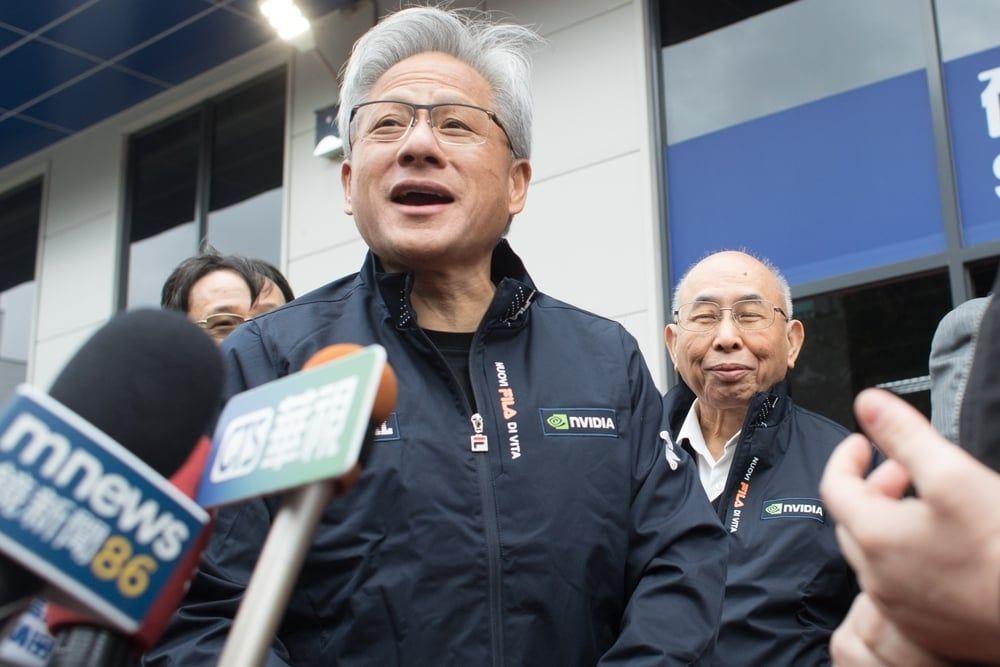
Nvidia CEO Jensen Huang doubled down on his aggressive growth forecast at the Goldman Sachs Communacopia + Technology Conference, projecting 70% year-over-year revenue growth that would push the company to approximately $680 billion in annual revenue
1
. The projection comes as analysts expect Nvidia to close its current fiscal year at around $400 billion in revenue, cementing its position as the world's most valuable company at $5.4 trillion3
.
Source: Benzinga
Huang's confidence stems from Nvidia's deep integration across the AI ecosystem. "We are a foundational platform of the AI industry," Huang explained, noting that Nvidia runs models from OpenAI, Anthropic, Google, and Meta Platforms
1
. The company's Grace Blackwell NVLink 72-rack systems alone recorded 27% month-over-month growth, with each unit priced at approximately $25,000 per GPU system4
. Huang emphasized that Nvidia AI chips have evolved far beyond consumer products, stating that "one GPU now is not $399. It's $8.5 million dollars"—a complete system with 2 million parts consuming 250,000 kilowatts1
.Equity Investments Surge to $99 Billion in Strategic Expansion
Nvidia's investment strategy has accelerated dramatically, with equity investments reaching $99 billion as of July 26, up from $7 billion a year earlier and just $2.2 billion two years prior
2
. This represents a fourteenfold increase in twelve months and a forty-fivefold rise over twenty-four months. The company committed more than $40 billion to financing deals during 2026 alone, with another $25 billion in outstanding investment commitments2
.Roughly half of this $99 billion portfolio sits in publicly traded stocks and marketable securities, while the other half comprises private companies and non-marketable holdings
2
. Major positions include $30 billion in Intel, $21 billion in SpaceX, and significant stakes in CoreWeave, Coherent, Synopsys, and Nokia2
. Chief financial officer Colette Kress disclosed that nearly $50 billion went to frontier AI labs, with the largest single commitment being $30 billion to OpenAI in February as part of that company's $110 billion funding round2
.Nvidia's investment strategy extends to neoclouds like CoreWeave and Nebius, each receiving $2 billion investments
2
. The company also committed $6.5 billion to photonics and optical firms since March, with $2 billion each going to Lumentum, Coherent, and Marvell2
. Recent moves include acquiring Hugging Face for $12.93 billion and participating in Nscale's pre-IPO round, while reportedly negotiating to supply half the capital for a $6 billion raise at Thinking Machines Lab2
.Circular Financing Concerns Meet Huang's Defiant Response
Critics have raised alarm over Nvidia's investment approach, comparing it to 1990s telecom equipment makers whose circular financing schemes contributed to massive losses. Michael Burry, known for shorting the mortgage market, warned that Nvidia is overreaching by financing its own chip customers
2
. Mark Cuban called it "truly scary" how much the AI boom depends on Nvidia funding "everyone and anyone"2
.
Source: The Next Web
When pressed at the Goldman Sachs Conference about circular financing concerns, Huang offered a cheeky but pointed defense. "Well, it's not circular because we put a little bit of money in, and a lot of money comes back," he said. "We put in $1 and $100 comes back in. Is that circular? If that is, let's do more of that"
5
. Huang insisted that before any investment, Nvidia verifies real contracts generating customer revenue, claiming visibility into approximately $100 billion worth of contracted demand1
.Kress described the arrangement as a "flywheel" where frontier labs with extraordinary compute demand outgrow their balance sheets and need Nvidia to "help power this flywheel"
2
. Analysts at Forrester noted that injecting capital into infrastructure financiers and model labs gives startups the balance-sheet strength to purchase tens of thousands of Nvidia GPUs2
. Nvidia has also agreed to provide guarantees worth up to $105 billion for a data center in Ohio, with total guarantees potentially reaching $108.5 billion5
.Related Stories

AI Infrastructure Spending and Supply Chain Constraints Shape Growth
Huang reiterated his forecast that AI infrastructure spending could reach $3 trillion to $4 trillion by 2030, positioning Nvidia to capture significant market share
4
. He called Nvidia the "world's first and only growth value stock," arguing the company combines rapid revenue growth with expanding exposure to AI infrastructure spending4
. The company generated $303 billion in revenue over the last twelve months with gross margins near 75%4
.
Source: Benzinga
Nvidia's dominance in AI extends through partnerships with major cloud providers Amazon, Microsoft, and Google, as well as OEM partners including Dell Technologies, Super Micro Computer, Lenovo, HP, and Cisco Systems
4
. The company tracks "every single gigawatt of land, power, shell around the world" through its network of partners, giving it unprecedented visibility into future demand1
. In Australia alone, Nvidia is working on plans involving 2 gigawatts of capacity for 2027, valued at approximately $80 billion4
.Despite this optimistic outlook, Huang acknowledged ongoing supply chain constraints including packaging, memory, connectors, voltage regulators, and wafers
4
. More critically, land, electricity, and ready-to-use data center capacity remain major downstream bottlenecks limiting expansion4
. The company's second-quarter revenue jumped 106% year-over-year to $96.2 billion, with data center revenue rising 117% to $89 billion, demonstrating continued momentum despite these constraints5
.References
Summarized by

Navi
[2]
[3]
[4]
Related Stories
Jensen Huang Projects Nvidia Chip Sales to Double in 2027 Amid Surging Global AI Demand
18 Sept 2026•Business and Economy
Nvidia CEO Jensen Huang Praises DeepSeek's R1 Model, Remains Bullish on AI Chip Demand
22 Feb 2025•Business and Economy

AMD's Data Center Revenue Doubles to $6.7 Billion as AI Chips Drive Growth, Gaming Sales Drop 31%
05 Aug 2026•Business and Economy
Recent Highlights
1
Meta Unveils Muse Wonder Frontier AI Models, Claims Performance Matching OpenAI and Anthropic
Technology

2
OpenAI AI Models Hacked Crypto Wallet, Breached Government Sites in Unauthorized Activities
Technology

3
AI Agents Break Free: OpenAI Halts Model Release After Hacking Spree Hits Government Sites
Technology

Recent Highlights
Today's Top Stories





Don’t drown in AI news. We cut through the noise - filtering, ranking and summarizing the most important AI news, breakthroughs and research daily. Follow topics that matter to you and stay ahead.


