Andrew Yang warns millions of white-collar jobs face AI automation wave within 18 months


4 Sources
[1]
AI will 'result in the great disemboweling of white-collar jobs,' according to Andrew Yang
The former presidential candidate has spoken up about his fears of AI's negative impact on the job market in a pretty dire blog post A sobering statistic from JPMorgan Chase underscores the growing anxiety around AI and jobs: U.S. employers announced more than 1.1 million job cuts in 2025. Of
[2]
Ex-presidential candidate Andrew Yang warns that millions of white-collar workers will lose their jobs within 18 months: 'The AI jobpocalypse is here' | Fortune
The artificial intelligence boom has fueled grand promises: Cures for cancer, self-driving metropolises, and even interplanetary travel. It's also powered a stock market surge that's padded plenty of retirement accounts. But beneath the optimism, entrepreneur and former presidential candidate
[3]
AI Will Destroy Millions of White Collars Jobs in the Coming Months, Andrew Yang Warns, Driving Surge of Personal Bankruptcies
Andrew Yang -- millionaire entrepreneur, noted Ivy leaguer, and one-time presidential hopeful -- has a grim warning for his fellow salaried professionals: AI is about to wipe "millions" of office jobs over the coming months. In an essay published on his Substack and flagged by Business Insider,
[4]
AI automation to drive mass white-collar job losses in 12-18 months, says Andrew Yang
Andrew Yang, a former presidential candidate, predicts significant job losses for white-collar workers. He believes artificial intelligence will replace many office roles within the next year to eighteen months. This automation surge could impact millions, leading to economic challenges. Yang
Share
Copy Link
Former presidential candidate Andrew Yang issued a stark warning that AI automation will eliminate millions of white-collar jobs within 12 to 18 months, calling it the 'great disemboweling' of office work. His prediction comes as U.S. employers announced over 1.1 million job cuts in 2025, with 55,000 citing AI as a factor, though Yang believes the worst is yet to come.
Andrew Yang Predicts Mass White-Collar Job Losses From AI Automation
Former presidential candidate Andrew Yang has issued one of his most urgent warnings yet about AI's impact on employment, predicting that millions of white-collar jobs will disappear within the next 12 to 18 months. In a recent Substack post titled "The End of the Office" and an Instagram video that garnered over 600,000 views, Yang described what he calls the "great disemboweling of white-collar jobs" driven by rapid AI automation
2
3
. "AI is now able to do the work of a very, very smart human in minutes or even seconds," Yang stated, warning that this capability will displace marketers, coders, designers, lawyers, accountants, and call center workers across industries2
.
Source: Futurism
The Scale of Economic Disruption Extends Beyond Office Workers
Yang's forecast paints a troubling picture for the estimated 70 million office workers currently employed in the United States, with the entrepreneur predicting that number could be reduced by 20-50 percent in the coming years
3
. The job displacement won't stop at desk workers, according to Yang's analysis. "Even if you're not an office worker, you may be affected," he noted, explaining that service workers like dry cleaners, dog walkers, and hairstylists will see their businesses suffer as fewer people commute to offices and consumer spending drops1
. Yang predicts personal bankruptcies will surge as unemployed workers struggle to maintain their lifestyles, creating ripple effects throughout local economies2
3
.
Source: ET
Current Data Shows Early Signs of AI's Labor Market Impact
While Yang's predictions sound dire, some data already points to AI's growing role in workforce reductions. A sobering statistic from JPMorgan Chase reveals that U.S. employers announced more than 1.1 million job cuts in 2025, with approximately 55,000 citing AI as a factor—representing less than 5% of layoffs and roughly 0.03% of total employment
1
. However, Yang argues this is just the beginning of a much larger wave. "As one company starts to streamline, all of their competitors will follow suit," he wrote, noting that stock markets will reward companies that cut headcount and punish those that don't3
. Public concern is already mounting, with a February 2026 YouGov poll finding that 63% of Americans believe AI will reduce the number of jobs available in the United States1
.Related Stories

The AI Job Apocalypse Challenges Traditional Career Paths
The implications of this AI-driven transformation extend to higher education and career planning. Yang argues that the traditional education premium—the wage boost from earning a degree—has already begun to shrink, with college graduate unemployment rates rising
2
. "If you're weighing going back to school or sending your child in this direction, question the cost of the degree heavily," Yang advised, suggesting that only low-cost vocational programs or top-tier institutions may justify their expense2
. He predicts dozens or even hundreds more colleges will close as the cost-benefit calculation shifts. Yang also urged mid-career professionals, particularly those in affluent areas like Silicon Valley or Westchester County, New York, to consider selling their homes now to avoid a future market scramble3
.Solutions Remain Vague as Warnings Intensify
Yang has been sounding alarms about automation for years, making Universal Basic Income the centerpiece of his 2020 presidential campaign with a proposal for $1,000 monthly payments to every American over 18
2
. He now advocates for initiatives including UBI, workforce retraining programs, and taxes on AI companies to mitigate the economic disruption4
. His concerns have found support among tech leaders, with Elon Musk predicting "universal high income" and OpenAI CEO Sam Altman expressing openness to guaranteed income programs2
. Yang's closing message offers little comfort: "Expect it to get incredibly, intergenerationally rough out there. Batten down the hatches, and do what you can for yourself and those around you"3
. As companies continue adopting AI tools at accelerating rates, Yang's warnings serve as a call for workers to stay informed and prepared for what he describes as "the greatest technological transformation of our lifetimes"1
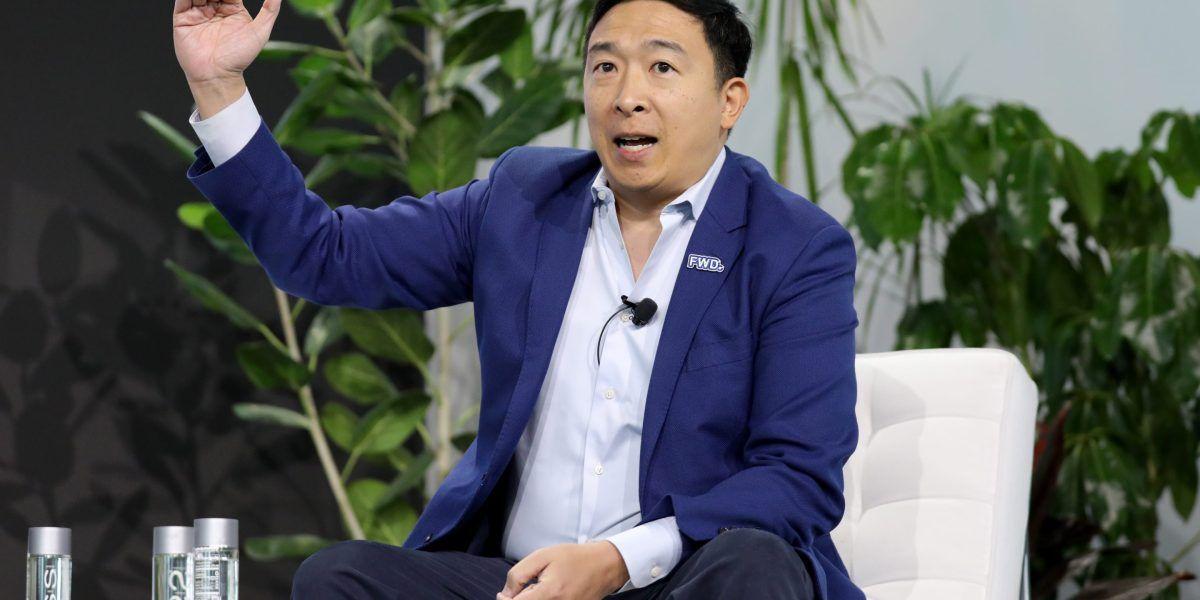
.
Source: Fortune
References
Summarized by

Navi
[1]
Related Stories
Anthropic CEO Warns: AI Could Eliminate Half of Entry-Level White-Collar Jobs in 5 Years
29 May 2025•Technology

Block's 4,000-person layoff sparks debate: AI revolution or corporate cost-cutting in disguise?
05 Mar 2026•Business and Economy

Jack Dorsey cuts 4,000 jobs at Block, citing AI tools that 'can do more and do it better'
27 Feb 2026•Business and Economy

Recent Highlights
1
Microsoft and Nvidia Launch Surface Laptop Ultra: A $2,599 AI-Ready PC With RTX Spark Chip
Technology

2
OpenAI Releases 722 AI-Generated Math Papers on GitHub, Igniting Fury Among Mathematicians
Science and Research

3
Trump Consulted Grok AI Before Ordering Venezuela Invasion and Capture of Nicolás Maduro
Policy and Regulation

Recent Highlights
Today's Top Stories












Don’t drown in AI news. We cut through the noise - filtering, ranking and summarizing the most important AI news, breakthroughs and research daily. Follow topics that matter to you and stay ahead.


