10 Sources
[1]
Anthropic's new Claude feature is quietly selling you on AI
At a time when AI backlash and data center protests are making headlines, Anthropic's Claude is rolling out a new feature that subtly makes the case for why you should keep using it. On Thursday, the company introduced "Reflect," a built-in dashboard that lets you track and visualize how you use Claude and your broader AI habits. On the surface, it's an analytics feature that offers insights into what sort of topics you've discussed, your overall usage patterns, and what kinds of tasks you tend to turn to AI for help with. But Reflect's larger purpose is about shaping how users think about AI itself. It does so by framing Claude as both a highly-utilized productivity tool and a part of your everyday workflow, as well as a technology that can be used mindfully. While Claude Reflect doesn't go so far as to quantify how much time you've saved on manual tasks by switching your workflows to AI, there's something about having all the work Claude helped with laid out in front of you that will likely make you see Claude as a tool you've come to rely on, and one very much a part of your everyday life. Meanwhile, Anthropic will push you to think critically about your AI usage, as Reflect will pop up questions from time to time, like "What's one thing you want to keep doing yourself, even if Claude could do it faster?" The app additionally offers tools to set quiet hours or schedule nudges to take a break from AI, Anthropic notes in its announcement -- a nod to the potentially addictive nature of working with AI chatbots, which never fail to respond to your questions and prompt follow-ups to keep the conversation going. The idea to add analytics to an app to subtly shape consumer sentiment is not a new one. In 2012, Google promoted a new utility called Gmail Meter, which number-crunched your email inbox, showing you traffic patterns, pie charts of email categories, how much data is in your inbox versus your archive, among other things. While navel-gazing over this type of data is fun for some technical folks, the meter also served as a way to display, in numbers and charts, how Gmail had become central to people's digital lives. Claude's Reflect does the same but it then takes things a step further, as it also trains users on how they can better use AI. For instance, Reflect might suggest that instead of re-explaining the context of your work across repeated tasks, you could use Claude's Projects feature. For Anthropic, this also has the benefit of more deeply integrating your daily workflows with Claude, which helps retain users and discourage them from switching to competitors' AI tools. Anthropic notes that more sensitive conversations may show up in Claude Reflect, but only at a high level, and any conversation connected to a health integration tool is left out of your insights entirely. None of the data in your insights is used for other purposes, the company also says. This Claude Reflect feature is available in beta for Free, Pro, and Max users who have memory turned on. Later, it will expand to include a view of how much time you've spent using Claude.
[2]
Anthropic's 'Reflection' Beta Tracks Your Habits to Improve How You Use Claude
Blake has over a decade of experience writing for the web, with a focus on mobile phones, where he covered the smartphone boom of the 2010s and the broader tech scene. When he's not in front of a keyboard, you'll most likely find him playing video games or watching horror movies. Anthropic on Thursday announced a new beta feature for Claude to help you better understand and reflect on your usage of the AI tool. It gives you access to a visual dashboard to see how you've interacted with the chatbot, and how you could better optimize your time using it, according to a blog post. Finding new ways to make the most out of AI isn't just a concern among users; the creators want the same thing so you'll continue to use their products. And while giving your data to AI can be concerning, it's helpful to see a feature that will feed you back some of your information in a potentially beneficial way. The new reflection tool will identify your usage patterns and present you with a summary of what you spent most of your time doing during a selected timeframe. Currently, you can choose one-, three-, six- or 12-month timeframes to dial in your usage or get a broader perspective. Anthropic says it'll soon add a specific view for how much time you've spent using Claude, too. The reflection dashboard will provide insights for your overall usage, peak activity, conversation line charts and task breakdown charts. You can set quiet hours or get reminders to take a break after a certain amount of time using Claude as well. Anthropic says you can build new skills within the reflection dashboard and optimize the ways you work with Claude, using the 4D AI Fluency Framework. The framework consists of skills including delegation, description, discernment and diligence. Your reflection gives you a summary of how you've interacted with Claude across each of the 4D framework's pillars. It'll also provide suggestions on how to improve your workflows with Claude, such as starting a Project instead of re-explaining context. Your reflection dashboard won't include information from incognito chats or use files from tools you've connected before. The blog post gives a specific example where if you've asked Claude to summarize your email inbox, the summary itself may appear in the reflection, but the specific emails wouldn't. Any conversation connected to a health integration tool will also be left out of your reflection. Anthropic says it worked with digital media and wellbeing experts from the MIT Media Lab's Advancing Humans with AI program, the Digital Wellness Lab at Boston Children's Hospital and the Family Online Safety Institute to build this tool. The blog post says that while sensitive conversations can surface with a reflection, they will only appear at a high level. The reflection dashboard is now available in beta for free, Pro and Max users who have enabled memory in their Claude accounts. You can access your reflection by opening settings on the web or desktop app and selecting the option to reflect on your usage. Currently, reflections on Cowork conversations are not available, but will be soon.
[3]
Say hello to Claude Wrapped
The popularity of Spotify Wrapped has kicked off a wide range of year-in-review features, on apps from YouTube to Uber -- and now, the lookback trend has come to AI. Anthropic on Thursday announced a "reflect" feature for its Claude chatbot, allowing users to see an analysis of their usage data over the past month, three months, six months, or year. Anthropic bills the reflection dashboard as a way to "see your patterns and shape them," the company wrote in a blog post. It begins with a summary of an individual's key topics brought up with Claude, as well as types of tasks they delegate and their usage patterns, including peak usage times. Users will also be able to set their own "quiet hours" or break reminders after certain amounts of time. (Anthropic also said that an analysis of total time spent using Claude, seeming to imply a metric like hours of usage tallied up, would be coming soon.) "It lets you easily track and visualize how you use Claude, and decide whether that time aligns with your goals ... Your reflection also invites you to step back and examine the role Claude plays in your life. It will periodically surface questions like, 'What's one thing you want to keep doing yourself, even if Claude could do it faster?'" Anthropic wrote. Somewhat ironically, once a user answers such a question, the company said the dashboard would then give them "the chance to talk it through with Claude." Anthropic has spent a lot of money marketing itself as the company behind an "AI collaborator" that allows people to think more deeply -- there have been ads, billboards, and even literal "thinking" caps. And Claude's "reflect" feature is billed the same way, with the company's blog post instructing people to use it to "build AI skills that support your original thinking." The feature will show examples of how you interact with Claude, "like noting that you often rework email drafts in your own voice, or delegate tasks only after settling the strategy yourself," Anthropic wrote. Anthropic said the reflection dashboard won't pull from files within connected tools or platforms (like the actual emails within a connected email account), though the fact that a user may have used Claude to summarize their email inbox may come up in the reflection. It also won't pull from chats that occurred in incognito mode or in any way reference a "conversation connected to a health integration tool." As far as "sensitive topics," which the Anthropic is vague about defining, the company wrote that "sensitive conversations can still appear as part of your reflection, but only at a high level." The feature, which is currently available in beta mode for free users of Claude, as well as Pro and Max subscribers, will work for those who have memory turned on for their chats, and it's accessible via Settings on either the web or the Claude desktop app. The idea came from interviews with Claude users, Anthropic said, and the feature will also come to Claude Cowork "soon."
[4]
Claude's new Reflect dashboard wants to help you log off of Claude - Engadget
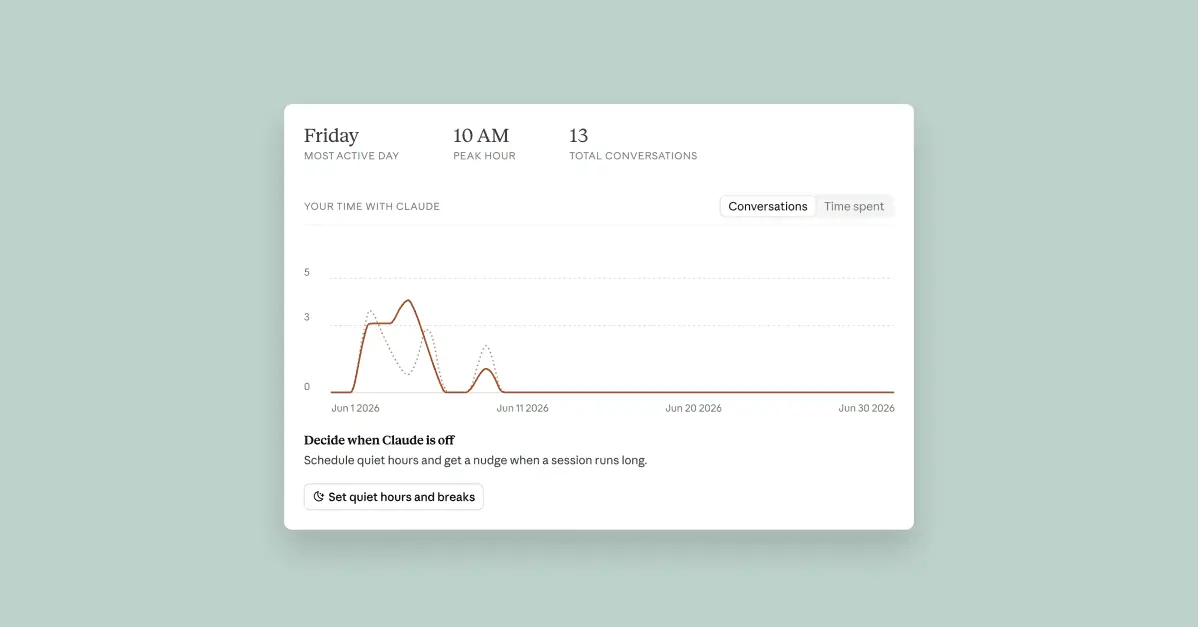
It's like a mix of Spotify Wrapped and the screen time tool on your phone. The internet loves a good usage dashboard, and today Anthropic is releasing one for Claude designed to help you "reflect" on the time you've spent with its chatbot. Think of the new feature as something of a cross between Spotify Wrapped and Apple's Screen Time tool. You can generate your first report by opening Claude's settings menu and navigating to the new "Reflect" tab. For now, the dashboard is only available through the Claude web client and desktop app. At the top, you'll see a paragraph-long summary of your recent conversations with the chatbot. By default, Claude will collate your last month of interactions, but you can also see your last three, six or 12 months of usage. Under that, the interface lists your most active day, peak hour and total chats over your selected time period, with a visual representation just below. In the future, you'll also be able to see how much time you've spent chatting with Claude, but for now that metric isn't available. If you continue scrolling, there's a toggle to configure break reminders and time limits. You can independently set these of the Reflect interface by navigating to the "Time and focus" tab, and dismiss the nudges if you're in the middle of something. Further down, there's a breakdown of topics you've discussed with Claude, with a percentage assigned to the ones you bring up most often. If you've been following along with the screenshots, all of this should feel broadly familiar. The penultimate section does things a bit differently, offering a set of AI "fluency" recommendations designed to streamline your usage of Claude, which are grouped around guidelines Anthropic co-created with a group of academics. For example, if Claude finds you frequently re-establish the same or similar context when you go to write a question or request, it will recommend you use its Projects feature to group your prompts together, so that you don't need to repeat yourself so often. For a more specific example, I've been working on a story about inference costs -- the amount of AI labs like Anthropic pay for their trained models to process data -- and I've turned to Claude a few times to track down statements from executives like Dario Amodei and Sam Altman. Based on that usage, the Reflect dashboard recommended creating a custom fact-checking skill for Claude. When I went ahead with that suggestion, the chatbot devised a text template to ensure it would always list its source for a claim, as well as its confidence in the information it had found alongside any caveats. I'll admit I found the template helpful, and it wasn't something I would have thought to ask Claude to do on its own. According to Ryn Linthicum, Anthropic's head of wellbeing policy, Reflect came out of a study the company's Societal Impacts team recently completed where participants expressed a mixture of optimism and anxiety around Claude and other AI products. "We were really intentional about building [the dashboard] with an eye toward how we can upskill people's usage of Claude, not in a way that encourages them to spend more time with it, but instead enables them to get more efficient at meeting their goals, and hopefully get off of Claude or preserve the things that they want to think about," Linthicum told Engadget. Linthicum says part of the reason the dashboard doesn't currently display the exact amount of time you've used Claude is because it wasn't a metric Anthropic had been tracking internally, due to it being something the product team "didn't want to maximize." Looking forward, they note Anthropic plans to surface that information for users so they can use it alongside the usage management settings. In the future, the dashboard will also be available mobile, and reflect your usage there. Anthropic is releasing Reflect in beta today. Notably, the company is making the feature available to Free accounts, in addition to Pro and Max subscribers.
[5]
Anthropic's new Claude Reflect is basically Spotify Wrapped crossed with Digital Wellbeing
Users can set quiet hours and receive "nudges" to let them know it's time to stop using Claude for a bit. When it comes to working with AI, it feels like people fall into one of a few categories of users. We've got the utterly clueless, sure. There are the people who have dabbled a little with stuff like AI Mode in Search, but aren't doing any real heavy lifting. And then there are those who actually know their way around and regularly employ AI to help get tasks done. If you're maybe in that third group but are worried about sliding into the fourth -- helpless AI addicts who can't get anything done the old-fashioned way -- Anthropic's Claude has a new tool that's built just for you. We're talking about Claude Reflect, a new dashboard in Claude Settings that feels like somewhat of a cross between Spotify Wrapped and Digital Wellbeing. On one side, it's designed to be a powerful tool for self-reflection, looking at what you've been using Claude to get done. You can see how your usage changes over time, going up to a year back. Reflect will break that down by types of tasks, showing how much time you spend using Claude to draft documents, organize your schedule, and everything else it helps you out with. As you should only expect from an AI tool, there's plenty of analysis of that usage available, not just looking at how you've been taking advantage of Claude in the recent past, but also offering suggestions on new ways you might want to consider employing Claude in the future. The other side of Claude Reflect feels like Anthropic's take on Digital Wellbeing, letting you set controls for yourself to place limits on your AI usage. You can define quiet hours for when you know better than to go crawling down an AI rabbit hole, and get a "nudge" from the system reminding you to give it a rest. Of course, you have full control over all of this, and don't need to take advantage of it at all. Access to Claude Reflect begins now for users on the Free, Pro, and Max tiers. If you're not seeing it, Anthropic reminds users that this kind of insight requires having Memory enabled in Settings, so give that a toggle if you're still having trouble.
[6]
Claude AI may ask you if you're using it too much
Overuse of smartphones is now a widely recognised problem, but we're also starting to see people perhaps get overly dependent on chatbots like Claude AI and ChatGPT. Claude creator Anthropic is currently testing a beta feature intended to allow users to reflect on how they are using the AI and be prompted to perhaps use it less ... It was just a few days ago that "father of the iPod" Tony Fadell said we didn't think enough about how smartphone usage might become problematic when we created the devices, and we need to address overuse of AI before it becomes an issue rather than afterwards. Anthropic seems to agree, as the company has today launched a beta intended to help Claude users reflect on their past usage of the chatbot. Your reflection starts with a summary of how you've been using Claude, covering key topics, your usage patterns, and the types of tasks you often work through. You can look back on your Claude chat activity over the past one, three, six months, or 12 months. The reflect feature provides a breakdown of when you use Claude most, and what you spent that time working on. Soon, we'll add a view of how much time you've spent using Claude. Claude will also periodically prompt you to consider whether you are using it too much, although Anthropic ironically suggests that if you do have concerns, you should talk it through with ... Claude. Your reflection also invites you to step back and examine the role Claude plays in your life. It will periodically surface questions like, "What's one thing you want to keep doing yourself, even if Claude could do it faster?" and give you the chance to talk it through with Claude. The company is also providing tools akin to Screen Time. Within your dashboard, you can also set quiet hours or schedule a nudge to take a break from using Claude after a certain amount of time. Finally, Anthropic is promoting what it calls the 4D AI Fluency Framework. * Delegation: Setting goals and deciding whether and how to engage with AI * Description: Effectively describing goals to prompt useful AI behaviors and outputs * Discernment: Accurately assessing the usefulness of AI outputs and behaviors * Diligence: Taking responsibility for what we do with AI and how we do it Do you think over-dependence on AI is an issue for you personally or for people more generally? Please share your thoughts in the comments. I'll kick things off by expressing my dismay at how many people are now (very obviously) having ChatGPT write their social media posts ...
[7]
'Reflect' with Claude gives users insight into chatbot habits
Claude's new reflection tool offers users unique insight into their habits. Credit: Joseph Maldonado/Rene Ramos/Mashable If you use Anthropic's Claude AI chatbot, and you're wondering if you're using it too much, assistance is coming from an unlikely source: Claude. Anthropic says Claude's new "reflect" tool is designed to help users answer complex questions about their AI use. That includes whether you're using Claude effectively, too often, or for too many tasks that are better suited for yourself instead of artificial intelligence, Anthropic said in a blog post Thursday. What will Claude's reflect feature help with? The insights dashboard shows key topics, usage patterns, and frequent tasks. Users can review their chat activity over periods of one, three, six, or 12 months. They can also set (and dismiss) quiet hours and break nudges. The feature "invites you to step back and examine the role Claude plays in your life," the company said in its announcement. "It will periodically surface questions like, 'What's one thing you want to keep doing yourself, even if Claude could do it faster?' and give you the chance to talk it through with Claude." Given the growing concern about AI use, including cognitive offloading and atrophy, the feature could offer users genuinely useful information. Users get in-depth details about how they "collaborate" with Claude, plus practical suggestions for prompting the chatbot without providing repetitive information. The tool also incorporates Anthropic's proprietary framework for AI use, which helps decide how to delegate to a chatbot and how to accurately assess its outputs. What about sensitive data and chats? The insight reports do not incorporate incognito chats. It doesn't access files in connected tools, such as your email inbox or health data. Reflection insights will cover sensitive conversations, such as discussions about mental health, but only at a high level. If Claude has previously shared mental health support resources during a chat, that information may appear in the dashboard as well. Anthropic consulted independent experts to develop insights that would help people evaluate what works best about Claude for them. Though Anthropic requires users to be 18 or older, Ryn Linthicum, Anthropic's head of well being policy, told Mashable that the company learned from youth developmental experts what tools could help young adults and parents of children better understand their AI use. The reflection feature is in beta for free and paid subscribers with their chat memories turned on.
[8]
AI gets its screen-time moment
Why it matters: AI chatbots are becoming work tool, search engine, confidant and coach all at once -- raising the same kinds of questions about healthy use that social media did, but with even more intimate data. Driving the news: Announced Thursday, Reflection lets users look back over one, three, six or 12 months of Claude activity, including key topics, usage patterns and the kinds of tasks they use Claude for. * It also offers prompts about AI's role in their lives, plus optional quiet hours and break reminders. * The tool is being released as a beta and is available to free and paid users who have Claude's memory feature turned on. What they're saying: "In our interviews with users, a common theme that's emerged is a desire to better understand how AI could be integrated into daily life," Anthropic said in a blog post. * "How often should someone use AI? How can it be used most effectively? When is AI suited to a task, and when is it better left to a human?" it said. "We built this feature to help answer these types of questions." The intrigue: The feature taps Claude to help users decide when not to use Claude. Between the lines: Anthropic said only certain types of data and usage is captured in Reflections. * It doesn't draw from incognito chats, nor from any data generated by connected health tools. * With other connected tools it is more complicated. Anthropic says that, for example, if you ask Claude to summarize your inbox, the summary might show up in a reflection, but not the underlying emails. Yes, but: Even high-level summaries can reveal sensitive personal patterns, the company acknowledges.
[9]
Claude Reflect is here. It's your usual yearly Wrapped, but with Anthropic's AI
It also makes you reflect on your usage and reminds you to take breaks. Anthropic just launched a usage analytics dashboard for Claude. It's like the 'Wrapped' feature you see every major streaming or AI service announce at the end of a year, except it's not called Claude Wrapped. The feature is called Claude Reflect, as it does more than simply tell you what you've been using the AI for. Available in beta for free, Pro, and Max users who have enabled memory, the feature encourages mindful use of Claude or other AI tools. So what does Claude Reflect actually show you? Available in Settings in Claude's web and desktop apps, Reflect generates a summary of your Claude activity for one, three, six, or 12 months. Recommended Videos It breaks down the topics you engage with most, identifies patterns in your usage, and categorizes your interactions using Anthropic's 4D AI Fluency Framework: delegation, description, discernment, and diligence. Think of it as a structured breakdown of how you work with AI rather than just a raw count of conversations and topics. The feature has been developed with MIT Media Lab, the Digital Wellness Lab at Boston Children's Hospital, and the Family Online Safety Institute. Anthropic also clarifies that incognito and health-integration conversations are excluded entirely. The data remains in the dashboard and is not used for any other purpose (via Anthropic). Why is the wellbeing angle the most interesting part? Because you don't expect it from a company that sells AI-based tools and services. Reflect will surface questions like "What's one thing you want to keep doing yourself, even if Claude could do it faster?" It lets you set quiet hours, and schedule nudges you to take a break. A time-spent view is coming soon as well, which, as the name suggests, will likely track the time you spend interacting with Claude. An AI company building something that actively nudges you to rely on AI less is, frankly, unusual, and I mean that as a compliment.
[10]
Claude Just Got Its Own 'Spotify Wrapped.' Here's What It Reveals About How You Use AI
Anthropic announced the release of a new reflection dashboard in Claude that measures and visualizes how much time you spent with the chatbot, including which tasks you focused on the most and when you recorded peak activity. You can trace your activity back to one, three, six, or 12 months as part of this beta feature that's being rolled out for all Free, Pro, and Max users. According to the company, the feature came as users expressed "a desire to better understand how, exactly, can AI be integrated into daily life." People who want to see their usage data have to allow the chatbot to generate memory from past conversations. This can be done by navigating to Settings, selecting the "Capabilities" tab, and turning on Memory functions. The "Reflect" tab is right there as well, which lights up with data, insights, and charts once you turn on Memory. Some of this information includes the percentage of time you spent on each task, such as coding projects, brainstorming sessions, food recipes, and more. A chart also shows you which time of the day you spend the most on Claude, along with your most active day of the week, and total conversations with the LLM. One of the goals of the dashboard is to help users improve "AI fluency" skills, including how you set goals, how descriptive your prompts are, how you assess the usefulness of a response and whether you push back. A yet-to-be released feature includes how much time you spent with Claude. In the past, features that dress up and display behavioral data -- even if it's fun for many users -- have raised privacy concerns. Spotify's Wrapped feature is one of the most prominent examples, parsing a year's worth of users' listening data to give them a summary of their favorite artists, songs, and music genres. In 2023, Pop critic Alex Petridis called Spotify's Wrapped feature "creepy" and said "its message is that something, somewhere is effectively spying on you, carefully taking note of everything you listen to and when." Anthropic addresses this in its announcement and says reflections aren't drawn from incognito chats, connected tools like your email or calendar, or health apps. "The information and insights in your reflection stay there, they aren't used for any other purpose," it said. Get 1 Smart Business Story delivered straight to your inbox when you subscribe to Inc.'s free daily newsletter.
Share
Copy Link
Anthropic introduced Claude Reflect, a new dashboard feature that tracks how users interact with its AI assistant while promoting mindful AI engagement. The beta feature offers usage analytics, task breakdowns, and digital wellbeing controls like quiet hours and break reminders. Available now for Free, Pro and Max users with memory enabled.
Anthropic rolled out Claude Reflect on Thursday, a new dashboard feature that transforms how users understand their relationship with its AI assistant
1
. The beta feature functions as a built-in analytics tool that visualizes AI usage patterns, tracks conversation topics, and identifies the types of tasks users delegate to Claude2
. Users can generate reports spanning one, three, six, or 12 months to examine their user interactions with AI over different timeframes3
.
Source: CNET
The new dashboard feature presents a paragraph-long summary of recent conversations, alongside metrics including most active day, peak usage hour, and total chats during the selected period
4
. While the interface currently doesn't display total time spent using Claude, Anthropic plans to add this metric soon1
.Claude Reflect incorporates digital wellbeing controls designed to help users manage their AI consumption more thoughtfully
5
. Users can set quiet hours to limit AI access during specific periods and configure break reminders after certain usage durations2
. The dashboard periodically surfaces prompts like "What's one thing you want to keep doing yourself, even if Claude could do it faster?" to encourage reflection on AI dependency1
.
Source: The Verge
According to Ryn Linthicum, Anthropic's head of wellbeing policy, the feature emerged from research by the company's Societal Impacts team, where participants expressed mixed feelings about AI tools
4
. "We were really intentional about building [the dashboard] with an eye toward how we can upskill people's usage of Claude, not in a way that encourages them to spend more time with it, but instead enables them to get more efficient at meeting their goals," Linthicum explained4
.The dashboard delivers AI fluency recommendations based on the 4D AI Fluency Framework, which Anthropic developed in collaboration with digital media and wellbeing experts from MIT Media Lab's Advancing Humans with AI program, the Digital Wellness Lab at Boston Children's Hospital, and the Family Online Safety Institute
2
. The framework encompasses four skills: delegation, description, discernment, and diligence2
.Claude Reflect analyzes how users interact with the AI assistant and suggests workflow improvements. For instance, if users frequently re-explain context across multiple conversations, the dashboard recommends using Claude's Projects feature to group related prompts together
1
. The system can also propose creating custom skills, such as fact-checking templates that ensure Claude always lists sources and confidence levels for its claims4
.Related Stories
Anthropic emphasizes that sensitive conversations may appear in Claude Reflect but only at a high level, with any conversation connected to health integration tools completely excluded from insights
1
. The dashboard won't pull from files within connected tools or platforms—for example, if users asked Claude to summarize their email inbox, the summary itself might appear, but specific emails wouldn't3
. Incognito chats are also excluded from the reflection2
.
Source: Android Authority
The beta feature is now available for Free, Pro and Max users who have the memory setting enabled in their Claude accounts
5
. Users can access their reflection by opening Settings on the web or desktop app and selecting the option to reflect on their usage2
. The feature will expand to mobile platforms and Claude Cowork conversations in the future3
.Summarized by
Navi
[3]
12 Aug 2025•Technology

23 Oct 2025•Technology

12 Sept 2025•Technology

1
Technology

2
Policy and Regulation

3
Policy and Regulation