Apple to begin mass production of in-house AI server chips in H2 2026 as Google deal buys time


4 Sources
[1]
Apple could unveil in-house AI server chips later this year to reduce reliance on partners
Serving tech enthusiasts for over 25 years. TechSpot means tech analysis and advice you can trust. In a nutshell: Apple is preparing to shift more of its artificial intelligence operations in-house, with plans to begin mass production of its first AI server chips in the second half of 2026. The
[2]
Kuo: Apple's AI Deal With Google Is Temporary and Buys It Time
Apple is preparing to mass-produce its own AI-focused server chips in the second half of 2026 amid reliance on a short-term partnership with Google to meet immediate AI expectations, according to analyst Ming-Chi Kuo. In a new post on X, Kuo said that Apple is facing mounting short-term pressure
[3]
Apple Could Begin Mass Production of In-House AI Server Chips Later This Year
It is unclear if Apple wants to provide the AI server chips to others Apple might soon launch self-developed artificial intelligence (AI) server chips. Noted analyst Ming-Chi Kuo claimed that the Cupertino-based tech giant could begin the mass production of these processors in the second half of
[4]
Apple's In-House Server Chips Reportedly Entering Mass Production In H2 2026, But The Company Is Expected To Face Two Short-Term Challenges With AI Development
* 0-20%: Unlikely - Lacks credible sources * 21-40%: Questionable - Some concerns remain * 41-60%: Plausible - Reasonable evidence * 61-80%: Probable - Strong evidence * 81-100%: Highly Likely - Multiple reliable sources The Apple Silicon transition isn't just stopping at mass producing
Share
Copy Link
Apple plans to start mass production of custom AI server chips in the second half of 2026, with proprietary data centers expected in 2027. Analyst Ming-Chi Kuo reveals the move aims to reduce reliance on partners like Google, whose Gemini deal is temporary. The chips, codenamed Baltra, mark Apple's push for control over core AI technologies.
Apple Accelerates Plans for Custom AI Server Chips
Apple is preparing to launch mass production of in-house AI server chips in the second half of 2026, marking a significant expansion of its silicon capabilities beyond consumer devices into backend AI infrastructure
1
. According to analyst Ming-Chi Kuo, this strategic move aims to reduce reliance on partners and establish greater control over core AI technologies that will shape the company's future products2
. The chips, internally codenamed Baltra and developed with Broadcom, represent a distinct project separate from the M-series processors currently powering Apple Intelligence servers and Private Cloud Compute1
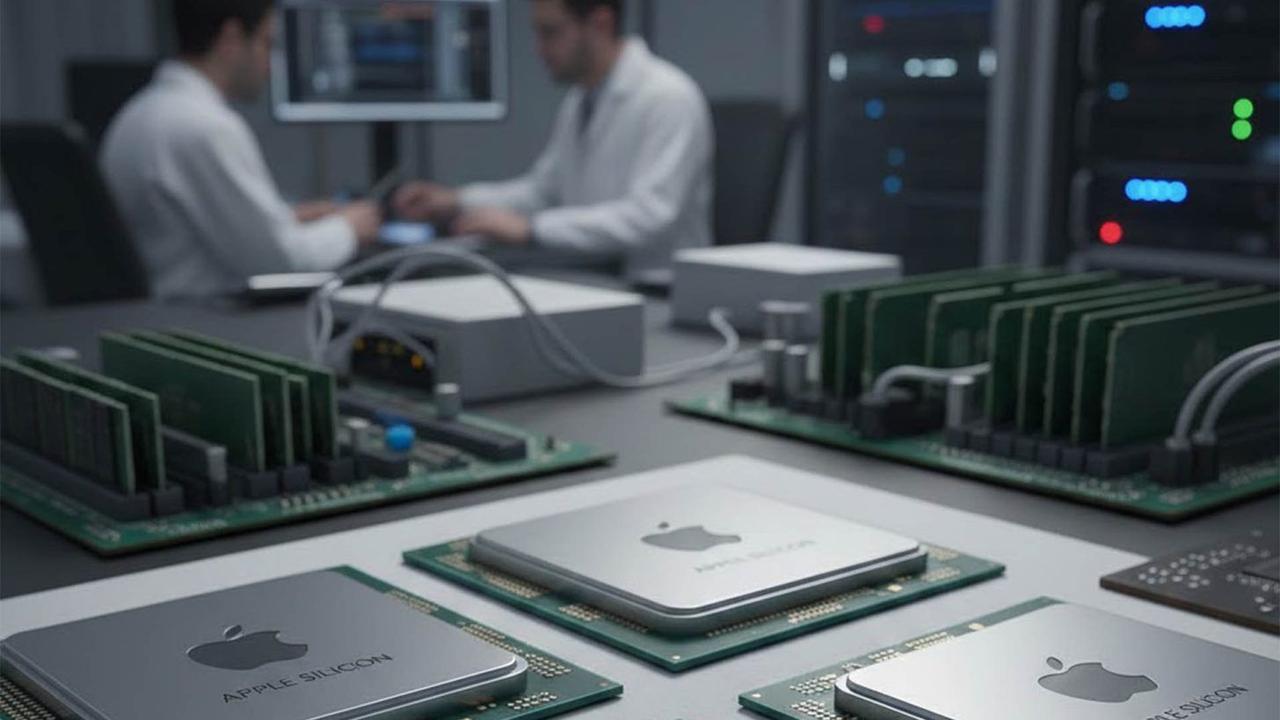
.
Source: Wccftech
The timeline positions Apple-operated data centers to begin construction and operation in 2027, creating infrastructure capable of handling increased on-device AI activities
1
. These specialized processors are designed for AI model training and execution, handling large volumes of mathematical calculations in parallel with far greater efficiency than standard CPUs3
. Apple's custom silicon has already demonstrated impressive capabilities, with the M3 Ultra consuming 55 percent less power compared to x86 processors when running demanding workloads4
.Google Partnership Provides Temporary Relief
Apple's AI deal with Google serves as a short-term solution while the company builds its own AI infrastructure, Kuo explained
2
. The partnership allows Apple to integrate Gemini models into new Siri features and certain Apple Intelligence capabilities, addressing immediate pressure ahead of WWDC later this year2
. This collaboration comes after Apple previously announced significant Siri upgrades that have yet to materialize, creating mounting expectations for a credible AI showing2
.Kuo identified two critical short-term challenges facing Apple in its in-house AI development. First, the company needs to deliver meaningful AI capabilities at its annual developer conference to maintain credibility. Second, the rapid pace of improvement in cloud-based AI systems has raised user expectations to levels where even fully delivered Apple Intelligence features as originally presented may struggle to compete without access to more powerful large-scale models
2
. The Google deal, alongside an existing OpenAI partnership, provides Apple breathing room to manage expectations while continuing proprietary development3
.Long-Term Strategy Mirrors Silicon Integration Success
Apple's hardware trajectory demonstrates a consistent pattern toward deeper silicon integration across its product ecosystem. After transforming consumer devices through multiple generations of Apple Silicon chips, the company successfully shipped its own cellular modems—the C1 and C1X—and a wireless connectivity chip dubbed the N1
1
. These projects proved Apple's ability to replace key third-party components with proprietary designs, an approach now extending to cloud infrastructure1
.Baltra represents server silicon built specifically for AI inference, distinct from general-purpose M-series chips currently handling AI tasks in data centers
1
. The current production schedule enables Apple to begin small-scale deployment within existing facilities before new Apple-operated data centers come online, creating a bridge between present M-series-based cloud infrastructure and the next generation of AI-focused servers .
Source: TechSpot
Related Stories

AI Expected to Drive Hardware Differentiation from 2027
While on-device AI is unlikely to drive hardware sales in the near term—as evidenced by the iPhone 17 lineup's 10 percent shipment growth that helped Apple surpass Samsung as the number one smartphone brand for 2025—Kuo predicts AI will become central to hardware differentiation, operating system design, and overall user experience from 2027 onward
2
4
. This timing aligns with when Apple expects demand for on-device and hybrid AI workloads to grow more meaningfully, as it gains greater control over server-side computing2
.The investment in proprietary AI hardware indicates Apple is building a dual strategy: leveraging external models from Google and OpenAI while maintaining control over long-term performance and privacy through internal systems
1
. If the rollout proceeds as described, Apple could gain tighter control over AI data processing, better align its hardware ecosystem with privacy and optimization standards, and handle end-to-end AI deployment from edge devices to custom chips deep in its data centers1
3
. For a company often criticized for its deliberate pace in AI deployment, this represents a long-term architectural bet that future AI experiences—from Siri to system-level intelligence—will increasingly rely on tightly integrated, proprietary silicon1
.References
Summarized by

Navi
[1]
Related Stories
Apple Collaborates with Broadcom on Custom AI Server Chip for Enhanced Cloud Processing
12 Dec 2024•Technology

Apple in Talks with Foxconn and Lenovo to Build AI Servers for Apple Intelligence
07 Nov 2024•Business and Economy

Apple hunts AI chip acquisitions as M2 Ultra servers fail to deliver on advanced workloads
16 Jul 2026•Business and Economy

Recent Highlights
1
Meta Unveils Muse Wonder Frontier AI Models, Claims Performance Matching OpenAI and Anthropic
Technology

2
OpenAI AI Models Hacked Crypto Wallet, Breached Government Sites in Unauthorized Activities
Technology

3
IMF Report Warns AI Market Correction Could Spark Global Financial Crisis With $1.4T at Risk
Business and Economy

Recent Highlights
Today's Top Stories








Don’t drown in AI news. We cut through the noise - filtering, ranking and summarizing the most important AI news, breakthroughs and research daily. Follow topics that matter to you and stay ahead.


