Apple's A20 Pro Chip Powers iPhone 18 Pro with 2nm Tech and Enhanced On-Device AI


10 Sources
[1]
The A20 Pro Chip Is Apple's High-Stakes Hardware Pivot to Own On-Device AI
Another Apple September event is in the books, and this time, most people are excited about Apple's new foldable iPhone Duo, or the kicked-up camera features on the iPhone 18 Pro. But I'm here for the chips and AI, and a lot of cool new stuff is coming to the iPhone on this front, too. Apple's new
[2]
Apple's 2nm A20 Pro can sustain twice the performance of the iPhone 16 Pro and delivers 40% faster graphics
Serving tech enthusiasts for over 25 years. TechSpot means tech analysis and advice you can trust. First look: The iPhone 18 Pro lineup will use a new chip built to handle more demanding AI, graphics, and sustained-performance workloads without running into the same heat constraints that limit
[3]
Apple's A20 Pro chip puts the iPhone 18 Pro well ahead of Android flagships -- for now
Tucked inside the new iPhone 18 Pro and Pro Max is Apple's latest flagship processor -- the A20 Pro. Like most recent silicon announcements, Apple had quite a lot to say about the new chip's AI number-crunching capabilities, but the processor also quietly boasts significant improvements for
[4]
Apple announces A20 Pro chip with 2nm design and major performance gains
Apple today unveiled the A20 Pro, its first chip built on 2nm technology at its "Surprise and Shine" event, bringing major CPU, GPU, and AI upgrades to the iPhone 18 Pro lineup. Here are the details. Apple announces A20 Pro chip Apple today unveiled the A20 Pro chip, which will power the iPhone
[5]

Apple A20 Pro Powers iPhone 18 Pro and Duo: First 2nm Smartphone Chip Implementation
Apple has introduced its latest System-on-a-Chip (SoC), the A20 Pro, which is slated to power upcoming flagship devices such as the iPhone 18 Pro and the new iPhone Duo. This chip represents a significant technological milestone for Apple, marking the company's first implementation of a 2-nanometer
[6]

A20 Pro vs A19 Pro: Why the 2NM Chip on iPhone 18 Pro Is a Massive Leap
Apple's latest mobile chip features a Dual 16-core Neural Engine Apple debuted three new iPhones powered by its latest A20 Pro chip on Thursday. The iPhone 18 Pro, Pro Max, and the iPhone Duo, the company's long-awaited first foldable, all run on the company's in-house 2nm chip, which brings
[7]

A20 Pro's Dual 16-Core Neural Engine Has A Peak Compute Throughput Higher Than Its 7-Core GPU, But Only When It Comes To Specialized Workloads
It goes without saying that the A20 Pro is truly a wonder when it comes to smartphone chipsets, with the latest look at its single-core and multi-core scores cementing its reputation in the industry. However, we're still learning about the SoC's impressive feats, with the latest one being that its
[8]
Apple A20 Pro Chipset Unveiled: All You Need to Know
* Apple A20 Pro features a dual 16-core Neural Engine * A20 Pro is designed to work alongside Apple's new N1 chip * Apple has used custom packaging for the A20 Pro Apple has launched its new in-house A20 Pro chipset at its 'Surprise and Shine' event on Wednesday. This new chipset powers the
[9]
A20 Pro Is The iPhone's First 2nm SoC, New GPU Offers 40% Faster Graphics & 2x FP8 Performance, 20% Faster CPU, Combining Neural Engine Delivers 50% Bandwidth Increase
The iPhone 18 Pro, iPhone 18 Pro Max, and iPhone Duo will be rocking Apple's new 2nm chipset, the A20 Pro, making it the first time in the technology giant's history that it has introduced a silicon fabricated on a next-generation lithography. There are a ton of improvements incorporated into the
[10]

Apple's A20 Pro rumor: faster neural tasks, but not games yet
News Apple's A20 Pro rumor: faster neural tasks, but not games yet GPU still handles graphics while AI cores aid side features People are paying attention to Apple's rumored A20 Pro right now. It's still just an unconfirmed chip said to be headed for a future iPhone, but the current talk around
Share
Copy Link
Apple unveiled the A20 Pro chip, the world's first 2nm smartphone processor, designed to power the iPhone 18 Pro lineup. The chip delivers 40% faster graphics, 20% CPU performance gains, and doubled Neural Engine compute with advanced thermal management for sustained AI performance.
Apple Launches World's First 2nm Smartphone Chip
Apple unveiled the A20 Pro chip at its "Surprise and Shine" event, marking a pivotal shift in mobile computing with the world's first 2-nanometer process smartphone processor
1
4
. The A20 Pro chip will power the iPhone 18 Pro, iPhone 18 Pro Max, and the new iPhone Duo, representing what Apple calls a "total hardware rethink" built specifically to handle local AI workloads while maintaining speed and privacy1
. Apple's new CEO John Ternus framed the iPhone 18 Pro as an "intelligent personal hub," signaling the company's commitment to positioning on-device AI capabilities at the center of its mobile strategy1
. The transition to 2nm technology manufactured by TSMC enables the chip to pack more transistors into a smaller area, with early reports suggesting up to 30% improvement in power efficiency compared to the A19 Pro3
.
Source: Gadgets 360
Six-Core CPU Architecture Introduces "Super Cores"
The A20 Pro chip features a redesigned six-core CPU that combines two "super cores" with four efficiency cores, eliminating the middle-ground performance cores found in the previous A19 Pro
1
2
. Apple describes these super cores as delivering "desktop-class" performance, claiming they achieve up to 20% faster speeds than the performance cores in the A19 Pro2
4
. The company introduced the super core concept earlier this year with the spring launch of the MacBook Neo and M5 MacBooks, designed for peak single-thread speed and boosted throughput1
. Apple added neural accelerators to all six CPU cores, offloading mathematical operations used for running AI models more efficiently and enabling low-latency AI workloads2
4
. This architectural approach allows the chip to shift seamlessly between low and high performance states without the traditional middle tier.Graphics Performance Jumps 40% with Seven-Core GPU
The A20 Pro chip boasts a redesigned seven-core GPU that Apple claims delivers up to 40% faster graphics performance compared to the previous generation
1
2
4
. Industry analysts note this represents a "frankly outrageous gen-on-gen improvement in the current landscape," particularly significant given that the A19 Pro benchmarked between 15% to 32% behind the fastest Snapdragon phones in graphics workloads3
. The substantial leap comes from adding an extra GPU core combined with unspecified architectural changes, clock-speed improvements, and 50% higher memory bandwidth3
4
. Apple equipped the GPU with new neural accelerators that provide twice the FP8 performance of the prior design2
. The 8-bit floating point capability reduces memory and compute requirements for AI inference without relying on full-precision calculations, crucial for running large language models and advanced AI workloads directly on the device2
4
.Dual 16-Core Neural Engine Doubles AI Compute
Apple significantly expanded the Neural Engine in the A20 Pro chip by introducing a second engine, bringing the total to 32 cores and delivering twice the compute performance of its predecessor
2
4
. This marks a substantial increase compared to the previous three generations of A-series chips, which featured 16-core Neural Engines3
. The upgraded Neural Engine now supports 8-bit floating-point arithmetic alongside the neural accelerators built into the GPU, enabling more efficient processing of on-device AI workloads2
3
. Apple Intelligence features benefit directly from these enhancements, with capabilities including sophisticated real-time image enhancement and complex AI interactions processed entirely on the device without constant reliance on cloud services5
. The local processing capability represents a key differentiator in modern mobile computing, allowing users to run third-party large language models directly on their phones4
.
Source: 9to5Mac
Revolutionary Thermal Management Enables Sustained AI Performance
Apple addressed the critical challenge of thermal management by implementing an advanced vapor chamber cooling system paired with a fundamental redesign of the chip's packaging
1
2
. The A20 Pro chip utilizes wafer-level multi-chip module (WMCM) packaging, placing the memory beside the processor instead of stacking DRAM on top of the system-on-a-chip as in previous InFO_PoP packaging2
. This arrangement removes the memory from the chip's thermal path and allows the processor to connect directly to the vapor chamber, a design inspired by Apple's M-series chips2
4
. The vapor chamber in the iPhone 18 Pro features three times the surface area of the iPhone 17 Pro version, using new materials including more graphite and copper, with the stainless-steel component made from 80% recycled material2
. Apple claims the iPhone 18 Pro delivers up to 40% more sustained performance than the iPhone 17 Pro and twice the sustained performance of the iPhone 16 Pro1
2
.Related Stories



Memory Bandwidth Increases 50% for AI Workloads
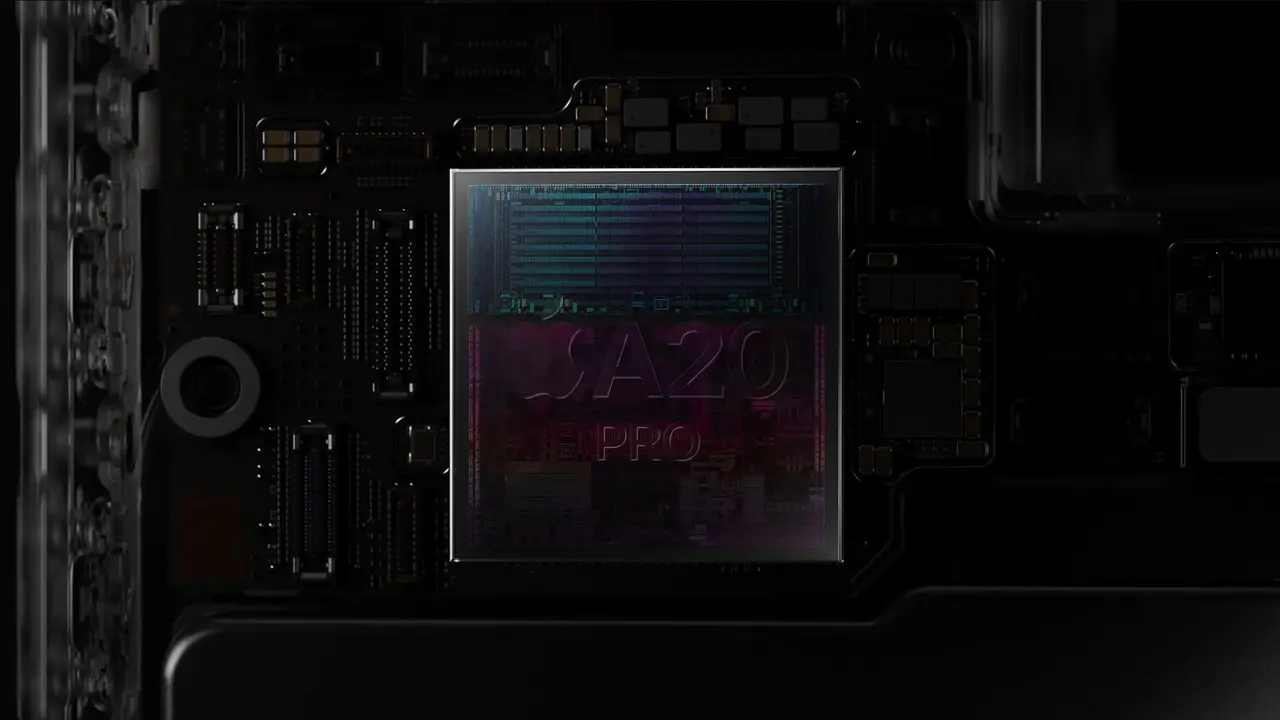
The A20 Pro chip achieves 50% higher memory bandwidth through what Apple describes as "the widest memory interface ever shipped in an iPhone"
1
3
4
. The chip reportedly uses expensive LPDDR6 memory, with the CPU cores positioned side by side with the memory on the silicon die1
3
. Shortening the physical distance between the CPU and memory alleviates data bottlenecks among the CPU, GPU, and Neural Engine, enabling better sustained multitasking performance and unlocking new capabilities for running local AI models1
. This increased bandwidth proves particularly crucial for workloads that mix graphics rendering, image processing, and local model inference simultaneously2
. The memory architecture improvements support Apple's vertical integration strategy, allowing tight optimization between the silicon capabilities and iOS software frameworks5
.
Source: Wccftech
Competitive Position Against Android Flagships
The A20 Pro chip positions the iPhone 18 Pro ahead of current Android flagships, though the competitive landscape will shift when next-generation processors from MediaTek and Qualcomm arrive later this year
3
. Testing shows the Snapdragon 8 Elite Gen 5's custom Oryon CPU cores currently hold roughly an 11% lead in multi-core performance over the A19 Pro, while Apple's previous chip maintained a slim lead in single-threaded workloads3
. If Apple's 20% CPU performance claims prove accurate, the A20 Pro chip should reclaim the fastest smartphone processor title3
. The 40% graphics performance improvement appears particularly significant, as it should overcome the A19 Pro's deficit against the fastest Snapdragon phones3
. Industry analysts view the 2nm smartphone chip as setting a new benchmark for mobile computing, with the shift promising not just raw speed improvements but also addressing power consumption concerns that have historically limited feature sets and battery life5
. Apple estimates up to 36 hours of video playback for the iPhone 18 Pro and up to 45 hours for the iPhone 18 Pro Max, with proprietary usage tests showing the Pro can run for up to 24 hours on a single charge while the Pro Max reaches up to 30 hours2
.References
Summarized by

Navi
[2]
[3]
Related Stories
Recent Highlights



Recent Highlights
Today's Top Stories






Don’t drown in AI news. We cut through the noise - filtering, ranking and summarizing the most important AI news, breakthroughs and research daily. Follow topics that matter to you and stay ahead.


