Apple wants up to 200,000 people to grade AI health answers


19 Sources
[1]
Apple launches new app to study how people use AI for health
Big AI labs like OpenAI and Anthropic have made their bets on offering chatbots that can answer health-related queries with specialized features. Apple is debuting a new study to understand how people use AI for health. But it isn't quite following other AI startups just yet; it wants to study how
[2]
Apple Launches New App to Study How People Use AI for Health
This is everything you need to know about the research study's eligibility, requirements and privacy. Since 2019, when Apple first launched its Research app, the company has partnered with medical universities and institutions to run a range of health studies on hearing, heart health and movement,
[3]
Apple's new study looks to improve the effectiveness of AI health tools
Apple announced a new study today with the goal of better understanding how people interact with conversational AI health tools and how useful their responses actually are. The company is conducting the Apple Health AI Usage Study in collaboration with OpenEvidence, a clinical AI platform used by
[4]
Apple's new research app is designed to make AI health tools more user-friendly
It will allow users to ask health questions and rate the responses. Apple has unveiled a new research study with the aim of learning how people use AI health tools in order to make them more effective and user-friendly. The company is launching the Health AI Usage Study in conjunction with
[5]

'Health is deeply personal': Apple opens a health AI study on iPhone
Up to 200,000 people in the US can join the health AI study and share HealthKit data such as sleep and lab results. Apple says that data won't train AI models. Apple has launched a research study and an iPhone app to learn how people use AI for health questions. The company announced the Apple
[6]

Apple provides a safe way to ask an AI questions about your health
A growing number of people are asking AI chatbots about their health issues, raising two major concerns: safety and privacy. Apple is now offering a safer way to do this through an Apple Health AI Usage Study. This is actually one of Apple's research studies, but those volunteering to take part in
[7]

Apple Seeks 200,000 People for AI Health Study
Apple on Sunday announced the launch of an Apple Health AI Usage Study that gives participants access to a dedicated iPhone app that answers everyday health questions using medical research and, optionally, their own Health app data. Conducted in collaboration with clinical AI company
[8]

Apple needs your help to make health AI better
Only adults aged 21 or over from the U.S. are eligible. Credit: Apple Apple is launching an app to evaluate health AI, and the company needs your help to do it. It's all a part of a new research study, conducted in collaboration with clinical AI platform OpenEvidence, called the Apple Health AI
[9]

Apple launches first-of-its-kind AI health app -- privacy-focused research program opens for its first 200,000 iPhone testers
* Apple has launched an 'Apple Health AI Study App' * This lets you talk about your health with an AI chatbot * It's designed for research, but available to US residents Apple has been rumored to be launching an AI-powered Health+ app for over a year now -- and while that still hasn't emerged,
[10]

Apple launches a health AI study to find out whether people can trust AI with medical questions
A new Apple study is testing whether AI health answers actually hold up. Apple today launched something a little different from its usual lineup of hardware and software updates. It's called the Apple Health AI Usage Study, a research project built to understand how people actually behave when
[11]

Apple's new health AI app is a study, not your doctor
Trusting Apple with your data isn't the same as trusting AI with your health Apple's new health AI app lets study participants ask medical questions, but it isn't a substitute for a clinician. The US research project will examine how people understand, use, and trust its answers. The short
[12]

Apple Teams Up With OpenEvidence for Health AI Research Study in the US
Users can choose to share selected data from Apple HealthKit Apple has launched a US research study with clinical AI platform OpenEvidence to explore how people use AI for health information. The company says the study will examine how users assess AI-generated responses and whether access to
[13]

Apple launches Health AI Usage Study in the US with OpenEvidence
Apple has announced the Apple Health AI Usage Study in the United States, a virtual research study and associated app examining how people interact with conversational AI tools for health-related questions. Conducted in collaboration with OpenEvidence, the study will examine what drives user
[14]

Apple Launches New AI Health App to Study How Users Seek Medical Advice
Apple has introduced a new AI health research app with OpenEvidence. The study will examine how users understand medical answers, share health information and interact with AI-powered healthcare tools. Apple has launched a new app in the US to study how people use artificial intelligence for
[15]

Apple wants AI to make sense of your health data: What it can mean for future Apple Watches
The research could help Apple develop AI-powered health explanations, personalised insights and doctor visit summaries for future devices. Apple seems to be planning big on artificial intelligence and how it can help people understand their health. The company has announced the Apple Health AI
[16]

Apple launches app to study how people use AI for health
Apple has partnered with OpenEvidence, an AI tool for doctors trained on medical journals. The app will provide simplified answers to everyday health questions, drawing on sources such as The New England Journal of Medicine, Journal of the American Medical Association, and Nature. Apple launched
[17]

Apple and OpenEvidence Seek 200,000 Consumers for Health AI Study | PYMNTS.com
With the Apple Health AI Usage Study, Apple aims to support the design of health AI experiences by examining what drives user trust, the quality of responses, comprehension and everyday health actions, according to the release. "Insights from this study will help advance the broader scientific
[18]

Apple's New iPhone App Is an AI Health Trial, Exclusive to 200K People
The Health AI Usage Study will let you talk to an Apple Intelligence-powered chatbot about your health questions, so the company can gauge how good its AI is at doling out health info. Apple's latest iPhone app is a little different: It's an AI-powered health research tool designed to give the
[19]
Apple Just Released a New App
Apple today launched a new research study in the U.S. to explore the use of AI for health, and it has released a dedicated iPhone app for participants. In a press release, Apple said the study and app are "designed to advance the understanding of how people interact with conversational health AI
Share
Copy Link
Apple launched its Health AI Usage Study on Sunday, recruiting up to 200,000 Americans to test AI health answers built on peer-reviewed medicine. The move follows ChatGPT Health, Copilot Health and Perplexity Health.
Apple has launched a research study to learn how ordinary people use AI for health questions, and it wants up to 200,000 Americans to take part. The Apple Health AI Usage Study, announced Sunday, runs through a dedicated iPhone app and asks what happens when people turn to AI about their health: whether they understand the answers, whether they trust them, and what they do next
3
1
.
Source: The Verge
The timing is the telling part. Rivals moved earlier in 2026, per TechCrunch and The Next Web: OpenAI launched ChatGPT Health in January, and Microsoft and Perplexity launched Copilot Health and Perplexity Health in March
1
5
. One in three US adults already use AI chatbots for health information2
. Apple is arriving after those rivals, not ahead of them, per the launch dates above1
5
. That makes the study, not a shipped product, Apple's first move into consumer health AI in 2026, per that reporting1
5
. TechCrunch reads the approach as study-first: Apple wants clinically grounded answers understood before it builds the consumer product1
.How the study works
The answers come from OpenEvidence, a clinical AI platform healthcare professionals use, grounded in peer-reviewed medical sources, among them The New England Journal of Medicine, the Journal of the American Medical Association and Nature
3
4
. One report adds the National Comprehensive Cancer Network and the Cochrane Database to that list2
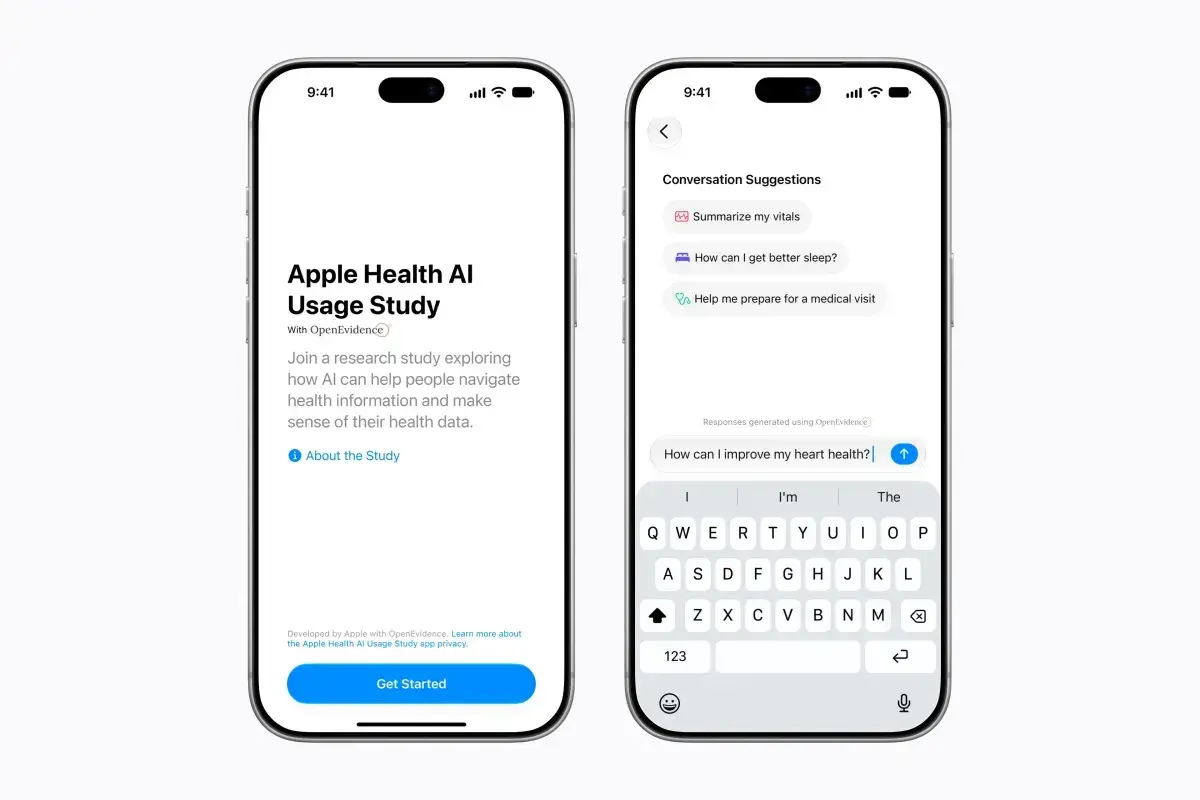
. That clinical grounding is what separates the app from a general chatbot, per the sources.Participants type health questions and get plain-language answers with links to the citations behind them. They rate each response on accuracy, detail and relevance, and complete monthly surveys
3
2
. They can optionally share HealthKit data such as sleep, activity and lab results, which requires separate opt-ins1
2
. The app's listing also touts visit preparation and personalized exercise or meal plans, listed capabilities rather than proven ones9
.
Source: TechCrunch
Enrollment opened with the announcement. Recruitment is capped at 200,000, open to US residents aged 21 or older with an iPhone 15 Pro or later
2
7
. The app keeps Siri and Apple Intelligence out of its answers, though it does require an Apple Intelligence-capable iPhone; per one outlet, on-device Apple models classify question categories3
2
.Privacy and limits
Health data is the sensitive part, and Apple's pitch leans on it. Study data will not train AI models, Apple says, though one outlet notes it may inform feature development
8
6
. The data is anonymized on-device and sent to a secure cloud run by contractor UST Global, where it is delinked from participant IDs2
. It then passes to OpenEvidence, which deletes question and response data within 24 hours2
7
. Apple researchers see only coded, de-identified survey responses and conversation summaries, per the same report2
6
. Privacy protections and clinical guardrails were built in from the start, Apple says, and participants control what they share8
7
.The sharpest limit is safety. The app provides no medical advice, and per one outlet there is no live monitoring, so staff will not contact a participant who asks about self-harm
2
. The study is planned to run up to 12 months per one report, though another puts it past 12 months, and there is no set date for results1
2
.Apple's own argument for the study comes from Sumbul Desai, its vice president of Health and Fitness: "At Apple, we believe responsible innovation starts with scientific rigor and clinical grounding"
3
. An outside voice in Apple's announcement materials makes the deeper case. "Patients and clinicians are both turning to AI, but the tools they use are being built and tested in separate worlds," said Dr. Robert Wachter, chair of medicine at the University of California, San Francisco, in Apple's announcement materials7
. TechRadar links the study to year-old rumors of an AI-powered Health+ app, while flagging that link as speculation9
. The App Store description says the study will help Apple build better health AI products9
.
Source: CNET
Related Stories
References
Summarized by

Navi
Related Stories
Apple's AI-Powered Health Coach: Revolutionizing Personal Wellness
31 Mar 2025•Health
Apple Health App Gets AI-Powered Upgrade With Health Age Feature and At-Home Movement Evaluations
04 Nov 2026•Technology
Apple's New AI Model Revolutionizes Health Predictions Using Apple Watch Behavioral Data
12 Jul 2025•Technology
Recent Highlights


Recent Highlights
Today's Top Stories





Don’t drown in AI news. We cut through the noise - filtering, ranking and summarizing the most important AI news, breakthroughs and research daily. Follow topics that matter to you and stay ahead.


