Artificial Neural Networks Achieve Superior Performance with Biological Pre-Training


2 Sources
[1]
Artificial neural networks learn better when trained with biological data
Technical University of Munich (TUM)Jun 12 2025 The ability to precisely predict movements is essential not only for humans and animals, but also for many AI applications - from autonomous driving to robotics. Researchers at the Technical University of Munich (TUM) have now discovered that
[2]
How artificial intelligence can learn from mice
The ability to precisely predict movements is essential not only for humans and animals, but also for many AI applications -- from autonomous driving to robotics. Researchers at the Technical University of Munich (TUM) have now discovered that artificial neural networks can perform this task better
Share
Copy Link
Researchers at the Technical University of Munich have discovered that artificial neural networks can predict movements more accurately when pre-trained with biological data from early visual system development, mimicking the process of retinal waves in vertebrates.
Biological Inspiration Enhances AI Performance
Researchers at the Technical University of Munich (TUM) have made a groundbreaking discovery in the field of artificial intelligence. They found that artificial neural networks can significantly improve their ability to predict movements when pre-trained with biological data from early visual system development
1
.Mimicking Nature's Pre-Training Process
The study, published in PLOS Computational Biology, draws inspiration from a fascinating biological phenomenon. In vertebrates, including mice, cats, and humans, the retina undergoes a built-in training program before the eyes even open. This process, known as "retinal waves," involves spontaneous activity patterns that spread across the eye's neural tissue in wave-like motions
2
.Professor Julijana Gjorgjieva of Computational Neuroscience at TUM explains, "We took inspiration from nature and incorporated a pre-training stage, analogous to that in the biological visual system, into the training of neural networks"
1
.Experimental Design and Results
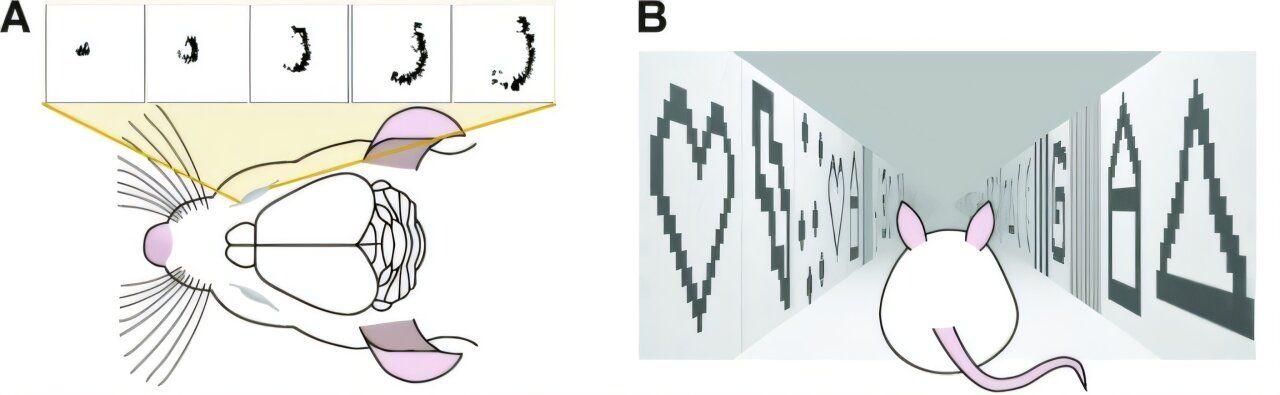
Source: Tech Xplore
The research team conducted a series of experiments to test the effectiveness of this biologically-inspired pre-training:
- They pre-trained one group of neural networks using retinal wave data from a mouse.
- Both pre-trained and non-pre-trained networks were then trained on an animated film simulating a mouse's perspective running through a corridor.
- The networks were tasked with predicting the evolution of visual patterns on the corridor walls.
The results were striking: networks pre-trained with retinal waves consistently outperformed those without pre-training, both in speed and accuracy
1
.Related Stories

Ruling Out Training Duration as a Factor
To ensure that the improved performance wasn't simply due to longer overall training time, the researchers conducted additional experiments. They shortened the training time on the animation for pre-trained networks, equalizing the total training duration for all networks. Even under these conditions, the pre-trained networks maintained their superior performance
2
.Real-World Application and Implications
In a final test, the team increased the challenge by using real-world footage captured from a roaming cat's perspective. Despite the lower video quality and more complex movements, the networks pre-trained with retinal waves still outperformed all others
1
.This research has significant implications for various AI applications, particularly in fields requiring precise movement prediction such as autonomous driving and robotics. By incorporating biological principles into AI training, we may be able to create more efficient and accurate systems that better mimic the remarkable capabilities of biological visual systems.
References
Summarized by

Navi
[2]
Related Stories
MovieNet: Brain-Inspired AI Revolutionizes Video Analysis with Human-Like Accuracy
10 Dec 2024•Science and Research

AI-Powered 'Digital Twin' of Mouse Visual Cortex Revolutionizes Brain Research
11 Apr 2025•Science and Research

Brain Cells Outperform AI in Learning Speed and Efficiency, Study Reveals
13 Aug 2025•Science and Research
Recent Highlights
1
Microsoft and Nvidia Launch Surface Laptop Ultra: A $2,599 AI-Ready PC With RTX Spark Chip
Technology

2
Trump Consulted Grok AI Before Ordering Venezuela Invasion and Capture of Nicolás Maduro
Policy and Regulation

3
Scientists Build AI Model That Reconstructs Images From Brain Scans in Record Time
Science and Research

Recent Highlights
Today's Top Stories






Don’t drown in AI news. We cut through the noise - filtering, ranking and summarizing the most important AI news, breakthroughs and research daily. Follow topics that matter to you and stay ahead.


